




- Pharmaceuticals
- Cardiovascular Drugs Market
Cardiovascular Drugs Market Size, Share, and Growth Forecast 2026 - 2033
Cardiovascular Drugs Market by Drug Type (Antihypertensive, Antihyperlipidemic, Anticoagulants), Disease Indication (Hypertension, Hyperlipidemia), Distribution Channel (Hospital Pharmacies, Retail Pharmacies), and Regional Analysis, 2026 - 2033

Cardiovascular Drugs Market Size and Trend Analysis
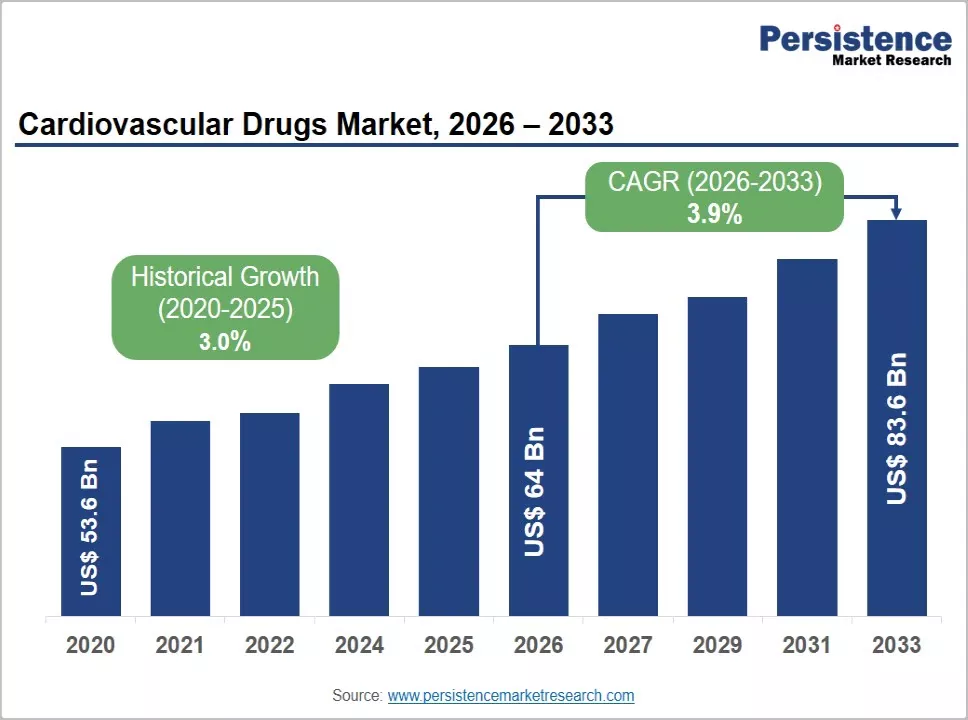
The global cardiovascular drugs market size is likely to be valued at US$ 64.00 billion in 2026 and is projected to reach US$ 83.65 billion by 2033, growing at a CAGR of 3.9% during the forecast period between 2026 and 2033.
This steady trajectory reflects durable prescription volumes anchored by aging demographics, rising hypertension prevalence in low- and middle-income countries, and expanding access frameworks. The World Heart Federation estimates that cardiovascular conditions account for approximately 18.6 million deaths annually, sustaining structural demand across antihypertensive, anticoagulant, and antihyperlipidemic drug classes with minimal cyclicality through the forecast period.
Key Industry Highlights
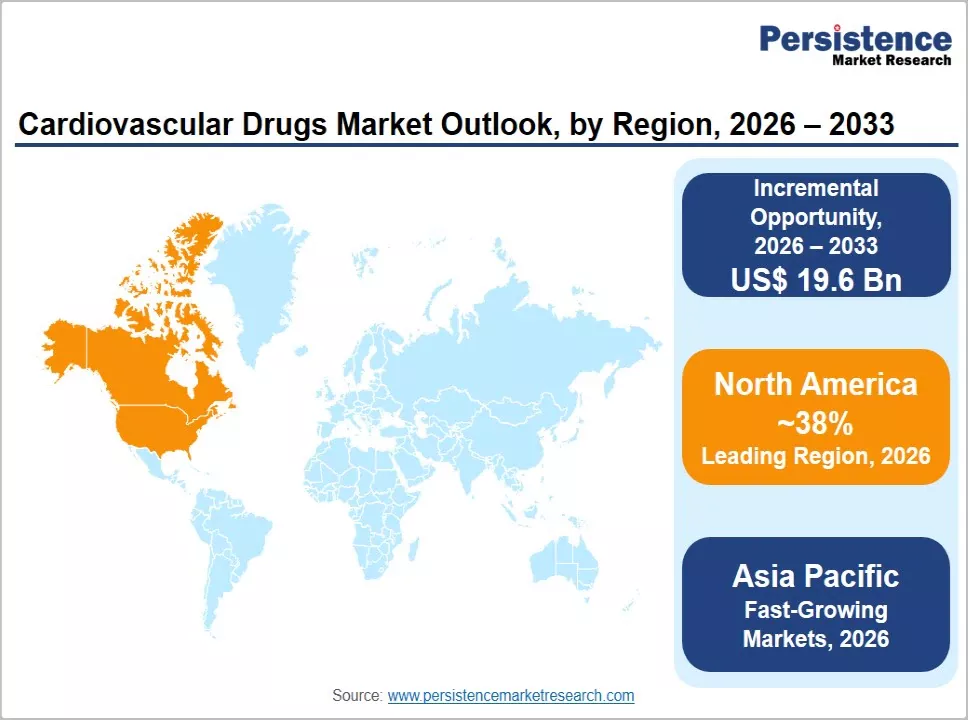
- Dominant Region: North America command around 35% market share in 2026, fueled by the American College of Cardiology's guideline-driven formulary adoption and the Medicare Part D drug pricing reform embedded in the Inflation Reduction Act, which will progressively reshape the premium drug pricing environment through 2033.
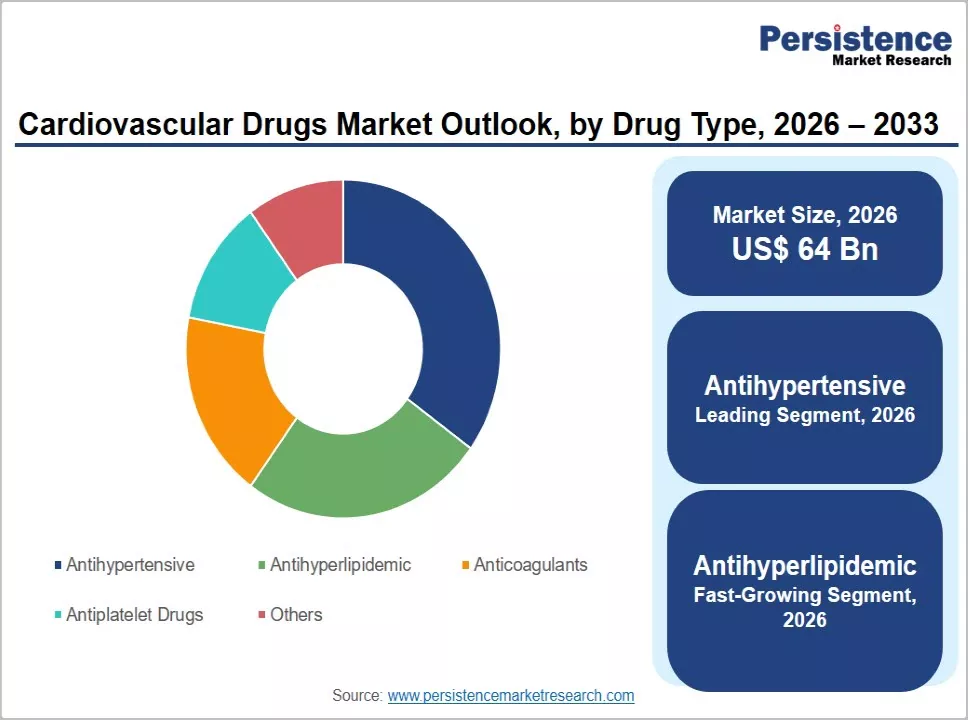
- Leading Drug Type: Antihypertensive agents hold 35% drug-type share in 2026, propelled by the structural permanence of hypertension as the world's most prevalent cardiovascular condition. The segment's dominance is durable: ARBs and calcium channel blockers face no credible therapeutic substitution threat within the forecast window.
- Dominant Disease Indication: Hypertension as a disease indication accounts for 38% of market value the single largest clinical segment at reinforcing that blood pressure management remains the commercial and clinical backbone of the global cardiovascular drugs industry, with patient populations expanding faster than current treatment coverage can accommodate.
- Leading Distribution Channel: Online pharmacy dispensing is the fastest-growing distribution channel, catalyzed by Amazon Pharmacy's cardiovascular drug coverage expansion and the NHS England Pharmacy First initiative. This channel shift compresses per-prescription margins but significantly extends geographic access for maintenance antihypertensives and statins in underserved populations.
- Fastest-growing Region: Asia Pacific's 4.9% CAGR the fastest of any region positions the cardiovascular drugs sector for its next commercial frontier. China's Healthy China 2030 plan and India's expanding generic manufacturing infrastructure are simultaneously building domestic demand and supply-side scale, creating a region that will increasingly define the volume economics of the global cardiovascular drugs landscape through 2033.
DRO Analysis
Driver - Rising Global Burden of Hypertension and Related Comorbidities
The World Health Organization (WHO) estimates that approximately 1.28 billion adults between 30 and 79 years of age live with hypertension globally, with nearly half unaware of their diagnosis. This diagnostic gap particularly acute in sub-Saharan Africa and South Asia directly expands the addressable patient population for first-line antihypertensive therapies such as ACE inhibitors, angiotensin receptor blockers (ARBs), and calcium channel blockers.
National health programs in India, Brazil, and Nigeria have initiated structured hypertension screening initiatives since 2022, feeding patients into sustained long-term pharmacotherapy regimens. As screening coverage broadens, prescription initiation rates rise, translating into durable, recurring revenue streams for manufacturers operating across the cardiovascular drugs landscape.
Restraint - Generic Penetration and Price Erosion in Mature Drug Classes
Statins, beta-blockers, and older ACE inhibitors have undergone deep generalization, compressing manufacturer margins across a substantial portion of the cardiovascular drugs segment. Per IQVIA Institute for Human Data Science analysis, branded cardiovascular drugs lose on average 70-90% of market value within 24 months of patent expiry in highly competitive generics markets like the U.S. and Germany. This pricing pressure limits revenue growth for established portfolios and constrains the R&D reinvestment capacity of mid-tier cardiovascular drug manufacturers who lack premium pipeline assets to offset volume-driven margin compression.
Opportunity - Expansion of PCSK9 Inhibitors and RNA-Based Lipid Therapies in High-Risk Populations
The commercial opportunity in next-generation lipid-lowering therapy is substantial and underpenetrated. Regeneron Pharmaceuticals and Sanofi's alirocumab (Praluent) and Amgen's evolocumab (Repatha) addressed only a fraction of eligible high-risk patients through 2023, largely due to prior authorization hurdles and cost barriers.
However, payer policy is shifting. Major U.S. insurers including CVS Caremark revised PCSK9 inhibitor coverage criteria in 2024, reducing documentation requirements for high cardiovascular risk patients. As reimbursement pathways widen and biosimilar PCSK9 inhibitors enter the market through 2026–2027, patient uptake is forecast to accelerate meaningfully across this high-margin cardiovascular drugs segment.
Category-wise Analysis
Drug Type Insights
Why Do Antihypertensive Drugs Command the Largest Share of the Cardiovascular Drugs Market?
Antihypertensive drugs are projected to dominate the drug type segment hold around 35% of market share in 2026, driven by the sheer scale of the hypertension patient population and the near-universal requirement for long-term pharmacotherapy. Cardiologists and primary care physicians prescribe ARBs such as valsartan and olmesartan as first-line agents for newly diagnosed hypertensive patients across integrated hospital networks, while combination fixed-dose formulations of ACE inhibitors with calcium channel blockers dominate high-volume public health procurement programs in emerging economies.
Antihyperlipidemic agents are likely to be the fastest-growing drug type, propelled by the launch of Novartis's inclisiran (Leqvio), which requires only two injections annually a dosing convenience that primary care networks and employer-sponsored wellness programs are actively incorporating into cardiovascular risk reduction protocols since its U.S. commercial rollout in 2022.
Disease Indication Insights
What Is Driving Demand for Hypertension Therapies Across the Global Cardiovascular Drugs Industry?
Hypertension is expected to account around 38% of market share in 2026, driven by the unmatched global prevalence of the condition and the clinical imperative for sustained pharmacological blood pressure control. Hospital outpatient cardiology departments rely on structured hypertension management protocols typically combining an ARB or ACE inhibitor with a diuretic to manage post-acute coronary syndrome patients, while national formularies in public health systems across the U.K., Germany, and Brazil mandate hypertension screening and treatment as preventive care benchmarks.
Hyperlipidemia is likely to be the fastest-growing disease indication. The American Heart Association's 2023 cholesterol guidelines expanded statin eligibility criteria for intermediate cardiovascular risk patients, directly increasing the population qualifying for lipid-lowering therapy initiation and driving formulary uptake among previously untreated adults aged 40–75.
Distribution Channel Insights
Hospital pharmacies are likely to be the lead the segment command around 42% of market share in 2026, fueled by the clinical complexity of cardiovascular drug initiation and the dominant role of institutional procurement in this therapeutic category. Inpatient cardiology units, cardiac intensive care wards, and electrophysiology departments rely on hospital pharmacy dispensing for intravenous anticoagulants such as heparin, oral anticoagulants like warfarin and direct oral anticoagulants (DOACs) during post-operative monitoring, and intravenous antiarrhythmics requiring controlled clinical supervision. These high-acuity scenarios anchor hospital pharmacy dominance structurally rather than cyclically.
Online pharmacies are anticipated to the fastest-growing distribution channel. Amazon Pharmacy's expansion of cardiovascular drug formulary coverage across 46 U.S. states by 2024, combined with the Pharmacy First initiative launched by NHS England in January 2024, has normalized digital dispensing for maintenance cardiovascular medications particularly oral antihypertensives and statins among adherent chronic disease patients seeking convenience and cost savings.
Regional Insights
North America Cardiovascular Drugs Market Trends and Insights
North America is forecast to 38% of market share in 2026, fueled by the highest per-capita cardiovascular drug expenditure globally and a deeply established managed care infrastructure. The Inflation Reduction Act (IRA) of 2022 introduced Medicare drug price negotiation, with cardiovascular agents among the first ten drugs subject to negotiation a development that will reshape pricing dynamics for leading antihypertensives and anticoagulants by 2026. Payer-driven formulary management and specialty pharmacy networks continue to structure market access for premium cardiovascular agents.
U.S. Cardiovascular Drugs Market Size
The U.S. is projected to command around 88% of the North America regional market in 2026. Demand is anchored by the clinical guideline infrastructure of the American College of Cardiology (ACC), whose treatment pathways for heart failure, atrial fibrillation, and atherosclerotic cardiovascular disease drive formulary adoption of newer DOAC and PCSK9 inhibitor classes. Medicare Part D expansion under the IRA will progressively reshape patient out-of-pocket dynamics through 2033.
Canada Cardiovascular Drugs Market Size
Canada is expected to account for 12% of the North America regional market in 2026. Provincial formulary decisions coordinated through the Canadian Drug Review (CDR) process under the Canadian Drug Pricing Alliance (CADTH) govern reimbursement access for newer cardiovascular agents, moderating adoption speeds relative to the U.S. Biosimilar entry into the ARB and statin segments is expected to shift volume and formulary priority through 2028.
Europe Cardiovascular Drugs Market Trends and Insights
Europe is projected to command around 18% of market share in 2026, with mature universal healthcare systems providing structural prescription volume but also stringent health technology assessment (HTA) gatekeeping for premium-priced agents. The European Medicines Agency's accelerated review pathways for cardiovascular biologics and the European Heart Network's prevention policy frameworks are progressively shaping reimbursement landscapes across member states. Generic penetration remains high for established classes, moderating overall regional growth relative to Asia Pacific.
Germany Cardiovascular Drugs Market Size
Germany is anticipated to account around 23% of the Europe regional market in 2026. Germany's Gemeinsamer Bundesausschuss (G-BA) benefit assessment framework evaluates the added clinical value of new cardiovascular agents against existing standard of care a process that directly determines negotiated reimbursement prices under AMNOG legislation. Positive benefit assessments for newer heart failure and lipid-lowering therapies position Germany as the region's highest-value early access market.
U.K. Cardiovascular Drugs Market Size
The U.K. is expected to command about 20% of the Europe regional market in 2026. The National Institute for Health and Care Excellence (NICE) cardiovascular technology appraisals including recent positive guidance on sodium-glucose cotransporter-2 (SGLT2) inhibitors for heart failure are driving formulary expansion within NHS England integrated care systems. Post-Brexit regulatory divergence between the Medicines and Healthcare Products Regulatory Agency (MHRA) and EMA is creating parallel approval timelines that manufacturers must manage independently.
Asia Pacific Cardiovascular Drugs Market Trends and Insights
Which Region Will Drive the Fastest Cardiovascular Drugs Market Growth Through 2033?
Asia Pacific is likely to be the fastest-growing region in the cardiovascular drugs market, expanding at a CAGR of 4.9%. The region accounts for an estimated share of the global market in 2026, at current penetration levels, but the trajectory is defined by accelerating urbanization, dietary shifts elevating dyslipidaemia prevalence, and government-led universal health coverage (UHC) expansions in China, India, and Southeast Asia. China's Healthy China 2030 initiative has prioritized cardiovascular disease prevention, funding hypertension and hyperlipidaemia drug procurement through national essential medicine lists at scale.
China Cardiovascular Drugs Market Size
China is estimated to command around 32% of the Asia Pacific regional market in 2026. China's volume-based procurement (VBP) program has dramatically reduced generic cardiovascular drug prices while expanding volume access across tier-2 and tier-3 hospitals, sustaining patient numbers while compressing per-unit revenue. Domestic manufacturers including CSPC Pharmaceutical Group are investing in innovative cardiovascular pipeline assets to offset VBP margin pressure.
Japan Cardiovascular Drugs Market Size
Japan is anticipated to capture around 23% of the Asia Pacific regional market in 2026. Japan's rapidly aging population with citizens aged 65 and over constituting approximately 29% of the total population per Statistics Bureau of Japan data sustains structural demand for antihypertensive and antiplatelet therapies. Biennial drug price revisions by Japan's Ministry of Health, Labor and Welfare (MHLW) apply consistent downward pricing pressure, incentivizing manufacturers to prioritize premium innovative agents over generics.
Competitive Landscape
The global cardiovascular drugs market exhibits a moderately consolidated structure, with a small group of multinational pharmaceutical companies controlling the most commercially valuable branded assets while a large competitive base of generics manufacturers contests volume in off-patent categories. Bristol-Myers Squibb Company and Pfizer Inc. jointly anchor the anticoagulant segment through apixaban (Eliquis), the world's highest-revenue oral anticoagulant.
AstraZeneca and Novartis AG lead the innovation frontier in cardiometabolic agents, while Bayer AG, Sanofi, and Merck & Co., Inc. maintain deep formulary penetration across antihypertensive and antithrombotic portfolios. Competitive differentiation increasingly hinges on real-world evidence generation, digital adherence programming, and biosimilar defense strategies rather than primary clinical trial efficacy alone.
Key Industry Developments
- In October 2026, researchers from the University of Michigan identified potential cardiovascular and metabolic benefits of sotagliflozin, an FDA-approved medication marketed by Lexicon Pharmaceuticals as Inpefa. The study, published in The Journal of Clinical Investigation, found that sotagliflozin reduced platelet activation in patients with and without type 2 diabetes and protected mice against blood clot formation. Researchers also highlighted its potential to reduce diabetes-related risks and cardiovascular events, including heart attacks and strokes.
- In August 2026, Eli Lilly and Company announced that the U.S. Food and Drug Administration (FDA) had approved Mounjaro (tirzepatide) to reduce major cardiovascular risks, including cardiovascular death, non-fatal heart attacks, and non-fatal strokes, in adults with type 2 diabetes at high risk of these events. The approval followed the SURPASS-CVOT clinical trial, which enrolled more than 13,000 participants across 30 countries and demonstrated that Mounjaro performed comparably to Trulicity (dulaglutide) in reducing major cardiovascular events. The trial reported an 8% lower rate of cardiovascular death, heart attack, or stroke with Mounjaro compared with Trulicity.
Companies Covered in Cardiovascular Drugs Market
- Bristol-Myers Squibb Company
- Pfizer Inc.
- Bayer AG
- Janssen Pharmaceuticals, Inc.
- AstraZeneca
- Sanofi
- Novartis AG
- Merck & Co., Inc.
- Gilead Sciences, Inc.
- F. Hoffmann-La Roche Ltd
Frequently Asked Questions
The global cardiovascular drugs market is valued at US$ 64.00 billion in 2026.
The World Health Organization's global hypertension initiative targeting diagnosis and treatment coverage expansion in low- and middle-income countries, and regulatory approvals of novel RNA-based and PCSK9 inhibitor therapies by the FDA and EMA that create premium therapeutic categories beyond traditional small-molecule cardiovascular agents.
Antihypertensive drugs hold around 35% of market share, fueled by the sheer scale of the hypertension patient population.
North America lead the market with a 38% share. Its position is sustained by high per-capita cardiovascular drug expenditure, mature managed care formulary infrastructure, and guideline-driven prescribing coordinated through the American College of Cardiology.
The expansion of PCSK9 inhibitor reimbursement coverage and the commercial scaling of RNA-based lipid therapies such as inclisiran represent the highest-value opportunity in the cardiovascular drugs market through 2033.
The market is moderately consolidated, led by Bristol-Myers Squibb Company, Pfizer Inc., AstraZeneca, Novartis AG, and Bayer AG, which collectively control the most commercially significant branded cardiovascular drug portfolios.


