




- Hardware & Software IT Services
- U.S. Wearables Market
U.S. Wearables Market Size, Share, and Growth Forecast, 2026 - 2033
U.S. Wearables Market by Product (Wrist-wear, Headwear, Footwear, Neckwear, Body-Wear, Earwear, Others), Connectivity (Bluetooth, Wi-Fi, Cellular, NFC, Others), Application (Healthcare, Fitness & Wellness, Gaming and Entertainment, Defense & Public Safety, Education, Enterprise & Industrial, Fashion & Lifestyle, Others) Analysis for 2026 - 2033

U.S. Wearables Market Size and Trends Analysis
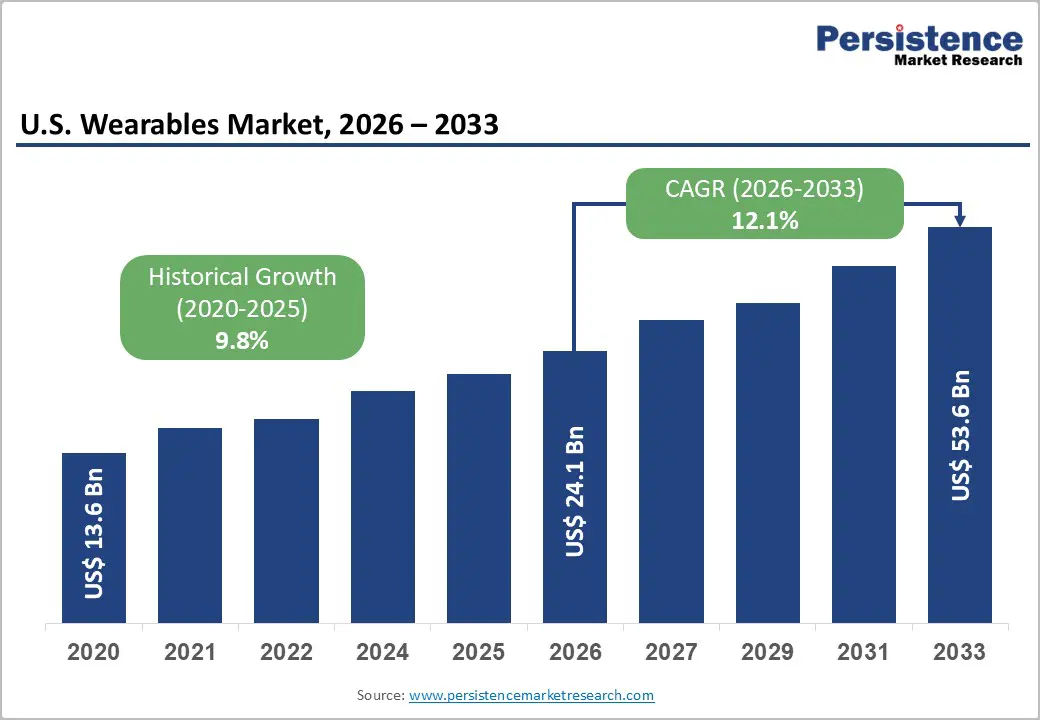
The U.S. Wearables Market size is projected to rise from US$24.1 Bn in 2026 to US$53.6 Bn by 2033. It is anticipated to witness a CAGR of 12.1% during the forecast period from 2026 to 2033, driven by increasing health consciousness and technological advancements in sensors and AI integration.
The rising adoption of devices for real-time fitness tracking and preventive healthcare, accelerated by post-pandemic wellness trends, underpins this expansion. Seamless connectivity with smartphones and IoT ecosystems further boosts consumer demand, enabling personalized insights that sustain market momentum. Government initiatives, such as campaigns by the U.S. Department of Health and Human Services promoting wearables for preventive care, are amplifying adoption and supporting connectivity with smartphones.
Key Industry Highlights:
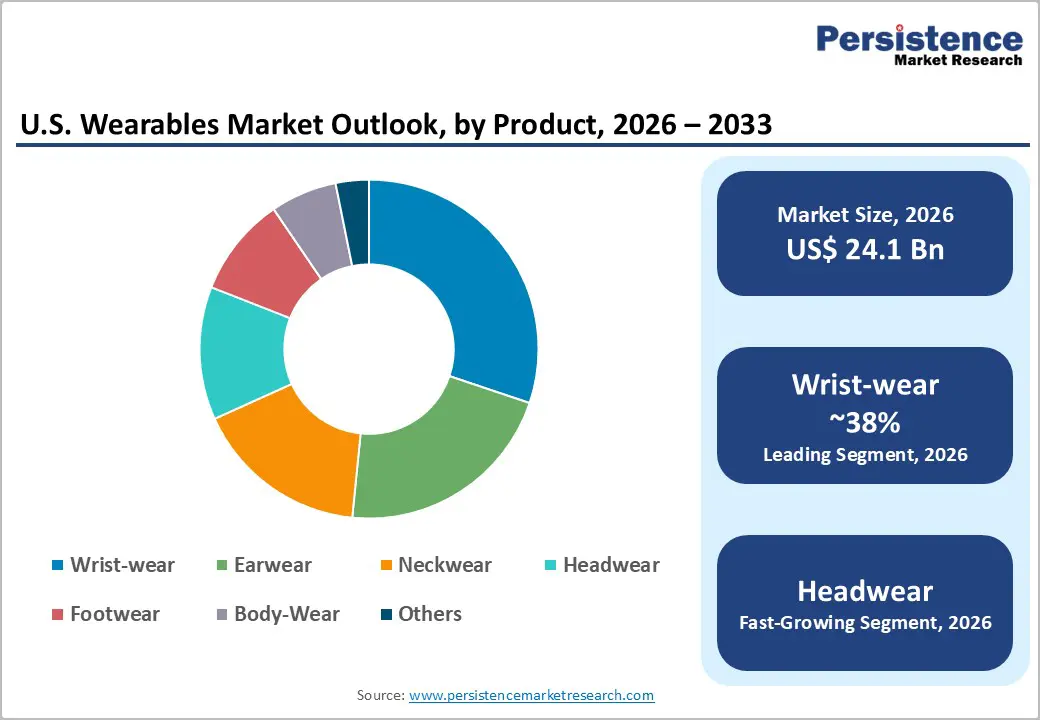
- Leading Product: Wrist-wear captures more than 38% market share in 2026, valued at over US$ 9.1 Bn, driven by demand for health monitoring, fitness tracking, real-time notifications, and seamless smartphone connectivity. Headwear shows the highest growth at a CAGR of 14.9%, catering to hands-free communication, audio experiences, and fitness tracking with style and convenience.
- Leading Connectivity: Bluetooth dominates with over 54% market share in 2026, valued at more than US$ 13 Bn, providing low-power, seamless connectivity for continuous data syncing and device interoperability. Cellular connectivity is expected to grow at the highest CAGR of 15.6%, driven by the need for smartphone-independent functionality, remote monitoring, and real-time data transmission for active users, seniors, and children.
- Leading Application: Fitness & wellness leads the market with over 27% share in 2026, valued at more than US$ 6.5 Bn, due to consumer focus on preventive care, activity tracking, and lifestyle management. Healthcare is projected to grow at a CAGR of 14.5%, fueled by demand for continuous, real-time monitoring of chronic conditions and integration with telehealth and digital health platforms.
- Key Opportunities: Integration with AI and personalized healthcare platforms enables predictive health insights, subscription-based services, and wearable-enabled diagnostics. Smart clothing innovations with embedded sensors provide seamless physiological monitoring, combining comfort, style, and functionality, creating new revenue streams.
| Key Insights | Details |
|---|---|
|
U.S. Wearables Market Size (2026E) |
US$24.1 Bn |
|
Market Value Forecast (2033F) |
US$53.6 Bn |
|
Projected Growth (CAGR 2026 to 2033) |
12.1% |
|
Historical Market Growth (CAGR 2020 to 2025) |
9.8% |
Market Dynamics
Driver - Rising Digital Health Adoption and Preventive Care Awareness
Rising digital health adoption and preventive care awareness are key growth drivers. According to the Centers for Disease Control and Prevention (CDC), approximately six in ten U.S. adults live with at least one chronic disease, increasing the need for continuous and remote health monitoring solutions. Wearables equipped with ECG, SpO2, and sleep tracking capabilities align with reimbursement frameworks supported by the Centers for Medicare & Medicaid Services (CMS) for remote patient monitoring programs. The expansion of the broader digital health ecosystem has strengthened physician–patient data integration through electronic health records (EHRs), improving clinical decision-making. Consumers increasingly seek real-time health insights to reduce hospital visits, enhance lifestyle management, and track fitness metrics, thereby driving sustained demand.
Advancements in Connectivity and Sensor Technologies
Integration of AI-driven analytics, advanced biosensors, and low-power chipsets has significantly improved device accuracy and battery efficiency. The nationwide rollout of 5G networks by major U.S. telecom providers has strengthened cellular-enabled wearables, enabling standalone connectivity without smartphones. The evolution of the Internet of Things (IoT) supports seamless interoperability of devices across home, enterprise, and healthcare ecosystems. Continuous R&D investments by companies such as Apple Inc. and Samsung Electronics Co. Ltd. have enhanced form factors, water resistance, and health-grade sensors, making wearables increasingly indispensable to daily digital lifestyles. Low-power semiconductors have extended battery life by over 50% in wrist-worn devices, addressing usability concerns and boosting adoption.
Restraint - Proliferation of Counterfeit Products
The market faces challenges from counterfeit and unlicensed devices that mimic popular brands such as Apple Inc. and Samsung Electronics Co. Ltd. These fake products often compromise device quality, safety, and reliability, which erode consumer trust in authentic brands. Regulatory enforcement against such products is limited and fragmented, making it difficult to fully curb their circulation. Counterfeit devices also undermine market revenues by capturing demand that would otherwise go to genuine products. Consumers exposed to substandard devices report negative experiences, impacting brand reputation and slowing adoption among cautious buyers.
Device Saturation and Upgrade Cycles
High penetration of smartwatches, fitness bands, and other wearables in urban U.S. populations has led to slower replacement rates. Many devices offer only incremental improvements in features, leading consumers to retain existing models longer. Price-sensitive segments hesitate to upgrade to premium devices unless substantial innovation is introduced. Multifunctional smartphones and health apps reduce the perceived necessity for standalone wearables in certain user groups. Sales growth in mature markets slows despite rising overall demand, limiting the potential for short-term revenue expansion.
Opportunity - Integration with AI and Personalized Healthcare Platforms
AI-powered analytics are unlocking predictive health insights. Machine learning models detect irregular heart rhythms, stress patterns, and sleep disorders with increasing precision. The growth of Artificial Intelligence in healthcare is enhancing interoperability between wearable data and clinical systems. Partnerships between device makers and healthcare providers are enabling subscription-based health services, creating recurring revenue streams. As regulatory pathways for digital therapeutics mature under the U.S. Food and Drug Administration (FDA), wearable-enabled diagnostics and therapy monitoring are expected to drive substantial market opportunities.
Smart Clothing Innovations
Smart clothing, embedded with sensors and conductive fibers, offers real-time monitoring of physiological parameters such as heart rate, temperature, and muscle activity. These garments track fitness, posture, and rehabilitation progress without the need for separate devices. Growing consumer interest in seamless health monitoring and active wear is driving adoption. Major sports brands are investing in smart textiles to combine style, comfort, and functionality. With increasing R&D in washable electronics and flexible sensors, smart clothing is positioned to become a significant wearable segment, offering new revenue streams for companies.
Category-wise Analysis
Product Insights
Wrist-wear capturing more than 38% market share in 2026, with a value exceeding US$ 9.1 Bn, as it directly meets key consumer needs, fitness tracking, health monitoring, such as heart rate and sleep, and convenient smartphone connectivity all in one device. Its form factor is comfortable, always visible, and easy to interact with during daily activities. Users also prefer wrist-wear for real-time notifications and quick access to essential apps without pulling out a phone. Widespread adoption is driven by growing health consciousness and the desire for seamless tech integration into everyday life.
Headwear demonstrates the highest growth rate with a CAGR of 14.9% due to consumers increasingly wanting hands-free, convenient tech that integrates smoothly into daily life. Smart caps and headsets address needs like on-the-go communication, audio experiences, and fitness tracking without bulky devices. They also enhance safety and situational awareness by keeping their ears and hands free. With rising demand for stylish yet functional accessories, headwear fits both fashion and utility needs.
Connectivity Analysis
Bluetooth holds over 54% market share in 2026, with a value exceeding US$ 13 Bn, due to its ability to deliver low-power, seamless connectivity between devices like smartwatches, fitness trackers, and smartphones. It supports real-time health data syncing, notifications, and audio streaming while preserving battery life, meeting consumers’ demand for convenience and continuous usage. Its universal compatibility and easy pairing further make it the most practical and widely adopted connectivity option in wearable devices.
Cellular is expected to grow at the highest rate, with a CAGR of 15.6%, due to the increasing need for independent, smartphone-free functionality. Consumers want smartwatches and health trackers that make calls, stream music, access emergency services, and transmit real-time health data without relying on Bluetooth pairing. Rising demand for remote patient monitoring, child safety tracking, and elderly care devices further strengthens the need for always-on connectivity. Expanding 4G/5G coverage and carrier-supported wearable data plans make cellular-enabled devices more practical and attractive for active, on-the-go lifestyles.
Application Insights
Fitness & wellness commands the largest market share at over 27% in 2026, with a value exceeding US$ 6.5 Bn, due to consumers increasingly prioritizing health monitoring and preventive care in daily life. Wearables that track activity, heart rate, sleep, and stress help users stay motivated, set goals, and make healthier lifestyle choices. The demand reflects a shift toward personalized, real-time insights that support long-term well-being rather than just tech features. Integration with fitness apps and health ecosystems makes these devices central to everyday health routines.
Healthcare is expected to grow at a CAGR of 14.5% due to the rising need for continuous and real-time health monitoring, especially for chronic conditions such as heart disease and diabetes. Consumers increasingly demand early detection tools that track heart rate, oxygen levels, sleep quality, and irregular rhythms without frequent hospital visits. The aging population and growing preference for remote patient monitoring are accelerating adoption among providers and insurers. Integration with digital health platforms and telehealth services is making wearables essential for preventive care and personalized treatment management.
Competitive Landscape
The U.S. wearables market is moderately consolidated, led by large multinational technology firms with strong brand ecosystems and advanced R&D capabilities. Market leaders differentiate themselves through proprietary operating systems, integrated health platforms, and premium product design. Continuous investment in AI-driven health analytics, sensor innovation, and subscription-based wellness services shapes competitive positioning. Strategic acquisitions and partnerships with healthcare providers further strengthen long-term defensibility.
Key Developments:
- In February 2026, ?URA announced a strategic partnership as the Official Wearable of Team USA and the LA28 Olympic & Paralympic Games. ?URA will equip U.S. athletes competing in the 2026 and 2028 Games with the Oura Ring to support performance, recovery, sleep, and overall well-being optimization.
- In January 2026, U.S. Food and Drug Administration (FDA) Commissioner announced new guidance at CES 2026 stating that most fitness trackers, sleep monitors, and AI wellness tools will remain outside medical device regulations if they avoid clinical claims. The move aims to reduce regulatory barriers and support innovation in lifestyle-focused wearables across the U.S. market.
Companies Covered in U.S. Wearables Market
- Apple Inc.
- Samsung Electronics Co. Ltd.
- Sony Group Corporation
- Garmin Ltd.
- Xiaomi Corporation
- Adidas AG
- Nike Inc.
- Fitbit Inc.
- Fossil Group Inc.
- Meta
- Oura Health Oy
- Others
Frequently Asked Questions
The U.S. market is projected to be valued at US$24.1 Bn in 2026.
Rising demand for real-time health monitoring, preventive healthcare, and growing fitness consciousness are key drivers of the market.
The market is expected to witness a CAGR of 12.1% from 2026 to 2033.
Expanding remote patient monitoring, AI-powered preventive healthcare, and AR/VR adoption, driving new subscription-based and data-driven revenue models, is creating strong growth opportunities.
Apple Inc., Samsung Electronics Co. Ltd., Sony Group Corporation, Garmin Ltd., Xiaomi Corporation, Adidas AG, Nike Inc. are among the leading key players.


