




- Automotive
- Lane Keep Assist System Market
Lane Keep Assist System Market Size, Share, and Growth Forecast 2026–2033
Lane Keep Assist System Market Function Type (Lane Keeping System and Lane Departure Warning), Component (Vision Sensor/Camera, Electronic Power-Assisted Steering (EPAS) Actuator), Vehicle Type (Passenger, Commercial Vehicles), Regional Analysis, 2026–2033

Lane Keep Assist System Market Size and Trend Analysis
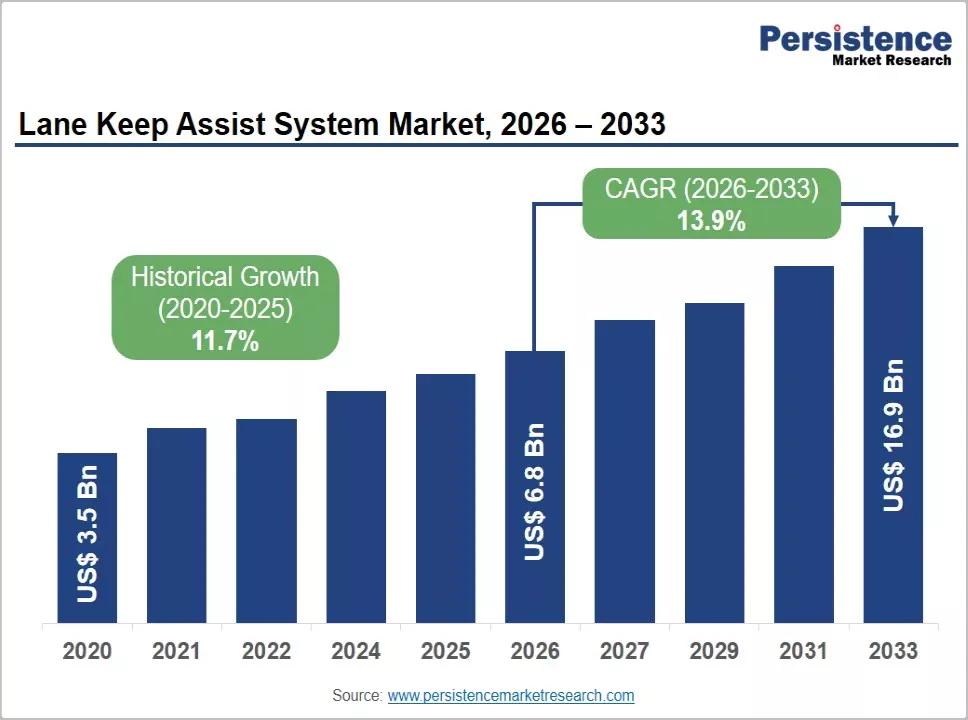
The global lane keep assist system market size is likely to be valued at US$ 6.8 billion in 2026, and is estimated to reach US$ 16.9 billion by 2033, growing at a CAGR of 13.9% during the forecast period 2026–2033.
Growth is underpinned by mandatory advanced driver assistance requirements, expanding safety rating protocols, and rising demand for assisted driving features across passenger and commercial vehicles.
The market has been experiencing solid growth, reflecting staggered regulatory timelines and cost sensitivity in entry-level segments. However, the forecast period anticipates robust acceleration as lane keeping becomes standard equipment, camera and steering technologies become more affordable, and automakers use lane-level perception as the foundation for Level 2 and Level 2+ driving systems.
Key Industry Highlights
- Dominant Function Type: Lane keeping systems are set to command around 61% of the revenue share in 2026 and are likely to grow at 14.6% CAGR through 2033, as active steering correction replaces warning-only systems in new vehicle specifications.
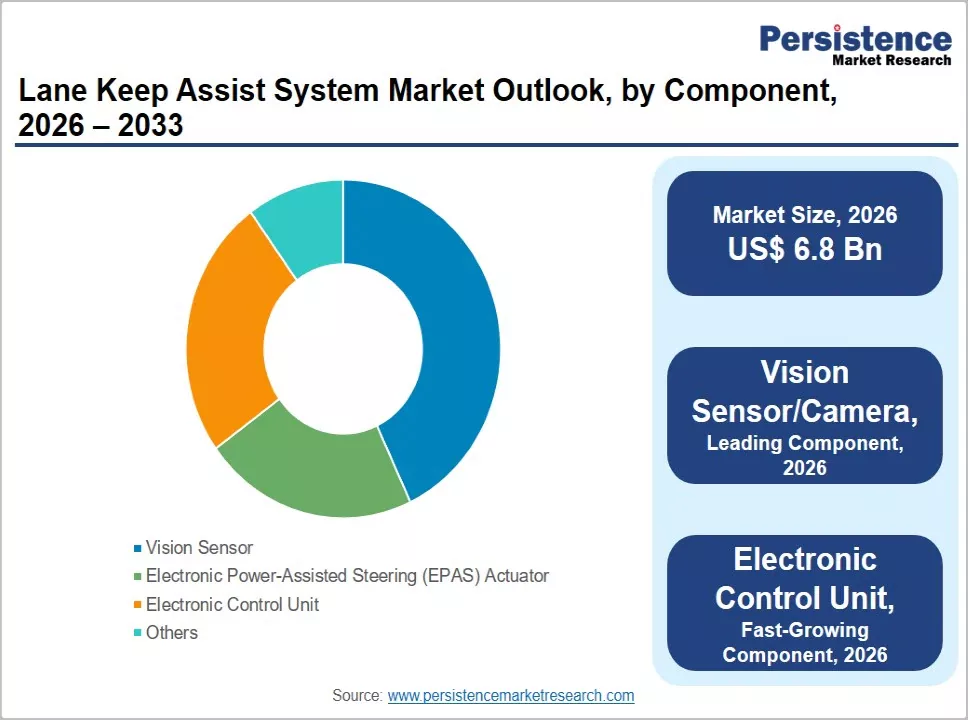
- Leading Components: Vision sensors and cameras are expected to lead with 46% in 2026, while EPAS actuators are likely to be the fastest-growing at about 14.8% CAGR during 2026–2033, reflecting the need for precise steering intervention.
- Dominant Vehicle Type: Passenger vehicles are anticipated to lead with an estimated 79% share in 2026, while commercial vehicles are slated to represent the fastest-growing segment at 15.6% CAGR from 2026 to 2033.
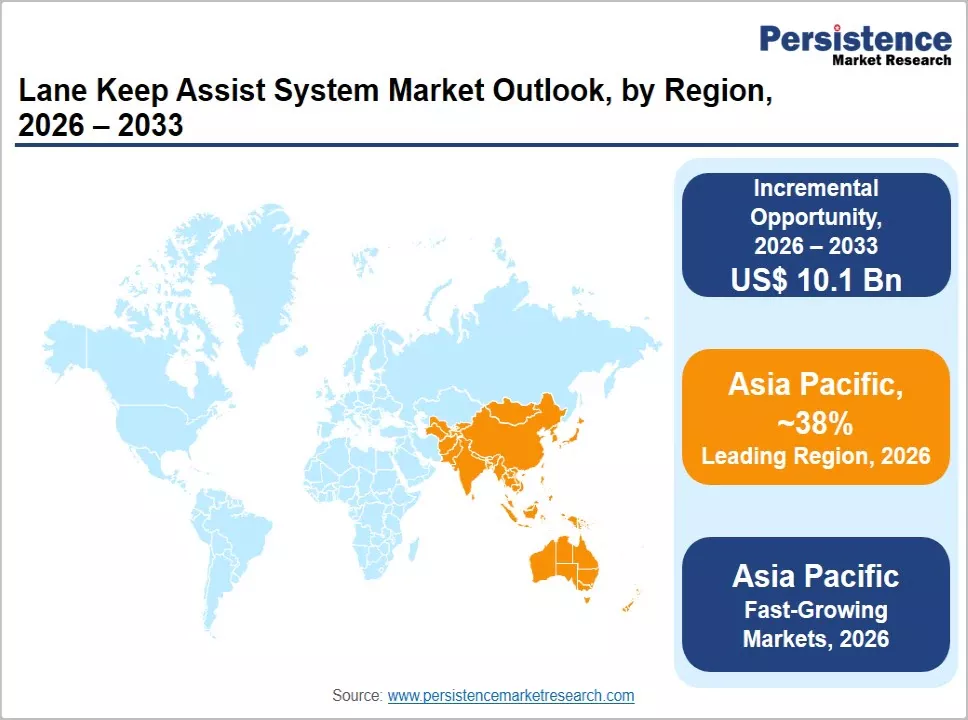
- Regional Leadership: Asia Pacific is poised to dominate with an estimated 38% share in 2026 and register a 14.8% CAGR through 2033, led by vehicle production in China, India, and Japan.
- Competitive Environment: Competitive dynamics include next-generation camera launches, software licensing agreements for vision technology, and local production expansion by Tier 1 suppliers in high-growth markets such as India and China.
DRO Analysis
Drivers: Safety Regulation and New Car Assessment Programmes as Primary Growth Catalyst
Safety regulation is the leading force driving the lane keep assist system market growth, as governments and rating bodies make lane-level assistance a standard expectation. In the European Union, all new vehicles registered since July 2024 must carry emergency lane keeping, along with emergency braking and intelligent speed assistance under the General Safety Regulation.
In the U.S., the National Highway Traffic Safety Administration decided to add lane keeping assist to its New Car Assessment Program, and the first vehicle meeting the new advanced driver assistance criteria has already been announced, even though some program updates were delayed in 2025. Other markets, including Australia, which has outlined a mandate for new vehicles from 2029, are following similar paths.
Assisted Driving Penetration and Consumer Acceptance
Growing consumer familiarity with Level 2 assistance and the inclusion of lane keeping in insurance and safety rating considerations are pushing automakers to equip a larger share of models. Newer protocols also assess how smoothly lane keeping intervenes, encouraging suppliers to refine algorithms and reduce driver annoyance. This convergence of regulatory certainty, safety ratings, and technology maturity ensures sustained growth in the lane keep assist system market in the coming years.
Restraints: Sensor Reliability Limitations and System Cost in Entry-Level Vehicles
Sensor reliability remains a major challenge for the lane keep assist system market. Camera-based systems depend on visible lane markings, and performance degrades in poor weather, glare, snow-covered roads, faded paint, or construction zones, causing disengagement or incorrect corrections. Drivers frequently switch off systems that they find intrusive, which limits real-world safety benefits and creates reputational risk for automakers. The cost of high-resolution cameras, control units, and calibration also remains a concern for entry-level and emerging market vehicles.
Calibration Complexity and Liability Concerns
Windshield replacement, collision repair, and wheel alignment can require recalibration of forward cameras, adding cost and complexity for owners and repair shops. Questions about liability when assistance fails or when drivers over-rely on the system also create uncertainty for automakers and insurers. Regional differences in road markings and rating requirements force suppliers to tune algorithms by market, raising validation costs and extending development schedules.
Opportunities: Software-Defined Vehicles and Localization in Emerging Markets
Software-defined vehicle architectures allow lane keeping to be upgraded through over-the-air updates, enabling suppliers to monetize improved performance and new features over the vehicle life. Tier 1 suppliers are launching modular assisted driving portfolios that combine in-house radar chips, multi-purpose cameras, and AI-based driving software, giving automakers scalable options from basic lane keeping to highway pilot. Licensing of advanced computer vision technology is also lowering development barriers for new entrants.
High-Volume Emerging Markets and Commercial Fleets
Emerging markets such as India, Southeast Asia, and Latin America are experiencing rapid growth in sport utility vehicles with assisted driving features, supported by local production of cameras and electronic control units. Commercial vehicle operators are also adopting lane departure and lane keeping technologies to reduce accidents and insurance costs, creating opportunities for truck, bus, and van platforms with longer service lives and strong demand for aftermarket upgrades.
Category-wise Insights
Function Type Analysis
Why Do Lane Keeping Systems Lead the Lane Keep Assist Market?
Lane keeping systems are the leading function type segment, expected to hold about 61% of the lane keep assist system market revenue share in 2026. Unlike warning-only functions, lane keeping systems apply gentle steering torque to guide the vehicle back toward the lane center, and many versions provide continuous lane centering for highway driving. Regulatory requirements for emergency lane keeping and the use of lane keeping as the foundation for adaptive cruise control combinations have made active intervention the preferred specification. The segment is projected to grow at about 14.6% CAGR through 2033 as intervention logic improves and calibration becomes less intrusive.
Lane departure warning remains an important segment, particularly in cost-sensitive vehicles, commercial vehicles, and markets with early-stage regulation. These systems alert drivers through visual, audible, or haptic signals when the vehicle drifts out of the lane without a turn signal. Their lower hardware requirements, as they do not need steering actuation, make them attractive for older platforms and aftermarket installations, although growth is slower as active systems become standard on new models and safety ratings reward intervention over warning alone.
Component Analysis
Why Do Vision Sensors and Cameras Lead Lane Keep Assist Components?
Vision sensors and cameras are the leading component segment, projected to capture about 46% of the revenue share in 2026. Forward-facing cameras mounted behind the windshield detect lane markings, road edges, and other vehicles, and increasingly support multiple assisted driving functions from a single module. Newer cameras offer wider fields of view, higher resolution, improved low-light performance, and embedded AI processing, which help lane keeping handle sharp curves and complex road scenes. Because cameras are shared with emergency braking and traffic sign recognition, they carry a higher value content per vehicle.
EPAS actuators are the fastest-growing component segment, anticipated to achieve 14.8% CAGR during the 2026–2033 period. Electronic power-assisted steering allows software to apply precise corrective torque, making it essential for lane keeping and lane centering. Rising electric vehicle penetration, which favors electric steering over hydraulic systems, and demand for redundancy in higher automation levels are increasing demand for advanced actuators. Electronic control units, which process camera inputs and command steering, benefit from the shift toward centralized domain controllers, while other components such as radar and inertial sensors provide complementary data.
Vehicle Type Analysis
Which Vehicle Type Dominates the Lane Keep Assist System Market?
Passenger vehicles dominate the vehicle type segment, projected to account for about 79% of the revenue share in 2026. High production volumes, consumer demand for safety features, and regulatory coverage of cars and light vans make this segment the primary volume driver. Lane keeping is increasingly offered as standard equipment even in compact vehicles and sport utility vehicles, supported by lower sensor prices and software reuse across platforms. Safety rating incentives encourage automakers to include lane keeping across trim levels to secure higher star ratings.
Commercial vehicles represent the fastest-growing vehicle type segment, expected to register about 15.6% CAGR through 2033. Fleet operators are deploying lane departure and lane keeping systems to reduce run-off-road accidents, driver fatigue-related incidents, and insurance costs, while regulations in major markets extend advanced driver assistance requirements to trucks and buses. Heavy vehicles require ruggedized cameras and steering actuation designed for longer duty cycles and greater loads, creating higher content per unit and opportunities for specialized suppliers.
Regional Insights
North America Lane Keep Assist System Market Trends and Insights
North America is anticipated to account for an estimated 26% of the global lane keep assist system market in 2026. The region's lane keep assist industry is likely to benefit from strong consumer uptake of assisted driving, the inclusion of lane keeping in the New Car Assessment Program, and high sales of sport utility vehicles and pickup trucks with advanced technology packages. Insurance incentives and rising awareness of road safety are expected to support adoption, while camera and steering suppliers are expanding local capacity. Competition among established Tier 1 suppliers and software-focused technology providers is also expected to intensify through 2033.
U.S. Lane Keep Assist System Market Size
The U.S. is estimated to account for approximately 83% of the North America lane keep assist system market in 2026. Market growth is likely to be supported by federal safety rating updates, voluntary industry commitments on emergency braking and driver assistance, and rapid adoption of hands-free highway features. Although implementation timelines for some New Car Assessment Program updates were delayed, automakers are already testing vehicles against the new lane keeping criteria. Aftermarket calibration services and fleet adoption in trucking and delivery are also expected to support demand through 2033.
Canada Lane Keep Assist System Market Size
Canada is projected to represent approximately 17% of the North America lane keep assist system market in 2026. Market expansion is expected to be driven by the integration of Canadian sales with the U.S. vehicle supply chain, rising penetration of assistance packages in popular sport utility vehicles, and growing electric vehicle adoption supported by federal and provincial incentives. Challenging winter conditions, including snow-covered lane markings, are encouraging suppliers to improve camera performance and sensor fusion. Commercial fleets across logistics and public transit are also anticipated to adopt lane departure technologies through 2033.
Europe Lane Keep Assist System Market Trends and Insights
Europe is estimated to account for approximately 17% of the global lane keep assist system market in 2026. The region's market is expected to benefit from the General Safety Regulation requirement for emergency lane keeping on all new vehicles since July 2024, and from the Euro NCAP 2026 protocols, which evaluate assisted driving performance and encourage manufacturers to refine intervention quality. Strong premium and electric vehicle production, together with the presence of global Tier 1 suppliers, is likely to sustain technology development. Growth is also expected to be supported by upgrading of existing models to meet requirements for new registrations.
Germany Lane Keep Assist System Market Size
Germany is anticipated to account for approximately 29% of the Europe lane keep assist system market in 2026. Demand is expected to be supported by the country's premium automakers, leading steering and camera suppliers, and strong investment in AI-based driving software. The completion of an AI-based driving software stack for series production by a major German supplier and an automotive software company in July 2026 highlights the pace of development. Regulatory compliance, electric vehicle expansion, and export demand are projected to support market growth through 2033.
Why Is Asia Pacific Expected to Lead the Lane Keep Assist System Market?
Asia Pacific is projected to account for approximately 38% of the global lane keep assist system market in 2026, making it the largest regional market. The region is also anticipated to register the fastest growth, expanding at an estimated CAGR of 14.8% through 2033. Market expansion is likely to be driven by the world's largest vehicle production base, rapid electric vehicle adoption, and rising safety expectations. China and India are expected to remain the primary demand centres, while Japan and South Korea contribute through technologically advanced domestic automakers and suppliers.
China Lane Keep Assist System Market Size
China is estimated to represent approximately 47% of the Asia Pacific lane keep assist system market in 2026. The country's market is expected to benefit from intense competition among electric vehicle makers to offer assisted driving features at affordable prices, together with rising safety ratings requirements. Collaboration between global Tier 1 suppliers and Chinese chipmakers is expanding production of multi-purpose cameras, with mid-segment assisted driving platforms secured by several domestic automakers. Tighter regulatory oversight of assisted driving introduced in 2025 is likely to favor suppliers with robust validation, sustaining China's regional leadership through 2033.
India Lane Keep Assist System Market Size
India is projected to account for approximately 13% of the Asia Pacific lane keep assist system market in 2026. The market is expected to witness strong expansion, supported by the Bharat New Car Assessment Programme, growing demand for sport utility vehicles, and the introduction of assisted driving packages by domestic and international automakers. Localization of camera manufacturing, including a new high-definition camera production line inaugurated in Sanand in April 2026, is likely to improve cost competitiveness. Rising incomes and road safety awareness are also expected to support adoption in mid-priced vehicles.
Competitive Landscape
The global lane keep assist system market structure is moderately consolidated, with the top suppliers, including Bosch, ZF, Aumovio, and Denso, controlling around 45% of the revenue share. These established players have been leveraging deep relationships with global automakers, integrated camera, radar, and steering portfolios, and large validation capabilities. They are also known to invest heavily in R&D to maintain technological leadership in AI-based perception, software-defined architectures, and functional safety.
Regional and niche competitors such as Valeo, Aptiv, Magna, Hyundai Mobis, Hitachi Astemo, Mobileye, JTEKT, and Nexteer are focusing on specialized segments such as steering actuation, vision software, and regional automaker partnerships. Barriers such as automotive safety certification, long development cycles, and large validation requirements limit new entrants, but licensing of vision technology is enabling software-centric companies to participate. Market consolidation is expected to increase gradually as larger suppliers form technology partnerships and acquire specialized vision and software firms.
Key Market Developments
- In July 2026, Bosch and CARIAD completed an AI-based driving software stack for series production, supporting assisted driving functions across future vehicle platforms.
- In April 2026, Valeo inaugurated a new high-definition surround-view camera production line at its Sanand facility in India, strengthening localization and supporting growing demand for advanced driver assistance systems.
- In February 2026, ZF's ADAS business unit for passenger cars and Harbinger announced an agreement to license Harbinger's Phantom AI computer vision technology for passenger car ADAS products.
Companies Covered in Lane Keep Assist System Market
- Robert Bosch GmbH
- ZF Friedrichshafen AG
- Aumovio SE
- Denso Corporation
- Valeo SA
- Aptiv PLC
- Magna International Inc.
- Hyundai Mobis Co., Ltd.
- Hitachi Astemo, Ltd.
- Mobileye Global Inc.
- JTEKT Corporation
Frequently Asked Questions
The global lane keep assist system market is valued at US$ 6.8 billion in 2026 and is projected to reach US$ 16.9 billion by 2033, expanding at a CAGR of 13.9% during 2026–2033.
Mandatory advanced driver assistance requirements, expanding safety rating protocols, and rising demand for assisted driving features across passenger and commercial vehicles are driving the market.
Lane keeping systems lead function types with about 61% share, vision sensors and cameras lead components with about 46%, passenger vehicles lead vehicle types with about 79%, and BEVs lead electric vehicle types with about 46% in 2026.
Asia Pacific dominates the market with an estimated 38% share in 2026 and is projected to register a 14.8% CAGR through 2033, led by vehicle production in China, India, and Japan.
Software-defined vehicle upgrades, localization in emerging markets, commercial fleet adoption, and licensing of advanced vision technology are key market opportunities.
The market is moderately consolidated, with Bosch, ZF, Aumovio, and Denso controlling around 45% of the revenue share.


