




- Automotive
- In-cabin Sensing Market
In-cabin Sensing Market Size, Share, and Growth Forecast 2026–2033
In-cabin Sensing Market by Sensor Type (Capacitive Steering Sensors, Torque Steering Sensors, Printed Sensors), Monitoring System (Driver, Cabin, Thermal Monitoring Systems), End-user (Automotive, Electrical & Electronics), and Regional Analysis, 2026–2033

In-cabin Sensing Market Size and Trend Analysis
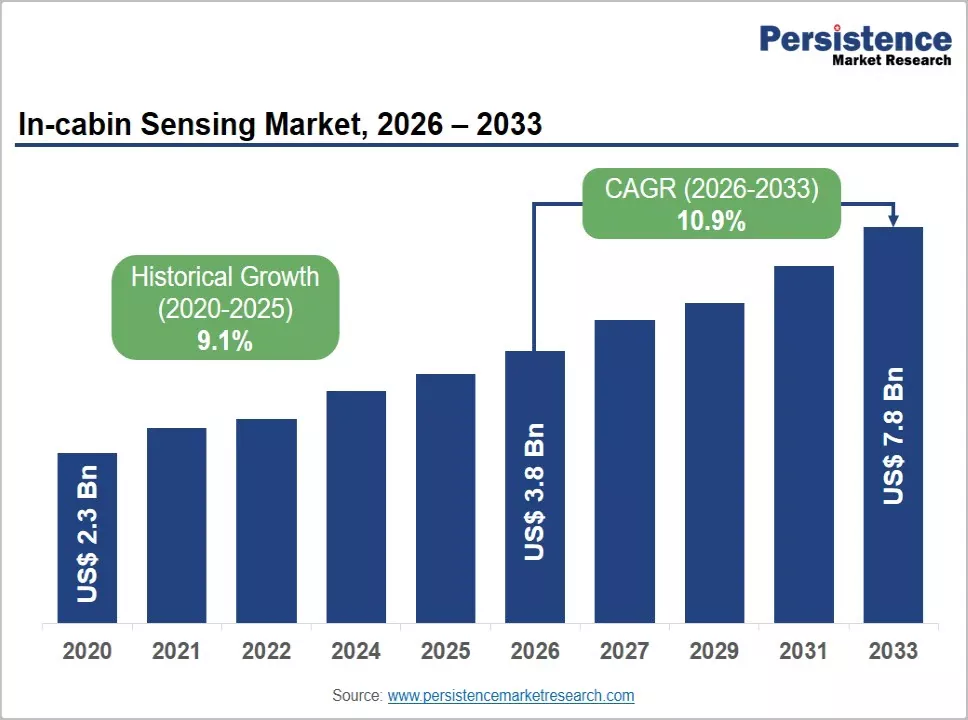
The global in-cabin sensing market size is likely to be valued at US$ 3.8 billion in 2026, and is estimated to reach US$ 7.8 billion by 2033, growing at a CAGR of 10.9% during the forecast period 2026–2033.
Growth is underpinned by mandatory driver monitoring requirements, evolving new car assessment protocols, and rising investment in occupant safety and personalized in-vehicle experiences.
The market has been experiencing healthy growth, reflecting the staggered timing of regulations and cost pressures on entry-level vehicles. However, the forecast period anticipates robust acceleration as regulatory deadlines take effect, camera and radar-based monitoring scales to high-volume platforms, and automakers use cabin data to support assisted driving, child presence detection, and software-defined vehicle features.
Key Industry Highlights
- Dominant Sensor Type: Capacitive steering sensors are set to command around 47% of the revenue share in 2026, while printed sensors are likely to grow the fastest at 12.6% CAGR through 2033, as thin, flexible sensing surfaces are integrated into steering wheels and seats.
- Leading Monitoring System: Driver monitoring systems are expected to lead with 54% in 2026, while cabin monitoring systems are likely to be the fastest-growing at about 13.2% CAGR during 2026–2033, reflecting child presence detection and occupant classification requirements.
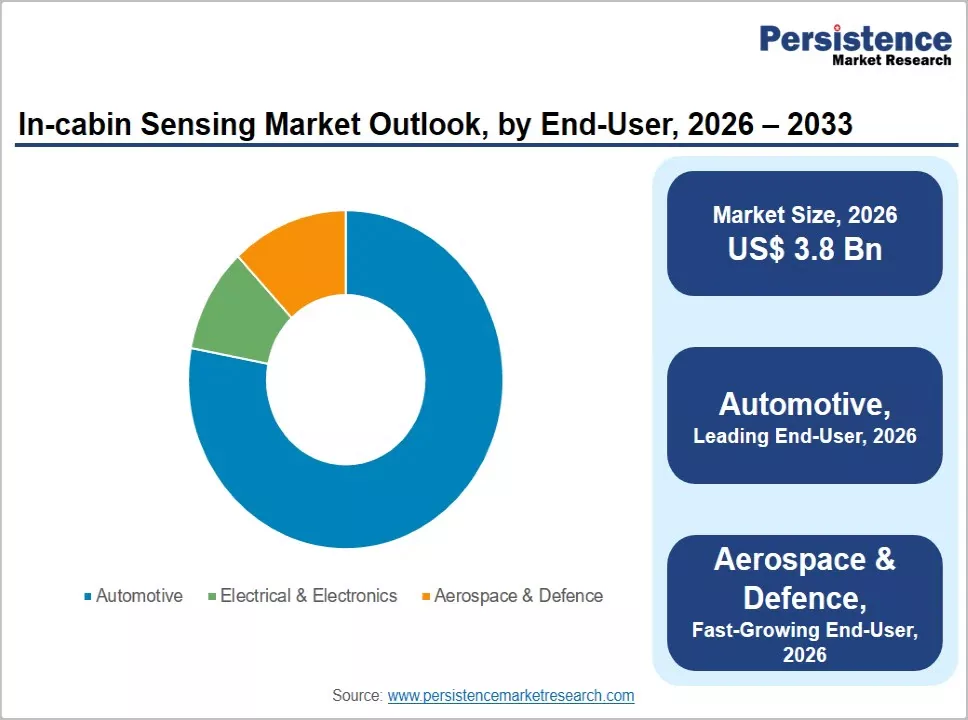
- Dominant End-user: Automotive is anticipated to lead with an estimated 83% share in 2026, while aerospace & defence is slated to represent the fastest-growing end-user segment at 11.8% CAGR from 2026 to 2033.
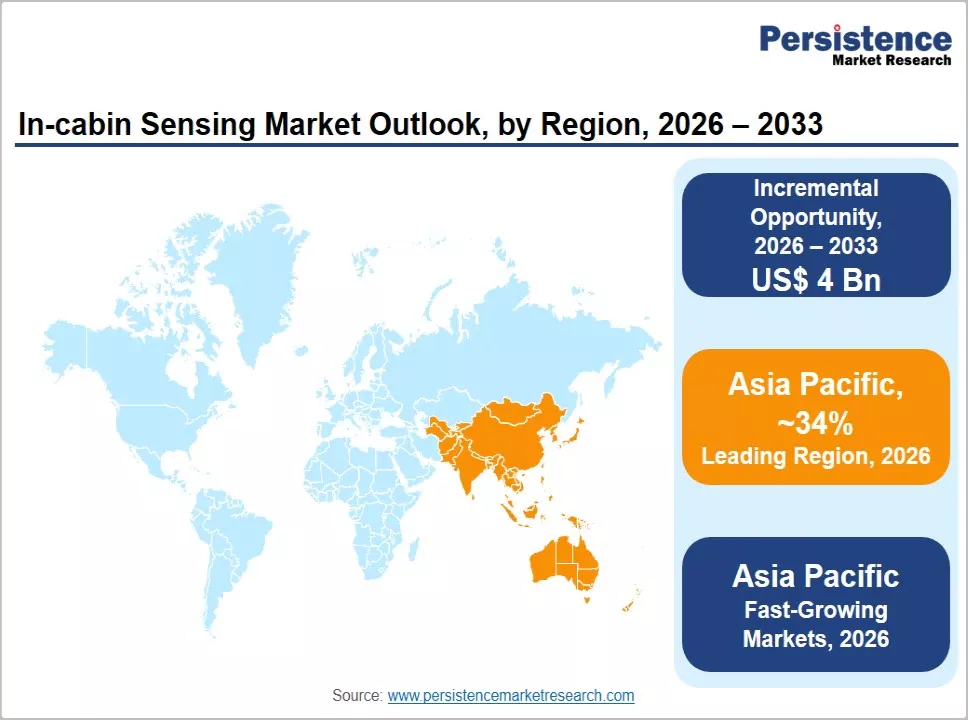
- Regional Leadership: Asia Pacific is poised to dominate with an estimated 34% share in 2026 and register an 11.8% CAGR through 2033, led by vehicle production in China, Japan, and India.
- Competitive Environment: Competitive dynamics include driver monitoring program wins with global automakers, partnerships between camera suppliers and Tier 1 integrators, and low-cost infrared image sensors aimed at high-volume platforms.
DRO Analysis
Drivers: Regulatory Mandates and Safety Ratings as Primary Growth Catalyst
Regulation is the leading force driving the in-cabin sensing market growth, as authorities and safety rating bodies move driver and occupant monitoring from a premium option to a baseline requirement. The European Union's General Safety Regulation requires drowsiness and attention warning and, from July 2026, advanced driver distraction warning on all new vehicles, while Euro NCAP's 2026 protocols place greater emphasis on driver engagement, child presence detection, seatbelt misuse detection, and adaptive restraint systems. Similar regulatory and consumer pressure is building in the U.S., Japan, China, and India, where safety programmes and legislation on hot car deaths and impaired driving are encouraging cabin sensing adoption across more models.
Assisted Driving Oversight and Personalized Cabin Experience
As Level 2 and Level 2+ assisted driving systems spread, automakers need reliable confirmation that drivers remain attentive, which increases reliance on gaze tracking, hands-on detection, and steering sensing. Beyond safety, cabin data enables personalization of climate, audio, and displays, and supports health and wellness features such as fatigue and stress detection. This convergence of regulation, assisted driving oversight, and user experience ensures sustained growth in the in-cabin sensing market in the coming years.
Restraints: Cost Pressure, Privacy Concerns, and Integration Complexity
Cost pressure remains a major challenge for the in-cabin sensing market, particularly in entry-level vehicles where every component is scrutinized. Camera modules, infrared illuminators, and dedicated processing add bill-of-materials cost, while placement in the steering column, mirror, or A-pillar requires careful design to maintain accuracy across driver heights, eyewear, and lighting conditions. Automakers also face validation challenges, as warnings that appear arbitrary or overly sensitive reduce customer acceptance and lead some drivers to disable the feature.
Data Privacy and Fragmented Requirements
Cameras that observe drivers and passengers raise privacy and data protection concerns, requiring on-device processing, strict retention policies, and transparent consent, especially in Europe. Differences in regulations, rating protocols, and customer expectations across regions force suppliers to adapt software and hardware for multiple markets. These factors add engineering effort and delay program launches, particularly for smaller suppliers and for new vehicle platforms with compressed development schedules.
Opportunities: Cabin Monitoring Expansion and Cost-Optimized Sensing Platforms
The shift from driver-only monitoring toward full cabin awareness is creating new revenue streams. Child presence detection, seatbelt reminders, occupant classification, left-behind object detection, and passenger health monitoring all require additional sensing coverage using cameras, radar, and thermal sensors. Semiconductor suppliers are launching affordable infrared image sensors with higher sensitivity and sharpness to scale driver and occupant monitoring across mass-market platforms, reducing camera module cost and enabling single-camera architectures.
Robotaxis, Commercial Fleets, and Aerospace Adoption
Robotaxi and shared mobility operators require continuous monitoring of passenger behavior, cleanliness, and safety without a human driver, expanding demand for cabin analytics. Commercial fleets are adopting driver monitoring to reduce accidents and insurance costs, while aircraft and defense cockpits are exploring pilot fatigue and cabin environment sensing. These adjacent applications broaden the customer base beyond passenger cars and create opportunities for software licensing and recurring fleet analytics services. Aftermarket retrofit systems are also gaining relevance in regions where regulations for existing fleets are tightening.
Category-wise Insights
Sensor Type Analysis
Why Do Capacitive Steering Sensors Lead the In-cabin Sensing Market?
Capacitive steering sensors are the leading sensor type segment, expected to hold about 47% of the in-cabin sensing market revenue share in 2026. These sensors detect hand contact on the steering wheel rim through changes in capacitance, enabling hands-on detection that supports assisted driving, driver attentiveness checks, and heated steering functions. They are compact, cost-effective, and well established in production, which makes them the default choice for hands-on detection across Level 1 and Level 2 vehicles. Because capacitive sensing can be integrated into the wheel structure at low cost, demand is closely linked to growth in assisted driving feature penetration. Torque steering sensors form the second major segment, measuring steering input in electric power steering systems and supporting driver engagement estimation.
Printed sensors are likely to grow the fastest through 2033. Using conductive inks on thin, flexible substrates, printed sensors can be shaped to curved surfaces and embedded in steering wheel covers, seats, armrests, and door panels with low weight and thickness. They enable presence, pressure, and touch sensing without bulky hardware, supporting occupant detection, seat occupancy classification, and gesture-based controls. Improved durability, reduced production costs through roll-to-roll manufacturing, and rising demand for lightweight electric vehicle interiors are strengthening adoption, while ongoing work on temperature stability and long-term reliability continues to open new automotive applications.
Monitoring System Analysis
Which Monitoring System Dominates In-cabin Sensing?
Driver monitoring systems dominate the monitoring system segment, projected to capture about 54% of the revenue share in 2026. These systems use infrared cameras and computer vision algorithms to track eye gaze, eyelid closure, head pose, and phone use, issuing alerts for drowsiness and distraction. Regulatory mandates and safety ratings have turned driver monitoring into a required feature for new vehicle types, creating predictable demand. Recent production awards, including a major U.S. automaker integrating a driver monitoring system on a single ADAS chip, illustrate the shift toward consolidated architectures that combine driver monitoring with perception on shared computing platforms.
Cabin monitoring systems represent the fastest-growing monitoring system segment, anticipated to achieve 13.2% CAGR during the 2026–2033 period. These solutions extend sensing to rear seats and the entire interior, detecting occupants, children, pets, seatbelt use, and objects. Euro NCAP's focus on child presence detection and growing legislative attention to children left in hot vehicles are accelerating adoption, while radar-based sensing offers robust detection through blankets and in darkness. Thermal monitoring systems are also gaining relevance, using infrared temperature sensing to support occupant comfort, heating and cooling optimization, and detection of living beings in the cabin.
End-user Analysis
Why Does Automotive Lead the End-user Segment?
Automotive is the leading end-user segment, expected to account for about 83% of the in-cabin sensing market in 2026. Passenger cars, light commercial vehicles, trucks, and buses represent large production volumes that are subject to safety regulation and rating programmes. Tier 1 suppliers and automakers are increasingly integrating sensing into the cockpit domain controller, enabling over-the-air updates and feature monetization. Long vehicle development cycles lead to multi-year supply contracts, providing revenue visibility for sensor and software providers, and fleet operators add demand through retrofit driver monitoring for safety management.
Aerospace and defence is the fastest-growing end-user segment, expected to register about 11.8% CAGR through 2033. Applications include pilot fatigue and attention monitoring, cabin environment sensing, and occupant status monitoring in military vehicles and aircraft. The electrical and electronics segment supplies the underlying cameras, image sensors, radar chips, and processing hardware used in cabin systems, and is benefiting from semiconductor product launches optimized for in-cabin imaging, with additional demand from consumer-grade wearables and infotainment integration. Defense vehicle programmes increasingly specify occupant and crew status monitoring for situational awareness.
Regional Insights
North America In-cabin Sensing Market Trends and Insights
North America is anticipated to account for an estimated 27% of the global in-cabin sensing market in 2026. The region's in-cabin sensing industry is likely to benefit from rising adoption of hands-free assisted driving, regulatory attention on impaired driving and rear-seat child safety, and strong demand for sport utility vehicles and pickup trucks with advanced cockpit electronics. Recent production awards from U.S. automakers for camera-based driver monitoring are expected to raise volumes, while fleet safety programmes in trucking and ride-hailing support aftermarket demand. Competition among established Tier 1 suppliers and software-focused technology providers is also expected to intensify through 2033. Commercial vehicle regulations and fleet telematics adoption are also expected to support demand.
U.S. In-cabin Sensing Market Size
The U.S. is estimated to account for approximately 86% of the North America in-cabin sensing market in 2026. Market growth is likely to be supported by assisted driving deployments, insurance and fleet safety programmes, and federal legislation addressing hot car deaths and impaired driving technologies. Automakers are expected to equip a larger share of models with driver monitoring to enable hands-free highway driving features, while new Tier 1 manufacturing investments, such as a recently opened North American facility for integrated occupant and driver monitoring systems, are likely to strengthen local supply chains through 2033.
Canada In-cabin Sensing Market Size
Canada is projected to represent approximately 14% of the North America in-cabin sensing market in 2026. Market expansion is expected to be driven by integration with the North American vehicle production base, rising adoption of connected vehicle features, and commercial fleet safety requirements in trucking and public transit. Winter driving conditions also increase interest in reliable steering hands-on detection and interior climate sensing. Growing penetration of electric vehicles, which feature advanced digital cockpits, is anticipated to support wider adoption of cabin sensors through 2033. Government clean transportation incentives are also expected to broaden electric vehicle volumes carrying advanced cockpit sensing.
Europe In-cabin Sensing Market Trends and Insights
Europe is estimated to account for approximately 10% of the global in-cabin sensing market in 2026. The region's market is expected to benefit from the General Safety Regulation, whose driver distraction warning requirement extends to all new vehicles from July 2026, and from Euro NCAP's 2026 protocols emphasizing driver engagement and child presence detection. European Tier 1 suppliers and technology firms are also expanding partnerships on joint monitoring solutions, as showcased at CES 2026. Strong premium vehicle production and stringent privacy rules are likely to favor on-device processing and secure architectures.
Germany In-cabin Sensing Market Size
Germany is anticipated to account for approximately 31% of the Europe in-cabin sensing market in 2026. Demand is expected to be supported by the country's premium automakers, leading automotive suppliers, and strong investment in electric vehicle and software-defined vehicle platforms. German manufacturers are increasingly specifying driver and occupant monitoring across entire model ranges to meet regulatory deadlines and safety ratings. Close collaboration between automakers, camera suppliers, and semiconductor companies is projected to support continued market expansion through 2033. Premium brands are also expected to use cabin sensing for personalized comfort and wellness features that support brand differentiation.
Why Is Asia Pacific Expected to Lead the In-cabin Sensing Market?
Asia Pacific is projected to account for approximately 34% of the global in-cabin sensing market in 2026, making it the largest regional market. The region is also anticipated to register the fastest growth, expanding at an estimated CAGR of 11.8% through 2033. Market expansion is likely to be driven by high vehicle production, rapid electric vehicle adoption, and growing safety regulation. China, Japan, and India are expected to remain the primary demand centres, with automakers increasingly specifying driver monitoring for assisted driving and new car assessment programmes.
China In-cabin Sensing Market Size
China is estimated to represent approximately 45% of the Asia Pacific in-cabin sensing market in 2026. The country's market is expected to benefit from the world's largest vehicle production base, rapid growth in electric vehicles with advanced digital cockpits, and tighter oversight of assisted driving systems introduced in 2025. Domestic automakers and suppliers are integrating driver and occupant monitoring into mass-market models at aggressive price points, while commercial vehicle regulations already require driver fatigue monitoring in certain fleets. Local innovation in cockpit computing is projected to sustain China's regional leadership through 2033.
Japan In-cabin Sensing Market Size
Japan is projected to account for approximately 24% of the Asia Pacific in-cabin sensing market in 2026. The market is expected to witness steady expansion, supported by the country's strong automotive supplier base and advanced safety technology adoption. Several Japanese automakers have awarded driver and occupant monitoring programmes to global technology suppliers, indicating rising specification across new vehicle platforms. Ageing driver demographics also increase interest in attention and health-related monitoring features, supporting demand for advanced cabin sensing through 2033. Cooperation between automakers and domestic electronics suppliers is expected to remain a key feature of the market.
Competitive Landscape
The global in-cabin sensing market structure is moderately fragmented, with automotive Tier 1 suppliers such as Bosch, Aumovio, Valeo, Denso, and Aptiv controlling a significant share of integrated cockpit and monitoring system revenue. These established players have been leveraging long-standing relationships with automakers, safety validation expertise, and the ability to deliver complete hardware and software systems. They are also known to invest heavily in R&D to advance camera, radar, and AI-based occupant analysis.
Specialist technology providers such as Seeing Machines, Smart Eye, and Mobileye are focusing on driver monitoring software and perception platforms, while Gentex, Joyson Safety Systems, and STMicroelectronics are expanding in cameras, steering sensing, and image sensors. Barriers such as functional safety certification, automotive qualification, and long design cycles limit new entrants, although software-centric start-ups are participating through licensing and partnerships. Market consolidation is expected to increase gradually as larger suppliers acquire niche sensing firms, while collaborations between suppliers and automakers continue to expand. Over-the-air software updates are also enabling suppliers to add features and licensing revenue after vehicles leave the factory.
Key Market Developments
- In October 2026, STMicroelectronics introduced the ST SafeSense VD56GA, a 1.1 MP automotive image sensor for infrared in-cabin sensing, designed to help scale driver and occupant monitoring at lower system cost.
- In August 2026, YFORE Technology debuted its integrated Occupant & Driver Monitoring System at the opening of its North American manufacturing facility in Georgia, covering driver fatigue, distraction, seatbelt status, and occupant classification.
- In March 2026, Mobileye announced that a leading U.S. automaker will integrate Mobileye DMS into future vehicles equipped with the EyeQ6L system-on-chip, extending its in-cabin sensing platform momentum.
Companies Covered in In-cabin Sensing Market
- Robert Bosch GmbH
- Aumovio SE
- Valeo SA
- Denso Corporation
- Aptiv PLC
- Seeing Machines Limited
- Smart Eye AB
- Mobileye Global Inc.
- Gentex Corporation
- Joyson Safety Systems
- STMicroelectronics N.V.
Frequently Asked Questions
The global in-cabin sensing market is valued at US$ 3.8 billion in 2026 and is projected to reach US$ 7.8 billion by 2033, expanding at a CAGR of 10.9% during 2026–2033.
Mandatory driver monitoring requirements, evolving new car assessment protocols, and rising investment in occupant safety and personalized in-vehicle experiences are driving the market.
Capacitive steering sensors lead sensor types with about 47% share, driver monitoring systems lead monitoring systems with about 54%, and automotive leads end-users with an estimated 83% in 2026.
Asia Pacific dominates the market with an estimated 34% share in 2026 and is projected to register an 11.8% CAGR through 2033, led by vehicle production in China, Japan, and India.
Expansion from driver-only to full cabin monitoring, cost-optimized infrared sensing platforms, robotaxi and fleet adoption, and aerospace applications are key market opportunities.
The market is moderately fragmented, with Bosch, Aumovio, Valeo, Denso, and Aptiv controlling a significant share of revenue, alongside specialist providers such as Seeing Machines, Smart Eye, and Mobileye.


