




- Automotive
- SUV Pickup Car Market
SUV Pickup Car Market Size, Share, and Growth Forecast 2026 - 2033
SUV Pickup Car Market by Vehicle Type (Subcompact, Compact, Midsize, Full-size SUVs, Midsize Pickups, Full-size Pickups), Propulsion Type (Gasoline, Diesel, Hybrid Electric), Price Tier (Economy, Mid-range, Premium), and Regional Analysis, 2026 - 2033

SUV Pickup Car Market Size and Trend Analysis
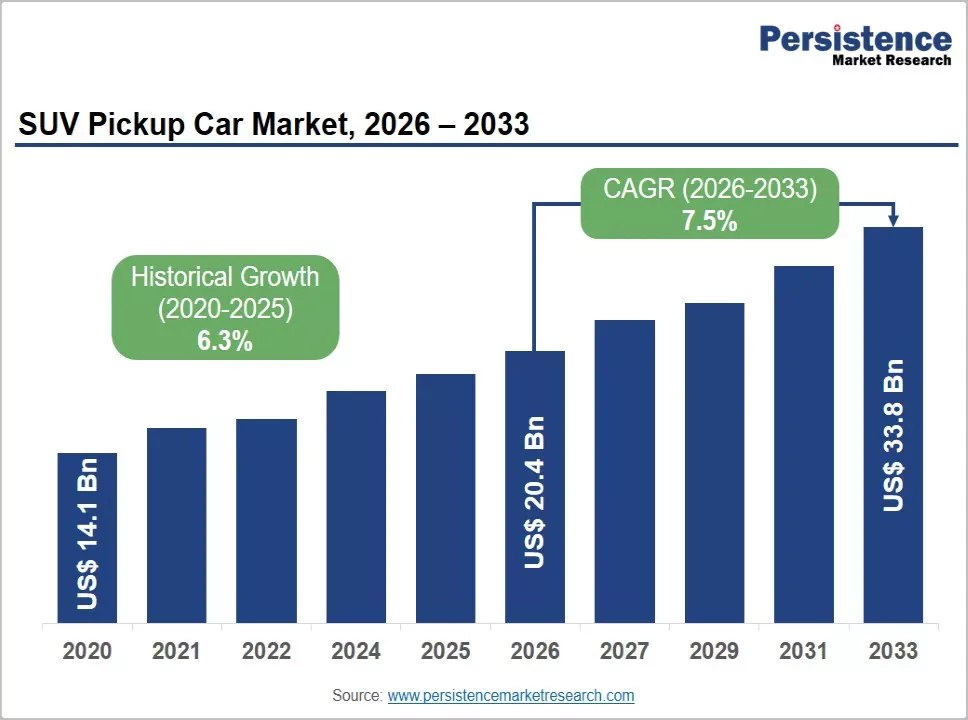
The global SUV pickup car market size is likely to be valued at US$ 20.4 billion in 2026, and is estimated to reach US$ 33.8 billion by 2033, growing at a CAGR of 7.5% during the forecast period 2026 - 2033.
Growth is underpinned by sustained consumer preference for utility-oriented body styles, rapid hybridization of popular nameplates, and expanding product portfolios from both established and emerging automakers.
The market registered steady growth during the historical period, supported by crossover adoption and recovery in vehicle production. However, the forecast period anticipates faster expansion as electrified powertrains, rising urban incomes in emerging economies, and demand for versatile, family-oriented vehicles widen the addressable buyer base.
Key Industry Highlights
- Dominant Vehicle Types: Compact SUVs are set to command around 34% of the revenue share in 2026, while midsize pickups are likely to grow the fastest at 8.6% CAGR through 2033, as new entrants target the segment.
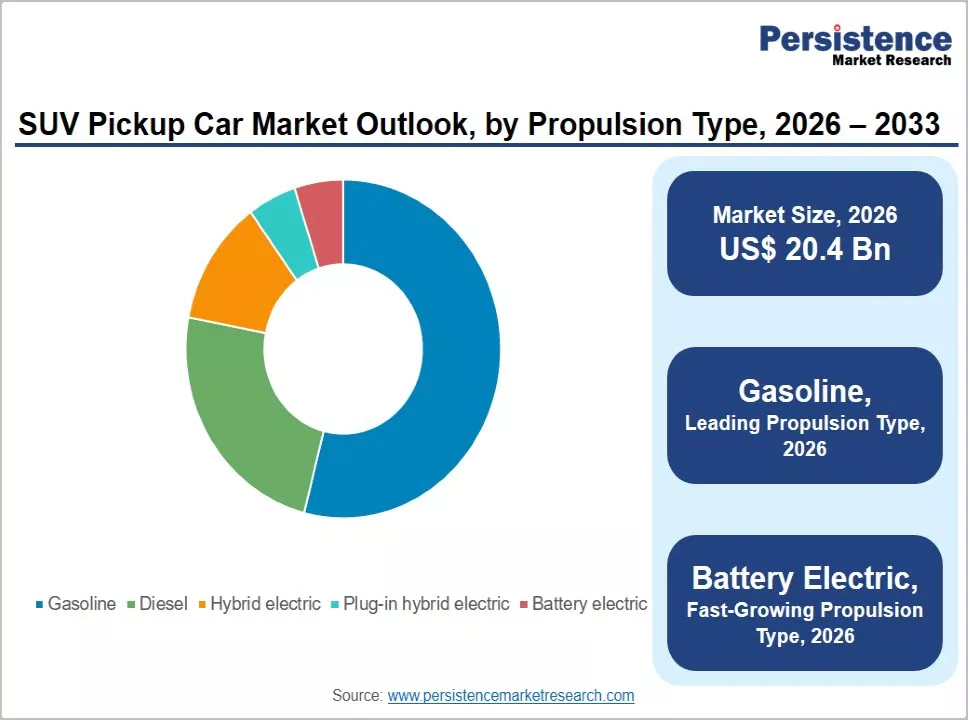
- Leading Propulsion Type: Gasoline is expected to lead with 56% in 2026, while hybrid electric vehicles are likely to be the fastest-growing at about 12.4% CAGR during 2026 - 2033, reflecting buyer preference for fuel savings without charging dependence.
- Dominant Price Tier: Mid-range vehicles are anticipated to lead with an estimated 41% share in 2026, while premium models are slated to represent the fastest-growing tier at 8.8% CAGR from 2026 to 2033.
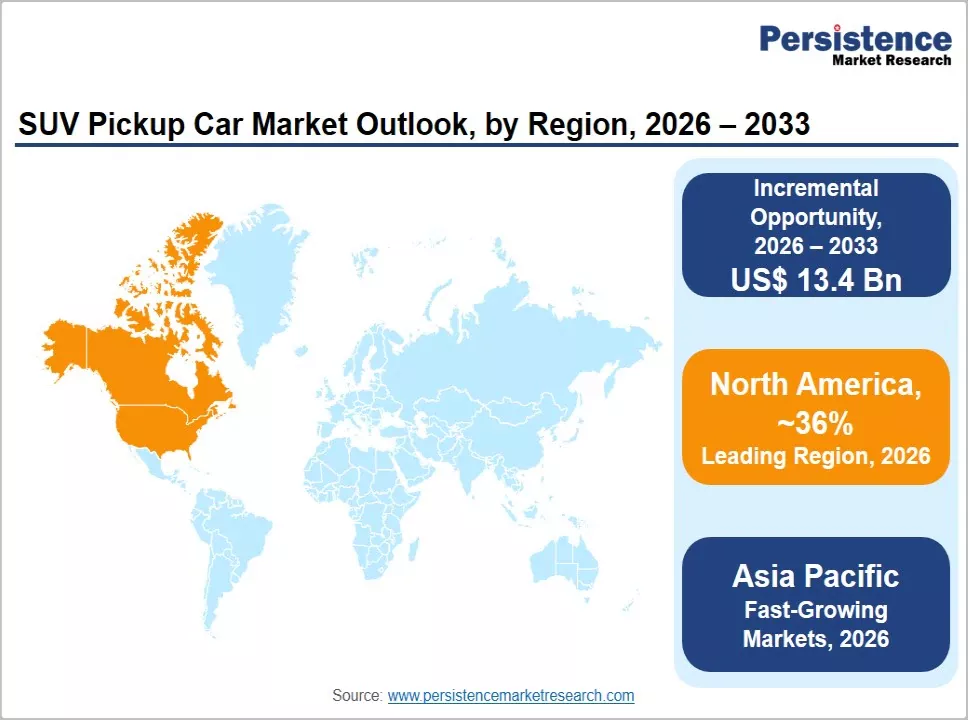
- Regional Leadership: North America is poised to dominate with an estimated 36% share in 2026, while Asia Pacific is likely to register the fastest growth at 8.9% CAGR through 2033, led by China, India, and Southeast Asian nations.
- Competitive Environment: Competitive dynamics include hybrid-first product strategies, localized production to manage trade barriers, and new pickup entries from automakers seeking share in North America.
DRO Analysis
Drivers: Hybridization and Expanding Utility-Vehicle Portfolios as Primary Growth Catalysts
Consumer migration toward utility vehicles remains the leading force driving the SUV pickup car market growth, as buyers favor higher seating positions, cargo flexibility, and all-weather capability over traditional sedans. Automakers are responding by widening portfolios across subcompact, compact, midsize, and full-size body styles and by electrifying best-selling nameplates.
Toyota moved its redesigned RAV4 to an exclusively hybrid and plug-in hybrid lineup for the 2026 model year, while Honda has confirmed that its next-generation CR-V will be fully hybrid, signaling that electrified powertrains are becoming standard in the highest-volume segments. These shifts lower fuel costs for owners and help manufacturers comply with tightening emission and fuel economy standards, supporting steady replacement demand.
Rising Incomes and Lifestyle-Oriented Demand
Growing disposable incomes in emerging economies and the popularity of recreational and family-oriented mobility are expanding first-time SUV ownership. Pickups are also gaining appeal as lifestyle vehicles, supported by crew-cab layouts, advanced infotainment, and driver-assistance features that raise average transaction values and sustain long-term growth.
Restraints: Trade Barriers, Affordability Pressure, and Slower Battery Electric Adoption
Rising vehicle prices, higher borrowing costs, and trade-related tariffs are weighing on affordability, particularly for midsize and full-size models that carry higher material and technology content. Several automakers import a significant share of their models and components across borders, which exposes pricing and margins to tariff changes and supply chain disruptions. Consumers in many markets are also delaying purchases as monthly payments and insurance costs climb, limiting volume growth in the economy and mid-range tiers.
Slower Electric Demand and Regulatory Uncertainty
Battery electric SUVs and pickups have faced slower-than-expected uptake due to high prices, charging infrastructure gaps, and changing incentive policies. Ford, for example, deferred its three-row electric SUV to 2027 and shifted investment toward hybrids, reflecting a broader recalibration of electrification plans. Such program delays and policy uncertainty complicate capital planning and temper near-term growth in battery electric segments.
Opportunities: Midsize Pickup Expansion and Electrified Powertrain Diversification
New pickup entries are reshaping competitive dynamics, creating opportunities for automakers and suppliers. Hyundai has announced plans for its first midsize pickup in North America before the end of the decade, while Kia intends to introduce its first U.S.-focused pickup by 2030 with hybrid and extended-range options. Volkswagen is also advancing its Scout brand, with an all-electric pickup and a rugged SUV designed for American buyers. These launches are expected to intensify competition, broaden consumer choice, and stimulate demand for hybrid, plug-in hybrid, and extended-range configurations.
Emerging Markets and Regional Customization
Automakers are adopting region-specific strategies, offering affordable compact SUVs in India and Southeast Asia, rugged pickups in Australia, Thailand, and the Middle East, and plug-in hybrid variants in China. Localized production, flexible platforms, and partnerships with regional suppliers are likely to lower costs and unlock additional demand in underpenetrated markets through 2033.
Category-wise Insights
Vehicle Type Analysis
Why Do Compact SUVs Lead the SUV Pickup Car Market?
Compact SUVs are the leading vehicle type segment, expected to hold about 34% of the market revenue share in 2026. They balance affordability, fuel efficiency, interior space, and maneuverability, making them the default choice for first-time SUV buyers and small families. Strong nameplates from Toyota, Honda, Hyundai, and Nissan benefit from high brand loyalty and wide dealer reach. Hybrid variants are increasingly the volume trims, as demonstrated by Honda reporting that hybrids account for more than half of CR-V sales mix.
Midsize pickups are likely to grow the fastest through 2033. These vehicles provide a practical middle ground between compact pickups and full-size trucks, offering adequate towing capacity, lower purchase prices, and easier urban use. Growing launches from Hyundai, Kia, and Ford, along with electrified and extended-range options, are expanding the buyer pool, while emerging markets continue to rely on midsize pickups for commercial and recreational use.
Propulsion Type Analysis
Which Propulsion Type Dominates the SUV Pickup Car Market?
Gasoline engines dominate the propulsion segment, projected to capture about 56% of the revenue share in 2026. The widespread availability of refueling infrastructure, lower upfront costs, and proven durability keep gasoline powertrains the preferred option, particularly in full-size SUVs and pickups used for towing and hauling. Automakers continue to refine turbocharged and downsized engines to improve efficiency, extending the segment’s relevance. However, its share is expected to decline gradually as electrified alternatives scale.
Hybrid electric vehicles represent the fastest-growing propulsion segment, anticipated to achieve about 12.4% CAGR during the 2026 - 2033 period. Hybrids offer meaningful fuel savings and lower emissions without requiring charging infrastructure, appealing to mainstream buyers. Record hybrid sales reported by Toyota, Honda, and Hyundai highlight accelerating adoption, while plug-in hybrid and extended-range variants are gaining traction among buyers seeking electric driving for daily use with combustion backup for longer trips.
Price Tier Analysis
Why Does the Mid-range Tier Lead SUV Pickup Car Sales?
The mid-range tier is poised to lead with an estimated 41% share in 2026, favored for its balance of features, brand value, and monthly affordability. Most volume nameplates from mainstream automakers sit in this band, offering advanced safety systems, connected infotainment, and flexible trims. Competitive financing and leasing programs further support demand, and the tier benefits from steady fleet and family purchases.
The premium tier is the fastest-growing price segment, expected to register about 8.8% CAGR through 2033. Buyers are trading up for larger cabins, hybrid powertrains, and digital features, while automakers are launching upscale trims to improve margins. Genesis, for example, plans to introduce its first hybrid with the GV80 SUV, reflecting the expansion of electrified premium offerings. Rising incomes and personalization options are expected to sustain premiumization.
Regional Insights
North America SUV Pickup Car Market Trends and Insights
North America is anticipated to account for an estimated 36% of the global SUV pickup car market in 2026. The region’s market is likely to benefit from entrenched consumer preference for trucks and utility vehicles, strong replacement demand, and rapid growth in hybrid offerings. Pickups remain among the best-selling vehicles in the region, and compact SUVs continue to set annual sales records. Automakers are expanding hybrid portfolios and localizing production to reduce exposure to trade barriers. Competition among established domestic brands and Japanese and Korean entrants is expected to intensify through 2033, particularly in the midsize pickup segment.
U.S. SUV Pickup Car Market Size
The U.S. is estimated to account for approximately 80% of the North America SUV pickup car market in 2026. Market growth is likely to be supported by sustained demand for full-size pickups, compact crossovers, and three-row SUVs, along with rapid hybrid uptake. Toyota’s hybrid-only RAV4 and Honda’s hybrid-led CR-V strategy underscore the shift toward electrified volume models. New entries such as the Hyundai and Kia pickups planned for the end of the decade, along with the Scout brand, are anticipated to broaden choice. Affordability and tariff pressures remain factors to monitor.
Canada SUV Pickup Car Market Size
Canada is projected to represent approximately 11% of the North America SUV pickup car market in 2026. Demand is expected to be driven by compact and midsize SUVs suited to varied climates, along with a durable preference for pickups in resource-oriented provinces. Plug-in hybrid and hybrid models are likely to gain share as federal and provincial programs encourage lower-emission vehicles. The country’s integrated manufacturing ties with the U.S., including assembly of popular hybrid SUVs, are anticipated to support supply and regional competitiveness through 2033.
Europe SUV Pickup Car Market Trends and Insights
Europe is estimated to account for approximately 14% of the global SUV pickup car market in 2026. The region’s market is expected to benefit from the continued popularity of compact and subcompact crossovers, stringent fleet carbon dioxide targets, and strong adoption of plug-in hybrid and battery electric variants. Emissions regulations are likely to encourage automakers to electrify popular nameplates, while urban low-emission zones favor smaller SUVs. Pickups hold a smaller but stable niche, supported by commercial and leisure users. Competition from Chinese manufacturers entering with value-oriented electrified SUVs is expected to intensify through 2033.
Germany SUV Pickup Car Market Size
Germany is anticipated to account for approximately 21% of the Europe SUV pickup car market in 2026. Demand is expected to be supported by the strong presence of domestic premium manufacturers, high company car adoption, and growing electrified model offerings. Premium compact and midsize SUVs from German brands remain among the most popular choices, while plug-in hybrid and battery electric versions gain share as incentives and corporate fleet policies evolve. Investments in charging infrastructure and domestic production of electrified SUVs are projected to support market expansion through 2033.
Why Is Asia Pacific Expected to Be the Fastest-Growing Region in the SUV Pickup Car Market?
Asia Pacific is projected to account for approximately 27% of the global SUV pickup car market in 2026, with the region anticipated to register the fastest growth at an estimated CAGR of 8.9% through 2033. Market expansion is likely to be driven by rising household incomes, urbanization, and rapid electrified SUV launches by regional manufacturers. China and India are expected to remain the primary demand centers, while Australia, Thailand, and Southeast Asian countries sustain pickup demand for commercial and recreational purposes. Growing exports of competitively priced electrified SUVs are also expected to reshape global competition.
China SUV Pickup Car Market Size
China is estimated to represent approximately 42% of the Asia Pacific SUV pickup car market in 2026. The country’s market is expected to benefit from the strong preference for SUVs among urban buyers and the rapid adoption of plug-in hybrid and extended-range electric models. Domestic manufacturers such as BYD, Great Wall, and Geely continue to expand portfolios, including pickup offerings aimed at export markets. Supportive industrial policies, advanced battery supply chains, and aggressive pricing are likely to sustain China’s regional leadership through 2033.
India SUV Pickup Car Market Size
India is projected to account for approximately 13% of the Asia Pacific SUV pickup car market in 2026. The market is expected to witness strong expansion, supported by the popularity of compact and midsize SUVs, rising aspirations among first-time buyers, and a steady stream of new launches from Mahindra, Tata Motors, Hyundai, and Maruti Suzuki. Growing interest in hybrid and electric SUVs, together with government incentives for localized manufacturing, is likely to encourage wider electrified adoption. Pickups continue to serve rural and commercial users, supporting additional demand.
Competitive Landscape
The global SUV pickup car market structure is moderately consolidated, with the top manufacturers, including Toyota, Ford, General Motors, and Stellantis, controlling a significant share of the revenue. These established players leverage extensive dealer networks, strong nameplate recognition, and large production scale. They are also known to invest heavily in hybrid systems, platform sharing, and connected vehicle technologies to maintain leadership.
Regional and challenger competitors such as Hyundai, Kia, Honda, Nissan, Mahindra, and BYD are focusing on specialized segments and geographic strongholds. Barriers such as capital intensity, regulatory compliance, and distribution reach limit new entrants, but electrified platforms are enabling new brands to participate through value-oriented pricing. Market competition is expected to intensify as automakers launch midsize pickups, localize production, and expand hybrid lineups across regions.
Key Market Developments
- In November 2026, Honda announced that the next-generation CR-V arriving for the 2028 model year will be offered with a fully hybrid powertrain, as hybrids already account for more than half of the model’s sales mix.
- In April 2026, Kia confirmed plans to launch its first U.S.-focused pickup by 2030, featuring hybrid and extended-range powertrains to enter one of the industry’s most competitive segments.
- In September 2025, Hyundai unveiled its growth strategy at its CEO Investor Day, including a first midsize pickup for North America before the end of the decade and a next-generation hybrid system for the redesigned Palisade.
Companies Covered in SUV Pickup Car Market
- Toyota Motor Corporation
- Ford Motor Company
- General Motors Company
- Stellantis N.V.
- Honda Motor Co., Ltd.
- Hyundai Motor Company
- Kia Corporation
- Nissan Motor Co., Ltd.
- Volkswagen AG
- Mahindra & Mahindra Ltd.
- BYD Company Limited
Frequently Asked Questions
The global SUV pickup car market is valued at US$ 20.4 billion in 2026 and is projected to reach US$ 33.8 billion by 2033, expanding at a CAGR of 7.5% during 2026 - 2033.
Sustained consumer preference for utility-oriented body styles, rapid hybridization of popular nameplates, and expanding product portfolios from established and emerging automakers are driving the market.
Compact SUVs lead vehicle types with about 34% share, gasoline leads propulsion types with about 56%, and the mid-range tier leads price tiers with an estimated 41% in 2026.
North America dominates with an estimated 36% share in 2026, supported by entrenched preference for trucks and utility vehicles, while Asia Pacific is projected to grow fastest at 8.9% CAGR through 2033.
Midsize pickup launches, electrified powertrain diversification, and region-specific strategies in emerging markets are key market opportunities.
The market is moderately consolidated, with Toyota, Ford, General Motors, and Stellantis controlling a significant share of the revenue.


