




- Automotive
- Truck Manufacturing Market
Truck Manufacturing Market Size, Share, and Growth Forecast 2026 - 2033
Truck Manufacturing Market by Truck Type (Light Duty, Medium Duty, Heavy Duty), Tonnage Capacity (3.5 - 7.5 Tons, 7.5 - 16 Tons), Fuel Type (Diesel, Petrol, CNG/LNG), Body Type (Flatbed, Box Truck, Refrigerated), and Regional Analysis, 2026 - 2033

Truck Manufacturing Market Size and Trends Analysis
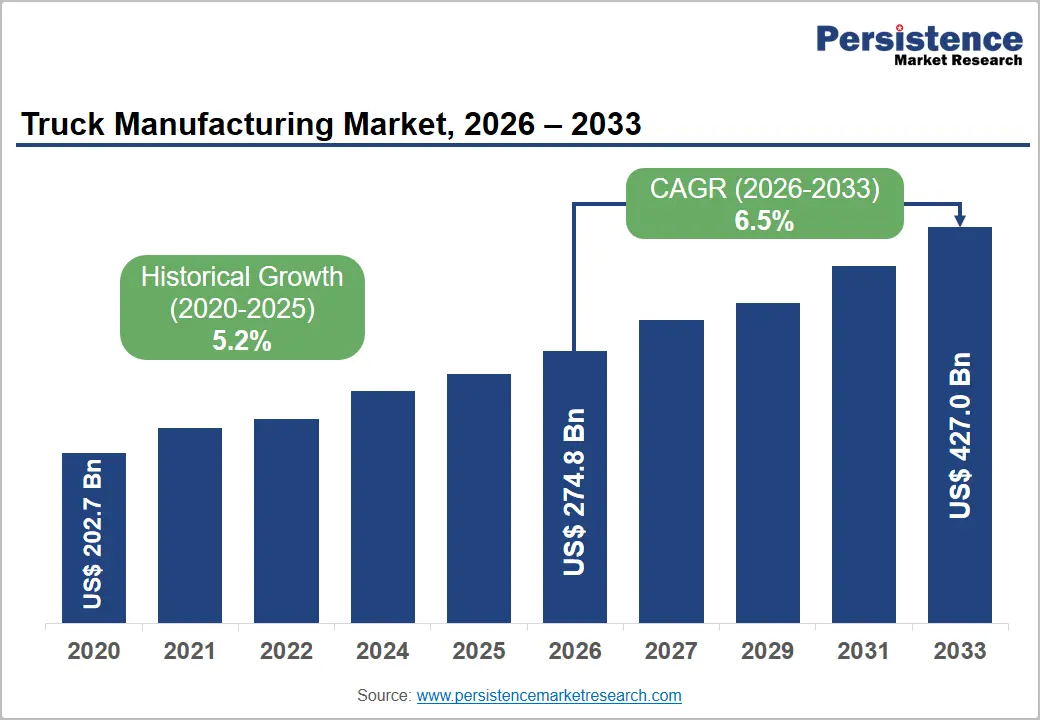
The global truck manufacturing market size is likely to be valued at US$274.8 billion in 2026 and is estimated to reach US$427.0 billion by 2033, growing at a CAGR of 6.5% during the forecast period from 2026 to 2033, driven by the expansion of e-commerce, increasing freight transportation, and rising investments in highway and logistics infrastructure. Increasing replacement of aging truck fleets with fuel-efficient and low-emission models is also predicted to spur growth.
Key Industry Highlights:
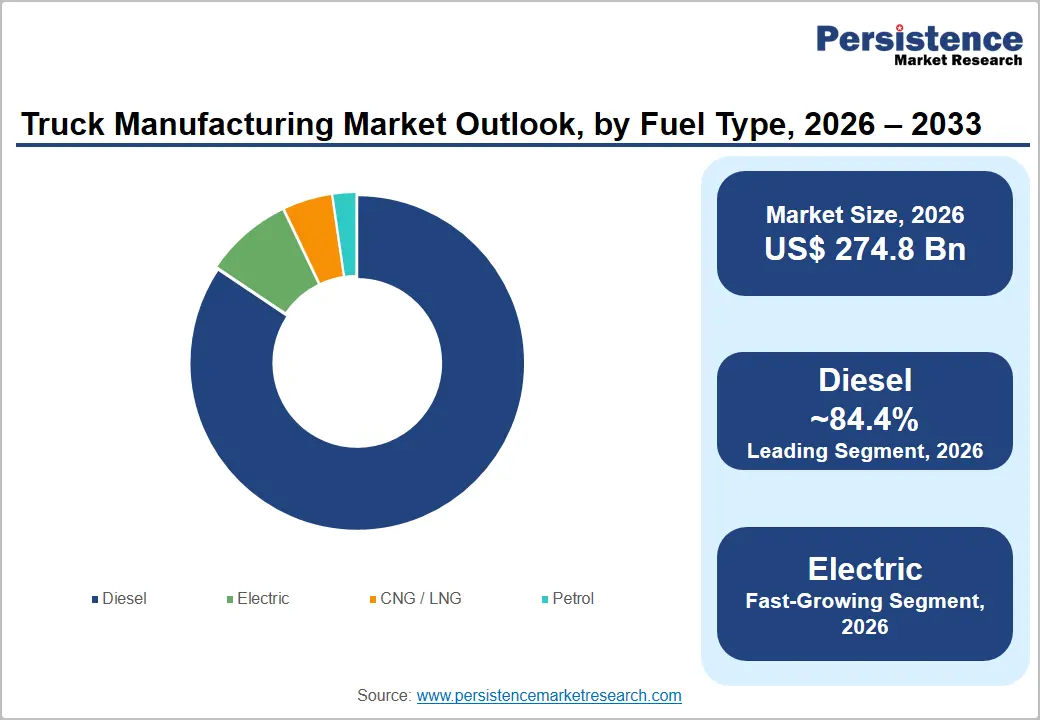
- Leading Fuel Type: Diesel, approximately 84.4% share in 2026, as it delivers high torque and a long driving range.
- Dominant Body Type: Box trucks, around 30.7% share in 2026, as their enclosed cargo space provides secure transportation for retail goods and industrial products.
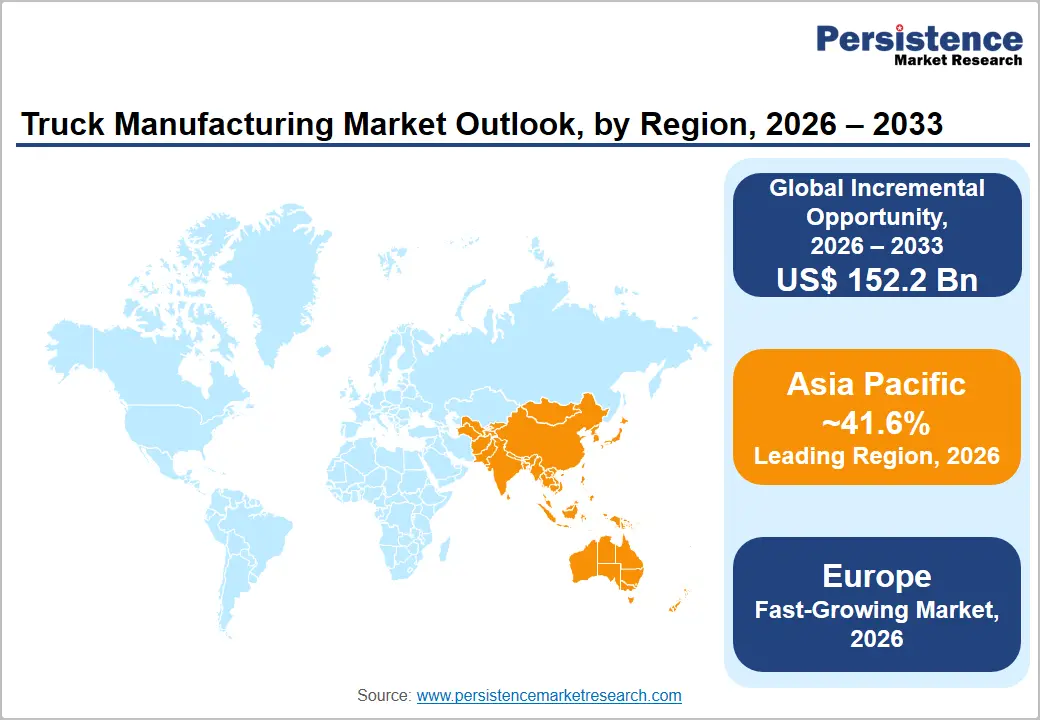
- Leading Region: Asia Pacific, with about 41.6% share in 2026, spurred by its superior commercial vehicle production base and expanding logistics sectors.
- Fast-growing Region: Europe, backed by increasing adoption of zero-emission trucks and stringent emission regulations.
- Facility Expansion: In October 2025, Scania inaugurated its new truck manufacturing facility in Rugao, China. The plant represents Scania's largest production investment outside Europe and is designed to manufacture both conventional and battery-electric heavy-duty trucks. It enabled the company to strengthen its presence across the Asia Pacific commercial vehicle market.
DRO Analysis
Driver - Boom of E-Commerce and Logistics Globally
The rise of e-commerce has made medium and light-duty trucks an indispensable part of retail fulfillment infrastructure. According to the U.S. Census Bureau, e-commerce sales in the U.S. reached approximately US$1.11 trillion in 2023, a 7.6% surge year-on-year. Consumers are increasingly expecting faster deliveries, i.e., 80% of American consumers actively seek speedy, convenient, and friendly delivery service. Also, 68% of online shoppers consider short delivery windows the deciding factor when placing an order.
These expectations have compelled logistics carriers to broaden and upgrade their fleets continuously. In June 2025, for example, DHL agreed with Daimler Truck and rental company Hylane to lease 30 Mercedes-Benz eActros 600 trucks under a Transport-as-a-Service model. The agreement aims to specifically support rising urban delivery demand. As e-commerce volumes increase and consumer tolerance for slow delivery shrinks, fleet operators must maintain sufficient truck capacity to absorb peak and everyday volumes.
Heavy Construction Activity and Mining Expansion
Infrastructure development and resource extraction are creating sustained demand for dump trucks and heavy freight vehicles. According to the American Trucking Associations (ATA), traffic congestion on the National Highway System results in 1.2 billion hours of lost productivity annually for the trucking industry, equivalent to 425,533 commercial truck drivers sitting idle for an entire year. It results in nearly US$74.1 billion in added operational costs, a figure that strengthens the expansion of material-moving activity dependent on heavy trucks. Construction is one of the largest contributors to heavy truck demand.
As the U.S. Infrastructure Investment and Jobs Act (IIJA) continues disbursing funds for roads, bridges, and freight rail, demand for vocational trucks moves with it. In September 2024, Hitachi Construction Machinery launched a full model upgrade of its rigid dump truck, the EH4000AC-5, with a 242-tonne payload capacity, which is one of the highest in the market. This shows how manufacturers are broadening truck capability in response to the intensity of modern construction and mining assignments.
Restraint - EV Battery Material Shortages and Electronic Component Gaps
Truck manufacturers expanding Electric Vehicle (EV) production face persistent supply chain vulnerabilities associated with the materials required for battery manufacturing. Lithium, cobalt, nickel, and manganese are essential inputs. Their supply is geographically concentrated. According to a peer-reviewed study published in Environmental Science and Ecotechnology (2025) by researchers from the Chinese Academy of Sciences and Peking University, a single cobalt shock could trigger global EV battery supply chaos. Also, the global cobalt supply chain was found to be far more vulnerable than previously recognized.
The research further confirmed that disruptions propagate quickly across six stages of the cobalt lifecycle, right from mining to recycling. A 2024 supply chain analysis published by Sucden Financial also confirmed that Lithium Nickel Manganese Cobalt Oxide (NMC) battery supply chains face additional geographical risks due to concentrations of nickel, cobalt, and manganese sourced from a limited number of countries, primarily the Democratic Republic of Congo, Russia, and Australia. This makes the combined vulnerability across multiple supply chain stages substantially greater than individual risks alone. These single-country dependencies expose truck manufacturers to production disruptions at any point in the battery material chain.
Opportunity - Hydrogen Combustion Engines to Provide a Low-Cost Solution
Hydrogen Internal Combustion Engines (H2-ICE) are emerging as a practical alternative to fuel cells and battery-electric trucks, particularly for high-payload freight operations where upfront cost and infrastructure flexibility matter. Unlike hydrogen fuel cells, H2-ICE trucks can be built on existing diesel engine platforms, significantly reducing development time and cost. In a landmark agreement announced in June 2026, Daimler Truck AG and KEYOU GmbH entered a partnership to commercialize H2-ICE trucks for the road freight market.
Daimler Truck will supply Mercedes-Benz Actros L 1848 tractor units with engines based on its existing 12.8-litre platform to KEYOU, which will convert them to hydrogen-powered internal combustion engines. The resulting KEYOU HICE.40 is a 40-ton tractor unit with a range of up to 650 kilometers, with market launch planned for 2027. Daimler Truck confirmed that H2-ICE trucks deliver lower system complexity compared with fuel cells and a compact footprint, making them suited to payload-intensive freight applications. The H2-ICE approach enables truck manufacturers to meet emissions targets without waiting for the fuel cell cost curve to drop or the charging infrastructure to expand.
AI and Robotics to Reduce Defects and Propel Assembly Output
Automotive and commercial vehicle manufacturers are integrating AI-assisted robots and Collaborative Robots (cobots) into assembly lines to improve precision, reduce waste, and maintain output consistency. AI-enabled robots can now adapt their movements based on real-time visual feedback, allowing them to handle the variability of complex tasks such as cable routing or fitting transmission components. This helps in replacing fixed programs that could not respond to in-process variation. The investment trend confirms broad industry commitment to this direction.
From January through September 2025, North America-based companies ordered 26,441 robots valued at US$1.8 billion, representing a 6.6% increase in units and a 10.6% hike in revenue compared to the same period in 2024, with automotive manufacturers recording the highest robot order levels of 2025. Caterpillar, which manufactures heavy vocational vehicles, is applying NVIDIA Omniverse to build digital twins of its factories and supply chains, enabling advanced manufacturing capabilities such as predictive maintenance and process simulation before physical changes are made. As truck platforms diversify across diesel, electric, and hydrogen powertrains, flexible AI-based assembly is becoming essential for managing simultaneous multi-variant production.
Category-wise Analysis
Fuel Type Insights
Diesel is predicted to lead with a share of approximately 84.4% in 2026, as it delivers high torque at low engine speeds. This makes it suitable for hauling heavy loads, climbing steep roads, and operating over long distances without putting excessive strain on the engine. Diesel engines are also known for their durability and can operate for several hundred thousand kilometers with proper maintenance, making them a practical choice for freight operators. According to the International Energy Agency (IEA), road freight remains the largest source of global diesel demand because heavy-duty trucks continue to rely primarily on diesel for long-haul transportation.
Electric trucks are estimated to be the fastest-growing segment over the forecast period, as governments are introducing strict emission regulations while offering financial incentives for zero-emission commercial vehicles. Also, battery prices are declining, and charging infrastructure is expanding. These factors are making electric trucks more attractive for urban delivery, regional logistics, and port operations. According to the IEA, global electric truck sales almost doubled in 2025, exceeding 400,000 units and reaching 9% of worldwide truck sales, marking the fifth consecutive year of growth.
Body Type Insights
Box trucks are anticipated to dominate with a share of nearly 30.7% in 2026, as they deliver exceptional versatility across industries. The enclosed cargo compartment protects goods from rain, dust, theft, and physical damage. It makes these vehicles suitable for transporting retail products, furniture, electronics, pharmaceuticals, parcels, and industrial equipment. A single box truck can serve multiple industries without requiring major modifications, allowing fleet operators to maximize vehicle utilization.
Refrigerated units are expected to remain in the second position in 2026, as global demand for temperature-controlled transportation is increasing. Fresh food, frozen products, dairy items, seafood, vaccines, biologics, and specialty medicines all require strict temperature control throughout the supply chain. As international trade in perishable products expands, logistics companies are investing in refrigerated fleets to maintain product quality and comply with food safety regulations.
Regional Insights
Asia Pacific Truck Manufacturing Market Trends
Asia Pacific is anticipated to lead in 2026 with a share of nearly 41.6%, as it combines the world's largest manufacturing base with high freight movement and rising domestic demand. China, India, Japan, and South Korea have extensive industrial production, which creates constant demand for heavy-, medium-, and light-duty trucks. The region also hosts leading truck manufacturers, including FAW Jiefang, Sinotruk, Dongfeng, Tata Motors, Ashok Leyland, Isuzu, and Hino Motors. According to IEA, Asia accounts for the largest share of global road freight activity and dominates commercial vehicle production, supported by ongoing industrialization and expanding logistics networks.
China Truck Manufacturing Market Trends
China will likely lead in Asia Pacific in 2026 with a share of around 45.8%, as it is the world's largest producer and consumer of commercial vehicles. Strong manufacturing output, extensive construction activity, and a rapidly expanding logistics sector continue to generate demand for trucks across all weight categories. The country also benefits from a complete domestic supply chain for batteries, electric motors, semiconductors, and vehicle components, allowing manufacturers to introduce new truck models quickly and at competitive costs.
India Truck Manufacturing Market Trends
In 2026, India is projected to account for a share of approximately 22.1%, owing to continuous investments in infrastructure, highways, mining, manufacturing, and e-commerce logistics. The country also houses a superior domestic manufacturing hub led by Tata Motors, Ashok Leyland, Mahindra Truck and Bus, and Eicher Motors. These companies are expanding production while introducing LNG, CNG, and battery-electric trucks to meet changing customer requirements. According to the Society of Indian Automobile Manufacturers (SIAM), commercial vehicle production continues to be supported by infrastructure spending and replacement demand from fleet operators.
Europe Truck Manufacturing Market Trends
Europe will likely be the fastest-growing market over the forecast period with a share of nearly 10.2% in 2026, because the region is constantly transitioning toward low-emission freight transportation. The European Union's CO2 emission standards for heavy-duty vehicles require manufacturers to significantly reduce emissions over the coming years. This is encouraging fleet operators to replace aging diesel trucks with battery-electric and hydrogen-powered models. The region is also investing heavily in charging and hydrogen refueling infrastructure. Under the Alternative Fuels Infrastructure Regulation (AFIR), EU member states are expanding charging networks along key transport corridors to support commercial vehicles.
Germany Truck Manufacturing Market Trends
Germany will likely register a substantial share of approximately 39.9% in 2026, as it is home to some of the world's most prominent commercial vehicle manufacturers, including Daimler Truck, MAN Truck & Bus, and the TRATON Group. The country remains a key center for truck engineering, exports, and research. Local manufacturers are investing heavily in battery-electric trucks, hydrogen fuel-cell technology, and autonomous driving systems to maintain their global competitiveness.
Netherlands Truck Manufacturing Market Trends
A share of around 25.4% is predicted to be held by the Netherlands in 2026, as it serves as one of Europe's most important logistics hubs. The Port of Rotterdam, the largest seaport in Europe, handles substantial freight volumes that require efficient road transportation across the continent. This creates consistent demand for heavy-duty trucks and modern fleet solutions. The country is further encouraging zero-emission freight transport through government incentives and investments in charging infrastructure. Local logistics companies are now deploying electric trucks for urban and regional deliveries to comply with local emission regulations.
North America Truck Manufacturing Market Trends
North America is predicted to witness decent growth in 2026 with a share of approximately 4.3%, owing to exponential freight demand from manufacturing, retail, agriculture, and cross-border trade. The region has an extensive highway network and a well-established trucking industry that moves most domestic freight. Fleet operators continue to replace aging trucks with new models that deliver better fuel efficiency, improved safety systems, and advanced telematics. Manufacturers are also investing in alternative-fuel trucks. Daimler Truck North America, PACCAR, Volvo Trucks North America, and Navistar are extending their electric truck portfolios while continuing to improve diesel efficiency for long-haul operations.
U.S. Truck Manufacturing Market Trends
A share of nearly 63.8% is expected to be held by the U.S. in 2026, as it has one of the world's largest road freight networks. Trucks transport nearly 73% of the country’s freight by weight, according to the American Trucking Associations (ATA). Continuous demand from e-commerce, retail distribution, construction, and industrial production is pushing fleet expansion and vehicle replacement. The country is also boosting investment in clean transportation. The U.S. Environmental Protection Agency (EPA) introduced strict greenhouse gas standards for heavy-duty vehicles, encouraging manufacturers to develop clean truck technologies.
Competitive Landscape
The global truck manufacturing market is moderately consolidated, with a handful of multinational OEMs accounting for a significant share of global production. Dominant players include Daimler Truck, Volvo Group, TRATON Group, PACCAR, Iveco Group, Tata Motors, FAW Jiefang, Sinotruk, and Dongfeng. Competition is no longer pushed primarily by engine performance or payload capacity. Instead, manufacturers are differentiating themselves through electrification, software-defined vehicles, connected fleet services, hydrogen fuel-cell technology, and localized manufacturing.
The competitive landscape is becoming increasingly regional despite the global presence of leading manufacturers. Companies are broadening production close to key demand centers to reduce logistics costs, comply with local regulations, and strengthen after-sales service. China-based manufacturers such as SANY and BYD are establishing assembly operations in Europe and other overseas markets to compete with established Western brands. Technology partnerships have also become a key competitive strategy.
Key Industry Developments:
- In May 2026, Volvo Trucks announced a global product program featuring a new generation of powertrains for heavy-duty trucks. The company stated that the investment would improve its battery-electric, fuel-efficient combustion, and alternative-fuel truck portfolio while supporting its long-term net-zero emissions strategy.
- In April 2026, the newly formed Japan-based truck holding company resulting from the Mitsubishi Fuso-Hino integration officially commenced operations. The new organization combines the engineering, manufacturing, and sales capabilities of both companies to improve competitiveness in zero-emission and intelligent commercial vehicle technologies.
- In November 2025, Ashok Leyland announced plans to extend its manufacturing capacity and introduce a new range of premium heavy-duty trucks. The company confirmed investments in research & development, high-horsepower engine development, and manufacturing expansion while preparing to launch 320 to 360 HP trucks targeting mining and other demanding commercial applications.
Companies Covered in Truck Manufacturing Market
- Daimler Truck
- Volvo Group
- TRATON Group
- PACCAR Inc.
- Iveco Group
- Isuzu Motors
- Hino Motors
- Tata Motors
- Ashok Leyland
- FAW Jiefang
- Sinotruk
- Dongfeng Motor Corporation
- Hyundai Motor Company
- Foton Motor
- JAC Motors
- Others
Frequently Asked Questions
The global truck manufacturing market is projected to be valued at US$274.8 billion in 2026.
The truck manufacturing market is expected to reach US$427.0 billion by 2033.
Key market trends include the ongoing electrification of truck fleets and the integration of connected and autonomous technologies.
Diesel is expected to be the leading fuel type with a share of nearly 84.4% in 2026, owing to its low operational downtime.
The truck manufacturing market is expected to grow at a CAGR of 6.5% from 2026 to 2033.


