




- Specialty & Fine Chemicals
- Thermoplastic Elastomer Market
Thermoplastic Elastomer Market Size, Share, and Growth Forecast 2026 - 2033
Thermoplastic Elastomer Market by Type (Styrenic Block Copolymers, Thermoplastic Polyurethane, Thermoplastic Vulcanizates), Application (Automotive, Building & Construction, Footwear, Electrical & Electronics, Medical), and Regional Analysis, 2026 - 2033

Thermoplastic Elastomer Market Size and Trend Analysis
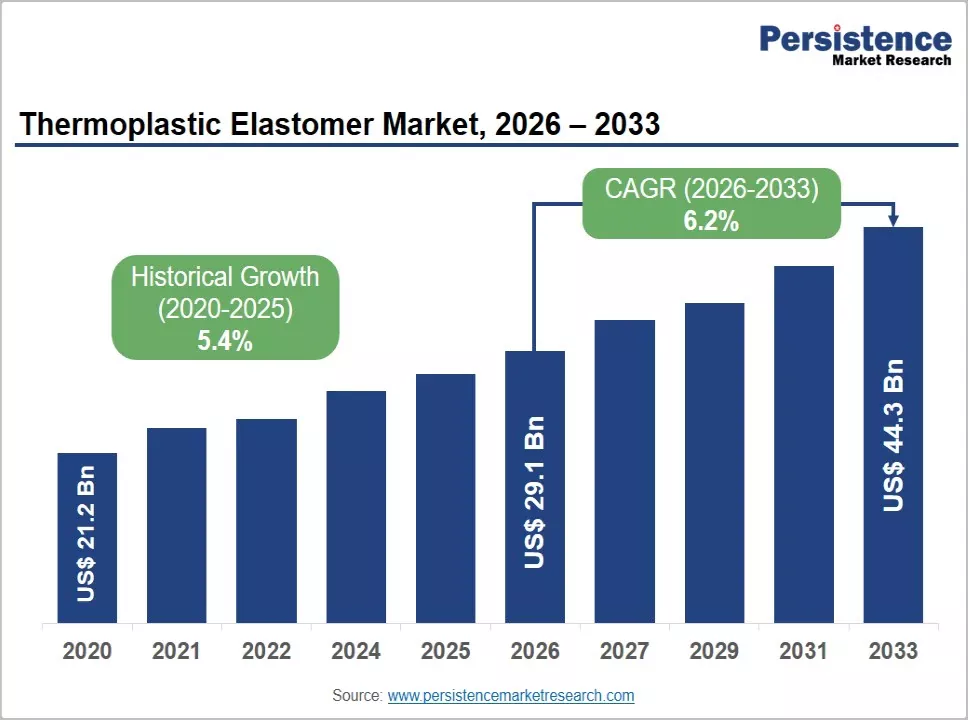
The global thermoplastic elastomer market size is likely to be valued at US$ 29.1 billion in 2026, and is estimated to reach US$ 44.3 billion by 2033, growing at a CAGR of 6.2% during the forecast period 2026 - 2033. Growth is underpinned by the replacement of vulcanized rubber and plasticized PVC across automotive, medical, and consumer applications, rising demand for recyclable and lightweight materials, and the steady expansion of footwear and electronics manufacturing in Asia.
The market recorded a CAGR of 5.4% during 2020–2025, as volatile styrene and butadiene feedstock costs, supply chain disruptions, and uneven automotive output tempered volumes. However, the forecast period anticipates firmer acceleration as brands pursue circular-economy commitments, recycled-content and bio-based grades gain commercial traction, and electric vehicles raise the specification of sealing, soft-touch, and cable-insulation materials.
Key Industry Highlights
- Dominant Type: Styrenic block copolymers are set to command around 34% of the revenue share in 2026, while thermoplastic polyurethane is likely to grow the fastest at 7.4% CAGR through 2033, supported by demand for abrasion-resistant footwear and flexible electronics.
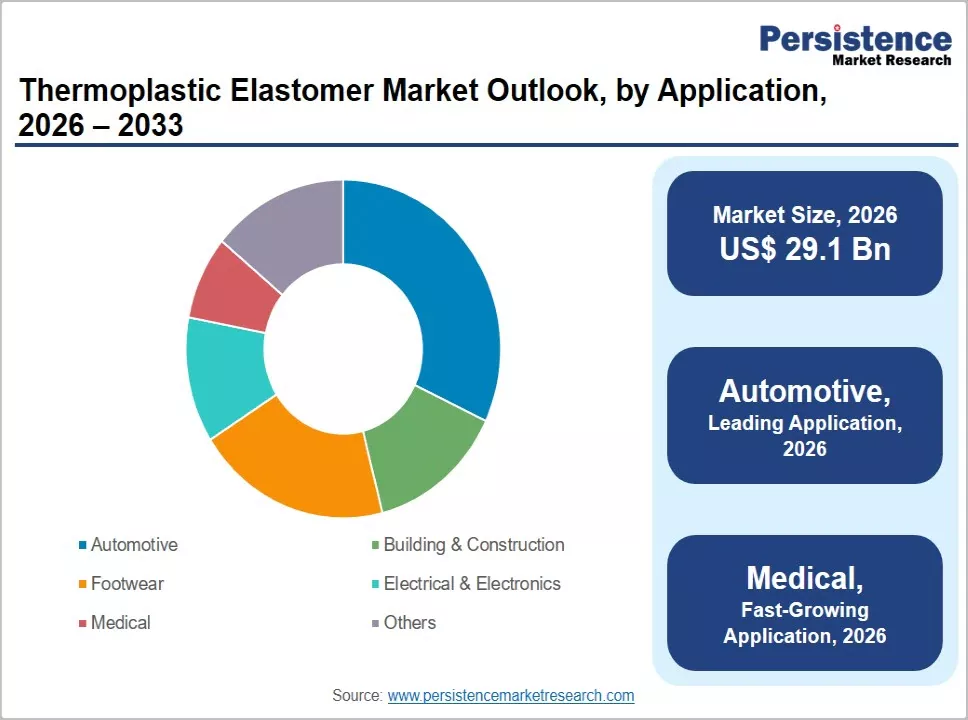
- Leading Application: Automotive is expected to lead with 36% in 2026, while medical applications are likely to be the fastest-growing at about 8.3% CAGR during 2026–2033, reflecting the shift away from PVC and latex in devices and tubing.
- Sustainability Shift: Recycled-content, bio-based, and halogen-free grades are anticipated to widen their presence, with compounders securing GRS and ISCC PLUS certifications to meet brand owner sustainability targets.
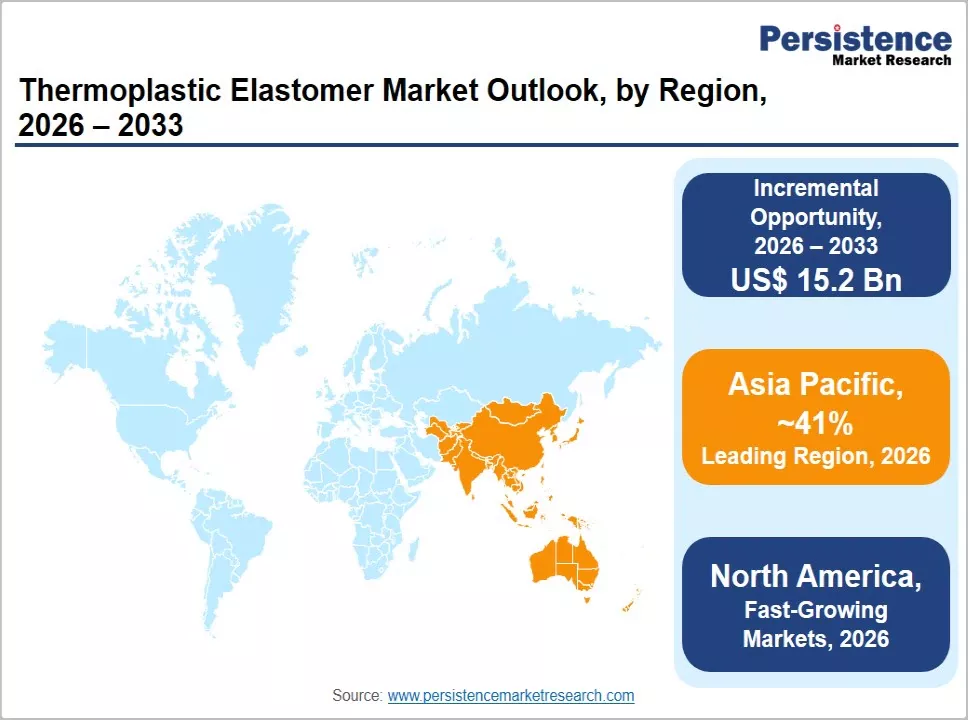
- Regional Leadership: Asia Pacific is poised to dominate with an estimated 41% share in 2026 and register a 7.1% CAGR through 2033, led by manufacturing depth in China, India, and Southeast Asia.
- Competitive Environment: Competitive dynamics include portfolio expansion in recycled and bio-based compounds, bonding-grade innovation for hard-soft overmolding, and regional compounding capacity additions closer to customers.
DRO Analysis
Drivers: Material Substitution and Lightweighting as Primary Growth Catalyst
Substitution of conventional vulcanized rubber, flexible PVC, and silicone with thermoplastic elastomers is the leading force driving the thermoplastic elastomer market growth, as manufacturers seek materials that combine rubber-like elasticity with the processing efficiency of thermoplastics. TPEs can be injection molded, extruded, and overmolded without vulcanization, shortening cycle times, lowering energy consumption, and allowing scrap to be reprocessed. Automotive makers use them in weather seals, interior skins, soft-touch surfaces, and cable sheathing to cut vehicle weight and improve cabin quality, while electric vehicle platforms add demand for high-voltage cable insulation and vibration-damping components. Footwear brands rely on TPU and styrenic compounds for lightweight midsoles and outsoles, and healthcare manufacturers are adopting TPEs for tubing, seals, and device grips as hospitals move away from PVC and latex. These overlapping uses sustain steady volume growth and support premium pricing in specialized grades.
Circular Economy Mandates and Recyclable Material Design
Regulatory and brand pressure for recyclability is reinforcing demand. Because TPEs are melt-processable, they fit design-for-recycling strategies in a way that thermoset rubbers cannot, and compounders are responding with grades that contain post-industrial and post-consumer recyclate, bio-based content, and verified product carbon footprint data. The European Union’s revised approach to end-of-life vehicles, which targets higher recycled plastic content in new cars, is expected to encourage automakers to qualify recycled-content elastomer compounds, strengthening long-term demand across regions.
Restraints: Raw Material Price Volatility and Performance Limitations at Temperature Extremes
Feedstock volatility is a major challenge for the thermoplastic elastomer market. Styrenic block copolymers depend on styrene, butadiene, and isoprene, thermoplastic polyurethanes on isocyanates and polyols, and thermoplastic vulcanizates on EPDM and polypropylene, so petrochemical price swings, plant outages, and energy costs feed directly into compound pricing. Compounders often operate with delayed price pass-through, which compresses margins during sharp upswings, while converters facing cost pressure may revert to lower-cost PVC or conventional rubber where performance requirements allow.
Heat Resistance Gaps and Recycling Infrastructure
Many TPEs still trail vulcanized rubber and silicone in compression set, long-term heat resistance, and chemical resistance, restricting use in under-the-hood, high-temperature sealing, and some industrial applications. In addition, overmolded components that bond TPEs to engineering plastics complicate mechanical recycling, and collection and sorting infrastructure for post-consumer elastomers remains limited in many regions. Long qualification cycles in automotive and medical applications also delay commercialization of new grades and slow the pace at which innovative materials reach volume production.
Opportunities: Electric Mobility, Medical Devices, and Bio-Based Elastomers
Electric vehicles, healthcare, and sustainable consumer products offer the most attractive expansion avenues. EV platforms use more cable insulation, battery sealing, charging-connector, and noise-vibration components, many of which can be served by flame-retardant and halogen-free TPE and TPV grades. In healthcare, ageing populations and growth in minimally invasive procedures are raising demand for sterilization-resistant, latex-free, and phthalate-free elastomers, with compounders introducing soft-touch healthcare grades whose optimized compression set supports seals and flexible interfaces. Wearables, e-bike grips, and portable consumer devices add further niches where tactile quality and colorability command premium pricing.
Recycled Content and Hard-Soft Bonding Innovation
Compounders are investing in recycled-content portfolios, bio-based feedstock, and grades that bond directly to polyamide, polycarbonate, and ABS without adhesives or primers. Direct-bonding TPVs, for example, can replace silicone in hard-soft combinations while avoiding vulcanization and post-treatment steps, simplifying manufacturing and supporting design-for-recycling. Collaborations between compounders and automotive suppliers to develop sealing systems with more than 50% recycled content show how sustainability requirements are turning into commercial specifications, creating differentiated revenue pools for suppliers able to deliver certified, consistent, high-performance materials.
Category-wise Insights
Type Analysis
Why Do Styrenic Block Copolymers Lead the Thermoplastic Elastomer Market?
Styrenic block copolymers (SBCs) are the leading type segment, expected to hold about 34% of the thermoplastic elastomer market revenue share in 2026. Grades such as SBS, SEBS, and SIS offer a broad hardness range, good processability, and strong compatibility with polyolefins and oils, making them the preferred base for compounds used in automotive interiors, grips, adhesives, sealants, and consumer goods. SEBS compounds are widely used for soft-touch overmolding and as a PVC alternative in medical tubing, while SBS and SIS are central to hot-melt adhesives and bitumen modification in road and roofing applications. The segment benefits from large installed capacity, established supplier relationships, and cost competitiveness, although feedstock volatility and competition from Asian producers continue to influence pricing.
Thermoplastic polyurethane (TPU) is likely to grow the fastest through 2033, at an estimated 7.4% CAGR. TPU combines high abrasion resistance, tensile strength, elasticity, and resistance to oils and greases, which makes it well suited for footwear midsoles, cable jacketing, films, hoses, and protective cases. Demand is being driven by lightweight sports footwear, EV charging cables, 3D-printing filaments, and flexible electronics, where few elastomers match its durability. Producers are developing bio-based and recycled-content grades, as well as hydrolysis-resistant and halogen-free flame-retardant grades, to address sustainability and safety requirements. Thermoplastic vulcanizates and thermoplastic polyolefins are also gaining share in automotive sealing and under-the-hood components that need superior heat and weathering resistance.
Application Analysis
Why Does Automotive Lead Thermoplastic Elastomer Applications?
Automotive is the leading application segment, anticipated to account for about 36% of the thermoplastic elastomer market revenue share in 2026. TPEs and TPVs are used in weather-strips, door and window seals, air ducts, bellows, grommets, instrument-panel skins, floor mats, and wire and cable insulation, where they replace EPDM rubber and PVC to reduce weight and processing time. Automakers also value their recyclability, good surface aesthetics, and suitability for overmolding onto rigid plastics. As electric vehicles proliferate, demand is expanding for halogen-free, flame-retardant, and noise-damping compounds for high-voltage cables, battery enclosures, and charging systems. Long qualification periods and multi-year platform contracts make automotive demand predictable and favor established, specification-approved suppliers.
Medical applications represent the fastest-growing segment, expected to register about 8.3% CAGR during 2026–2033. Hospitals and device makers are replacing PVC and natural rubber latex in tubing, IV components, syringe plungers, masks, catheters, seals, and device grips with TPEs that are latex-free, free of phthalate plasticizers, and resistant to repeated sterilization. Grades with optimized compression set support long-term sealing performance in reusable devices, while soft-touch compounds improve ergonomics in handheld and wearable products. Growth in home healthcare, diagnostics, and disposable devices is lifting volume requirements, and compounders are introducing biocompatible grades aligned with ISO 10993 and USP Class VI. Building & construction, footwear, and electrical & electronics remain important, supported by roofing membranes, soles, and cable insulation.
Regional Insights
North America Thermoplastic Elastomer Market Trends and Insights
North America is anticipated to account for an estimated 22% of the global thermoplastic elastomer market in 2026. The region’s market is likely to benefit from a large automotive and medical device manufacturing base, growing adoption of recycled-content compounds, and a strong presence of specialty compounders. Reshoring of medical and electronics production, together with demand for lightweight vehicle components, is expected to support consistent consumption of SBCs, TPVs, and TPUs. Customers are also seeking certified recycled and bio-based grades to meet corporate sustainability targets, encouraging suppliers to expand local compounding and technical service capabilities through 2033.
U.S. Thermoplastic Elastomer Market Size
The U.S. is estimated to account for approximately 78% of the North America thermoplastic elastomer market in 2026. Market growth is likely to be supported by automotive sealing and interior applications, the country’s large medical device industry, and wide use of TPEs in consumer products, adhesives, and wire and cable. Investments in electric vehicle and battery supply chains are also expected to stimulate demand for flame-retardant and halogen-free compounds. Producers are anticipated to emphasize recycled-content and bio-based grades, as well as bonding-grade materials that simplify overmolding on engineering plastics, to serve brand owners and tier-one suppliers.
Canada Thermoplastic Elastomer Market Size
Canada is projected to represent approximately 12% of the North America thermoplastic elastomer market in 2026. Market expansion is expected to be driven by the Ontario automotive assembly corridor, the medical device and packaging sectors, and infrastructure projects that use TPE-modified bitumen and sealing materials. Cross-border integration with U.S. supply chains is likely to support steady consumption, while growing interest in recycled plastics and extended producer responsibility programmes is expected to encourage the use of recyclable elastomer compounds. Cold-climate performance requirements in roofing, seals, and outdoor equipment are also anticipated to sustain demand for specialized grades through 2033.
Europe Thermoplastic Elastomer Market Trends and Insights
Europe is estimated to account for approximately 15% of the global thermoplastic elastomer market in 2026. The region’s market is expected to benefit from strict material regulations, a strong automotive and medical technology base, and ambitious circular economy policies. REACH restrictions on hazardous substances and the European Green Deal’s emphasis on recyclability are likely to encourage the replacement of PVC and thermoset rubbers with recyclable TPEs. Leading compounders headquartered in the region are expected to retain advantages in sustainability certification, technical service, and application development, although high energy costs and soft industrial demand continue to challenge producers and converters.
Germany Thermoplastic Elastomer Market Size
Germany is anticipated to account for approximately 27% of the Europe thermoplastic elastomer market in 2026. Demand is expected to be supported by the country’s automotive industry, precision engineering sector, and medical technology exports. German automakers and suppliers are likely to specify TPEs for sealing systems, interior components, and cabling in electric vehicle platforms, while recycled-content grades developed with domestic compounders are expected to gain acceptance. Several leading European TPE compounders operate in the country, strengthening local innovation and application support. Investments in bonding-grade materials and sustainable formulations are projected to support market expansion through 2033.
Why Is Asia Pacific Expected to Lead the Thermoplastic Elastomer Market?
Asia Pacific is projected to account for approximately 41% of the global thermoplastic elastomer market in 2026, making it the largest regional market. The region is also anticipated to register the fastest growth, expanding at an estimated CAGR of 7.1% through 2033. Market expansion is likely to be driven by large footwear, electronics, and automotive manufacturing clusters, rising medical device production, and expanding local compounding capacity. China and India are expected to remain the primary growth centres, while Vietnam, Indonesia, and Thailand are likely to benefit from the relocation of footwear and consumer goods production.
China Thermoplastic Elastomer Market Size
China is estimated to represent approximately 48% of the Asia Pacific thermoplastic elastomer market in 2026. The country’s market is expected to benefit from its position as the largest producer of footwear, consumer electronics, and electric vehicles, which together generate substantial demand for TPU, SBC, and TPE compounds. Domestic producers are expanding capacity and moving into higher-value grades, supported by policies promoting advanced materials and new energy vehicles. International compounders also continue to present automotive, consumer, and medical solutions at fairs such as CHINAPLAS to capture demand. Continued growth in electric vehicle output and exports is projected to sustain China’s regional leadership through 2033.
India Thermoplastic Elastomer Market Size
India is projected to account for approximately 11% of the Asia Pacific thermoplastic elastomer market in 2026. The market is expected to witness strong expansion, supported by growing automotive production, expanding footwear and consumer goods manufacturing, and government initiatives such as Make in India and production-linked incentive schemes. Rising healthcare spending and local medical device manufacturing are also likely to increase demand for medical-grade TPEs, while domestic compounders such as India Thermoplastics Engineers are developing TPV and TPE grades for automotive and industrial uses. Infrastructure investment and rising two-wheeler and passenger vehicle output are anticipated to further support consumption.
Competitive Landscape
The global thermoplastic elastomer market structure is moderately fragmented, with leading suppliers such as Kraton, BASF, Covestro, Dow, and Celanese holding a substantial share of the revenue through integrated feedstock positions, broad grade portfolios, and global technical service networks. These established players are investing in recycled-content and bio-based products, bonding-grade innovations, and regional compounding capacity to protect margins and deepen relationships with automotive, medical, and consumer customers.
Specialized compounders such as KRAIBURG TPE, Teknor Apex, and Mitsubishi Chemical Group are focusing on application-ready compounds, color matching, and certifications that shorten customer qualification. Barriers such as long approval cycles, formulation expertise, and customer lock-in limit new entrants, while regional producers in China, India, and Southeast Asia are expanding capacity to serve cost-sensitive segments. Consolidation is expected to continue gradually as larger groups acquire specialty compounders to broaden portfolios and geographic reach, while collaborations with automotive suppliers and brand owners accelerate adoption of recycled-content materials.
Key Market Developments
- In September 2026, MOCOM introduced Alfater XL A70I 4PA1210, a thermoplastic vulcanizate engineered for direct adhesion to PA12, targeting hard-soft two-component applications in automotive, electrical and electronics, and sports and leisure without additional vulcanization or post-treatment steps.
- In January 2026, KRAIBURG TPE unveiled its portfolio of application-ready TPE compounds for automotive, consumer, electronics, and medical uses ahead of CHINAPLAS 2026, including selected grades with GRS and ISCC PLUS certification and product carbon footprint data.
- In September 2025, KRAIBURG TPE introduced a new series of thermoplastic elastomers engineered for e-bike handles, supporting its broader focus on bio-based TPEs, certified recycled content, and product carbon footprint transparency.
Companies Covered in Thermoplastic Elastomer Market
- Kraton Corporation
- BASF SE
- Covestro AG
- The Dow Chemical Company
- Celanese Corporation
- KRAIBURG TPE GmbH & Co. KG
- Teknor Apex Company
- Mitsubishi Chemical Group Corporation
- LCY Group
- Huntsman Corporation
- Asahi Kasei Corporation
Frequently Asked Questions
The global thermoplastic elastomer market is valued at US$ 29.1 billion in 2026 and is projected to reach US$ 44.3 billion by 2033, expanding at a CAGR of 6.2% during 2026 - 2033.
Replacement of vulcanized rubber and plasticized PVC in automotive, medical, and consumer applications, rising demand for recyclable and lightweight materials, and expanding footwear and electronics manufacturing are driving the market.
The leading segments in 2026 are styrenic block copolymers by type (about 34% share) and automotive by application (about 36% share).
Asia Pacific dominates the market with an estimated 41% share in 2026 and is projected to register a 7.1% CAGR through 2033, led by manufacturing depth in China, India, and Southeast Asia.
Growth of electric mobility, rising demand for latex-free and phthalate-free medical elastomers, and the commercialization of recycled-content and bio-based grades are key market opportunities.
The market is moderately fragmented, with Kraton, BASF, Covestro, Dow, and Celanese holding a substantial share of the revenue, alongside specialized compounders such as KRAIBURG TPE and Teknor Apex.


