




- Specialty & Fine Chemicals
- Specialty Polyamides Market
Specialty Polyamides Market Size, Share, and Growth Forecast 2026 - 2033
Specialty Polyamides Market by Product (Long Chain Specialty Polyamide, High-Temperature Specialty Polyamide, and MXD6), Application (Transportation, Energy, Consumer Goods, Industrial Coatings, Electronics), and Regional Analysis, 2026 - 2033

Specialty Polyamides Market Size and Trend Analysis
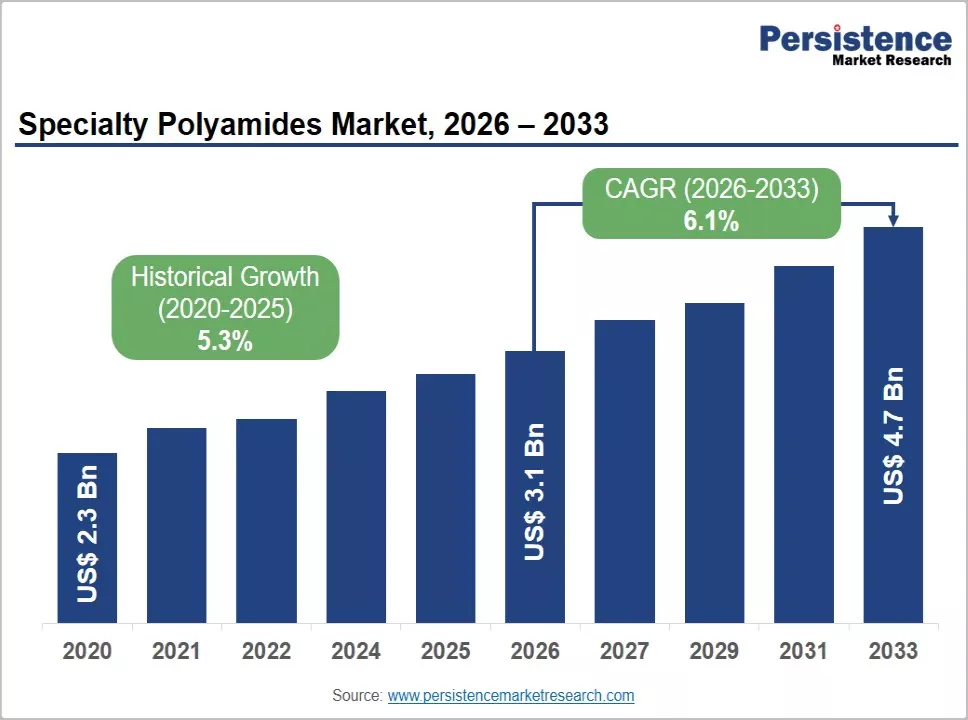
The global specialty polyamides market size is likely to be valued at US$ 3.1 billion in 2026, and is estimated to reach US$ 4.7 billion by 2033, growing at a CAGR of 6.1% during the forecast period 2026 - 2033. Growth is underpinned by the replacement of metal and conventional plastics in vehicles, rising electrification, and increasing use of high-performance polymers in electronics, energy systems, and sports and consumer products.
The market recorded a CAGR of 5.3% during 2020–2025, as automotive production swings, raw material volatility, and tight supply of key monomers constrained volumes. However, the forecast period anticipates firmer acceleration as electric vehicle platforms scale, regional capacity comes on-stream in Asia, and bio-based and transparent grades broaden the range of commercial applications.
Key Industry Highlights
- Dominant Product: Long chain specialty polyamides are set to command around 49% of the revenue share in 2026, while MXD6 is likely to grow the fastest at 7.6% CAGR through 2033, driven by high-barrier packaging and lightweight structural uses.
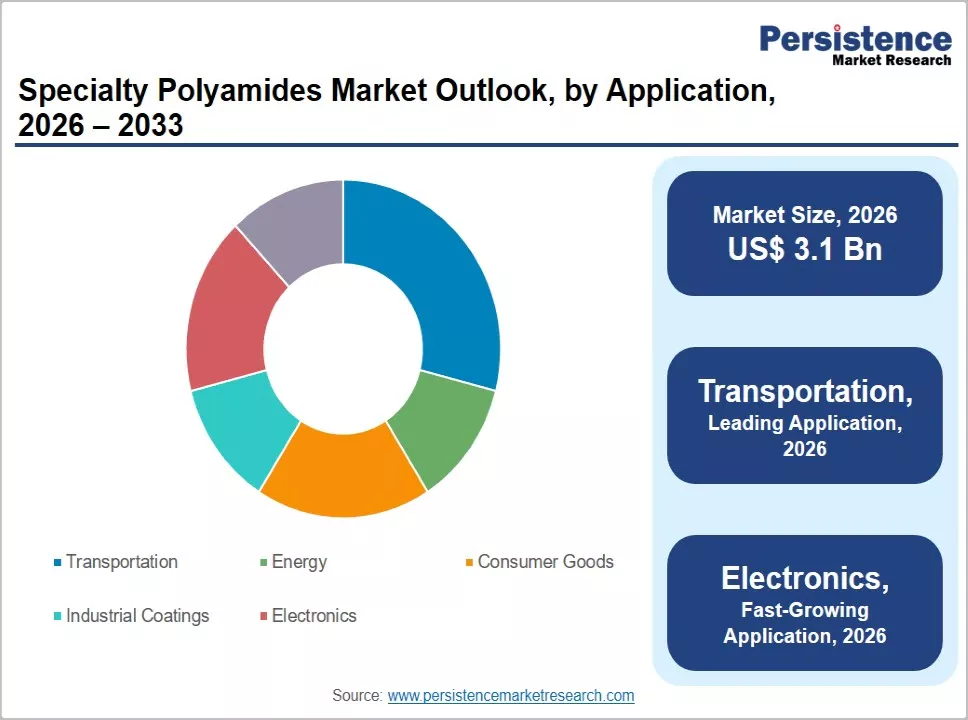
- Leading Application: Transportation is expected to lead with 44% in 2026, while electronics are likely to be the fastest-growing application at about 7.8% CAGR during 2026–2033, reflecting connector miniaturization and thermal management needs.
- High-Temperature Grades: High-temperature specialty polyamides such as PA46, PA6T, PA9T, and PA10T are anticipated to gain share in electric vehicle and under-the-hood components that operate above 150°C.
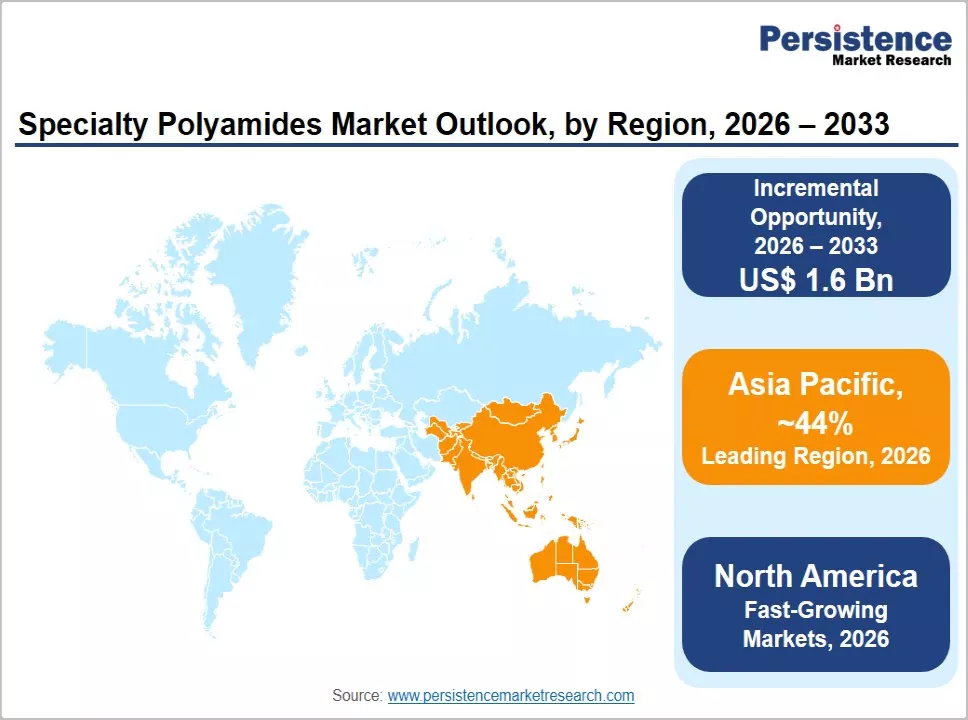
- Regional Leadership: Asia Pacific is poised to dominate with an estimated 44% share in 2026 and register a 7% CAGR through 2033, led by new long-chain capacity in China and advanced materials production in Japan.
- Competitive Environment: Competitive dynamics include capacity enhancements in Asia, bio-based and transparent grade expansions, and private equity-led restructuring of high-performance polymer businesses.
DRO Analysis
Drivers: Electrification and Metal Replacement as Primary Growth Catalyst
Vehicle electrification and lightweighting are the leading forces driving the specialty polyamides market growth, as automakers seek materials that combine high heat resistance, chemical resistance, and mechanical strength with lower weight. Long chain polyamides such as PA11 and PA12 are used in fuel and brake lines, pneumatic tubing, battery cooling lines, and cable sheathing, while high-temperature grades serve turbocharger air ducts, connectors, and thermal management parts.
In electric vehicles, they are used in battery pack components, coolant systems, and charging connectors that must withstand temperature cycling and aggressive fluids. Replacement of metal with polyamide parts reduces vehicle weight and cost while allowing integration of functions, which supports consistent demand through platform cycles and expansion of electric vehicle output. Regulatory pressure to cut emissions and improve efficiency, including CO2 targets for new vehicles in Europe and fuel economy standards elsewhere, reinforces the case for lightweight polymer solutions, and the growing complexity of battery thermal management systems is adding polyamide content per vehicle.
Energy, Electronics, and Sports Applications
Beyond transportation, specialty polyamides are gaining ground in hydrogen and gas distribution, offshore flexible pipes, photovoltaic components, miniaturized electronic connectors, 3D printing powders, and high-performance sports footwear.
These diverse uses broaden the demand base and support premium pricing, since suppliers can meet exacting performance and certification requirements. Gas networks and hydrogen infrastructure increasingly specify polyamide liners and fittings because of their low permeability and long service life.
Restraints: Raw Material Constraints and High Production Costs
Raw material dependence is a major challenge for the specialty polyamides market. Long chain grades rely on specialized monomers such as laurolactam and castor-derived sebacic and undecanoic acids, whose supply is concentrated and subject to agricultural and petrochemical swings.
Complex, capital-intensive polymerization processes and limited numbers of qualified producers make capacity additions slow and expensive, and supply disruptions can leave customers short of critical grades. Supply of castor oil, the key renewable feedstock for PA11 and several PA10-based grades, is concentrated in a few producing regions, which exposes bio-based supply chains to weather and trade risks.
Cost Premiums and Competition from Alternatives
Specialty polyamides cost considerably more than commodity PA6 and PA66, which restricts adoption in price-sensitive applications. Alternatives such as PPS, PPA, PEEK, and metal parts compete in some high-temperature uses, and moisture absorption in certain polyamide grades can limit dimensional stability.
Long qualification cycles in automotive and energy applications further delay revenue from new grades, requiring suppliers to invest heavily in testing and application support. Recycling pathways for specialty polyamides are also still developing, as multi-material assemblies and glass-fibre reinforced grades complicate recovery and limit closed-loop supply.
Opportunities: Bio-Based Polyamides, Hydrogen Infrastructure, and Regional Localization
Bio-based long chain polyamides derived from castor oil offer a way to reduce carbon footprints while retaining performance. Producers are also developing transparent polyamides for electronics, filtration, and healthcare, where clarity and chemical resistance are valued.
Hydrogen storage and distribution, including Type IV tank liners and hydrogen hoses, represents a growing niche, since polyamides combine low permeability with toughness at low temperatures. Recycled and mass-balance certified grades are also entering the market, allowing automakers and consumer brands to lower product carbon footprints without requalifying materials.
Local Production Close to Asian Customers
Localization of production in Asia is helping suppliers respond faster to automotive and consumer electronics customers and improve supply chain resilience. Producers are doubling capacity in China and Singapore, and local players are announcing plans for PA612, MXD6, and PA10T, which should widen availability and reduce lead times.
Customers benefit from shorter supply chains, while suppliers gain from closer technical collaboration with electric vehicle and electronics manufacturers. Metal-to-plastic conversion in aerospace interiors, rail, and industrial equipment provides further headroom, as does the adoption of selective laser sintering powders for end-use parts in medical, tooling, and sports applications.
Category-wise Insights
Product Analysis
Why Do Long Chain Specialty Polyamides Lead the Specialty Polyamides Market?
Long chain specialty polyamides are the leading product segment, expected to hold about 49% of the specialty polyamides market revenue share in 2026. Grades such as PA11, PA12, PA610, PA612, PA1010, and PA1012 feature carbon chains longer than ten atoms between amide groups, which gives low moisture absorption, outstanding impact strength, flexibility at low temperatures, and resistance to fuels, oils, and chemicals. These properties make them suitable for automotive fluid lines, pneumatic hoses, optical fiber cables, oil and gas flexible pipes, 3D printing powders, and sports products. Demand is supported by the transition to electric vehicles and the expansion of capacity by leading producers, including the doubling of long-chain polyamide capacity in Asia. Sports and consumer applications, notably high-performance footwear soles made from polyether block amide, add a high-margin outlet for long-chain grades.
MXD6 is likely to grow the fastest through 2033, at an estimated 7.6% CAGR. This semi-crystalline polyamide, made from meta-xylylenediamine and adipic acid, offers high stiffness, strength, and excellent gas barrier performance. It is used in multilayer bottles and films that extend shelf life, as well as in glass-fiber reinforced compounds for thin-wall structural parts and metal replacement. Growth reflects demand for recyclable high-barrier packaging and lightweight engineered components. High-temperature specialty polyamides, including PA46, PA6T, PA9T, and PA10T, are also gaining momentum in connectors, turbocharger parts, and electric vehicle thermal systems that require sustained performance above 150°C. Suppliers are also working to improve the compatibility of MXD6 barrier layers with PET recycling streams, which brand owners require.
Application Analysis
Why Does Transportation Lead Specialty Polyamides Applications?
Transportation is the leading application segment, anticipated to account for about 44% of the specialty polyamides market revenue share in 2026. Specialty polyamides are used in fuel lines, brake and clutch lines, air brake tubing, quick connectors, turbocharger ducts, engine covers, battery housings, and coolant systems. Automakers favor them for their combination of light weight, heat and chemical resistance, and design freedom. As electric vehicles proliferate, demand is expanding for flame-retardant, high-voltage connector, and thermal management materials. Long qualification periods and multi-year platform contracts make transportation demand predictable and favor suppliers with proven reliability, global production footprints, and application engineering capabilities. Aerospace and rail add smaller but high-value uses.
Electronics represents the fastest-growing application segment, expected to register about 7.8% CAGR during 2026–2033. High-temperature polyamides withstand lead-free soldering and surface-mount processes, making them suitable for connectors, switches, sockets, and housings. Miniaturization, higher data speeds, and growth in electric vehicle and renewable energy electronics are raising requirements for thermal stability, low moisture uptake, and flame retardancy. Transparent polyamides are also being used in lenses, display components, and filtration housings. Energy, consumer goods, and industrial coatings remain important, supported by gas distribution components, sports footwear, powder coatings, and protective linings that exploit the chemical resistance and toughness of these materials. Power tools and battery packs for portable devices also use flame-retardant polyamide housings that meet strict electrical safety standards.
Regional Insights
North America Specialty Polyamides Market Trends and Insights
North America is anticipated to account for an estimated 20% of the global specialty polyamides market in 2026. The region’s market is likely to benefit from a substantial automotive base, a strong oil and gas and aerospace sector, and growing electric vehicle and battery manufacturing. Local production of long-chain and high-temperature polyamides, together with investment in specialty nylon capacity, is expected to improve supply security. Customers are also seeking bio-based and recycled-content grades to meet sustainability goals, encouraging suppliers to expand regional technical service and compounding through 2033.
U.S. Specialty Polyamides Market Size
The U.S. is estimated to account for approximately 82% of the North America specialty polyamides market in 2026. Market growth is likely to be supported by automotive and light truck production, electric vehicle supply chain investments, and demand from energy, aerospace, and industrial applications. Domestic producers such as Nylon Corporation of America have been expanding batch reactor capacity for long-chain nylons and copolymers, with an additional reactor in Manchester, New Hampshire, expected to start up in late 2026. Increasing adoption of 3D printing powders and hydrogen-related components is further anticipated to support demand.
Canada Specialty Polyamides Market Size
Canada is projected to represent approximately 8% of the North America specialty polyamides market in 2026. Market expansion is expected to be driven by automotive assembly in Ontario, oil and gas infrastructure, and industrial equipment manufacturing. Integration with U.S. supply chains is likely to support steady consumption, while investments in battery and electric vehicle manufacturing are expected to create opportunities for flame-retardant and thermal management polyamides. Demand for cold-climate performance and chemical-resistant materials in energy applications is also anticipated to sustain specialized grade consumption through 2033.
Europe Specialty Polyamides Market Trends and Insights
Europe is estimated to account for approximately 18% of the global specialty polyamides market in 2026. The region’s market is expected to benefit from a technologically advanced automotive industry, leading specialty chemical producers, and policies promoting electrification and circularity. Producers headquartered in the region are expected to retain competitive advantages in high-performance grades, bio-based chemistries, and application development. However, high energy costs and restructuring in the broader chemical industry may influence investment decisions, encouraging suppliers to expand closer to growth markets in Asia while maintaining innovation hubs in Europe.
Germany Specialty Polyamides Market Size
Germany is anticipated to account for approximately 36% of the Europe specialty polyamides market in 2026. Demand is expected to be supported by the country’s automotive and electric mobility sector, machinery industry, and presence of leading polyamide producers. Evonik’s Marl site, where PA12 capacity was expanded by 50% through a EUR 400 million investment, remains a core European supply source for long-chain polyamides. German automakers and suppliers are likely to specify advanced polyamides for lightweight and thermal management parts, supporting market expansion through 2033.
Why Is Asia Pacific Expected to Lead the Specialty Polyamides Market?
Asia Pacific is projected to account for approximately 44% of the global specialty polyamides market in 2026, making it the largest regional market. The region is also anticipated to register the fastest growth, expanding at an estimated CAGR of 7% through 2033. Market expansion is likely to be driven by the world’s largest electric vehicle and electronics manufacturing base, rising local production of specialty monomers and polymers, and growth in sports and consumer goods. China and Japan are expected to remain the primary centres, while South Korea, India, and Southeast Asia are likely to see rising consumption.
China Specialty Polyamides Market Size
China is estimated to represent approximately 46% of the Asia Pacific specialty polyamides market in 2026. The country’s market is expected to benefit from rapid electric vehicle growth, expanding electronics production, and capacity investments by both global and domestic suppliers. Evonik’s second polyamide reactor in Shanghai entered trial production in late 2025, doubling its long-chain capacity in Asia, while Sinopec Hunan Petrochemical has outlined plans for PA612, MXD6, and PA10T facilities. Government support for advanced materials and import substitution is projected to sustain China’s regional leadership through 2033.
Japan Specialty Polyamides Market Size
Japan is projected to account for approximately 24% of the Asia Pacific specialty polyamides market in 2026. The market is expected to remain strong, supported by advanced automotive and electronics industries, established production of high-temperature polyamides such as PA9T and PA6T, and leadership in MXD6 through domestic producers. Japanese automakers’ progress in hybrid and electric platforms, along with demand for high-performance connectors and barrier packaging, is likely to sustain consumption. Emphasis on quality, process technology, and long-term supplier relationships is anticipated to support stable growth through 2033.
Competitive Landscape
The global specialty polyamides market structure is moderately consolidated, with the top vendors, including Arkema, Evonik, EMS-Chemie, and Envalior, controlling over half of the revenue share. These established players have been leveraging deep application expertise, integrated monomer production, and global manufacturing footprints. They are also known to invest heavily in R&D to maintain technological leadership in bio-based, transparent, and high-temperature grades. Bio-based leadership, notably in castor-derived polyamide 11, gives some of these companies a differentiated position as customers prioritize lower-carbon materials.
Regional and niche competitors such as Toray, UBE, Mitsubishi Gas Chemical, and Cathay Biotech are focusing on specialized segments and geographic strongholds. Barriers such as monomer access, process know-how, and customer qualification limit new entrants, but Asian capacity additions are intensifying competition. Market consolidation is expected to continue gradually as private equity and strategic buyers reorganize high-performance polymer businesses, while producers form partnerships with automotive and electronics customers to secure long-term demand. Recent regional capacity expansions and ownership changes are reshaping supply relationships, prompting customers to dual-source critical grades.
Key Market Developments
- In May 2026, Lone Star Funds completed the acquisition of RadiciGroup’s High Performance Polymers and Specialty Chemicals business areas, reshaping ownership in the polyamide value chain.
- In January 2026, Arkema announced that its new transparent polyamide production unit in Singapore is fully operational, giving it the largest transparent polyamide capacity in Asia and tripling its global output for these materials.
- In November 2025, Evonik completed trial production at a second polyamide reactor at its Shanghai site, paving the way to double its long-chain polyamide production capacity in Asia.
Companies Covered in Specialty Polyamides Market
- Arkema S.A.
- Evonik Industries AG
- EMS-CHEMIE Holding AG
- Envalior
- Toray Industries, Inc.
- UBE Corporation
- Mitsubishi Gas Chemical Company, Inc.
- Cathay Biotech Inc.
- DuPont de Nemours, Inc.
- Syensqo
- Kuraray Co., Ltd.
Frequently Asked Questions
The global specialty polyamides market is valued at US$ 3.1 billion in 2026 and is projected to reach US$ 4.7 billion by 2033, expanding at a CAGR of 6.1% during 2026 - 2033.
Vehicle electrification and lightweighting, replacement of metal with high-performance polymers, and growing demand from electronics, energy, and consumer applications are driving the market.
The leading segments in 2026 are long chain specialty polyamide by product (about 49% share) and transportation by application (about 44% share).
Asia Pacific dominates the market with an estimated 44% share in 2026 and is projected to register a 7% CAGR through 2033, led by new long-chain capacity in China and advanced materials production in Japan.
Bio-based and transparent polyamides, hydrogen storage and distribution components, and localization of production close to Asian customers are key market opportunities.
The market is moderately consolidated, with Arkema, Evonik, EMS-Chemie, and Envalior controlling over half of the revenue share.


