




- Specialty & Fine Chemicals
- Textile Auxiliaries Market
Textile Auxiliaries Market Size, Share, and Growth Forecast 2026 - 2033
Textile Auxiliaries Market by Product Type (Pretreatment Agents, Dyeing & Printing Agents, Finishing Agents), Application (Apparel, Home Furnishing, Technical Textiles), End-User (Textile Industry, Fashion Industry, Automotive), and Regional Analysis, 2026 - 2033

Textile Auxiliaries Market Size and Trend Analysis
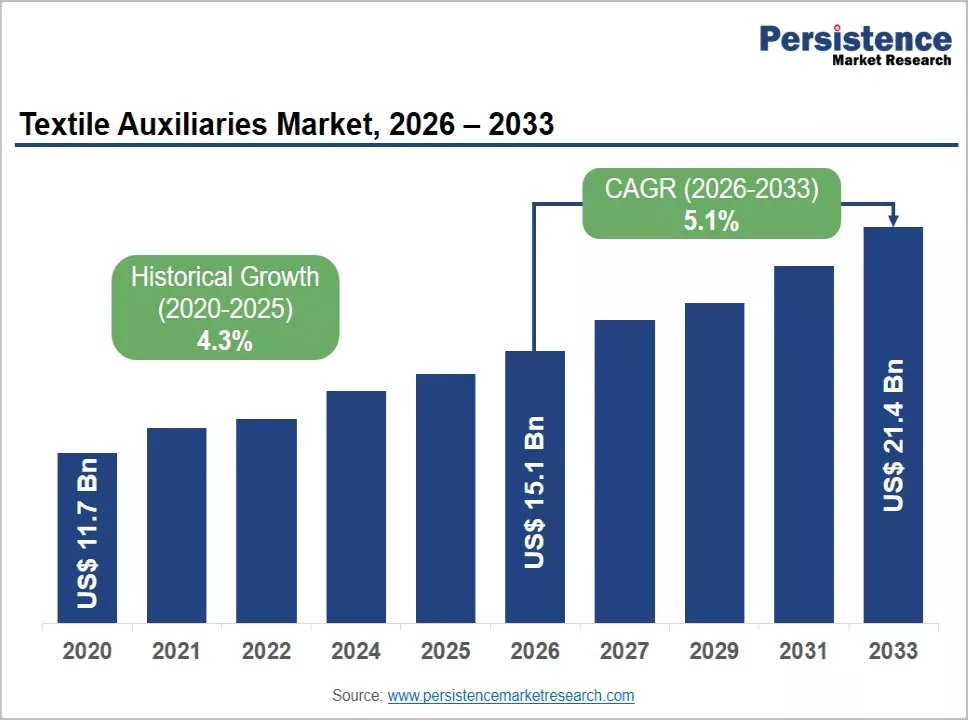
The global textile auxiliaries market size is likely to be valued at US$ 15.1 billion in 2026, and is estimated to reach US$ 21.4 billion by 2033, growing at a CAGR of 5.1% during the forecast period 2026 - 2033. Growth is underpinned by the expansion of apparel and home textile output in Asia, rising demand for functional and technical fabrics, and mounting pressure on mills to adopt water-saving, low-impact chemistry.
The market recorded a CAGR of 4.3% during 2020 - 2025, reflecting uneven consumer demand, volatile raw material and energy costs, and cautious inventory management across the textile value chain. However, the forecast period anticipates steadier acceleration as chemical management programmes tighten, digital printing scales, and brands prioritize cleaner formulations, higher process efficiency, and traceable supply chains.
Key Industry Highlights
- Dominant Product Type: Dyeing and printing agents are set to command around 41% of the revenue share in 2026, while finishing agents are likely to grow the fastest at 6.2% CAGR through 2033, as functional finishes gain wider commercial use.
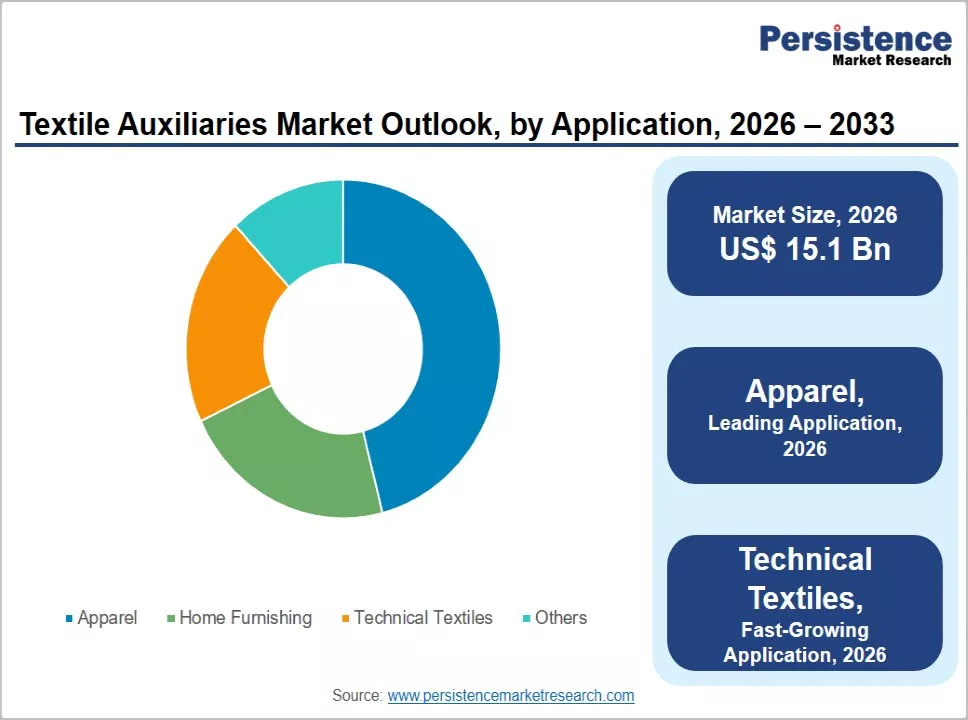
- Leading Application: Apparel is expected to lead with 52% in 2026, while technical textiles are likely to be the fastest-growing at about 6.8% CAGR during 2026–2033, reflecting demand for protective, medical, and automotive fabrics.
- Dominant End-User: The textile industry is anticipated to lead with an estimated 61% share in 2026, while automotive is slated to represent the fastest-growing end-user segment at 6.5% CAGR from 2026 to 2033.
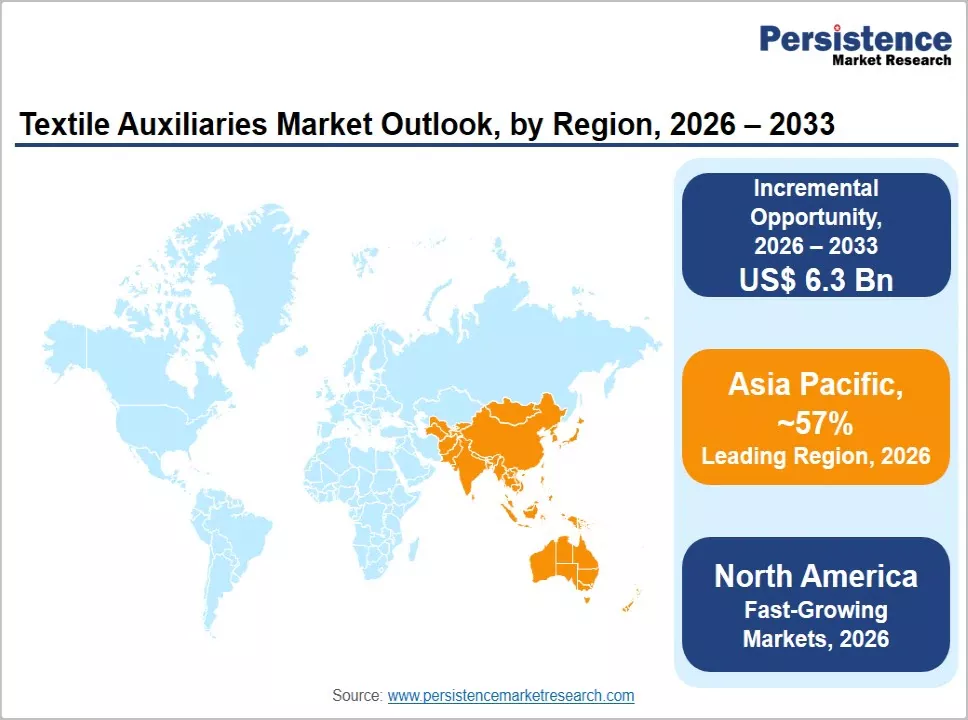
- Regional Leadership: Asia Pacific is poised to dominate with an estimated 57% share in 2026 and register a 5.7% CAGR through 2033, led by textile manufacturing clusters in China, India, and Southeast Asia.
- Competitive Environment: Competitive dynamics include portfolio carve-outs and acquisitions, sustainable chemistry launches, and capacity expansion in Asia, targeting India and Southeast Asia.
DRO Analysis
Drivers: Sustainable Chemistry and Textile Manufacturing Expansion as Primary Growth Catalyst
Sustainability-led reformulation is the leading force driving the textile auxiliaries market growth, as brands and mills respond to restrictions on hazardous substances, wastewater discharge limits, and chemical management programmes such as ZDHC. Mills are replacing conventional surfactants, finishing agents, and fluorinated repellents with biodegradable, low-VOC, water-based, and PFAS-free alternatives, which typically carry higher value per ton.
Simultaneously, textile and apparel production continues to expand in India, Vietnam, Bangladesh, and Indonesia, supported by supply chain diversification and government incentives, which broadens the base of pretreatment, dyeing, and finishing demand. Auxiliaries that reduce water, energy, and processing time, such as low-temperature scouring agents and enzymatic pretreatments, are gaining traction because they cut operating costs while meeting compliance requirements.
Digital Printing and Functional Textile Demand
Digital textile printing is creating demand for auxiliaries that improve ink fixation, colour depth, print sharpness, and compatibility with automated lines. At the same time, consumers and industrial buyers are asking for performance features such as water repellency, flame retardancy, antimicrobial protection, and stretch recovery. Specialty auxiliaries that deliver these properties support premium pricing and deeper customer relationships, reinforcing growth beyond the commodity end of the market.
Restraints: Raw Material Volatility and Regulatory Compliance Costs
Raw material volatility is a major challenge for the textile auxiliaries market. Surfactants, silicones, acrylics, and other intermediates are derived from petrochemical and oleochemical feedstocks, so price swings and supply disruptions feed directly into formulation costs. Many auxiliary suppliers serve price-sensitive mills with thin margins, which limits their ability to pass on increases quickly. Weak apparel demand and inventory corrections also lead mills to delay purchases, creating uneven order patterns for suppliers.
Compliance Burden and Pressure from Alternatives
Tightening restrictions on PFAS, alkylphenol ethoxylates, formaldehyde-releasing finishes, and other substances of concern oblige suppliers to reformulate products and re-certify them, increasing R&D and testing expenditure. Smaller regional producers often lack the resources to follow evolving requirements across markets, while performance gaps in some PFAS-free repellents can slow customer acceptance. Waterless and low-liquor dyeing technologies, such as supercritical CO2 and foam-based systems, may also reduce auxiliary consumption per unit of fabric over the longer term.
Opportunities: Technical Textiles, Circular Fashion, and Emerging Market Mills
Technical textiles offer the most attractive growth avenue, as applications such as protective clothing, medical textiles, filtration, geotextiles, and automotive interiors require specialized coatings, flame-retardant finishes, and durable functional treatments. Techtextil 2026 introduced textile chemicals and dyes as a dedicated product segment for the first time, reflecting how central chemistry has become to the next generation of technical materials. Producers capable of delivering high-performance, regulation-compliant solutions are positioned to capture higher margins than in conventional apparel chemistry.
Circular Textiles and Regional Capacity Building
Circular fashion creates new demand for auxiliaries compatible with fibre recycling, polyester and cotton blend separation, and dyeing of recycled fibres. Brands are also asking suppliers for traceable, lower-impact chemistry backed by third-party certifications. In India, Bangladesh, and Vietnam, growth in organized garment manufacturing and government-backed textile parks is lifting the use of branded auxiliaries over generic products, while local players such as Fineotex are using acquisition-led strategies and new product development to capture high-growth segments such as sustainable chemicals and performance textiles.
Category-wise Insights
Product Type Analysis
Why Do Dyeing & Printing Agents Lead the Textile Auxiliaries Market?
Dyeing and printing agents are the leading product type segment, expected to hold about 41% of the textile auxiliaries market revenue share in 2026. They include dispersing, leveling, fixing, and wetting agents, thickeners, binders, and print pastes that govern colour consistency, fastness, and fabric hand. Demand is closely tied to apparel and home textile volumes and benefits from the continuous need for colour matching and fashion-driven product cycles. The shift towards digital printing is also expanding demand for pretreatment and fixation chemistry tailored to ink-jet systems. Suppliers differentiate through technical service, shade reproducibility, and low-impact formulations that reduce water and energy consumption in dye houses.
Finishing agents are likely to grow the fastest through 2033, at an estimated 6.2% CAGR. This segment covers softeners, water and oil repellents, flame retardants, antimicrobial treatments, wrinkle-resistant finishes, and coatings that add functionality to fabric. Rising consumer preference for performance wear, workwear, home textiles with easy-care properties, and technical fabrics is supporting adoption. Regulatory limits on PFAS are accelerating the development of fluorine-free repellents, while demand for bio-based softeners and silicone alternatives is increasing. Higher formulation complexity and strict performance requirements allow suppliers to charge premium prices relative to pretreatment chemistry. Pretreatment agents, including scouring, bleaching, and desizing chemicals, remain a stable volume base.
Application Analysis
Why Does Apparel Lead Textile Auxiliaries Applications?
Apparel is poised to lead with an estimated 52% share in 2026, supported by the sheer volume of garments produced worldwide and the number of wet-processing steps each fabric undergoes. Cotton, polyester, and blended fabrics all require pretreatment, dyeing, printing, and finishing, giving apparel mills a wide range of auxiliary needs. Fast-fashion cycles, athleisure growth, and brand requirements for colour fastness, softness, and durability sustain recurring consumption. The segment is nonetheless exposed to consumer sentiment and inventory corrections, and mills in competitive regions often prioritize cost, which encourages suppliers to offer concentrated products and process-efficiency solutions that lower total cost of use.
Technical textiles are the fastest-growing application, expected to register about 6.8% CAGR through 2033. Protective clothing, medical textiles, filtration media, construction fabrics, and automotive interiors require coatings, flame-retardant treatments, hydrophilic or hydrophobic finishes, and bonding agents that meet strict performance standards. Auxiliary suppliers are developing PFAS-free repellents, halogen-free flame retardants, and durable antimicrobial finishes to satisfy regulations and end-user specifications. Because qualification is rigorous and performance requirements are high, suppliers enjoy stronger pricing power and customer stickiness. Home furnishing remains a steady segment, with upholstery, curtains, and bedding demanding stain-resistant, flame-retardant, and soft-hand finishes.
End-User Analysis
Why Does the Textile Industry Lead Textile Auxiliaries End-Users?
The textile industry is expected to remain the leading end-user, accounting for an estimated 61% share in 2026, as spinners, weavers, knitters, and processing mills purchase auxiliaries directly for every stage of fabric preparation, colouring, and finishing. Large integrated mills in China, India, Bangladesh, Pakistan, and Turkey rely on dependable supply, technical support, and compliance documentation, favouring suppliers with local warehouses and laboratories. Demand is relatively stable and tied to processing volumes, although mills are increasingly consolidating their supplier base and seeking partners that can help reduce water, energy, and effluent loads. Certification under programmes such as ZDHC and bluesign is becoming a prerequisite for access to global brand supply chains.
Automotive is the fastest-growing end-user segment, anticipated to achieve about 6.5% CAGR during the 2026–2033 period. Vehicle interiors use seat fabrics, headliners, carpets, airbag textiles, and belts that require flame retardancy, abrasion and UV resistance, low emissions, and stain protection. Growth in electric vehicles and the emphasis on lightweight, sustainable interior materials are lifting demand for recycled-fibre fabrics and low-VOC chemistry. The fashion industry, meanwhile, remains an important influencer, as brand-owned restricted substance lists and sustainability scorecards drive reformulation, even though purchases are made largely through mills. Qualification cycles in automotive are long, which rewards established suppliers with proven compliance records.
Regional Insights
North America Textile Auxiliaries Market Trends and Insights
North America is anticipated to account for an estimated 16% of the global textile auxiliaries market in 2026. The region’s market is likely to benefit from a strong technical textiles base, demand for protective and military fabrics, and growth in nonwovens for hygiene and medical use. Regulation of PFAS at the federal and state level is expected to accelerate adoption of fluorine-free finishes, while nearshoring from Asia is likely to support modest recovery in domestic and Central American textile processing. Specialty suppliers with strong technical service and compliance documentation are expected to remain well positioned through 2033.
U.S. Textile Auxiliaries Market Size
The U.S. is estimated to account for approximately 80% of the North America textile auxiliaries market in 2026. Market growth is likely to be supported by demand from nonwovens, technical textiles, carpets, and performance apparel, along with brand commitments to eliminate intentionally added PFAS from products. State-level restrictions on PFAS in textiles are expected to encourage reformulation and the introduction of fluorine-free repellents. Increasing local manufacturing of medical and protective fabrics is also anticipated to support investments in specialized finishing chemistry, even as overall apparel processing remains limited.
Canada Textile Auxiliaries Market Size
Canada is projected to represent approximately 8% of the North America textile auxiliaries market in 2026. Market expansion is expected to be driven by technical and industrial textiles, outdoor and protective clothing, and nonwoven products serving healthcare and filtration. Domestic demand is influenced by cross-border trade with the U.S., while sustainability policies and growing interest in circular textiles are likely to encourage use of certified, lower-impact chemistry. Cold-climate performance requirements for outerwear and industrial fabrics are also anticipated to sustain demand for durable water-repellent and functional finishes through 2033.
Europe Textile Auxiliaries Market Trends and Insights
Europe is estimated to account for approximately 11% of the global textile auxiliaries market in 2026. The region’s market is expected to benefit from the EU Strategy for Sustainable and Circular Textiles, extended producer responsibility for textiles, and some of the world’s most demanding chemical regulations under REACH. These frameworks are likely to encourage the adoption of safer, traceable chemistry and to favour suppliers with strong regulatory expertise. European producers specialize in high-value technical textile and finishing solutions, while portfolio restructuring is reshaping the competitive landscape, including the March 2026 spin-off of Erca’s textile auxiliaries unit into a separate company.
Germany Textile Auxiliaries Market Size
Germany is anticipated to account for approximately 24% of the Europe textile auxiliaries market in 2026. Demand is expected to be supported by a strong technical textiles industry, automotive interiors, and the presence of leading specialty chemical groups with headquarters and research centres in the country. German suppliers are likely to focus on PFAS-free repellents, flame-retardant finishes, and coatings for technical applications, while participation in international fairs such as Techtextil in Frankfurt continues to highlight innovation. Investments in resource-efficient processing and sustainable formulations are projected to support market expansion through 2033.
Why Is Asia Pacific Expected to Lead the Textile Auxiliaries Market?
Asia Pacific is projected to account for approximately 57% of the global textile auxiliaries market in 2026, making it the largest regional market. The region is also anticipated to register the fastest growth, expanding at an estimated CAGR of 5.7% through 2033. Market expansion is likely to be driven by concentrated textile and garment manufacturing, rising domestic consumption, and growing adoption of branded, compliance-ready chemistry. China and India are expected to remain the primary demand centres, while Bangladesh, Vietnam, Indonesia, and Pakistan are also likely to expand processing capacity to serve global apparel brands.
China Textile Auxiliaries Market Size
China is estimated to represent approximately 42% of the Asia Pacific textile auxiliaries market in 2026. The country’s market is expected to benefit from the world’s largest textile processing base, vertically integrated supply chains, and strong domestic auxiliary producers such as Transfar Chemicals. Environmental enforcement and wastewater standards are likely to push mills towards cleaner chemistry and upgraded dyeing equipment. International suppliers are also expanding local production and application laboratories to serve brand-driven demand for sustainable and high-performance solutions. Growth in technical textiles and exports to emerging markets is projected to sustain China’s regional leadership through 2033.
India Textile Auxiliaries Market Size
India is projected to account for approximately 17% of the Asia Pacific textile auxiliaries market in 2026. The market is expected to witness strong expansion, supported by government initiatives such as the PM MITRA integrated textile parks and production-linked incentive schemes for man-made fibre and technical textiles. Growth in cotton, polyester, and blended fabric processing, together with rising export orders, is likely to increase demand for pretreatment, dyeing, and finishing chemistry. Domestic suppliers, including Fineotex and other textile chemical makers, are broadening product ranges and exploring acquisitions and overseas expansion, while demand for ZDHC-compliant products is expected to rise.
Competitive Landscape
The global textile auxiliaries market structure is moderately fragmented, with the top vendors, including Archroma, CHT Group, Rudolf Group, and Transfar Chemicals, holding a significant share of the revenue. These established players have been leveraging broad product portfolios, application laboratories, and global regulatory expertise, and they invest steadily in sustainable chemistry, digital printing solutions, and PFAS-free technologies to maintain technological leadership.
Regional and niche competitors such as Fineotex, Sarex, Nicca, and Pulcra Chemicals are focusing on specialized segments and geographic strongholds, often competing on price, responsiveness, and local technical service. Barriers such as regulatory compliance, certification requirements, and customer qualification limit new entrants, but acquisitions and carve-outs are reshaping the landscape. Market consolidation is expected to continue gradually as global leaders acquire regional brands to expand portfolios and geographic reach, while smaller specialists collaborate with mills and brands to develop circular and low-impact chemistry.
Key Market Developments
- In April 2026, Techtextil in Frankfurt introduced Textile Chemicals & Dyes as a dedicated product segment for the first time, with CHT Group and RUDOLF presenting their latest auxiliaries for technical textiles.
- In March 2026, Nicca acquired the ZELAN business from The Chemours Company, adding an established textile finishing brand to its portfolio and strengthening its position in durable water-repellent chemistry.
- In March 2026, Erca Group spun off its textile auxiliaries activity into a separate entity, Erca TCS, to enable targeted research and investment in expanding its range of textile products.
Companies Covered in Textile Auxiliaries Market
- Archroma Management LLC
- CHT Group
- RUDOLF GmbH
- Zhejiang Transfar Whyyon Chemical Co., Ltd.
- Pulcra Chemicals GmbH
- Nicca Chemical Co., Ltd.
- Fineotex Chemical Limited
- Sarex Chemicals
- BASF SE
- Evonik Industries AG
- The Dow Chemical Company
Frequently Asked Questions
The global textile auxiliaries market is valued at US$ 15.1 billion in 2026 and is projected to reach US$ 21.4 billion by 2033, expanding at a CAGR of 5.1% during 2026 - 2033.
Sustainability-led reformulation, expansion of textile and apparel manufacturing in Asia, rising demand for functional and technical fabrics, and growth in digital textile printing are driving the market.
The leading segments in 2026 are dyeing & printing agents by product type (about 41% share), apparel by application (about 52% share), and textile industry by end-user (about 61% share).
Asia Pacific dominates the market with an estimated 57% share in 2026 and is projected to register a 5.7% CAGR through 2033, led by textile manufacturing clusters in China, India, and Southeast Asia.
Technical textiles, circular fashion and fibre recycling, PFAS-free and bio-based chemistry, and expanding organized garment manufacturing in emerging economies are key market opportunities.
The market is moderately fragmented, with Archroma, CHT Group, Rudolf Group, and Transfar Chemicals holding a significant share of the revenue, alongside regional specialists such as Fineotex, Sarex, and Nicca.


