




- Medical Devices
- Surgical Laser Rental Market
Surgical Laser Rental Market Size, Share, and Growth Forecast 2026 - 2033
Surgical Laser Rental Market by Product Type (Solid State Lasers, Gas Laser System), Rental Offering (Short Term, Long Term Rentals), Application (Surgical, Dentistry), End-user, and Regional Analysis, 2026 - 2033

Surgical Laser Rental Market Size and Trends Analysis
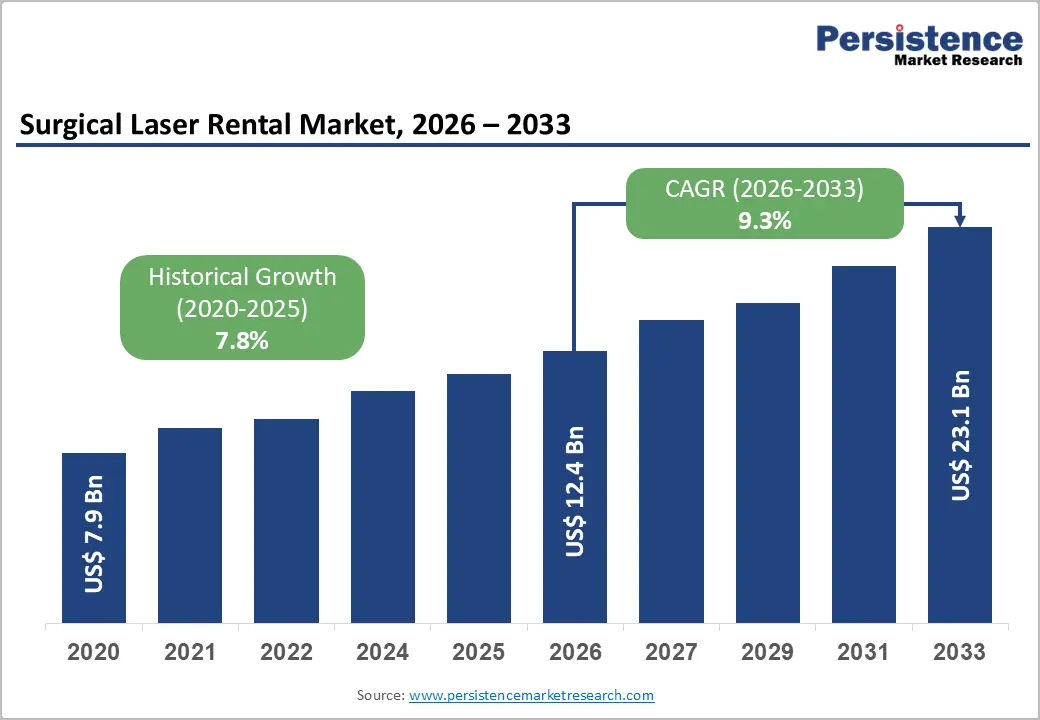
The global surgical laser rental market size is likely to be valued at US$12.4 billion in 2026 and is expected to reach US$23.1 billion by 2033, growing at a CAGR of 9.3% during the forecast period from 2026 to 2033, driven by increasing preference of hospitals and ambulatory surgical centers to shift from capital-intensive purchases to flexible pay-per-use models. Rising procedure volumes in minimally invasive and cosmetic surgeries are also propelling demand.
Key Industry Highlights:
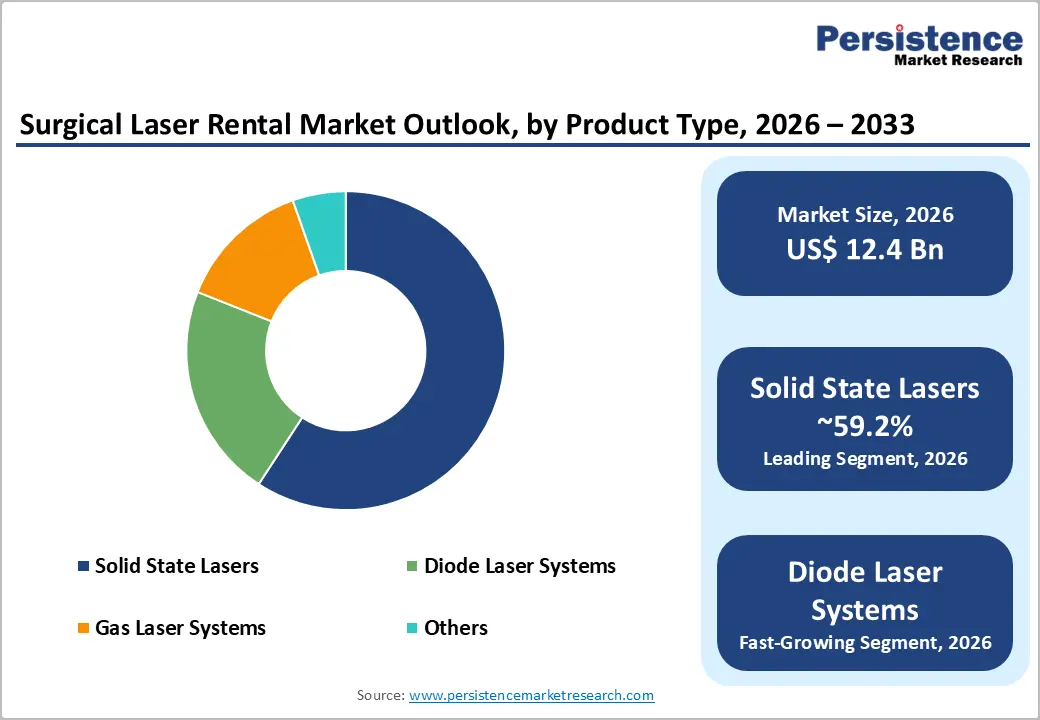
- Leading Product Type: Solid state lasers, approximately 59.2% share in 2026, owing to their ability to deliver consistent energy output.
- Dominant Application: Surgical, nearly 72.5% in 2026, as lasers enable minimally invasive procedures with reduced bleeding.
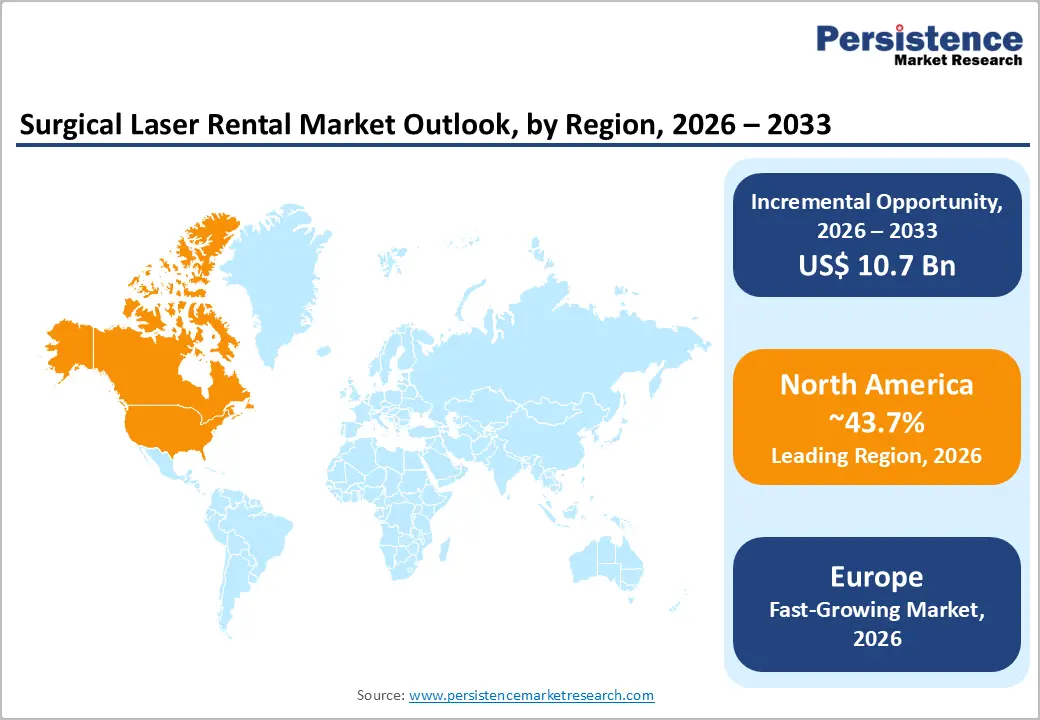
- Leading Region: North America, with about 43.7% share in 2026, spurred by the adoption of novel medical technologies.
- Fast-growing Region: Europe, augmented by increasing demand for outpatient procedures.
- Fast Track Approval: In July 2025, biolitec received FDA approval for its LEONARDO Duster Super Pulsed Thulium Fiber Laser (TFL). The system is designed for urological applications such as lithotripsy, benign prostatic hyperplasia, and soft tissue treatment.
DRO Analysis
Driver - Surging Patient Preference for Minimally Invasive Aesthetic Treatments
Cosmetic laser procedures, mainly skin resurfacing, hair removal, and tattoo removal, have seen sharp patient demand, and this directly fuels the rental model. Clinics and medspas prefer renting over purchasing because patient preferences shift quickly, and owning a single-modality device creates financial risk. According to the International Society of Aesthetic Plastic Surgery (ISAPS), around 35 million aesthetic procedures were performed globally in 2023, with over 19 million being non-surgical.
By 2024, non-surgical procedures climbed to 20.5 million worldwide, showcasing a consistent shift toward less invasive options. Laser-based treatments sit at the heart of this shift. The aesthetic sector, mainly dermatology and cosmetic clinics, relies heavily on laser technologies. With the rapidly evolving nature of aesthetic technology and shifting patient preferences, renting the latest devices rather than outright purchasing is highly preferred.
Rising Demand for Technology Access without the Burden of Ownership
Laser systems evolve fast. A device purchased today can become clinically or commercially outdated within a few years, especially with competing wavelengths and platforms constantly entering the market. The capital investment required to purchase surgical laser systems often ranges between US$100,000 and US$500,000. It is a major barrier for small clinics and ambulatory surgical centers.
Renting sidesteps this problem entirely. As of January 2025, 70% of U.S. hospitals preferred leasing laser equipment, with long-term rentals increasingly favored as they provide maintenance, training, regulatory support, and access for outpatient procedures. Hospitals and surgery centers are opting for rentals to avoid obsolescence, reduce capital risks, and maintain compliance with evolving regulatory and technology standards. By leasing novel systems, providers can keep pace with developments without long-term financial liabilities.
Restraint - Rigid Cost Structure When Cases Get Canceled
One of the most practical pain points in surgical laser rental is how costs are structured around individual procedures rather than flexible usage. Even when a case is canceled or does not require laser use after the equipment has been dispatched, the financial obligation remains. Rental companies charge a fee for the laser and their operator. Even if a particular procedure no longer requires the use of a laser, the rental company's representative fee and a standby fee will still be charged if the rental has already been arranged.
These charges are not minor. Standby fees can range from US$250 to US$500 or more per procedure, and they are not charged uniformly across all companies. For high-volume surgical centers with unpredictable case schedules, this inflexibility adds up. It makes per-case rental economically risky for facilities that cannot guarantee a steady procedure pipeline, thereby discouraging some providers from adopting the rental model altogether.
Opportunity - Launch of Multi-Wavelength and Dual Systems
Traditionally, covering multiple tissue indications meant investing in multiple laser platforms. Dual and multi-wavelength systems are changing that calculus. FDA 510(k)-cleared dual-wavelength devices, such as the Advalight ADVATx, now cover over 25 treatment indications, including rosacea, melasma, acne, vascular lesions, and scars, using a single handpiece with both 589 nm and 1319 nm wavelengths. In the surgical space, this design approach enables a single rented device to serve multiple functions in one procedure or across specialties.
In 2025, GIGAAMed received FDA clearance (K241791) for a multi-wavelength diode laser system covering 980 nm, 1470 nm, and 1940 nm wavelengths. These are widely used across soft tissue surgery, vascular treatments, tissue ablation, and dermatological procedures. For rental providers, multi-wavelength systems expand their addressable customer base. For clinics, a single rental agreement can cover urology, dermatology, and gynecology, further reducing cost and administrative overhead.
Integration of Real-Time Sensors to Monitor Tissue Responses
The next generation of surgical lasers is moving beyond simple energy delivery. Advanced systems now integrate intraoperative sensing that monitors tissue condition and feeds that data back to the system during use. Novel sensing systems in laser surgery incorporate Optical Coherence Tomography (OCT) integration, real-time temperature monitoring, and tissue response detection. These mechanisms provide continuous feedback regarding tissue condition and enable precise control of laser parameters in real time.
Peer-reviewed research published in PMC demonstrated the clinical value of this approach. A deep-learning-assisted OCT feedback system for laser osteotomy achieved a tissue-type identification accuracy of 96.28%, marking the first OCT implementation as an online feedback system for laser bone surgery. For the rental market, this matters as facilities access these high-cost intelligent systems without buying them. It makes sensor-based laser platforms commercially viable for mid-sized clinics that could never afford outright ownership.
Category-wise Analysis
Product Type Insights
The solid-state lasers segment is expected to dominate with a share of nearly 59.2% in 2026. Solid-state lasers have become the gold standard across multiple specialties for their ability to deliver deep tissue penetration with very controlled energy. Their dominance is also propelled by high precision, stable performance, and wide clinical applications across ophthalmology, urology, dermatology, and oncology. Their reliability matters too from a procurement standpoint.
The diode laser system segment is anticipated to be the fastest-growing in 2026. They benefit from low cooling demands, allowing battery-powered options that fit tele-dermatology and mobile ophthalmology clinics. This is mainly relevant for ambulatory surgical centers and small-scale specialty clinics. Their compact design, reliability, and energy efficiency also make them ideal for therapeutic and aesthetic procedures.
Application Insights
The surgical segment is estimated to lead with a share of approximately 72.5% in 2026. Surgical lasers are the backbone of minimally invasive care. They are used across more specialties than any other laser application. Increasing technological developments, high prevalence of chronic diseases, surging implementation of minimally invasive surgeries, and rising prevalence of ophthalmic disorders are propelling the segment’s growth. Increasing adoption across urology, gynecology, and general surgery further supports demand, while advanced visualization systems complement laser use.
The dentistry segment will likely remain in the second position in 2026. This is attributed to the increasing adoption of laser technology for a wide range of dental procedures. Lasers deliver higher precision, reduced pain, quicker recovery times, and minimized risk of infection compared to conventional tools. Patient preference is shifting decisively toward pain-free, anesthesia-free visits. Lasers deliver exactly that. Rising demand for minimally invasive and anesthesia-free dental procedures is augmenting the adoption of dental lasers.
Regional Insights
North America Surgical Laser Rental Market Trends
In 2026, North America is predicted to dominate with a share of approximately 43.7%. It combines the highest procedure volumes globally with favorable reimbursement, dense clinical infrastructure, and a superior base of domestic laser manufacturers. Reimbursement policy is a key differentiator. Ambulatory Surgical Centers (ASCs) now conduct around 72% of all U.S. surgeries, cutting facility costs by 45 to 60% and accelerating the shift toward laser techniques that shorten recovery times. The Food and Drug Administration (FDA) clearance activity further sustains momentum.
U.S. Surgical Laser Rental Market Trends
Increasing demand for minimally invasive medical procedures, high preference for cosmetic procedures, and rising adoption rate of novel technologies in the U.S. are the primary factors responsible for the dominance of this country. According to the American Society of Plastic Surgeons, nearly 23.7 million cosmetic minimally invasive procedures and 1.5 million cosmetic surgical procedures were performed in the U.S. in 2022. New technology launches happen in the country first. Lumenis, for instance, launched Folix in June 2024. It is a U.S. FDA-cleared fractional laser for hair loss treatment that utilizes unique technology to stimulate hair follicles and promote regrowth while minimizing tissue damage.
Europe Surgical Laser Rental Market Trends
Europe's strength comes from an amalgamation of aging demographics, high clinical standards, and an active regulatory framework that channels only proven technology into hospitals. According to Eurostat, the population aged 65 and over in the EU reached approximately 95.6 million in 2023, representing 21.3% of the total population. It is a demographic shift that significantly increases the prevalence of age-related conditions such as cataracts and skin lesions requiring laser intervention. The aesthetic sector adds another driver. The International Society of Aesthetic Plastic Surgery notes that Europe accounts for approximately 15% to 20% of global non-surgical cosmetic procedures, with laser skin resurfacing and hair removal ranking among the most popular treatments.
Germany Surgical Laser Rental Market Trends
Germany is the dominant market in Europe, owing to a tech-savvy medical community, statutory health insurance coverage, and one of the continent's most rapidly aging populations. The aging population in the country bolsters demand for laser treatments in oncology, ophthalmology, and urology. The statutory health insurance system covers a wide range of medically necessary laser therapies, ensuring broad patient access. Industrial strength, favorable reimbursement policies, and a tech-savvy medical community cement Germany's status as the dominant force and primary growth engine for Europe’s market.
U.K. Surgical Laser Rental Market Trends
The U.K. is surging steadily, supported by the National Health Service (NHS)-backed ophthalmic programs. The increasing number of patients requiring treatment is mainly due to the rising prevalence of eye disorders, which is increasing the demand for ophthalmic lasers and the number of LASIK surgeries performed in the country. On the access side, the NHS has actively extended dental and aesthetic laser availability. The U.K. introduced measures in 2024 to improve access to dental care under the NHS system. It included the introduction of dental vans fitted with the latest dental appliances, such as lasers, manned by specialists like dentists and hygienists to reach patients in remote areas.
Asia Pacific Surgical Laser Rental Market Trends
Asia Pacific is a key market worldwide owing to public-hospital overhauls and rising aesthetic procedure demand. Countries such as China, India, and South Korea are key contributors, with a rapidly growing demand for cosmetic laser treatments, laser-assisted surgeries, and diagnostic applications. India and China are seeing increased adoption of laser systems in both public and private healthcare sectors, supported by government initiatives to modernize hospitals and expand surgical capabilities. Medical tourism is another key driver, especially in Thailand, South Korea, and India, where international patients seek high-quality laser procedures at a fraction of Western costs.
China Surgical Laser Rental Market Trends
China has one of the most compelling growth stories in the market. Growth is attributed to the widespread use of laser technology in aesthetic procedures. The expanding middle-class population and their surging desire and consciousness for improved health and body care are key drivers. On the supply side, China is constantly building domestic laser manufacturing capacity, reducing dependence on imports and enabling more competitive pricing for local hospitals. It is the country with the highest estimated growth of laser technology in Asia Pacific due to the development of cosmetic clinics, growth of domestic production of laser equipment, increasing investment in healthcare, and high demand for laser corrective vision procedures.
Japan Surgical Laser Rental Market Trends
Japan occupies a mature but steadily growing position in Asia Pacific. According to the International Society of Aesthetic Plastic Surgery (ISAPS), nearly 1,320,533 cosmetic and aesthetic operations were carried out in Japan in 2018, with 401,713 hair removal treatments performed nationwide in that same year. The well-established manufacturing sector also plays a key role. Domestic companies such as Nidek contribute to both local adoption and export, especially in ophthalmic laser systems. Japan further benefits from its leadership in unique manufacturing and electronics, with a focus on precision and quality, propelling the adoption of laser systems for surgical and aesthetic procedures.
Competitive Landscape
The global surgical laser rental market is moderately consolidated, with a handful of specialized rental providers dominating high-demand regions. Companies such as HealthTronics, Inc., Advanced Surgical Technologies, LASErent, Southland Surgical Laser Rental, and Laser 2000 GmbH are among the key players influencing competition globally. Competition is primarily based on fleet availability, procedure-specific laser expertise, technician response time, and bundled services.
Hospitals and ambulatory surgical centers prefer vendors that provide installation, surgeon training, maintenance, and regulatory compliance support in rental contracts. This has created high entry barriers as maintaining certified laser inventories and trained biomedical support teams requires significant investment. The market is witnessing strategic consolidation as firms attempt to broaden specialty portfolios in urology, ophthalmology, gynecology, dermatology, and ENT surgery.
Key Industry Developments:
- In May 2025, Laser 2000 launched a new subsidiary in Bolzano, Italy, to improve regional support and responsiveness across Europe. The move shows the company's decentralized strategy aimed at boosting customer proximity, operational agility, and application-specific innovation.
- In May 2025, U.S. Med-Equip opened a new branch in Tucson, Arizona, to extend its medical equipment rental services across Arizona and New Mexico. The facility provides hospitals with quick access to critical care and surgical devices, supports 24/7 operations, and strengthens the company's footprint in the U.S. Southwest rental market.
- In March 2025, Alcon entered into a definitive merger agreement to acquire LENSAR, Inc. The deal included LENSAR's ALLY Robotic Cataract Laser Treatment System, its proprietary Streamline software, and the LENSAR legacy laser system.
Companies Covered in Surgical Laser Rental Market
- HealthTronics, Inc.
- Advanced Surgical Technologies
- LASErent
- Southland Surgical Laser Rental
- Southeast Laser Systems, Inc.
- Mobile Med Surgical Inc.
- Laser Surgical of Florida, Inc.
- Lynton Surgical
- Phoxton
- Laser 2000 GmbH
- Others
Frequently Asked Questions
The global surgical laser rental market is projected to be valued at US$12.4 billion in 2026.
The surgical laser rental market is expected to reach US$23.1 billion by 2033.
Key market trends include the rising shift toward pay-per-use models and surging integration of the latest laser technologies across specialties.
Solid state lasers are expected to be the leading product type with a share of nearly 59.2% in 2026, owing to their long lifespan and low maintenance requirements.
The surgical laser rental market is expected to grow at a CAGR of 9.3% from 2026 to 2033.
HealthTronics, Inc., Advanced Surgical Technologies, LASErent, and Southland Surgical Laser Rental are a few key market players.


