




- Medical Devices
- Surgical Drapes Market
Surgical Drapes Market Size, Share, and Growth Forecast 2026 - 2033
Surgical Drapes Market by Product Type (Surgical Drapes, Laparotomy Drapes, Universal Drapes, Others), Application (General Surgery, Orthopedic Surgery, Cardiovascular Surgery, Gynecological Surgery, Others), End-User (Hospitals, Ambulatory Surgical Centers, Specialty Clinics), and Regional Analysis for 2026 - 2033

Surgical Drapes Market Size & Trends Analysis
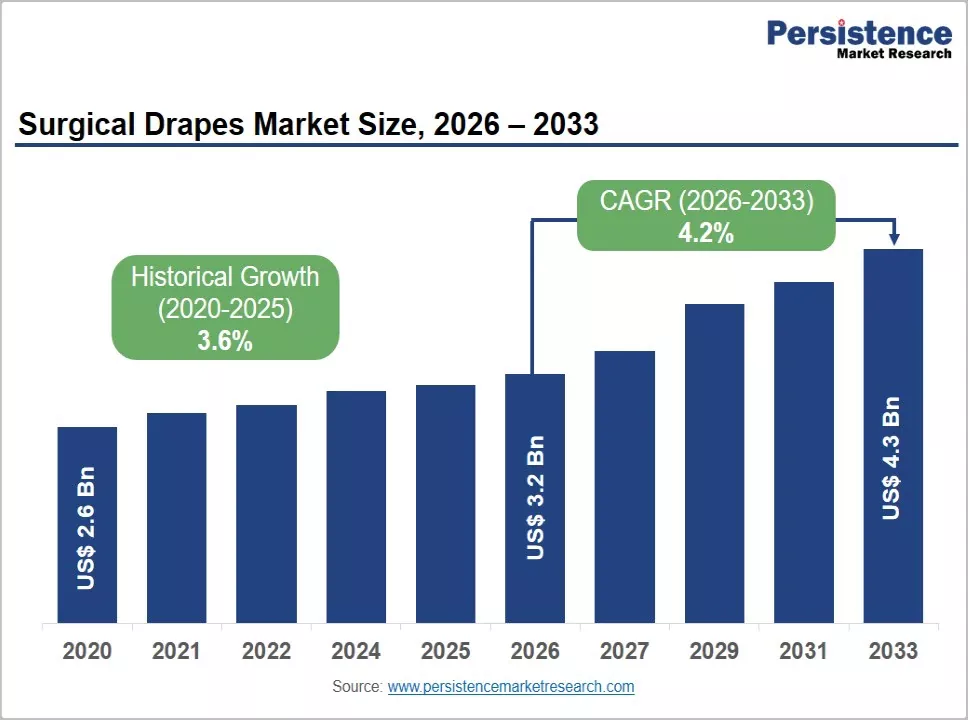
The global surgical drapes market is expected to be valued at US$ 3.2 billion in 2026 and is projected to reach US$ 4.3 billion by 2033, growing at a CAGR of 4.2% between 2026 and 2033. Rising surgical volumes and stricter infection prevention standards are the primary factors sustaining demand for surgical drapes.
The Lancet Commission on Global Surgery estimates that more than 313 million surgical procedures are performed worldwide each year, yet an additional 143 million procedures are needed annually in low- and middle-income countries to meet basic needs. At the same time, the World Health Organization (WHO) reports that about 11% of patients undergoing surgery in low- and middle-income countries acquire an infection, highlighting the clinical importance of effective sterile barriers. Ageing populations, a growing burden of chronic diseases requiring surgery, and the rapid expansion of ambulatory surgical centers are also contributing to market growth.
Key Industry Highlights
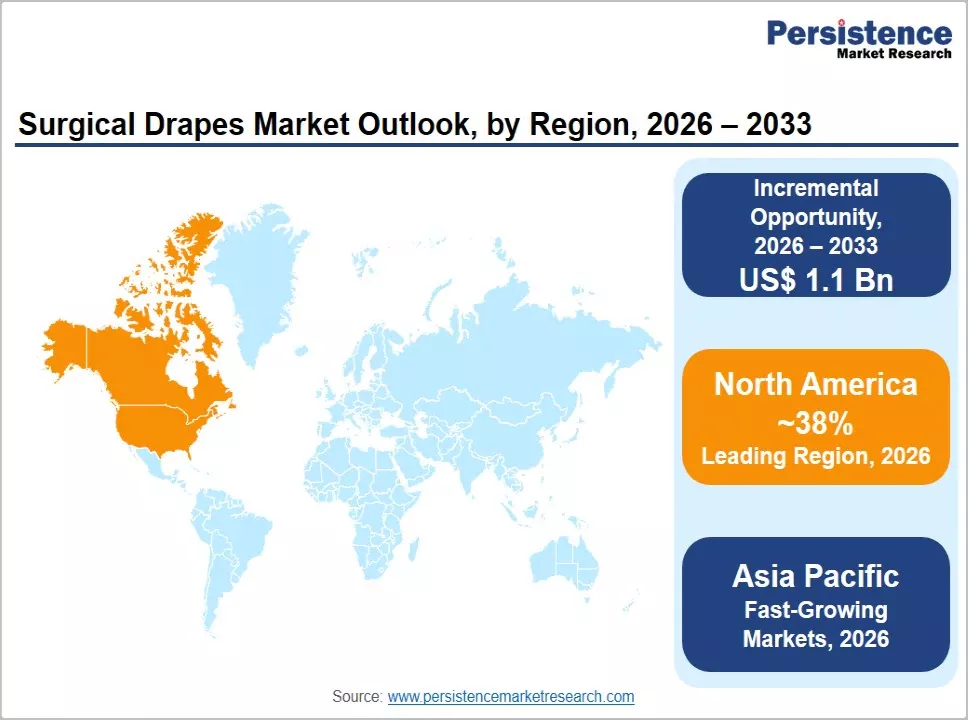
- Leading Region: North America is likely to lead the surgical drapes market with about 38% share in 2026, supported by high surgical volumes, strict FDA and AAMI standards, strong GPO purchasing networks, and widespread adoption of disposable drapes and custom procedure packs.
- Fastest-Growing Region: Asia Pacific is expected to post the fastest CAGR from 2026 to 2033, driven by China’s large surgical base, expanding insurance coverage in India and Southeast Asia, and the shift from reusable cotton to disposable nonwoven drapes.
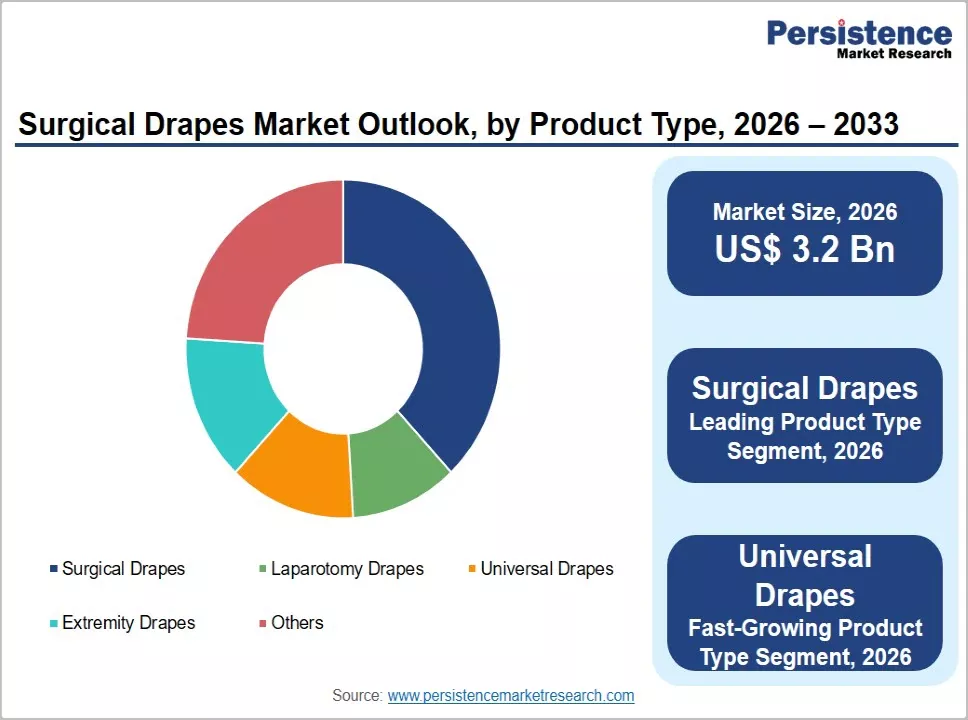
- Dominant Segment: Surgical drapes represent the leading product type segment, holding about 38% share in 2026, as nearly every sterile procedure requires a primary drape and standard drapes feature prominently in custom procedure packs supplied to hospitals.
- Fastest-Growing Segment: Universal drapes are expected to be the fastest-growing product type segment, fueled by the rapid growth of ambulatory surgical centers and specialty clinics seeking versatile, cost-efficient drapes that simplify inventory and speed operating room turnover.
- Key Market Opportunity: Sustainable, recyclable, and antimicrobial drapes tailored for ambulatory surgical centers, combined with localized manufacturing in high-growth markets such as India and Southeast Asia, offer strong growth potential for manufacturers through 2033.
Market Dynamics
Drivers - Rising Global Surgical Volumes and an Ageing Population
Growing global surgical volumes are a key demand driver for surgical drapes, as every sterile procedure requires at least one drape and most require several. The Lancet Commission on Global Surgery estimates that more than 313 million operations are performed worldwide each year, while about five billion people still lack access to safe, affordable surgical care, indicating significant untapped procedure volume. Population ageing is further amplifying this demand.
The United Nations projects that the number of people aged 65 years or older is expected to reach 1.6 billion by 2050, and older adults undergo disproportionately more cardiovascular, orthopedic, and oncologic procedures. In the U.S., a study published in The Journal of Rheumatology projected that primary total knee arthroplasty procedures can reach 1.26 million annually by 2030. Each additional procedure generates recurring demand for single-use drapes, incise drapes, and custom procedure packs across hospitals and outpatient facilities.
Stringent Infection Prevention Standards and Focus on Surgical Site Infections
Heightened focus on preventing surgical site infections (SSIs) is driving hospitals to invest in high-performance barrier drapes. The Centers for Disease Control and Prevention (CDC) estimates that on any given day, about 1 in 31 U.S. hospital patients has at least one healthcare-associated infection, with SSIs among the most common and costly types. According to CDC guidance, patients who develop an SSI face a two to 11-times higher risk of death.
In Europe, the European Centre for Disease Prevention and Control (ECDC) estimates that about 4.3 million patients acquire a healthcare-associated infection in EU/EEA hospitals each year. Technical standards further reinforce product requirements, as the ANSI/AAMI PB70 standard classifies barrier performance into four levels, while EN 13795 establishes performance requirements for surgical drapes in Europe. These frameworks, combined with penalties under the Centers for Medicare & Medicaid Services (CMS) Hospital-Acquired Condition Reduction Program, encourage adoption of fluid-resistant and higher-barrier drapes.
Restraints - Environmental Concerns Over Single-Use Disposables
Growing environmental scrutiny of single-use medical textiles is restraining market growth. Operating rooms are estimated to generate between 20% and 33% of total hospital waste, while disposable drapes and gowns represent a substantial share of this volume. According to Health Care Without Harm, the healthcare sector accounts for roughly 4.4% of global net greenhouse gas emissions, prompting health systems to assess product life cycles more closely.
The National Health Service (NHS) in England has committed to reaching net zero for the emissions it directly controls by 2040, while several European hospitals are shifting toward reusable woven drapes that can be laundered and sterilized multiple times. The WHO global guidelines for the prevention of surgical site infection state that either sterile disposable non-woven or sterile reusable woven drapes can be used, reducing the clinical preference for disposables alone and limiting volume growth in sustainability-focused markets.
Raw Material Price Volatility and Institutional Pricing Pressure
Volatile raw material costs and pricing pressure from institutional buyers limit profitability across the value chain. Most disposable drapes are made from polypropylene-based spunbond-meltblown-spunbond (SMS) nonwovens and polyethylene films, which are derived from petrochemicals and remain exposed to resin price fluctuations. Industry associations such as INDA, the Association of the Nonwoven Fabrics Industry, and EDANA in Europe have highlighted supply disruptions and cost inflation for nonwoven inputs during and after the COVID-19 pandemic.
At the same time, group purchasing organizations (GPOs), which the Healthcare Supply Chain Association (HSCA) reports are used by the vast majority of U.S. hospitals, negotiate aggressive contract pricing for commoditized drapes. Quality lapses add further risk, as seen in January 2020, when Cardinal Health recalled millions of AAMI Level-3 surgical gowns and related procedure packs over sterility concerns at a supplier facility. Together, these factors increase cost and supply-chain risks while limiting margins and creating barriers for new entrants.
Opportunities - Expansion of Ambulatory Surgical Centers and Demand For Universal Drapes
The migration of procedures to ambulatory surgical centers (ASCs) presents a significant growth opportunity, particularly for universal drapes and pre-assembled procedure packs. The Medicare Payment Advisory Commission (MedPAC) reports that more than 6,000 Medicare-certified ASCs operate in the U.S., while CMS has progressively expanded the ASC Covered Procedures List, adding total knee arthroplasty in 2020 and total hip arthroplasty in 2021. ASCs prioritize speed, standardization, and low inventory complexity, favoring versatile universal drapes that can be adapted to multiple procedures and custom packs that reduce turnover time.
Similar trends are visible in Europe, where Germany introduced hybrid DRG reimbursement in 2024 to encourage outpatient surgery, while France continues to promote ambulatory care through its national outpatient conversion policy. Manufacturers offering ASC-tailored universal drape kits, flexible supply agreements, and just-in-time delivery are positioned to address the growing requirements of this end-user channel through 2033.
Innovation in Sustainable and Antimicrobial Drapes
Innovation in sustainable and advanced-function drapes, combined with expanding healthcare access in emerging economies, creates another high-value opportunity. Hospitals increasingly seek products that combine barrier protection with lower environmental impact, driving interest in bio-based nonwovens, recyclable polypropylene drapes, and lighter-weight SMS fabrics that reduce material consumption. Several leading suppliers have set science-based emissions targets and are piloting take-back and recycling programs for single-use surgical textiles.
Antimicrobial incise drapes, such as Solventum's Ioban 2 drapes impregnated with an iodophor, offer differentiated functionality for high-risk orthopedic and cardiovascular procedures. Emerging markets add scale: India's National Medical Devices Policy 2023 aims to raise the country's share of the global medical devices market to 10–12% by 2047, supported by the Production Linked Incentive (PLI) scheme. Suppliers that combine eco-designed products with localized manufacturing in high-growth regions can address both premium and volume demand.
Category-wise Analysis
Product Type Insights
Surgical drapes are the leading product type segment, holding around 38% share of the market in 2026. Their dominance reflects near-universal use in operating rooms, where virtually every sterile procedure requires a primary drape to establish and maintain the sterile field. Guidelines from the CDC and the Association of periOperative Registered Nurses (AORN) emphasize proper draping as a core element of aseptic technique, sustaining high consumption. Standard drapes are also routinely included in custom procedure packs supplied under GPO contracts, reinforcing volume demand. Established brands such as Steri-Drape, now marketed by Solventum, and Mölnlycke Health Care’s BARRIER range are widely used in hospitals worldwide.
Universal drapes are projected to be the fastest-growing product type, driven by ambulatory surgical centers and specialty clinics that favor versatile, adaptable drapes that simplify inventory management and reduce procurement costs. Their standardized designs also support faster operating room preparation and lower inventory requirements across diverse procedures.
Application Insights
General surgery leads the application category, accounting for around 34% of the market share in 2026. The segment encompasses high-volume procedures such as appendectomies, cholecystectomies, hernia repairs, and bowel resections, which together represent a substantial share of operating room activity worldwide. In the U.S. alone, about 750,000 cholecystectomies and roughly 1 million hernia repairs are performed each year, according to data cited by the Society of American Gastrointestinal and Endoscopic Surgeons (SAGES). General surgery also carries notable SSI risk, particularly in colorectal procedures, which CMS monitors under its infection-linked payment programs, encouraging the use of laparotomy and incise drapes with fluid-control features. Gynecological surgery is another significant contributor, as the WHO reports that caesarean section rates have risen to 21% of all births globally.
Orthopedic surgery is projected to emerge as the fastest-growing application segment, driven by rising joint replacement volumes and the shift of arthroplasty to outpatient settings. Growing demand for standardized orthopedic procedure packs and specialized draping configurations also supports segment expansion.
End-User Insights
Hospitals are expected to dominate the market, capturing an estimated 61% share in 2026. They perform most complex, inpatient, and emergency surgeries, including cardiovascular, neurosurgical, trauma, and major oncologic procedures that require multiple large drapes per case. According to the American Hospital Association (AHA), there are more than 6,000 hospitals in the U.S., while the Organisation for Economic Co-operation and Development (OECD) reports that Japan and Germany have among the highest numbers of hospital beds per capita worldwide. Hospitals purchase drapes in high volumes through GPO contracts and integrated delivery networks, supporting favorable pricing and consistent supply. Strict infection control protocols overseen by accreditation bodies such as The Joint Commission further reinforce demand for certified, high-barrier drapes.
Ambulatory surgical centers are forecast to grow at the fastest CAGR through 2033, supported by payer incentives, lower procedure costs, and the expansion of approved outpatient orthopedic and cardiovascular procedures. Increasing migration of suitable surgeries from hospitals to ASCs also supports demand for standardized drapes and procedure packs.
Regional Analysis
North America Surgical Drapes Market Trends and Insights
North America is expected to maintain leadership in the global surgical drapes market, holding around 38% share in 2026. The region’s leadership is supported by high surgical volumes, advanced healthcare infrastructure, and strict infection control requirements enforced by regulators and accreditation bodies. Surgical drapes are regulated as Class II medical devices by the U.S. Food and Drug Administration (FDA), while barrier claims across the region are commonly validated against the ANSI/AAMI PB70 standard.
Key regional trends include a strong preference for disposable drapes, growing use of custom procedure packs that reduce operating room turnover time, and rapid expansion of ambulatory surgical centers. Health systems are also piloting reprocessing and recycling initiatives to address sustainability goals, while supply chain resilience has become a priority following pandemic-era shortages. These developments are prompting nearshoring of production within the Americas and diversification of sourcing away from single-country dependence.
U.S. Surgical Drapes Market Size
The U.S. surgical drapes market is estimated at about US$ 1.1 billion in 2026. The country performs tens of millions of surgical procedures annually across more than 6,000 hospitals and over 6,000 Medicare-certified ASCs. The CDC’s National Healthcare Safety Network (NHSN) tracks SSIs nationwide, while CMS links hospital reimbursement to infection outcomes through the Hospital-Acquired Condition Reduction Program, sustaining demand for high-barrier drapes.
Leading suppliers, including Medline Industries, Cardinal Health, and Owens & Minor, operate extensive domestic distribution networks and custom pack assembly facilities that serve integrated health systems. Growth opportunities are concentrated in outpatient orthopedics, as CMS continues to expand procedures eligible for ASC reimbursement, and in sustainable drape programs as large health systems pursue emissions reduction commitments and waste diversion targets.
Europe Surgical Drapes Market Trends and Insights
Europe is the second-largest market, accounting for about 28% of global market revenue in 2026. Demand is supported by high surgical volumes, universal health coverage, and a strong regulatory framework. Surgical drapes are governed by the EU Medical Device Regulation (MDR) 2017/745, with transition deadlines extended to 2027 and 2028 under Regulation (EU) 2023/607, and are required to meet performance requirements set by EN 13795-1. The ECDC estimates that 4.3 million patients acquire healthcare-associated infections in EU/EEA hospitals each year, keeping infection prevention a policy priority. The shift toward outpatient surgery, investment in hybrid operating rooms, and rising demand for procedure packs are also shaping procurement, while MDR compliance costs are prompting smaller suppliers to rationalize portfolios.
Germany Surgical Drapes Market Size
Germany’s surgical drapes market is projected to be valued at around US$ 205 million in 2026. The country has one of the highest surgical intensities in Europe, supported by an extensive hospital network and among the highest numbers of hospital beds per capita within the OECD. The German Arthroplasty Registry (EPRD) documents several hundred thousand hip and knee replacement procedures each year, sustaining strong orthopedic drape demand. The Robert Koch Institute (RKI) and its KRINKO commission issue infection prevention recommendations that shape operating room practices.
Hospital reform under the Hospital Care Improvement Act (KHVVG) and the introduction of hybrid DRG reimbursement in 2024 are accelerating the move toward outpatient surgery, creating demand for universal drapes and compact procedure packs. Domestic leaders such as Paul Hartmann AG and Lohmann & Rauscher strengthen local supply, innovation, and hospital partnerships.
U.K. Surgical Drapes Market Size
The U.K. surgical drapes market is estimated at about US$ 135 million in 2026. Demand is closely tied to NHS efforts to reduce elective care backlogs, as the NHS England referral-to-treatment waiting list has remained above seven million cases, with the government targeting 65% of patients treated within 18 weeks by March 2026. Expanded surgical hubs and increased theatre capacity are raising drape consumption, particularly in orthopedics and general surgery.
The UK Health Security Agency (UKHSA) runs mandatory SSI surveillance for orthopedic procedures, reinforcing demand for high-barrier drapes. Procurement is centralized through NHS Supply Chain, which drives standardization and competitive pricing. At the same time, the NHS commitment to net zero direct emissions by 2040 is encouraging trials of reusable drapes and lower-carbon materials, creating opportunities for suppliers offering validated sustainable alternatives.
France Surgical Drapes Market Size
France accounts for about 14% of European market revenue. The country performs a large volume of surgical procedures across its public and private hospital network, while national health policy has strongly promoted ambulatory surgery, with authorities targeting 70% of procedures to be performed on an outpatient basis. This shift favors compact, procedure-specific drape kits and universal drapes suited to fast turnover. Santé publique France coordinates national SSI surveillance through the SPICMI network, while the Haute Autorité de Santé (HAS) includes infection prevention indicators in hospital certification, reinforcing quality standards.
The French Society for Hospital Hygiene (SF2H) provides guidance on operating room practices, including draping. Opportunities are emerging in eco-designed drapes, as the French anti-waste law (AGEC) and hospital decarbonization plans encourage buyers to consider environmental impact in procurement decisions.
Asia Pacific Surgical Drapes Market Trends And Insights
Asia Pacific is projected to register the fastest CAGR between 2026 and 2033, driven by expanding healthcare infrastructure, rising surgical volumes, and growing adoption of international infection control standards. China anchors regional demand as one of the world’s largest surgical markets, with the National Health Commission (NHC) reporting tens of millions of inpatient surgical operations annually, while the country is also a global manufacturing hub for nonwoven medical textiles. Chinese volume-based procurement of medical consumables is lowering unit prices while expanding access in lower-tier hospitals.
Across the region, key trends include a transition from reusable cotton drapes to disposable nonwoven drapes, growth in private hospital chains, rising medical tourism, and wider adoption of procedure packs. Government health insurance expansion and hospital accreditation programs are improving compliance with sterile practices, while local manufacturers are scaling capacity to serve domestic and export markets, intensifying price competition.
India Surgical Drapes Market Size
India’s surgical drapes market is estimated at about US$ 95 million in 2026. Rising surgical volumes are supported by the Ayushman Bharat Pradhan Mantri Jan Arogya Yojana (AB PM-JAY), which provides health cover of up to INR five lakh per family per year for secondary and tertiary hospitalization and was extended in 2024 to all citizens aged 70 and older. The National Family Health Survey (NFHS-5) reported that 21.5% of births in India are delivered by caesarean section, rising to 47.4% in private facilities, driving strong gynecological drape demand.
Accreditation by the National Accreditation Board for Hospitals & Healthcare Providers (NABH) is encouraging adoption of disposable sterile drapes. The National Medical Devices Policy 2023 and PLI scheme support domestic manufacturing, creating opportunities for cost-competitive local production and exports.
Competitive Landscape
The global surgical drapes market is moderately consolidated, with a group of large multinational suppliers holding a significant share of hospital contracts alongside numerous regional and low-cost manufacturers. Leading companies such as Medline Industries, Cardinal Health, Owens & Minor, Mölnlycke Health Care, and Paul Hartmann AG compete through broad product portfolios, established GPO and tender relationships, and custom procedure pack capabilities. Key differentiators include certified barrier performance under AAMI PB70 and EN 13795, fluid-control and antimicrobial features, dependable supply chains, and clinical education services.
Strategic priorities include acquisitions to expand surgical portfolios, investment in automated pack assembly, nearshoring and dual sourcing to improve resilience, and research into bio-based and recyclable nonwovens. Emerging business models include value-based supply contracts, drape take-back programs, and hybrid offerings combining disposable and reusable drapes, while Asian manufacturers such as Winner Medical Co., Ltd. intensify price competition in export markets.
Key Industry Developments
- In December 2024, Medline Industries announced an agreement to acquire Ecolab’s global surgical solutions business, which includes equipment drapes and other operating room products, for about US$ 950 million, expanding its surgical draping portfolio and strengthening its presence in hospital operating rooms worldwide.
- In April 2024, 3M completed the spin-off of its healthcare business as Solventum Corporation, an independent publicly traded company that now markets Steri-Drape surgical drapes and Ioban antimicrobial incise drapes, enabling dedicated investment in infection prevention and surgical solutions.
Companies Covered in Surgical Drapes Market
- Cardinal Health
- 3M
- Owens & Minor
- Mölnlycke Health Care
- Halyard Health
- Medline Industries
- Stryker
- Paul Hartmann AG
- Lohmann & Rauscher
- Dynarex Corporation
- Ahlstrom
- Winner Medical Co., Ltd.
- Priontex
Frequently Asked Questions
The global surgical drapes market is expected to be valued at US$ 3.2 billion in 2026 and is projected to reach US$ 4.3 billion by 2033, expanding at a CAGR of 4.2% during the forecast period.
Market growth is primarily driven by rising surgical volumes and a strong focus on preventing surgical site infections.
North America is likely to lead the surgical drapes market with around 38% share in 2026.
The most significant opportunity lies in the rapid expansion of ambulatory surgical centers, which favor universal drapes and procedure-specific packs.
Key players operating in the surgical drapes market include Cardinal Health, 3M, Owens & Minor, Mölnlycke Health Care, Halyard Health, Medline Industries, Stryker, Paul Hartmann AG, Lohmann & Rauscher, Dynarex Corporation, Ahlstrom, Winner Medical Co., Ltd., and Priontex. Other notable participants include Solventum Corporation, Ansell Limited, Standard Textile Co., Inc., and Aspen Surgical Products, Inc.


