




- Food Ingredients & Additives
- Sugar Replacer Market
Sugar Replacer Market Size, Share, and Growth Forecast 2026 - 2033
Sugar Replacer Market by Product Type (High-Intensity Sweeteners, Polyols, Rare Sugars), Source (Natural, Artificial), Application (Beverages, Bakery & Confectionery, Dairy & Frozen Desserts, Tabletop Sweeteners), and Regional Analysis, 2026 - 2033

Sugar Replacer Market Size and Trends Analysis
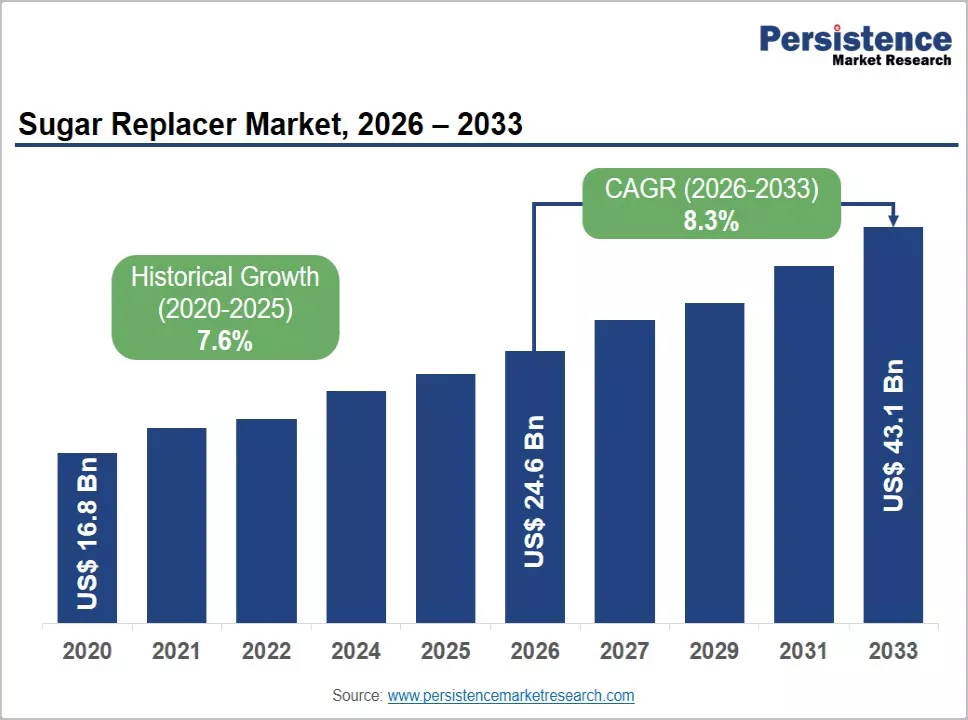
The global sugar replacer market size is likely to be valued at US$24.6 billion in 2026 and is estimated to reach US$43.1 billion by 2033, growing at a CAGR of 8.3% during the forecast period from 2026 to 2033, driven by tightening sugar-related labeling rules, rising diabetes prevalence, and the surging overlap between weight-management drug users and demand for sweetened, low-calorie products. Manufacturers are blending natural high-intensity sweeteners with rare sugars and taste-modulation technology to replicate sugar's taste more closely.
Key Industry Highlights:
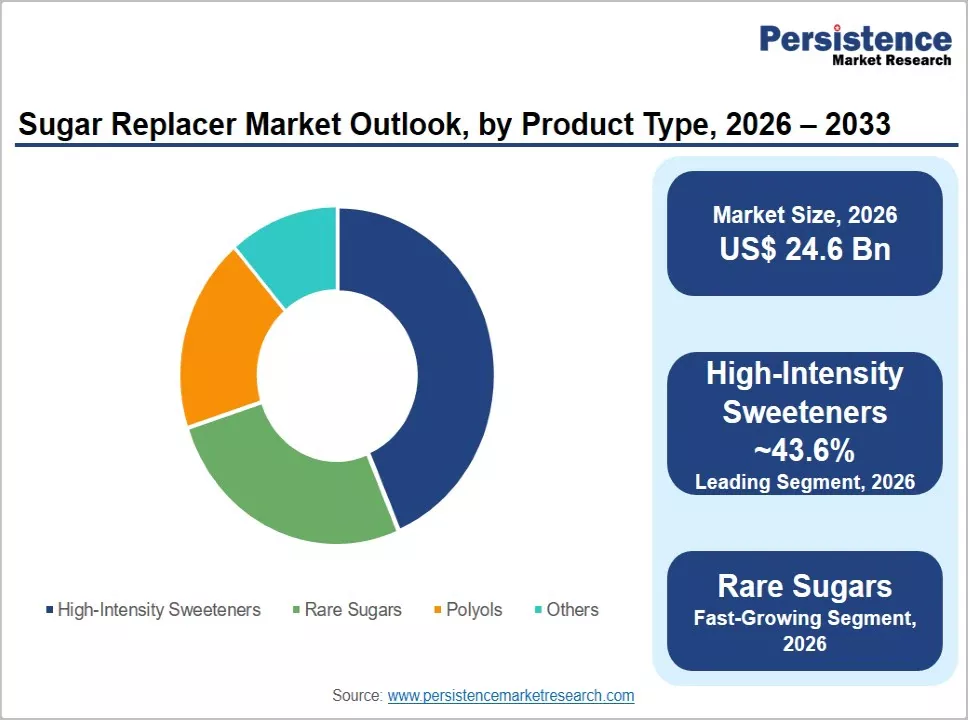
- Leading Product Type: High-intensity sweeteners, about 43.6% share in 2026, as stevia, monk fruit, and sucralose deliver strong sweetness at very low use levels across beverages and packaged foods.
- Dominant Application: Beverages, around 34.2% share in 2026, as carbonated soft drinks, juices, and functional drinks are reformulated most frequently in response to sugar-related labeling and taxation policies.
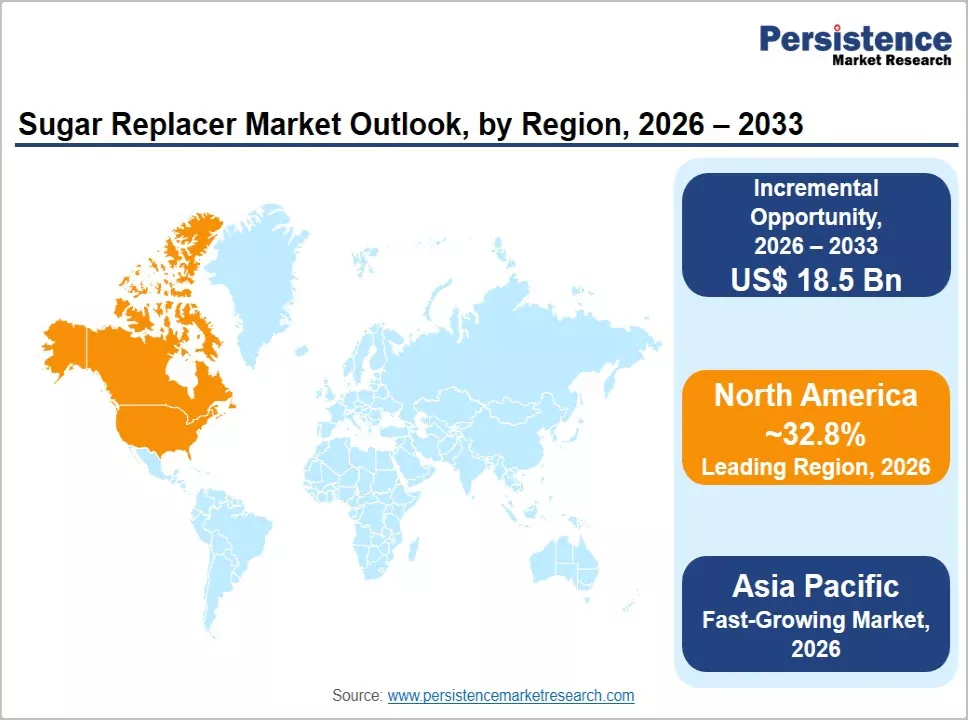
- Leading Region: North America, with about a 32.8% share in 2026, supported by an established sweetener supply base and rising demand tied to GLP-1 medication users who continue to prefer sweetened products.
- Fast-growing Region: Asia Pacific, due to a large and growing diabetic population and rapid new product development using natural sweeteners.
- Latest Agreement: In May 2026, Heartland Food Products Group announced a definitive agreement to acquire the Americas business of Whole Earth Brands, including the Equal, Whole Earth, Swerve, and Chuker sweetener brands. The transaction would combine these brands with Heartland’s Splenda portfolio and expand its presence across natural sweeteners, low- and no-calorie sweeteners, foodservice, retail, and ingredient solutions.
DRO Analysis
Driver - Front-of-Pack Labeling and Sugar Taxes to Push Reformulation Toward Sugar Replacers
Government policy is one of the clearest forces pushing manufacturers toward sugar replacers. Health Canada is implementing a mandatory front-of-pack “high in” nutrition symbol for products high in sugar, saturated fat, or sodium, with rules taking effect by 2026, following a labeling model already used in Mexico. Canada is also removing the requirement to list the specific amount of low- and no-calorie sweeteners in the ingredients list, aligning their treatment with other food additives.
In Latin America, similar warning-label policies have already prompted major beverage bottlers to expand their zero-sugar product ranges rather than carry a visible warning label on standard formulations. As more countries adopt comparable front-of-pack systems, beverage and packaged food companies are expected to accelerate reformulation using high-intensity sweeteners and rare sugars to avoid warning labels while retaining sweetness.
GLP-1 Medication Use to Sustain Demand for Sweetened, Low-Calorie Products
The rapid rise in use of GLP-1 receptor agonists such as semaglutide and tirzepatide is reshaping demand patterns in ways that support the sugar replacer market. While these medications reduce users' overall caloric intake, most users continue to prefer sweetened foods and beverages, creating demand for products that deliver familiar taste at a fraction of the calories. This has encouraged ingredient suppliers to develop combinations such as stevia and monk fruit blended together.
These are aimed at achieving a more sugar-like taste profile across a wider range of applications, including nutrition products and functional beverages targeted at this growing consumer group. Ingredient suppliers note that consumers are also becoming more attentive to which specific ingredient replaces sugar in a product, rather than focusing only on the overall reduction achieved, adding pressure on formulators to select replacers with credible natural positioning and demonstrated regulatory acceptance.
Restraint - Regulatory Caution and Mixed Health Guidance May Slow Adoption of Some Sweeteners
In May 2023, the World Health Organization issued a guideline recommending against the use of non-sugar sweeteners for weight control or reduction of noncommunicable disease risk, citing low-certainty evidence of long-term benefit and possible associations with increased risk of type 2 diabetes and cardiovascular disease in observational studies. Although the recommendation is conditional and does not apply to people with pre-existing diabetes, it has added a layer of caution to how some sweeteners are perceived and marketed.
The high production cost of natural sugar replacers such as stevia, monk fruit, and allulose compared with conventional sugar or synthetic sweeteners also limits adoption in price-sensitive markets and categories, and can slow reformulation among smaller manufacturers without in-house taste-modulation expertise. Sourcing adds a further complication. Much of the world's stevia supply is grown under contract in Paraguay, and monk fruit cultivation is concentrated in Guangxi province in China, creating traceability and supply-continuity challenges for buyers seeking certified organic or non-GMO raw material, and favoring vertically integrated suppliers with direct grower relationships over smaller, spot-market buyers.
Opportunity - Rare Sugars Excluded from Added-Sugar Counts to Support Continued Reformulation
Regulatory treatment of certain rare sugars is creating a distinct commercial advantage. In markets including the U.S., South Korea, and Australia and New Zealand, allulose is recognized as providing negligible calories and is excluded from total and added sugar declarations, giving formulators a labeling advantage unavailable to polyols or artificial sweeteners, which remain classified as food additives in several jurisdictions.
This regulatory positioning is encouraging continued investment in rare sugar production capacity and in blends that combine allulose with high-intensity sweeteners to more closely replicate sugar's bulk, texture, and browning behavior in baked goods. Suppliers are also investing in bioconversion and fermentation-based manufacturing routes for rare sugars and high-purity stevia extracts, aiming to improve taste consistency while making production more scalable and cost-efficient than extraction from natural sources alone.
Taste-Modulation Technology to Widen the Applications for High-Intensity Sweeteners
A persistent challenge with high-intensity sweeteners is off-notes, including metallic, bitter, or licorice-like aftertastes that limit how much sugar they can replace in a given formulation. Ingredient companies are responding with dedicated taste-modulation platforms designed to mask these off-notes and allow higher levels of sugar reduction without a corresponding loss in consumer acceptance, widening the range of products where near-total sugar replacement becomes commercially viable.
Suppliers report that side-by-side sensory testing is increasingly used to help brand teams select between competing sweetener systems more quickly, reflecting how central taste performance, not just cost or regulatory status, has become to purchasing decisions in this category.
Category-wise Analysis
Product Type Insights
High-intensity sweeteners are predicted to lead with a share of about 43.6% in 2026, as stevia, monk fruit, and sucralose provide substantial sweetness at very low usage levels, keeping formulation costs manageable even though the raw ingredients themselves are relatively expensive. Continued investment in next-generation stevia extracts with improved taste profiles is reinforcing this segment's position.
Rare sugars, including allulose and tagatose, are estimated to be the fastest-growing product type over the forecast period, supported by their favorable regulatory treatment in several major markets and by their close functional resemblance to sugar in baking and browning applications, a property polyols and high-intensity sweeteners cannot fully replicate.
Application Insights
Beverages are anticipated to dominate with a share of around 34.2% in 2026, as carbonated soft drinks, juices, and functional beverages are typically the first products reformulated in response to sugar taxes and front-of-pack warning labels. Zero- and reduced-sugar variants have become standard across most major beverage portfolios in markets with such policies in place.
The bakery and confectionery segment is expected to be the fastest-growing application over the forecast period, as rare sugars and taste-modulation technology make it increasingly possible to reduce sugar content in baked goods without sacrificing browning, moisture retention, or mouthfeel, properties that have historically been difficult to replicate with high-intensity sweeteners alone.
Regional Insights
North America Sugar Replacer Market Trends
North America is predicted to dominate with a global share of approximately 32.8% in 2026. The region benefits from a mature sweetener ingredient ecosystem, extensive food and beverage manufacturing capabilities, and exponential demand for products with reduced sugar and calorie content. Manufacturers are reformulating beverages, dairy products, bakery items, confectionery, and nutritional products to reduce conventional sugar while maintaining sweetness and acceptable taste. The surging focus on calorie-conscious product development is also creating opportunities for low-calorie sweeteners, sugar alcohols, and natural alternatives such as stevia, monk fruit, and allulose.
U.S. Sugar Replacer Market Trends
In 2026, a share of nearly 85.4% is expected to be held by the U.S. in North America, exhibiting its large packaged food and beverage industry and extensive reformulation activity. Demand is being supported by manufacturers seeking to reduce added sugar while retaining the sensory characteristics consumers expect from conventional products. Beverages, dairy and dairy alternatives, confectionery, bakery products, sauces, and functional foods are among the key categories where sugar-reduction strategies can create opportunities for alternative sweetening systems.
Asia Pacific Sugar Replacer Market Trends
Asia Pacific is anticipated to be the fastest-growing region globally in 2026, as the region carries a very large diabetic population and continues to lead global new product development activity incorporating sugar-reduction sweeteners. Rising diabetes prevalence in India and China, both home to large diabetic populations, is a key driver of reformulation across sugar-heavy food categories common in the region.
China Sugar Replacer Market Trends
China will likely lead in Asia Pacific in 2026 with a share of about 34.5%. The country benefits from a well-established monk fruit cultivation and processing hub, with Guangxi serving as a leading production hub. This strong domestic supply base supports the availability of natural sweetening ingredients for food and beverage manufacturers. At the same time, rising consumer awareness of sugar intake is encouraging manufacturers to reformulate products with lower sugar content. Demand is expanding across reduced-sugar beverages, dairy products, confectionery, and other packaged foods.
India Sugar Replacer Market Trends
India is projected to account for around 22.1% of the Asia Pacific sugar replacer market in 2026. The market is being supported by growing attention to sugar intake and the need to reformulate commonly consumed foods and beverages. India has a large market for sweetened tea and coffee, packaged beverages, confectionery, bakery products, and dairy-based foods, creating a broad application base for sugar-reduction ingredients. Manufacturers are increasingly exploring alternatives that can reduce sugar content without significantly changing sweetness or product positioning. Stevia is particularly relevant as it provides high-intensity sweetness at very low usage levels, while monk fruit is gaining attention as a plant-derived option for clean-label and naturally positioned formulations.
Europe Sugar Replacer Market Trends
Europe is expected to account for approximately 26.7% of the global sugar replacer market in 2026 and is likely to record steady growth during the forecast period. Regulatory and public-health initiatives aimed at reducing sugar consumption are creating a favorable environment for reformulation. The European Commission reported in 2025 that 12 EU countries had taxes on soft drinks, while evidence reviewed by the Commission indicated that manufacturers had reduced sugar content in some soft drinks following the introduction of tax schemes.
Germany Sugar Replacer Market Trends
Germany is expected to remain an important market for sugar replacers in Europe, supported by government-led efforts to reduce sugar in processed foods. It is estimated to account for a share of nearly 35.7% in 2026. The country’s National Reduction and Innovation Strategy for Sugar, Fats and Salt in Processed Foods sets science-based targets for reducing these nutrients and encourages food manufacturers to reformulate products. German government monitoring has indicated that reformulation efforts made so far have not yet been sufficient, creating continued scope for lower-sugar formulations and alternative sweetening systems.
U.K. Sugar Replacer Market Trends
In 2026, the U.K. will likely hold a share of approximately 29.3%, supported by the Soft Drinks Industry Levy (SDIL), which has encouraged manufacturers to lower sugar levels in beverages. The U.K. government reported in 2025 that the levy had contributed to the removal of almost half of the sugar from shop-bought soft drinks, while independent research cited by the government found a 47% average reduction in sugar in drinks within the levy’s scope between 2015 and 2024. Policy changes are expected to create further demand for sugar-reduction ingredients.
Competitive Landscape
The global sugar replacer market is moderately consolidated, with a small number of large ingredient companies supplying most high-intensity sweeteners, polyols, and rare sugars used in food and beverage reformulation, alongside specialized stevia and monk fruit processors. Cargill, ADM, Ingredion, Tate & Lyle, and Kerry Group maintain broad sweetener portfolios and taste-modulation platforms.
Companies such as Layn Natural Ingredients and Samyang concentrate on specific natural sweetener categories, including monk fruit and allulose. Partnerships between large ingredient companies and specialized bioconversion technology developers are becoming more common, as suppliers look to scale high-purity natural sweetener production without building every fermentation capability internally.
Key Industry Developments:
- In July 2026, HealthTech Bio Actives introduced Citrose, a citrus-derived high-intensity sweetener designed for reduced- and zero-sugar food and beverage formulations. The ingredient is Upcycled Certified and was developed to improve sweetness quality and provide a more sugar-like taste when used in blended sweetener systems.
- In June 2026, Manus unveiled its monk fruit sweetener produced at commercial scale in the U.S. through industrial fermentation. The company said the ingredient was the first monk fruit sweetener produced commercially in the U.S. using biomanufacturing, providing a domestic alternative to conventionally cultivated monk fruit, which has historically been sourced primarily from China.
- In June 2026, Truvia launched its Allulose Plus Stevia Sweetener & Monk Fruit Sweetener, a tri-blend combining allulose, stevia, and monk fruit. The company designed the product to provide a sugar-like taste with zero calories per serving and a 1:1 replacement ratio, while allulose contributes functionality such as browning and caramelization. The product was initially launched at Target, with broader retail distribution planned.
Companies Covered in Sugar Replacer Market
- Cargill, Incorporated
- Archer Daniels Midland Company
- Ingredion Incorporated
- Tate & Lyle PLC
- Kerry Group plc
- DSM-Firmenich
- Layn Natural Ingredients Co., Ltd.
- Samyang Corporation
- Roquette Frères
- Südzucker AG
- Others
Frequently Asked Questions
The global sugar replacer market is projected to be valued at US$24.6 billion in 2026.
The sugar replacer market is expected to reach US$43.1 billion by 2033.
Key market trends include front-of-pack labeling and sugar-tax-driven reformulation, sustained demand from GLP-1 medication users, favorable regulatory treatment of rare sugars such as allulose, and taste-modulation technology that masks off-notes in high-intensity sweeteners.
High-intensity sweeteners are expected to be the leading product type with a share of around 43.6% in 2026, as stevia, monk fruit, and sucralose deliver strong sweetness at very low use levels.
The market is expected to grow at a CAGR of 8.3% from 2026 to 2033.
Cargill, Incorporated, Archer Daniels Midland Company, and Ingredion Incorporated are a few key market players.


