




- Food Ingredients & Additives
- Green Cardamom Market
Green Cardamom Market Size, Share, and Growth Forecast, 2026–2033
Green Cardamom Market By Product Type (Small Green Cardamom, Large Green Cardamom), Nature (Conventional, Organic, Certified Organic), Application, Distribution Channel, and Regional Analysis for 2026–2033

Green Cardamom Market Size and Trends Analysis
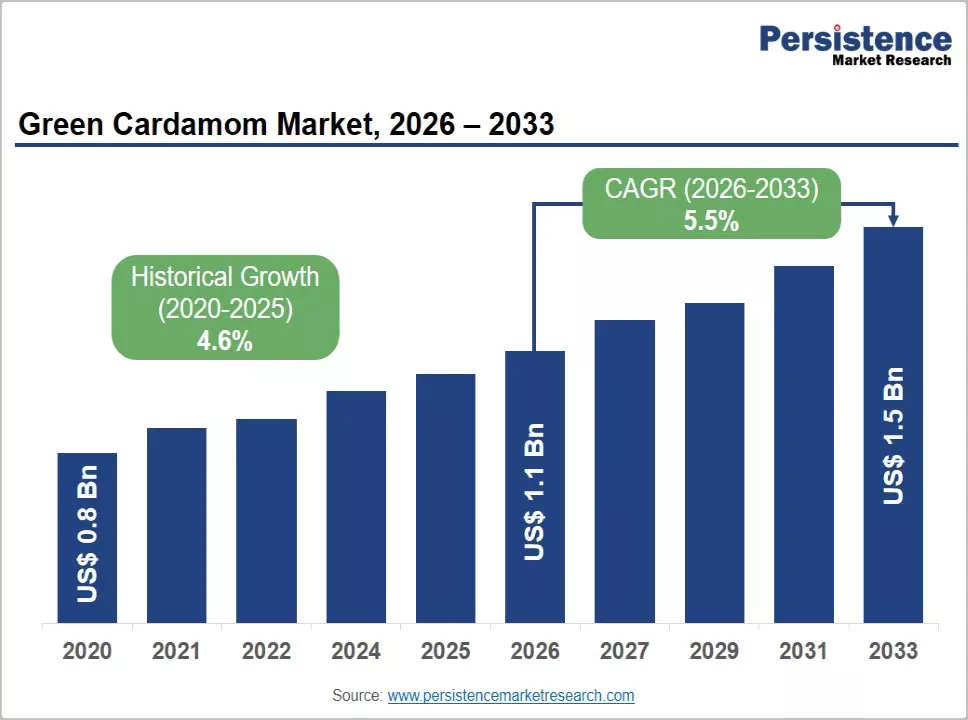
The global green cardamom market size is likely to be valued at US$ 1.1 billion in 2026 and is expected to reach US$ 1.5 billion by 2033, growing at a CAGR of 5.5% between 2026 and 2033, driven by increasing consumption of natural spices, expanding food and beverage applications, and rising demand for premium culinary ingredients. Growing international trade, wider adoption of organic spices, and increasing use of cardamom in beverages, bakery products, confectionery, and traditional food preparations are further supporting market expansion.
Key Industry Highlights
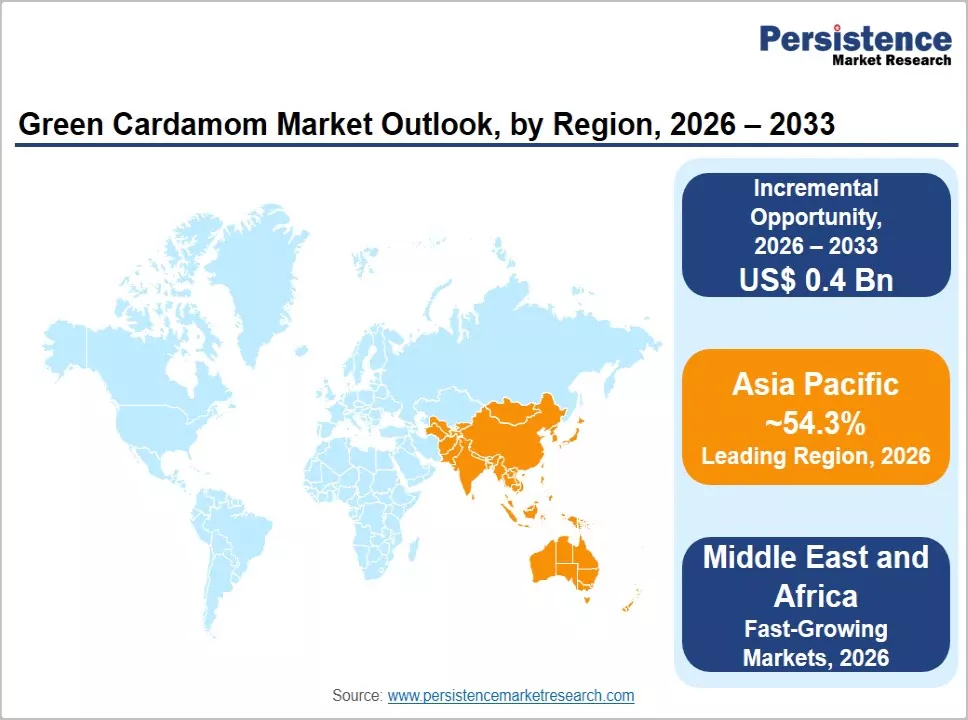
- Leading Region: Asia Pacific, anticipated to account for approximately 54.3% of the global market share, supported by established cultivation, strong domestic consumption, traditional culinary applications, and expanding spice exports.
- Fastest-growing Region: Middle East and Africa, driven by strong demand for cardamom in traditional beverages, regional cuisines, hospitality, and food service applications.
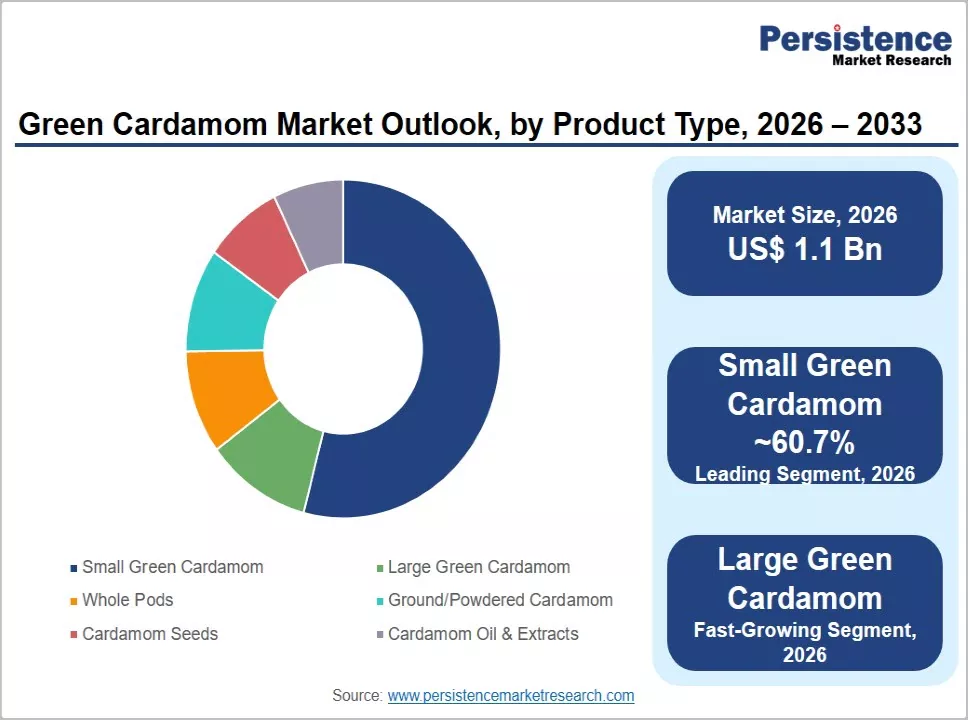
- Dominant Product Type: Small green cardamom, anticipated to account for 60.7% of the market share, supported by its widespread use in household cooking, beverages, confectionery, and premium spice blends.
- Leading Nature: Conventional cardamom, anticipated to account for 82.1% of the market share, supported by established cultivation networks, broad availability, and competitive pricing.
DRO Analysis
Drivers – Expanding Food and Beverage Applications Strengthen Cardamom Consumption
The increasing use of green cardamom across food and beverage applications is supporting market demand. Cardamom remains an important ingredient in traditional preparations across South Asia, the Middle East, and parts of Europe. Its aromatic characteristics support its use in tea, coffee, bakery products, confectionery, dairy preparations, spice blends, and packaged beverages.
Food manufacturers are also incorporating cardamom into flavored milk, ready-to-drink beverages, desserts, and premium confectionery. The expansion of packaged food consumption and specialty beverage categories is increasing demand for standardized cardamom ingredients, including whole pods, ground powder, oils, and extracts. This diversification is strengthening demand beyond conventional household consumption.
Growing International Trade and Established Production Networks Support Market Expansion
International trade is an important growth driver for the Green Cardamom Market, supported by established cultivation and distribution networks in major producing countries. India remains an important source of small cardamom, with production concentrated in Kerala, Karnataka, and Tamil Nadu.
According to the Spices Board of India, small cardamom production reached 20,696 metric tons in 2024–25, while exports increased to 6,728 metric tons from 6,168 metric tons in 2023–24. Export value also increased from ?999.59 crores (approx. US$107.8 million) to ?1,566.82 crores (nearly US$169 million) during the same period. Rising international trade is supporting demand from import-dependent markets and strengthening commercial opportunities for processors and exporters.
Restraint – Production Volatility and Climatic Dependence Affect Supply Stability
Green cardamom cultivation is concentrated in tropical high-altitude growing areas with specific rainfall, temperature, and shade requirements. Changes in rainfall patterns, prolonged dry periods, excessive moisture, and pest incidence influence crop productivity and harvesting volumes. India's small cardamom production declined from 25,230 metric tons in 2023–24 to 20,696 metric tons in 2024–25, reflecting the vulnerability of production to climatic and agricultural conditions. Price fluctuations resulting from changes in crop availability also affect procurement costs for processors, wholesalers, and packaged spice manufacturers. The dependence on geographically concentrated production areas increases supply-side exposure and influences export pricing.
Opportunities – Organic and Traceable Cardamom Create Premium Market Opportunities
Increasing consumer preference for natural, organic, and responsibly sourced food ingredients is creating opportunities for organic green cardamom. Consumers are increasingly examining ingredient origin, cultivation practices, certification, and product traceability when purchasing premium spices. Organic cardamom is gaining commercial relevance across specialty retail, natural food stores, premium spice brands, and international food ingredient supply chains. Producers are focusing on agricultural practices, residue management, post-harvest handling, and certification to access premium markets.
Food Processing and Value-added Cardamom Products Expand Commercial Potential
The growing use of cardamom in packaged foods, beverages, bakery products, and confectionery is creating opportunities for processed and value-added products. Whole pods remain important in household cooking, while ground cardamom, seeds, oils, and extracts offer greater flexibility for industrial formulations. Food manufacturers increasingly require consistent aroma, flavor intensity, particle size, and ingredient quality across production batches. Cardamom oil and extracts also provide opportunities in flavor formulations, fragrance, and personal care applications. Expansion of food processing and specialty beverage manufacturing is increasing the relevance of standardized cardamom ingredients and commercial processing capabilities.
Category-wise Analysis
Product Type Insights
Small green cardamom is anticipated to account for 60.7% of the market share. The segment benefits from widespread use in household cooking, traditional beverages, confectionery, bakery products, and spice blends. Small green cardamom is particularly important in Indian, Middle Eastern, and South Asian cuisines, where its aromatic properties support both sweet and savory preparations. Whole pods are commonly used in tea, rice dishes, curries, and desserts, while seeds and powdered cardamom are incorporated into packaged food formulations. Its established cultivation, extensive trading networks, and broad consumer acceptance continue to support segment dominance.
Large green cardamom is projected to be the fastest-growing product type. Increasing use in regional cuisines, spice blends, meat preparations, and commercial food processing is supporting demand. Large cardamom offers a distinct smoky flavor profile and is used in applications that require stronger aromatic characteristics. Whole pods continue to represent an important commercial format because of their suitability for traditional culinary preparations and retail packaging. Ground cardamom, seeds, and cardamom oil and extracts also contribute to market diversification through their applications in packaged foods, beverages, flavor formulations, and fragrance products.
Nature Insights
Conventional green cardamom is anticipated to account for 82.1% of the market share. Its dominance is supported by established agricultural production systems, widespread availability, and relatively broad price accessibility. Conventional cardamom is cultivated across major producing countries and distributed through domestic wholesale markets, exporters, spice processors, and organized retail channels. The segment benefits from established supply relationships and strong demand from household consumers and food manufacturers. Conventional whole pods and powdered cardamom remain important ingredients in traditional cooking, packaged spice blends, and commercial food preparations. Its extensive distribution network supports its leading position across both domestic and international markets.
Organic green cardamom is projected to be the fastest-growing segment, registering a CAGR of 6.5% during the forecast period. Increasing interest in certified agricultural products and traceable food ingredients is supporting demand for organic spices. Organic cardamom is gaining relevance among specialty retailers, premium spice brands, natural food manufacturers, and consumers seeking products cultivated under certified organic standards. Sustainably sourced, fair-trade sourced, and premium single-origin cardamom also represent important differentiated product categories. These products emphasize agricultural practices, producer relationships, geographical origin, and quality consistency. The expansion of specialty food retail and international demand for certified ingredients is strengthening commercial opportunities for premium cardamom suppliers.
Regional Insights
Asia Pacific Green Cardamom Market Trends
Asia Pacific is anticipated to account for approximately 54.3% of the market share, supported by established cultivation, strong household consumption, and extensive spice trading networks. The region includes major producing and consuming countries, with India representing an important source of small green cardamom. Traditional food preparations, tea consumption, confectionery, and packaged spice applications contribute to regional demand. The presence of agricultural production clusters and established wholesale markets also supports the availability of different cardamom grades and product formats.
India Green Cardamom Market Trends
India represents a major market for green cardamom because of its established cultivation base, extensive domestic consumption, and export-oriented spice industry. Kerala, Karnataka, and Tamil Nadu are the principal small cardamom-producing states. According to the Spices Board of India, small cardamom production reached 20,696 metric tons in 2024–25, compared with 25,230 metric tons in 2023–24. Kerala accounted for 18,310 metric tons of production during 2024–25, reflecting its importance in the domestic supply chain.
India's cardamom industry is supported by traditional household consumption, organized spice processing, auction-based trading, and international exports. In 2024–25, the country exported 6,728 metric tons of small cardamom, representing an increase from 6,168 metric tons in the previous year. Export value increased to ?1,566.82 crores, compared with ?999.59 crore in 2023–24. The Spices Board also operates productivity improvement and post-harvest quality programs to support cultivation and export-oriented production.
China Green Cardamom Market Trends
China represents an important consumption and import market for cardamom, supported by its extensive food processing industry and established international spice trade. Cardamom is used in selected traditional preparations, spice blends, packaged foods, and commercial food formulations. Growing demand for differentiated flavors and specialty food ingredients is supporting opportunities for imported cardamom products.
The country's large food manufacturing base also supports demand for processed spice ingredients, including ground cardamom and extracts. International sourcing networks and established import distribution channels connect Chinese food manufacturers and traders with cardamom-producing countries. The expansion of packaged foods, specialty beverages, and premium culinary products is contributing to the diversification of cardamom applications.
North America Green Cardamom Market Trends
North America represents an established import-dependent market for green cardamom, supported by multicultural food consumption, specialty grocery retail, and demand from food and beverage manufacturers. The U.S. and Canada are the principal regional markets. Household consumption is supported by South Asian, Middle Eastern, and other international cuisines, while commercial applications include bakery products, confectionery, beverages, and packaged spice blends. Specialty food stores and online retailers also contribute to the availability of premium and organic cardamom.
U.S. Green Cardamom Market Trends
The U.S. represents the largest North American market for green cardamom, supported by international food consumption, a developed packaged food industry, and extensive spice import networks. Cardamom is used in tea, coffee, bakery products, desserts, spice blends, and specialty beverages. Food manufacturers also use cardamom powder and extracts in flavor formulations and premium packaged products.
Import compliance is an important factor influencing the U.S. market. The Food and Drug Administration's Foreign Supplier Verification Programs require covered food importers to establish risk-based procedures for verifying foreign suppliers. These requirements include supplier evaluation, hazard assessment, verification activities, and corrective actions. Such regulatory requirements influence sourcing, documentation, and quality-control practices across imported spice supply chains.
Europe Green Cardamom Market Trends
Europe represents an important import-oriented market, supported by established food processing industries, specialty food consumption, and demand for natural flavoring ingredients. Germany and the U.K. are key markets within the region. Cardamom is used in bakery products, confectionery, beverages, spice blends, and traditional food preparations. Premium and organic spice categories also contribute to demand diversification. European food safety requirements and harmonized pesticide residue standards influence sourcing, testing, and product quality across imported cardamom supply chains.
Germany Green Cardamom Market Trends
Germany represents a major European market for green cardamom, supported by its established food manufacturing industry and developed retail distribution network. Cardamom is used in bakery products, confectionery, seasonal food preparations, specialty beverages, and packaged spice blends. Demand from food manufacturers is supported by the use of natural flavoring ingredients in differentiated product formulations.
The German market also benefits from specialty food retail and increasing availability of organic spices. Suppliers serving the market place importance on product quality, traceability, and compliance with European food safety requirements. The European Union establishes harmonized maximum residue levels for pesticide residues across food and agricultural products, influencing agricultural sourcing and quality verification for imported cardamom.
U.K. Green Cardamom Market Trends
The U.K. represents an established market for green cardamom, supported by strong demand for international cuisines, specialty beverages, and packaged spice products. Cardamom is widely used in traditional South Asian cooking, tea preparations, desserts, bakery products, and premium food formulations. The presence of ethnic grocery stores and organized supermarket chains supports demand across household and commercial applications.
The country's foodservice industry also contributes to consumption through restaurants, cafes, hotels, and catering businesses. Online grocery retail and specialty spice brands are expanding access to organic, premium, and single-origin cardamom. Food safety documentation, ingredient traceability, and imported product quality remain important considerations for suppliers operating in the British market.
Middle East and Africa Green Cardamom Market Trends
The Middle East and Africa is anticipated to be the fastest-growing regional market for green cardamom, supported by strong traditional consumption, increasing demand for aromatic spices, and expanding foodservice activities. Cardamom holds an established position in regional beverage and culinary preparations, particularly in Gulf countries. Saudi Arabia and the United Arab Emirates represent important consumption and trading markets. Demand is supported by traditional Arabic coffee, tea preparations, rice dishes, desserts, and hospitality applications. The region's reliance on imported spices also supports international sourcing and distribution activities.
United Arab Emirates Green Cardamom Market Trends
The United Arab Emirates represents an important regional trading and consumption market for green cardamom. Demand is supported by traditional food and beverage preparations, a large hospitality industry, international food consumption, and the country's role as a regional spice distribution hub. Cardamom is widely used in Arabic coffee, tea, desserts, rice dishes, and commercial food preparations.
Dubai's established re-export and wholesale trading networks connect international spice suppliers with buyers across the Middle East, Africa, and South Asia. The UAE also serves as an important destination for Indian cardamom exports. India's small cardamom exports to the UAE reached 2,328 metric tons in 2024–25, according to Spices Board trade statistics. The combination of domestic consumption, hospitality demand, and international distribution supports the country's importance in regional cardamom trade.
Competitive Landscape
The global green cardamom market is fragmented, with competition occurring among agricultural producers, spice exporters, processors, branded spice manufacturers, and international ingredient suppliers. The competitive environment includes companies specializing in whole spices, ground cardamom, essential oils, and customized flavor ingredients. Major participants compete through sourcing relationships, product quality, processing capabilities, distribution networks, certification, and geographical reach.
Leading companies focus on strengthening procurement networks, improving product consistency, expanding processed spice portfolios, and increasing access to international retail and food manufacturing customers. Competition is also influenced by the ability to maintain consistent supply during fluctuations in agricultural production. Organic certification, traceability, food safety compliance, and premium packaging are increasingly important differentiating factors.
Key Industry Developments
- In July 2026, the Spices Board of India extended its SPICED (Sustainability in Spice Sector through Progressive, Innovative and Collaborative Interventions for Export Development) scheme and invited applications for assistance during FY 2026–27.
Companies Covered in Green Cardamom Market
- Synthite Industries Ltd.
- McCormick & Company
- Olam Group
- Eastern Condiments
- AVT Natural Products
- Nedspice Group
- Plant Lipids
- Everest Food Products
- MDH, Badia Spices
- Frontier Co-op
- Organic India
- DS Group
- Ajfan Dates & Nuts
- Husarich GmbH
Frequently Asked Questions
The global green cardamom market is projected to be valued at US$ 1.1 billion in 2026.
The global green cardamom market is expected to reach US$ 1.5 billion by 2033.
Key trends include increasing demand for organic spices, expanding applications in packaged food and beverages, growing international spice trade, rising adoption of premium and single-origin cardamom, and increasing online distribution of specialty spices.
Small green cardamom is anticipated to remain the leading product type, accounting for 60.7% of the market share.
The global green cardamom market is projected to expand at a CAGR of 5.5% between 2026 and 2033.
Major companies include Synthite Industries, McCormick & Company, Olam Group, Eastern Condiments, AVT Natural Products, Nedspice Group, and Plant Lipids.


