




- Specialty & Fine Chemicals
- Steviol Glycoside Market
Steviol Glycoside Market Size, Share, and Growth Forecast, 2026 - 2033
Steviol Glycoside Market by Product Type (Stevioside, Rebaudioside A, Others), Processing Method (Farming-Based Production, Fermentation-Based Production), Application, and Regional Analysis for 2026 - 2033

Steviol Glycoside Market Size and Trends Analysis
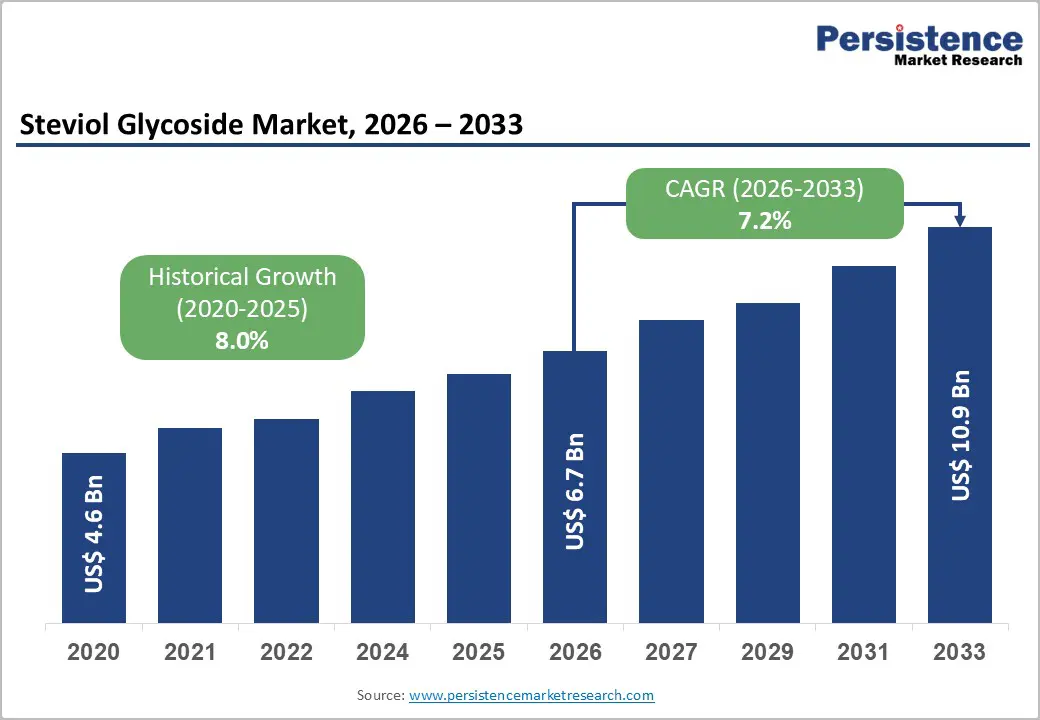
The global steviol glycoside market size is likely to be valued at US$6.7 billion in 2026 and is expected to reach US$10.9 billion by 2033, growing at a CAGR of 7.2% between 2026 and 2033, driven by sustained sugar-reduction reformulation across food and beverage categories, increasing regulatory acceptance of high-purity steviol glycosides, and rising consumer demand for low- and no-calorie natural sweeteners. Growth is increasingly driven by advancements in taste optimization, solubility enhancement, and fermentation-based production, which address historical limitations of early-generation stevia extracts.
Key Industry Highlights
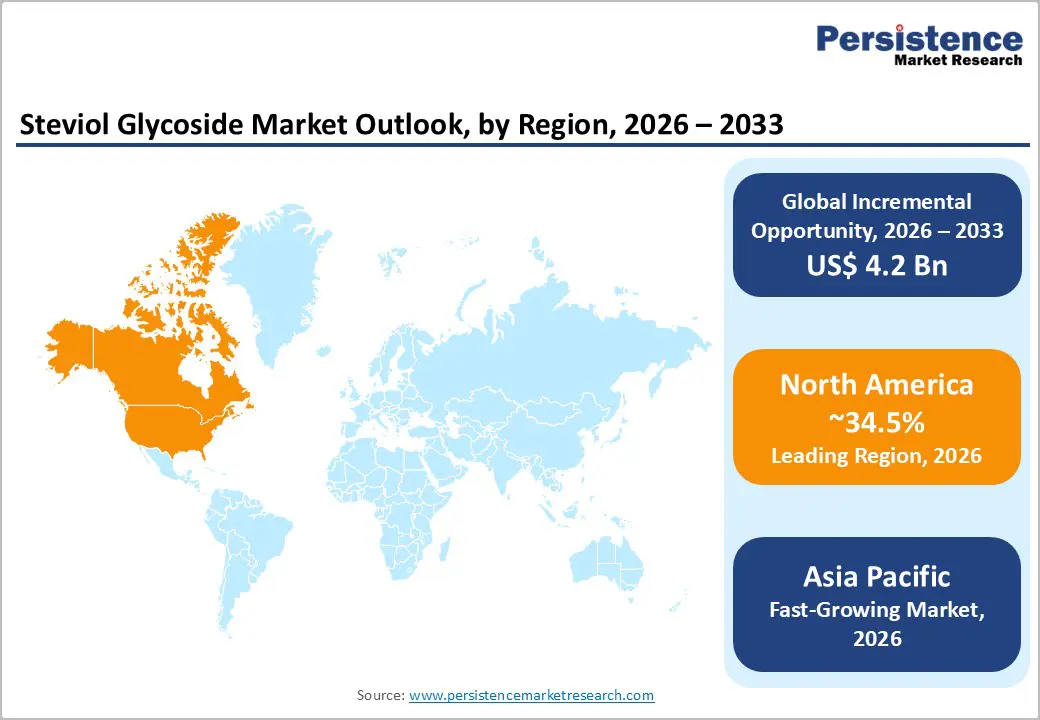
- Leading Region: North America is projected to account for approximately 34.5% of the market share, driven by strong reformulation demand and advanced innovation capabilities
- Fastest-growing Region: Asia Pacific, projected to expand at the highest growth rate due to rapid industrialization, cost-efficient production, and rising demand in emerging economies
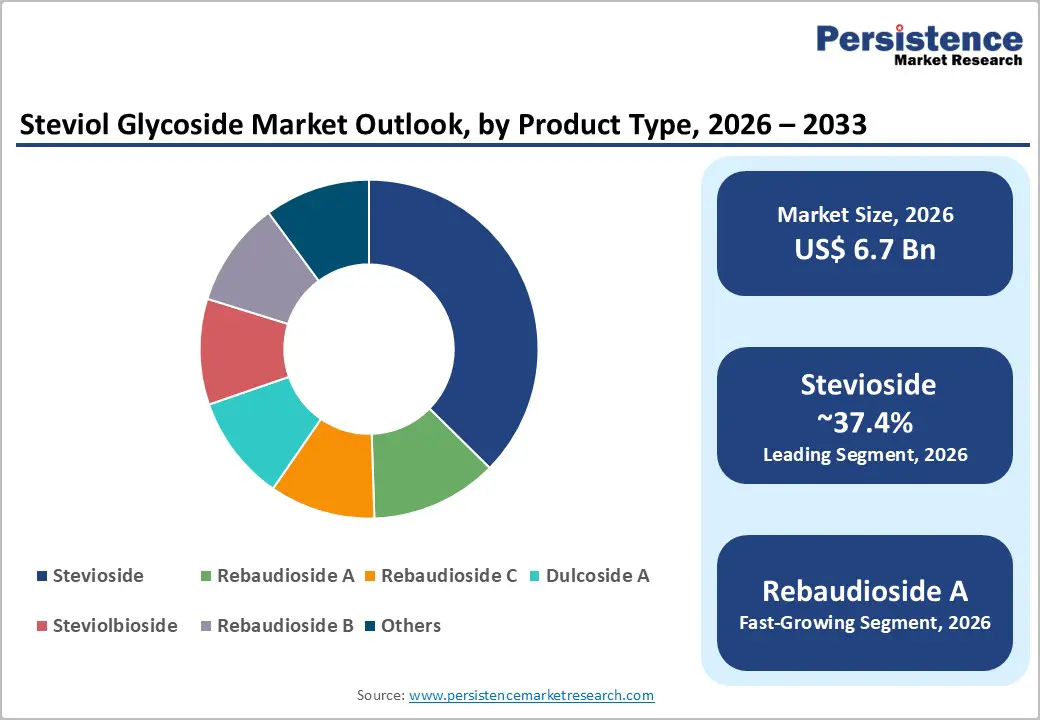
- Dominant Product Type: Stevioside is estimated to account for approximately 37.4% of the market share, driven by its cost efficiency, large-scale availability, and widespread use in food and tabletop sweetener applications.
- Leading Processing Method: Farming-based production is anticipated to hold approximately 59.7% of the market share, supported by established agricultural infrastructure and large-scale extraction capabilities.
| Key Insights | Details |
|---|---|
|
Steviol Glycoside Market Size (2026E) |
US$6.7 Bn |
|
Market Value Forecast (2033F) |
US$10.9 Bn |
|
Projected Growth (CAGR 2026 to 2033) |
7.2% |
|
Historical Market Growth (CAGR 2020 to 2025) |
8.0% |
DRO Analysis
Driver Analysis - Public-Health Sugar Reduction Policies Are Accelerating Adoption
Global health authorities continue to recommend reducing free sugar intake to below 10% of total energy intake, with additional benefits observed at levels below 5%. This guidance has translated into sugar taxes, front-of-pack labeling systems, and reformulation mandates, particularly in beverages and processed foods. OECD data confirms that such policies directly influence product reformulation strategies and reduce high-sugar product consumption. Steviol glycosides offer high-intensity sweetness with zero calories, making them a preferred alternative in compliance-driven reformulation. Food and beverage manufacturers increasingly rely on these ingredients to meet regulatory thresholds while maintaining taste profiles. This dynamic is especially strong in carbonated beverages, dairy, and packaged foods, where sugar reduction targets are most aggressive. The result is a structural shift in demand toward natural, plant-based sweeteners with proven safety and scalability.
Regulatory Acceptance Is Enabling Global Commercialization
Purified steviol glycosides are widely accepted across major markets, supported by established safety evaluations and defined intake limits. In the U.S., they are permitted through GRAS pathways, while in Europe, they are regulated under additive classification E960 with updated specifications that now include fermentation-derived variants. This regulatory clarity significantly reduces market-entry barriers for multinational manufacturers. It allows a standardized ingredient strategy across regions, which is critical for global brands operating in multiple regulatory environments. The alignment of safety standards across international bodies strengthens confidence among both manufacturers and consumers, accelerating adoption across food, beverage, and nutraceutical applications.
Product Innovation Is Improving Sensory Performance
The evolution of steviol glycosides from basic extracts to high-purity molecules such as Reb M and Reb D has transformed product performance. These advanced glycosides deliver a cleaner taste profile, with reduced bitterness and improved temporal sweetness. Manufacturers are also investing in bioconversion, enzymatic modification, and precision fermentation to increase the availability and consistency of these molecules. This innovation expands the application range into categories that were previously difficult to reformulate, including premium beverages, flavored dairy, and confectionery. As a result, steviol glycosides are no longer limited to niche applications but are becoming integral to mainstream product development.
Restraint Analysis - Taste Limitations and Supply Constraints Remain Challenges
Despite advancements, certain steviol glycosides still present bitterness, lingering aftertaste, or licorice-like notes, particularly at higher concentrations. These sensory challenges require additional formulation efforts, including blending with other sweeteners or using masking technologies, which can increase overall product cost. In parallel, minor glycosides such as Reb D and Reb M are present at very low concentrations in stevia leaves, making traditional extraction inefficient and costly. This limits large-scale availability through conventional farming methods. While fermentation offers a solution, its adoption requires capital investment and regulatory validation, which can slow market penetration.
Regulatory Complexity Increases Compliance Costs
Although steviol glycosides are widely approved, regulatory frameworks vary by region, particularly regarding acceptable inputs and processing methods. For example, crude stevia extracts and whole-leaf derivatives are not universally permitted in conventional foods, requiring manufacturers to rely on purified compounds. In Europe and other regulated markets, any modification to ingredient specifications requires formal approval, which can delay product launches. These factors increase compliance costs, extend development timelines, and create barriers for smaller manufacturers, limiting the pace of innovation and market entry.
Opportunity Analysis - Fermentation-Based Production Unlocks Scalability and Margins
Fermentation and bioconversion technologies represent a significant opportunity to overcome the limitations of traditional extraction. These methods enable the production of high-value glycosides such as Reb M and Reb D at a commercial scale, independent of agricultural yield constraints. They also offer sustainability advantages, including reduced land use, lower water consumption, and decreased carbon emissions. As environmental considerations become increasingly important in procurement decisions, fermentation-derived steviol glycosides are expected to command a premium, particularly in developed markets.
Emerging Markets Present Strong Demand Potential
Asia Pacific, Latin America, and parts of the Middle East are witnessing increasing demand for reduced-sugar products driven by urbanization, rising disposable incomes, and growing health awareness. These regions also benefit from cost-effective manufacturing and agricultural capabilities, particularly in stevia cultivation. Local producers are expanding vertically integrated operations, combining farming, extraction, and formulation capabilities. This creates opportunities for both domestic consumption and export-oriented growth, positioning emerging markets as key contributors to global supply and demand.
Expansion into New Application Areas
Beyond traditional food and beverage applications, steviol glycosides are gaining traction in pharmaceuticals, nutraceuticals, cosmetics, and personal care products, driven by their plant-based origins, zero-calorie profiles, and compatibility with clean-label formulations. In pharmaceuticals and nutraceuticals, they are increasingly used as natural sweeteners in syrups, chewable tablets, lozenges, and protein supplements, helping improve palatability without affecting glycemic response. Their stability across a wide pH range and temperature conditions further enhances their suitability for medicinal formulations. In cosmetics and personal care, steviol glycosides are being incorporated into oral care products such as toothpaste and mouthwash, as well as in lip care and skincare formulations, due to their mild sweetness, non-cariogenic nature, and perceived natural positioning. Some formulations also leverage their potential antioxidant and antimicrobial properties, supporting multifunctional product development. This diversification reduces reliance on core food and beverage applications while enabling manufacturers to target premium and health-oriented product segments.
Category-wise Analysis
Product Type Insights
Stevioside is anticipated to account for approximately 37.4% of the market share in 2026, making it the leading product type within the steviol glycoside market. Its dominance is primarily attributed to its commercial maturity, cost efficiency, and widespread availability across global supply chains. As one of the earliest discovered and industrialized steviol glycosides, stevioside forms the backbone of many traditional stevia-based formulations, particularly in cost-sensitive applications. Its strong position is reinforced by its compatibility with a wide range of food products, including bakery items, confectionery, and tabletop sweeteners. For instance, several mass-market sugar-substitute brands and processed-food manufacturers continue to use stevioside in blended sweetener systems, where a slight aftertaste can be effectively masked. In emerging markets, where price sensitivity remains high, stevioside-based formulations are widely adopted due to their affordability and established sourcing infrastructure. This combination of scalability and cost advantage ensures its continued leadership in the segment.
Rebaudioside A is expected to be the fastest-growing product type. Its growth is driven by its superior sensory profile, offering a cleaner sweetness with significantly reduced bitterness compared to earlier-generation glycosides such as stevioside. This improved taste performance makes Rebaudioside A particularly suitable for beverages, flavored dairy products, and premium packaged foods, where taste precision is critical. For example, global beverage manufacturers increasingly incorporate Rebaudioside A in reduced-sugar carbonated drinks and ready-to-drink teas to maintain flavor consistency while lowering calorie content. Its adoption is also expanding in functional foods and health-oriented product lines, where clean-label positioning is essential. As formulation technologies continue to evolve, Rebaudioside A is expected to gain broader acceptance across multiple high-growth application areas.
Processing Method Insights
Farming-based production is anticipated to hold approximately 59.7% of the market share in 2026, making it the dominant processing method in the steviol glycoside market. This approach relies on traditional cultivation of stevia plants, followed by extraction and purification, supported by well-established agricultural practices and existing infrastructure. The dominance of this method is closely linked to its ability to support large-scale production of commonly used glycosides such as stevioside and Rebaudioside A. Major producing regions, particularly in China and parts of Southeast Asia, have developed vertically integrated supply chains that combine farming, extraction, and processing. For example, large stevia producers operate dedicated cultivation programs alongside processing facilities to ensure a consistent raw material supply. This method remains highly relevant for mainstream applications due to its cost-effectiveness, regulatory familiarity, and ability to meet high-volume demand.
Fermentation-based production is expected to be the fastest-growing segment. This advanced approach uses microbial fermentation and bioconversion technologies to produce high-purity steviol glycosides, particularly rare molecules such as Reb M and Reb D, which are difficult to obtain via traditional extraction methods. This method addresses key limitations of farming-based production by ensuring consistent quality, scalable supply, and improved taste performance. For instance, fermentation-derived sweeteners are increasingly used in premium beverage formulations where even minor taste deviations are unacceptable. Fermentation supports sustainability objectives by reducing dependence on agricultural land and minimizing environmental impact. As demand for high-performance, clean-label sweeteners continues to rise, fermentation-based production is expected to play a critical role in shaping the market's future.
Regional Insights
North America Steviol Glycoside Market Trends - Fermentation-Based Reb M Innovation Driving Beverage Reformulation
North America is projected to account for approximately 34.5% of market share in 2026, driven by strong demand for low- and no-calorie products and a well-established regulatory framework. The U.S. leads the region, supported by a large packaged food and beverage industry and widespread adoption of sugar-reduction strategies among multinational brands. Major beverage players such as The Coca-Cola Company and PepsiCo have significantly expanded their reduced-sugar and zero-sugar portfolios, incorporating steviol glycosides into products such as flavored waters, diet sodas, and functional beverages. This shift has directly accelerated demand for high-performance sweetener systems.
The region benefits from a robust innovation ecosystem, with companies such as Cargill, Ingredion, and Archer Daniels Midland Company investing heavily in advanced glycoside development, particularly Reb M and Reb D. The commercialization of fermentation-derived solutions such as EverSweet has improved taste profiles while reducing environmental impact, enabling broader adoption in premium beverage categories.
Beverage reformulation remains a key growth driver, particularly in carbonated soft drinks, sports drinks, and ready-to-drink teas. Investment trends indicate a clear shift toward high-purity glycosides and fermentation-based production, reflecting growing demand for better taste and sustainability. Partnerships and technology collaborations, such as fermentation-focused joint ventures, are strengthening supply reliability and scalability. As consumer awareness of sugar reduction and clean-label ingredients continues to rise, North America’s leadership position is expected to remain strong, supported by continuous innovation and early adoption of next-generation sweetener technologies.
Europe Steviol Glycoside Market Trends - Regulatory-Driven Sugar Reduction and Premium Clean-Label Reformulation
Europe represents a mature market, with steviol glycosides accounting for a significant share of natural sweetener usage, supported by stringent regulatory standards and strong policy-driven demand for sugar reduction. Key markets such as Germany, the U.K., France, and Spain are leading adoption, driven by government-led sugar reduction initiatives and increasing consumer preference for clean-label products. The regulatory framework in the European Food Safety Authority ecosystem provides clear guidelines for steviol glycoside usage, including evolving provisions for fermentation-derived ingredients. This regulatory clarity has enabled companies such as Tate & Lyle and DSM-Firmenich to introduce advanced stevia solutions tailored for European markets.
For instance, the expansion of Reb M-based sweeteners and improved formulations has supported beverage reformulation efforts across the region, particularly in reduced-sugar soft drinks and dairy products. Growth in Europe is increasingly driven by premium product reformulation and sustainability-focused innovation. Major beverage brands, including European operations of The Coca-Cola Company, have reformulated products such as Coca-Cola variants with reduced sugar content using steviol glycosides.
Retailers and private-label brands are introducing low-sugar alternatives to meet the evolving consumer expectations. The region offers strong opportunities for suppliers capable of navigating regulatory requirements while delivering high-performance, sustainable ingredients, particularly in premium and health-oriented product segments.
Asia Pacific Steviol Glycoside Market Trends - Export-Led Production Hub Transitioning to High-Purity Innovation
Asia Pacific is expected to be the fastest-growing region, supported by strong manufacturing capabilities, expanding consumer markets, and increasing health awareness. China and Japan are key contributors, with well-established stevia production and innovation ecosystems. China serves as the global supply hub, with companies such as Layn Natural Ingredients, Sunwin Stevia International, and GLG Life Tech operating large-scale cultivation and extraction facilities. Japan continues to play a critical role in innovation, with Morita Kagaku Kogyo pioneering early commercialization and ongoing product development.
The region benefits from cost-efficient production, abundant raw materials, and vertically integrated supply chains, making it a dominant exporter of steviol glycosides. In addition to supply-side strength, demand is rising rapidly in markets such as India and Southeast Asian countries, where urbanization and increasing health awareness are driving consumption of reduced-sugar beverages and packaged foods. Regional beverage manufacturers are increasingly incorporating stevia-based sweeteners into flavored drinks, juices, and functional beverages to align with changing consumer preferences.
Investment trends in Asia Pacific are shifting toward value-added processing and advanced formulation capabilities. Companies are expanding beyond raw extract production into high-purity glycosides and customized ingredient systems for global clients. For example, Chinese producers are investing in refining technologies and international partnerships to improve product quality and expand export reach. This transition from commodity production to innovation-led growth is positioning Asia Pacific as a critical driver of future market expansion, both as a manufacturing base and as a rapidly growing consumer market.
Competitive Landscape
The global steviol glycoside market is moderately consolidated, with a mix of global ingredient companies and regional producers. Leading players focus on high-purity glycosides, advanced processing technologies, and strong distribution networks, while smaller firms compete on cost efficiency and regional supply capabilities. Competitive differentiation is increasingly based on taste performance, sustainability, regulatory compliance, and technical support, rather than raw material availability alone. Key players are focusing on product innovation, fermentation technology adoption, and global market expansion. Emphasis is placed on delivering high-quality, sustainable, and application-specific solutions while strengthening supply chain integration and technical service capabilities.
Key Industry Developments:
- In January 2025, Cargill announced the expansion of its EverSweet stevia sweetener portfolio in Europe, developed in partnership with DSM-Firmenich under the Avansya joint venture, aiming to scale fermentation-based production of high-purity Reb M and Reb D for improved taste and sustainability in food and beverage applications.
Companies Covered in Steviol Glycoside Market
- Cargill
- Ingredion Incorporated
- Tate & Lyle PLC
- Archer Daniels Midland Company
- dsm-firmenich
- Sweegen Inc.
- GLG Life Tech Corporation
- Layn Natural Ingredients Corp.
- Sunwin Stevia International Inc.
- Morita Kagaku Kogyo Co., Ltd.
- PureCircle Limited
- Avansya
- Zhucheng Haotian Pharm Co., Ltd.
- Qufu Xiangzhou Stevia Products Co., Ltd.
- Shandong Shengxiangyuan Biotechnology Co., Ltd.
- Daepyung Co., Ltd.
Frequently Asked Questions
The global steviol glycoside market is estimated to be valued at US$6.7 billion in 2026.
The steviol glycoside market is projected to reach US$10.9 billion by 2033.
Key trends include the shift toward high-purity glycosides such as Reb M and Reb D, rapid adoption of fermentation-based production technologies, and rising demand for clean-label and plant-based sweeteners.
The stevioside segment leads the market, accounting for approximately 37.4% of the market share, due to its cost-efficiency, established supply chains, and wide applicability in food products.
The steviol glycoside market is expected to grow at a CAGR of 7.2% between 2026 and 2033.
Some of the major players include Cargill, Ingredion, Tate & Lyle, Archer Daniels Midland Company, and Sweegen.


