




- Medical Devices
- Sterilization Monitoring Market
Sterilization Monitoring Market Size, Share, and Growth Forecast 2026 – 2033
Sterilization Monitoring Market by Product Type (Biological, Chemical Indicators), Technology (Biological, Chemical, Mechanical Monitoring), Process (Pack, Load Monitoring), End-user (Hospitals), and Regional Analysis, 2026 – 2033

Sterilization Monitoring Market Size and Trends Analysis
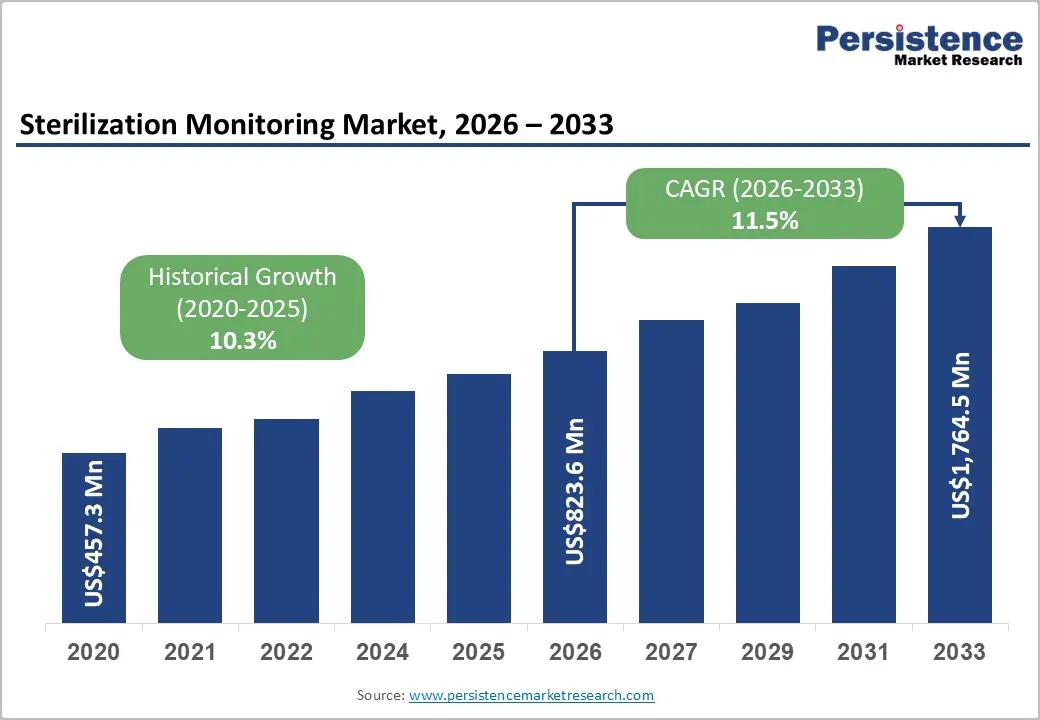
The global sterilization monitoring market size is likely to be valued at US$823.6 million in 2026 and is expected to reach US$1,764.5 million by 2033, growing at a CAGR of 11.5% during the forecast period from 2026 to 2033, driven by rising incidence of Hospital-Acquired Infections (HAIs), which affect nearly 7 to 10% of hospitalized patients globally, pushing healthcare facilities to adopt strict sterilization validation practices. Growth is further supported by increasing regulatory enforcement from bodies such as the FDA and ISO.
Key Industry Highlights:
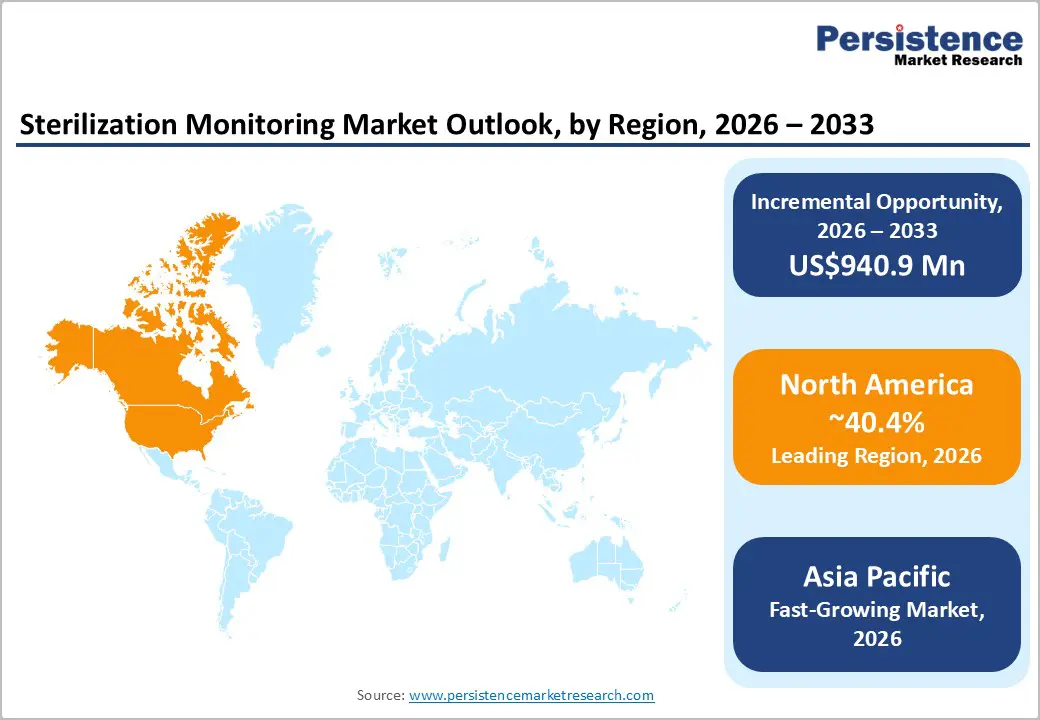
- Leading Region: North America, with about a 40.4% share in 2026, owing to strict regulatory enforcement by agencies such as the U.S. FDA.
- Fast-growing Region: Asia Pacific, backed by expanding healthcare infrastructure and rising surgical volumes.
- Leading Product Type: Chemical indicators, approximately 66.4% share in 2026, as they are used in every sterilization cycle and provide instant visual confirmation.
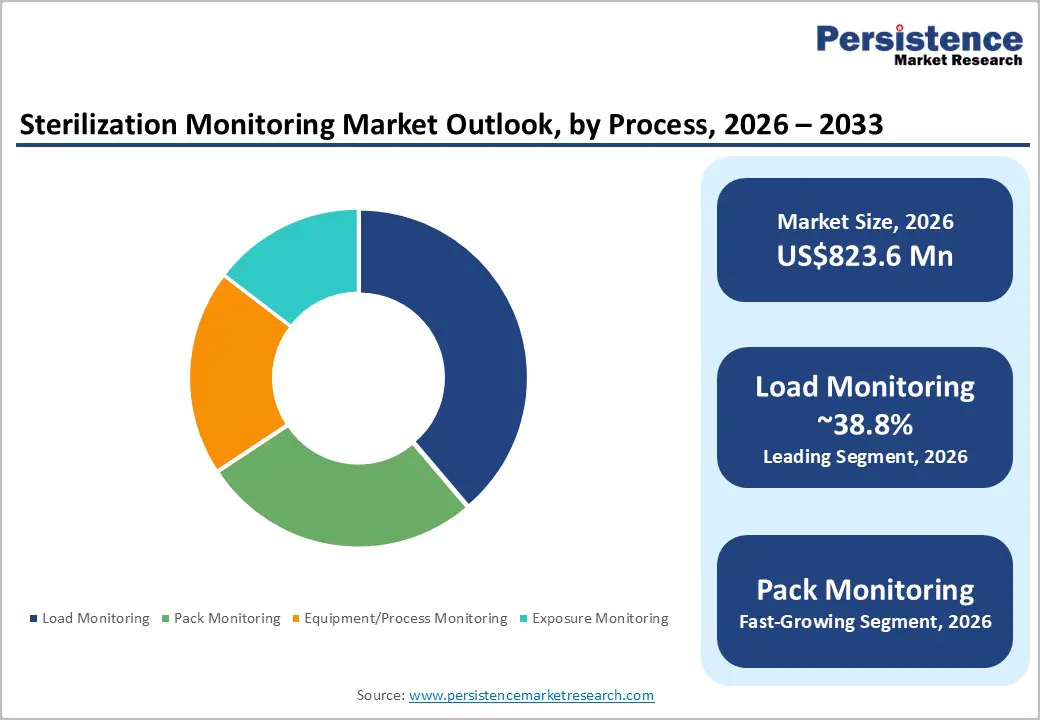
- Dominant Process: Load monitoring, nearly 38.8% in 2026, because each sterilization batch must be verified and documented before release.
- Facility Expansion: In May 2025, Sterigenics, a Sotera Health company, announced the expansion of its Haw River, North Carolina campus to include a new X-ray sterilization facility adjacent to its existing gamma facility. The facility is projected to serve medical device, pharmaceutical, biopharmaceutical, and commercial applications manufacturers in the Southeast U.S.
DRO Analysis
Driver - Increasing Number of Surgical Procedures Globally
As surgical volumes climb globally, the pressure on sterile processing departments to keep pace has intensified. According to an Ambulatory Surgery Center Association (ASCA) report from March 2025, the U.S. alone has more than 6,300 Medicare-certified ambulatory surgery centers. This growth in outpatient procedures means more instrument turnover per day, leaving little room for monitoring gaps.
The Centers for Disease Control and Prevention’s (CDC) National Healthcare Safety Network (NHSN) data estimated around 110,800 surgical site infections associated with inpatient surgeries. Each of these cases underscores why continuous sterilization monitoring is non-negotiable. As more procedures shift to same-day settings with quick turnarounds, superior cycle verification becomes both a patient safety requirement and an operational necessity.
Surging Concerns Over Hospital-Acquired Infections
The rise of drug-resistant organisms has made sterilization monitoring a frontline defense against Hospital-Acquired Infections (HAIs). A CDC surveillance report from November 2024 found that approximately 3.2% of hospitalized patients, i.e., about 1 in 31, acquire at least one HAI during their care. Central Sterile Supply Departments (CSSDs) now operate under strict scrutiny to eliminate these threats.
In April 2024, the CDC published updated core infection prevention and control practices for all healthcare settings, strengthening the use of sterilization monitoring products as a regulatory standard. This regulatory push, combined with the clinical risks posed by organisms such as C. difficile and MRSA, has made real-time monitoring central to hospital infection control programs.
Restraint - Incubation Wait Times May Disrupt Sterile Processing Workflows
A key barrier to Biological Indicator (BI) adoption is the time it takes to get results. Conventional biological indicators require 24 to 48 hours of incubation, which can cause significant delays in high-demand clinical environments. During this window, instruments must ideally remain quarantined, a step that several facilities struggle to follow in practice. As hospitals often lack sufficient space or instrument inventory to support proper quarantining, sterilized items are frequently returned to stock before results are confirmed.
It creates a compliance gap, especially for implantable devices where regulatory bodies require BI clearance before release. The AAMI's longstanding guidance traces back to a 1990 USP recommendation of seven-day incubation for certain BI types, a standard that has seen limited revision despite advances in clinical settings. Closing this gap remains a core challenge in sterile processing.
Opportunity - Digital and IoT Integration Transforms Sterilization Traceability
Manual documentation in sterile processing is steadily giving way to connected and intelligent systems. Platforms such as Ascendco Health's instrument tracking system now collect and clean surgical data, match instrument IDs across Electronic Health Records (EHRs) and tracking systems, and correct errors such as missing or duplicate records. Legacy systems simply cannot provide these capabilities.
An article published in Infection Control Today (2026) highlights that IoT integration and real-time equipment monitoring in Sterile Processing Departments (SPDs) are increasingly used to reduce workflow disruptions and improve surgical readiness. In May 2025, Aesculap partnered with Ascendco Health to boost surgical instrument tracking across U.S. health systems. This is a sign that AI-supported and load-by-load traceability is moving from pilot to mainstream adoption.
Speedy Biological Indicators to Shorten Instrument Release Times
Developments in rapid-readout BI technology are addressing the workflow bottleneck that conventional 24 to 48-hour indicators create. Solventum's Attest Super Rapid Readout Steam Biological Indicator (1492V/1492VS) delivers a final fluorescent result in just 24 minutes when used with the Attest Auto-reader 490 or 490M. It is an FDA-cleared and ISO-compliant solution.
This is a key step forward from traditional methods. Rapid and automated processing of this type can reduce instrument quarantine times by up to 38%, enabling quick turnaround of sterilized trays in healthcare facilities. For implantable devices, where AAMI, CDC, and AORN guidelines all require confirmed BI results before release, this speed improvement has direct clinical impact. SPDs can now clear loads with confidence before the next surgical case begins.
Category-wise Analysis
Product Type Insights
Chemical indicators are predicted to lead with a share of approximately 66.4% in 2026, as they are used in every cycle and support fast decision-making. They are placed inside packs or on the outside of every load, so their usage volume is naturally high. They give immediate visual results, which help sterile processing teams release instruments quickly. This is important in busy hospitals where surgical turnover is high. The CDC states that chemical indicators should be used in each sterilization cycle to verify exposure to key parameters such as temperature and steam. This routine requirement alone pushes their dominance.
Biological indicators are estimated to be the fastest-growing segment in the forecast period, as compliance pressure is increasing. They directly confirm microbial kill, making them essential for high-risk applications. Their adoption is rising due to strict regulations around patient safety. For example, the Association for the Advancement of Medical Instrumentation (AAMI ST79) requires biological monitoring at least weekly and for every implant load. Hospitals are under pressure to follow this strictly, especially after infection outbreaks linked to improper sterilization.
Process Insights
The load monitoring segment is anticipated to dominate with a share of nearly 38.8% in 2026, as it is associated with patient safety and release decisions. Every sterilized load must be verified before it is released for use. This makes load monitoring a mandatory step in sterile processing workflows. It combines chemical indicators, biological indicators, and physical data to ensure the entire batch is safe. The U.S. FDA emphasizes that sterilization validation must be documented for each load, especially for surgical instruments and implants. This requirement makes load monitoring central to compliance.
The pack monitoring segment is expected to remain in the second position in 2026, owing to the increasing complexity of surgical instruments. Modern surgical instruments have complex designs, including lumens and multi-layered assemblies. These designs make it harder for sterilants to penetrate every surface. Pack monitoring ensures that sterilization conditions reach inside individual packs, not just the chamber. This is becoming more important as minimally invasive and robotic surgeries increase.
Regional Insights
North America Sterilization Monitoring Market Trends
North America will likely lead and account for a share of approximately 40.4% in 2026, owing to its advanced healthcare infrastructure, high surgical volumes, and strict infection-control regulations. The U.S. Food and Drug Administration (FDA) and CDC mandate regular sterilization monitoring in hospitals, dental clinics, and ambulatory surgical centers. For example, in September 2023, the CDC updated its guidelines to emphasize Class 5 chemical indicators and biological monitoring for steam sterilization in surgical settings. Key players such as 3M, Steris, and Getinge are headquartered in North America, thereby propelling innovation in rapid-readout biological indicators and IoT-enabled monitoring.
U.S. Sterilization Monitoring Market Trends
The U.S. is expected to dominate in North America and account for a share of nearly 58.6% in 2026. The most prominent growth driver is the Ambulatory Surgery Center (ASC) boom. Medicare certified 6,150 U.S. ASCs by late 2024, a 3.8% annual increase, while ASC procedure volumes climbed 6.2% in the same period. These high-turnover facilities require rapid cycle verification that traditional hospitals did not previously demand at this pace. On the regulatory side, the FDA in January 2024 moved vaporized hydrogen peroxide from Established Category B to Established Category A for 510(k) submissions, easing regulatory hurdles for manufacturers using that sterilization process. This shift is broadening the range of low-temperature sterilization, requiring new monitoring tools.
Asia Pacific Sterilization Monitoring Market Trends
Asia Pacific is anticipated to be the fastest-growing market in 2026 with a share of nearly 27.8%. This growth is associated with healthcare infrastructure construction, and not just a rising disease burden. China added around 1,200 hospitals from 2022 to 2024, most equipped with central sterile departments large enough to justify mixed low-temperature and high-capacity steam installations. India is catching up, too. A mobile sterilization pilot improved instrument availability by 22% in district hospitals. Medical tourism in Thailand and Malaysia is also adding procedural volume. As more complex surgeries shift to these markets, the demand for validated and load-by-load monitoring follows automatically.
China Sterilization Monitoring Market Trends
A share of approximately 35.4% is expected to be recorded by China in 2026. The country's regulatory environment is tightening meaningfully. Increased regulatory scrutiny by healthcare authorities is fueling a transition to comprehensive sterilization techniques, including advanced methods such as hydrogen peroxide and ethylene oxide plasma. Investment is also centralizing. Multinational companies are localizing to keep pace, with Philips setting up an additional sterilizer assembly line in Suzhou to satisfy volume-based purchasing thresholds. Medtronic also opened a Shanghai innovation center to co-develop minimally invasive surgical kits with local clinical partners.
Japan Sterilization Monitoring Market Trends
Japan will likely witness steady growth in 2026 by accounting for a share of about 28.3%. The country's growth is less about expansion and more about the depth of compliance. It has one of the world's oldest populations; over 29% of the population is aged 65 or older. Older patients require more frequent surgeries and longer hospital stays, both of which increase sterilization cycle demand. Japan's sterilization technologies market is also witnessing increased implementation of IoT-enabled monitoring systems for sterilization processes, with a focus on precision and reliability that complies with the country's manufacturing culture.
Europe Sterilization Monitoring Market Trends
A share of approximately 19.3% is anticipated to be registered in Europe in 2026. Growth is mainly fostered by regulatory compliance with the EU's Medical Device Regulation (MDR). The MDR has had an outsized impact. The EU's MDR and IVDR have raised sterilization validation requirements, mandating comprehensive documentation and periodic re-audits, which have pushed a large number of medical devices through formal sterilization validation processes. Also, over 20,000 healthcare institutions in the EU adhere to sterilization validation standards. More than 150 million biological and chemical indicators were used in the region in 2024.
Germany Sterilization Monitoring Market Trends
Germany will likely account for a share of nearly 30.2% in Europe in 2026, backed by its advanced healthcare infrastructure and high volume of surgeries, especially among the aging population. These factors fuel consistent demand for infection control and sterilization monitoring. Sterilization monitoring system sales in Germany are further augmented by strict pharmaceutical manufacturing regulations and cGMP compliance requirements. The country is also home to gke-GmbH, one of the few European-headquartered sterilization monitoring companies with global reach, which positions Germany as both a production and consumption hub.
U.K. Sterilization Monitoring Market Trends
The U.K. market is predicted to hold a share of approximately 22.7% in 2026, influenced by the National Health Service’s (NHS) expansion and its zero-tolerance stance on preventable infections. According to a National Institute for Health and Care Excellence (NICE) report, approximately 300,000 patients in the U.K. acquire HAIs each year, costing the NHS around US$1.3 billion annually, with nearly US$75.3 million of that incurred after patients are already discharged. This financial burden has kept infection control, including sterilization monitoring, as a standing NHS priority. The Department of Health set a target to reduce gram-negative bacteraemia by 50% by 2024 to 2025, requiring a comprehensive approach across all care settings.
Competitive Landscape
The global sterilization monitoring market is moderately consolidated with a small group of multinational companies controlling a significant share. The competitive landscape is led by 3M (now operating its healthcare business through Solventum), STERIS, Getinge, Advanced Sterilization Products (ASP), and Mesa Laboratories. These companies maintain dominant positions through extensive product portfolios covering biological indicators, chemical indicators, process challenge devices, incubators, and digital monitoring systems.
A key competitive differentiator is the speed and accuracy of biological indicators, where companies are racing to reduce readout times. Mesa Laboratories’ rapid biological indicators now deliver results in under 30 minutes for steam sterilization, compared to the traditional 24 to 48 hours, significantly reducing instrument downtime in hospitals. ASP has also introduced advanced hydrogen peroxide-based monitoring systems integrated with its STERRAD sterilizers, strengthening customer lock-in by delivering bundled solutions.
Key Industry Developments:
- In April 2026, Advanced Sterilization Products (ASP) announced a strategic partnership with ChemDAQ, a provider of hazardous gas detection and monitoring solutions. The collaboration brings together ASP's low-temperature sterilization technologies with ChemDAQ's continuous gas monitoring expertise in sterile processing departments (SPDs).
- In January 2026, ASP GmbH, in collaboration with FUJIFILM Healthcare Europe GmbH, announced that the ULTRA GI Cycle received CE mark approval in Europe. The ULTRA GI Cycle is the latest addition to the STERRAD 100NX Sterilizer with ALLClear Technology. It provides a validated hydrogen peroxide gas plasma sterilization method specifically for duodenoscopes.
- In November 2025, SteriPro International Inc. and Getinge USA Sales, LLC announced a strategic partnership to expand off-site sterile processing capacity across North America. The collaboration brings together SteriPro's expertise in operating large-scale accredited off-site reprocessing centers and Getinge's leadership in sterilization equipment, automation, and digital workflow solutions.
Companies Covered in Sterilization Monitoring Market
- 3M Co.
- Cantel Medical Corp.
- Cardinal Health Inc.
- Etigam BV
- gke-GmbH
- HiMedia Laboratories
- Mesa Laboratories Inc.
- Propper Manufacturing Co. Inc.
- STERIS Plc
- Terragene SA
- Others
Frequently Asked Questions
The global sterilization monitoring market is projected to be valued at US$823.6 million in 2026.
The sterilization monitoring market is expected to reach US$1,764.5 million by 2033.
Key market trends include the shift toward rapid-read biological indicators and the integration of digital tracking systems.
Chemical indicators are expected to be the leading product type with a share of nearly 66.4% in 2026, as they are cost-effective and mandated by guidelines from the CDC for each cycle.
The sterilization monitoring market is expected to grow at a CAGR of 11.5% from 2026 to 2033.
3M Co., Cantel Medical Corp., Cardinal Health Inc., and Etigam BV are a few key market players.


