




- Advanced Materials
- Silicon Nanowires Market
Silicon Nanowires Market Size, Share, and Growth Forecast 2026 - 2033
Silicon Nanowires Market by Nanowires Type (Monodispersed Silicon Nanowires, Polydispersed Silicon Nanowires), by Application (Electronics, Medical, Energy Storage, Photovoltaics, Others), by Regional Analysis, 2026 - 2033

Silicon Nanowires Market Size and Trend Analysis
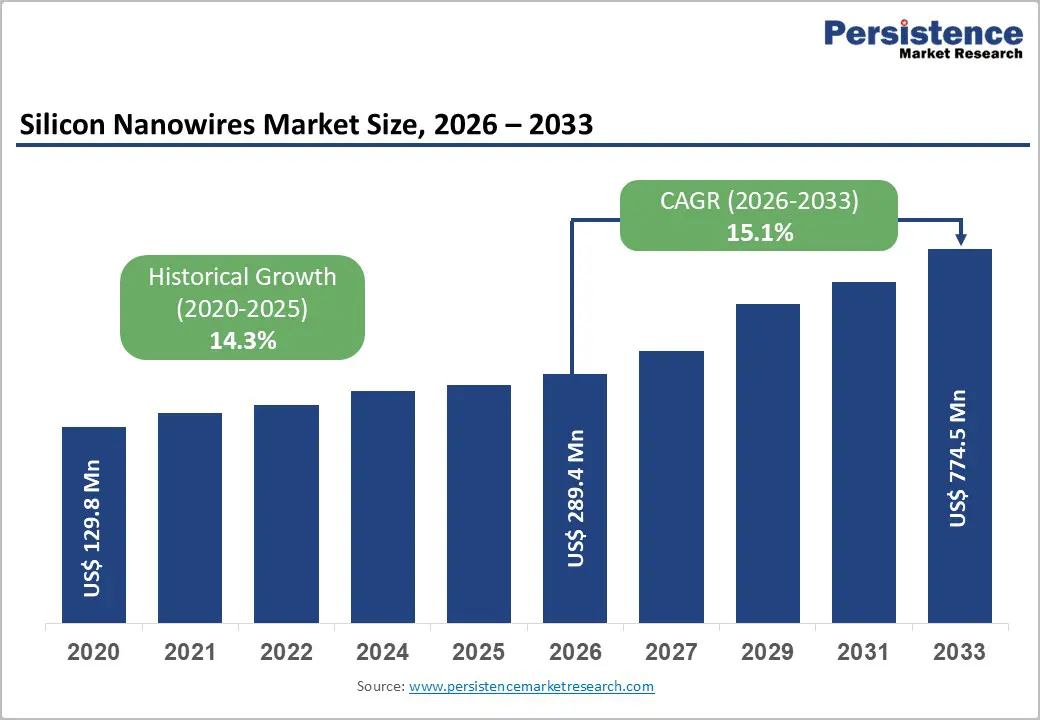
The global Silicon Nanowires Market size is expected to be valued at US$ 289.4 million in 2026 and projected to reach US$ 774.5 million by 2033, growing at a CAGR of 15.1% between 2026 and 2033.
Advancements in nanotechnology and rising demand for high-performance electronics drive this robust growth. Silicon nanowires offer superior electrical conductivity and mechanical flexibility compared to bulk silicon, enabling breakthroughs in transistors, sensors, and energy storage devices. Increasing adoption in photovoltaics and batteries, combined with rising semiconductor investments and scaling of energy-efficient technologies, further supports market expansion, positioning silicon nanowires as a core material for next-generation electronics.
Key Industry Highlights:
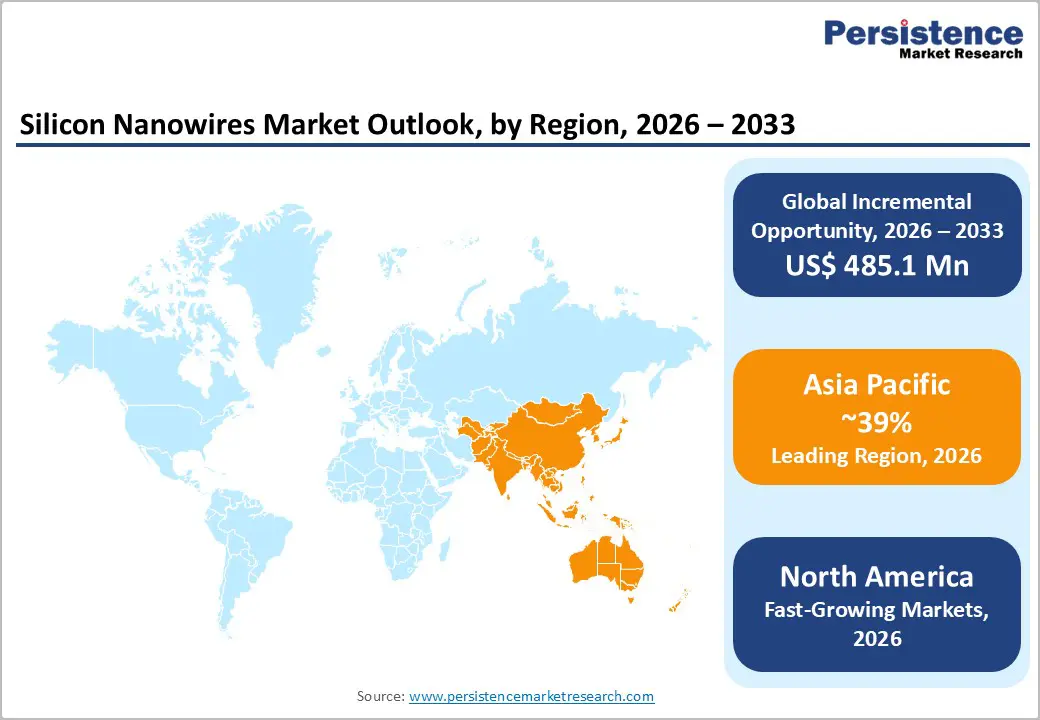
- Leading Region: Asia Pacific leads with 39% share in 2025, driven by manufacturing hubs in China, Japan, and India supporting electronics, energy storage, and photovoltaics.
- Fastest-Growing Region: North America grows fastest, driven by strong R&D funding, innovation, and semiconductor incentives, with a 34% share in 2025 and robust technology adoption.
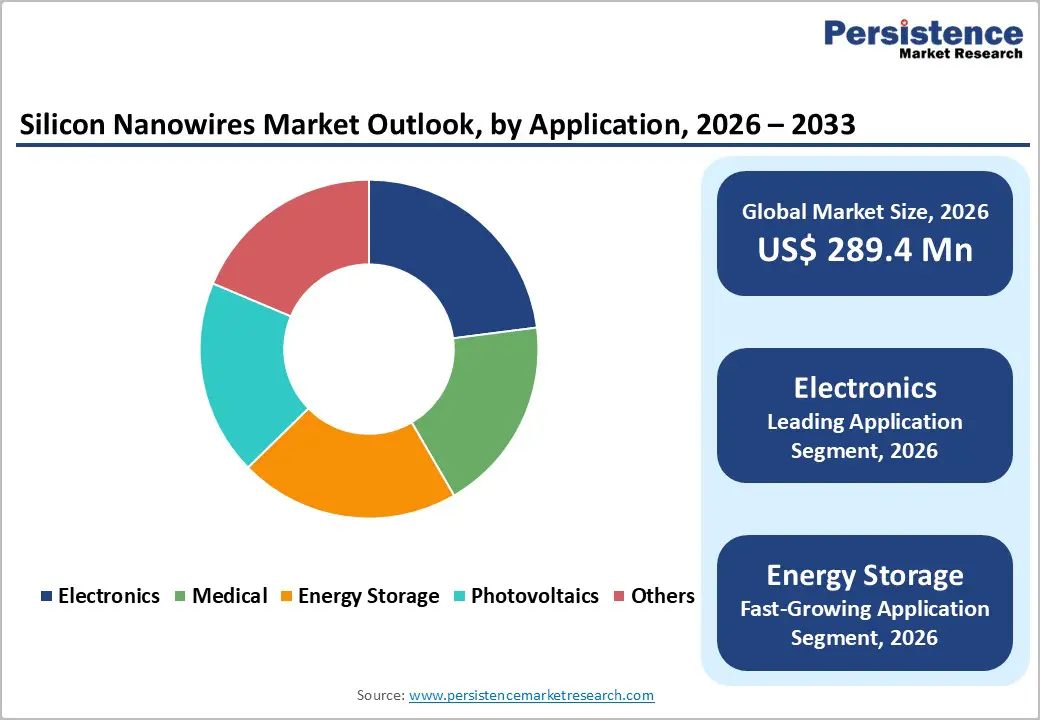
- Leading Application Category: Electronics dominates with 55% share in 2025, led by nanowire transistors enabling advanced AI chips, 5G networks, and low-power semiconductors.
- Fastest-Growing Category: Monodispersed silicon nanowires grow fastest due to uniform diameters and high electron mobility.
- Key Opportunity: Flexible electronics and wearables present major opportunities, targeting a $50 billion market by 2030 with bendable sensors and skin-compatible devices.
| Key Insights | Details |
|---|---|
|
Silicon Nanowires Market Size (2026E) |
US$ 289.4 million |
|
Market Value Forecast (2033F) |
US$ 774.5 million |
|
Projected Growth CAGR(2026-2033) |
15.1% |
|
Historical Market Growth (2020-2025) |
14.3% |
DRO Analysis
Drivers - Advancements in Semiconductor Miniaturization
Rapid advancements in semiconductor miniaturization are significantly boosting the demand for silicon nanowires in next-generation transistors. Their one-dimensional architecture allows for ultra-scaled field-effect transistors with superior gate control, drastically reducing leakage currents. This structural advantage supports extremely high transistor densities, enabling more powerful and compact chips that meet the increasing computational demands of 5G networks and AI accelerators.
As Moore’s Law approaches physical limits, silicon nanowires facilitate sub-2nm node devices, pushing innovation in quantum computing and high-performance electronics. Their integration enables more efficient, reliable, and miniaturized semiconductor solutions, strengthening chip performance while reducing energy consumption. These attributes position silicon nanowires as a core enabler for the rapidly evolving electronics landscape.
Rising Demand for Efficient Energy Storage Solutions
The rising need for high-capacity, fast-charging batteries in electric vehicles and renewable energy systems is driving the adoption of silicon nanowires as anode materials. Nanowires offer up to ten times the capacity of traditional graphite anodes and reduce volume expansion issues through nanoscale structuring, enhancing battery reliability and longevity.
This structural efficiency allows cycle life improvements beyond 1000 cycles, supporting large-scale, sustainable energy storage. As the global push for decarbonization and EV adoption intensifies, silicon nanowires are becoming a critical component in next-generation lithium-ion batteries, enabling high performance, rapid charging, and longer-lasting energy solutions for industrial, automotive, and renewable applications.
Restraints - High Production Costs and Scalability Challenges
Elevated manufacturing costs limit the widespread commercialization of silicon nanowires. Vapor-liquid-solid (VLS) synthesis requires expensive catalysts and high-temperature processing, making production significantly more costly than conventional silicon production. Scaling up these processes often results in yields below 80%, inflating material prices two to three times. These economic barriers hinder adoption in cost-sensitive sectors such as consumer electronics and large-scale energy storage applications.
Addressing scalability challenges remains critical, as current high costs prevent mass deployment of silicon nanowire-based devices. Innovations in low-cost fabrication techniques, such as plasma etching or template-assisted growth, are necessary to reduce production expenses. Without these improvements, market penetration may remain constrained, slowing growth in high-volume industrial and commercial applications.
Limited Standardization and Toxicity Concerns
The absence of global standards for nanowire characterization creates uncertainty in performance consistency, with diameter variability directly affecting device behavior. In addition, potential toxicity is a concern, as silicon nanowires can generate reactive oxygen species that compromise biocompatibility. Regulatory scrutiny, particularly under chemical-safety guidelines, may slow approvals for medical and consumer applications, thereby limiting market adoption.
Investors and manufacturers face challenges due to these unresolved risks, particularly in healthcare and biomedical applications. Ensuring standardized characterization protocols and demonstrating safety through rigorous testing will be crucial to building confidence among stakeholders. Failure to address these concerns may restrain growth and slow the integration of silicon nanowires across various industries.
Opportunities - Opportunities in Flexible Electronics and Wearables
The rapid growth of flexible electronics presents significant opportunities for silicon nanowires in wearables and IoT devices. Their mechanical flexibility allows them to withstand over 10,000 bending cycles, making them ideal for skin-compatible sensors and stretchable transistors. This capability supports next-generation health-monitoring devices, smart patches, and other wearable applications that demand both durability and high performance.
Rising wearable adoption, projected to reach 1 billion units by 2030, combined with funding for flexible hybrid technologies, positions silicon nanowires as a critical enabling material. Companies integrating nanowires into consumer electronics and medical wearables can capture a high-margin market, driving innovation in personal health monitoring, fitness tracking, and smart textiles, expanding both revenue potential and technological adoption globally.
Expansion in Biomedical Diagnostics and Therapeutics
Silicon nanowires’ biocompatibility opens new avenues in point-of-care diagnostics and targeted drug delivery systems. Their nanoscale structure enables label-free detection of biomarkers at femtomolar concentrations, vastly improving sensitivity compared to traditional assays. These properties support rapid and accurate detection in disease monitoring, including cancer, infectious diseases, and other critical conditions, enhancing diagnostic reliability.
As global diagnostics demand grows and nanowire-based biosensors gain regulatory approvals, companies can leverage silicon nanowires for real-time monitoring, personalized medicine, and advanced therapeutic applications. Adoption in drug delivery systems and sensitive biosensing platforms offers substantial revenue potential, making biomedical applications a key growth driver for the silicon nanowire market over the coming decade.
Category-wise Analysis
Nanowires Type Insights
Monodispersed silicon nanowires lead the market with a 65% share in 2025, driven by their uniform diameter of around 50 nm, which allows precise control in high-performance applications. Their superior electron mobility, approximately 2000 cm²/Vs, exceeds that of polydispersed variants by nearly 40%, enabling scalable CMOS integration. These nanowires are widely adopted in advanced semiconductor prototypes, supporting ultra-scaled transistor development for cutting-edge electronics.
Polydispersed silicon nanowires are emerging as the fastest-growing segment due to cost-effective production and flexibility for bulk applications. Their broader diameter distribution, while less uniform, is suitable for energy storage, sensors, and emerging photovoltaics, where ultra-precise scaling is less critical. Ongoing research into scalable synthesis and hybrid nanostructures is driving increased adoption across industrial and renewable energy applications.
Application Insights
Electronics dominates with a 55% market share in 2025, fueled by nanowire transistors that revolutionize logic circuits. Quantum-confined effects deliver on/off ratios exceeding 10^8, outperforming FinFET technology. Supported by semiconductor investments and initiatives, leading firms prioritize silicon nanowires for AI accelerators and low-power chips. Early deployments in test devices show significant power savings and enhanced processing efficiency, reinforcing electronics as the primary application segment.
Energy storage and biomedical applications represent the fastest-growing uses of silicon nanowires. Their high capacity, mechanical flexibility, and biocompatibility enable next-generation lithium-ion batteries, wearable sensors, and point-of-care diagnostics. Expanding EV adoption, growing renewable energy storage needs, and the rise of personalized medicine are driving rapid development and commercialization of nanowire-based solutions beyond traditional electronics.
Regional Insights
North America Silicon Nanowires Market Trends
North America accounts for a 34% market share in 2025 and is the fastest-growing region. The U.S. leads with strong nanotechnology research funding, including National Nanotechnology Initiative investments and NSF grants totaling hundreds of millions annually. Breakthroughs in scalable VLS synthesis have increased yields and reduced costs, supporting adoption in electronics, energy storage, and medical devices.
Supportive regulatory frameworks, including EPA nanomaterial guidelines, ensure safe commercialization. Combined with private sector expansions and advanced semiconductor ecosystems, North America is poised for rapid growth. The region’s focus on innovation, infrastructure, and technology integration enables adoption of next-generation silicon nanowire applications, including AI accelerators, EV batteries, and flexible electronics.
Europe Silicon Nanowires Market Trends
Europe is experiencing steady growth in silicon nanowire adoption, driven by research and innovation in renewable energy, medical diagnostics, and semiconductor applications. Germany leads through Fraunhofer Institute’s high-efficiency solar cell developments, while the UK, France, and Spain advance medical and industrial nanowire applications. Horizon Europe funds green nanotechnology projects, and patent activity surged in 2025, reflecting strong innovation and collaborative efforts.
The region is projected to grow at a CAGR of 10.2%. Coordinated regulations, research programs, and a strong focus on sustainable technologies support the adoption of silicon nanowires in energy, electronics, and healthcare, positioning Europe as a stable, innovation-focused market with growing application potential.
Asia Pacific Silicon Nanowires Market Trends
Asia Pacific leads the global market with a 39% share in 2025, driven by China’s large-scale nanowire manufacturing and low-cost fabs. Japan contributes through precision fabrication via AIST, while India invests heavily in semiconductor and nanotechnology infrastructure. ASEAN countries benefit from regional supply chains, and TSMC expansions further strengthen manufacturing capabilities, making Asia Pacific the dominant hub for silicon nanowire production and applications.
The region’s growth is fueled by strong industrial ecosystems, government incentives, and adoption in electronics, energy storage, and photovoltaics. Rapid scaling of production and cost advantages support wider commercialization. Asia Pacific remains a critical center for innovation and deployment of silicon nanowire technologies, catering to both domestic demand and global export markets.
Competitive Landscape
The global silicon nanowires market is highly fragmented, with numerous startups and research spin-offs driving innovation. Leading players focus on R&D collaborations, including partnerships with academic institutions, to develop advanced synthesis methods such as catalyst-free and low-cost fabrication techniques. Proprietary etching processes enable precise diameters below 20 nm, while innovations in doping and surface treatments enhance device performance across electronics, energy storage, and biomedical applications.
Emerging business models emphasize vertical integration, spanning nanowire synthesis to device fabrication, allowing companies to capture value in high-margin applications like sensors and wearable electronics. Strategic alliances, joint ventures, and selective mergers are increasingly used to access new technologies and scale production efficiently.
Key Developments:
- In March 2025, Imec unveiled 1nm-gate silicon nanowire transistors, achieving a 50% reduction in power consumption. This breakthrough enhances transistor efficiency for next-generation electronics, enabling smaller, faster, and more energy-efficient devices in high-performance computing and advanced semiconductor applications.
- In July 2024, IBM Research demonstrated nanowire-based neuromorphic chips for artificial intelligence, achieving a tenfold improvement in energy efficiency. The development supports highly efficient AI processing, low-power neural networks, and scalable neuromorphic architectures, marking a significant milestone in AI hardware innovation.
- In November 2025, Tokyo Electron launched a mass-production tool for silicon nanowires, reducing manufacturing costs by 40%. The technology accelerates large-scale fabrication, improves yield, and supports broader commercialization of nanowire-enabled electronics, batteries, and sensors across multiple industries.
Companies Covered in Silicon Nanowires Market
- Imec
- IBM Research
- Stanford University (spin-offs)
- Fraunhofer Institute
- AIST
- NanoLab Systems
- Bioneer Corporation
- Windsor Scientific
Frequently Asked Questions
The global Silicon Nanowires Market is expected to reach US$ 289.4 million in 2026, growing from historical trends.
Advancements in semiconductor miniaturization drive demand, with nanowires enabling sub-2nm transistors and 90% reduced leakage.
Asia Pacific leads with 39% share in 2025, powered by China's manufacturing and Japan's precision tech.
Flexible electronics offer huge potential, targeting 1 billion wearables by 2030 with durable, stretchable nanowire sensors.
Leading players include Imec, IBM Research, Fraunhofer Institute, and AIST, driving innovations in nanoelectronics.


