




- Energy & Utilities
- Scrubber System Market
Scrubber System Market Size, Share, and Growth Forecast 2026–2033
Scrubber System Market by Technology (Wet Scrubbers, Dry Scrubbers, Electrostatic Precipitators (Integrated)), Application (Marine, Industrial Power Generation, Chemical & Petrochemical, Cement & Metals), and Regional Analysis, 2026–2033

Scrubber System Market Size and Trend Analysis
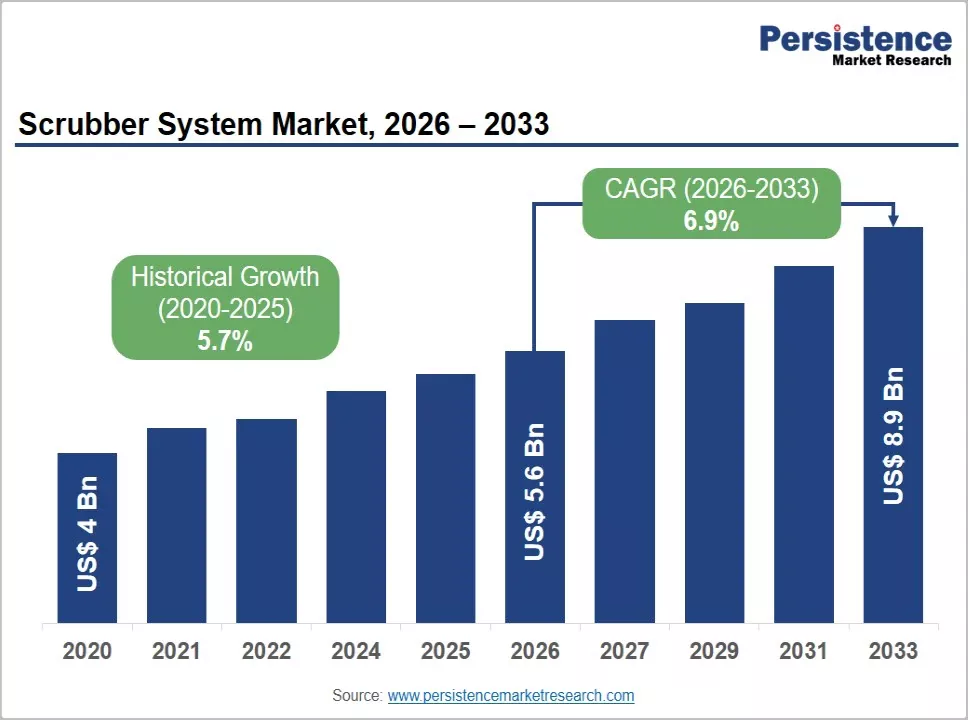
The global scrubber system market size is likely to be valued at US$ 5.6 billion in 2026, and is estimated to reach US$ 8.9 billion by 2033, growing at a CAGR of 6.9% during the forecast period 2026−2033. Growth is underpinned by tightening air quality regulations, expanding industrial and power generation capacity in emerging economies, and the need for sulphur and particulate abatement in maritime shipping and heavy industry.
The market has been experiencing moderate growth, reflecting uneven regulatory timelines and cyclical capital spending in power and shipping. However, the forecast period anticipates firmer expansion as emission norms tighten in Asia, new emission control areas take effect at sea, and operators pursue integrated systems that combine gas cleaning with wastewater treatment, carbon capture readiness, and digital monitoring.
Key Industry Highlights
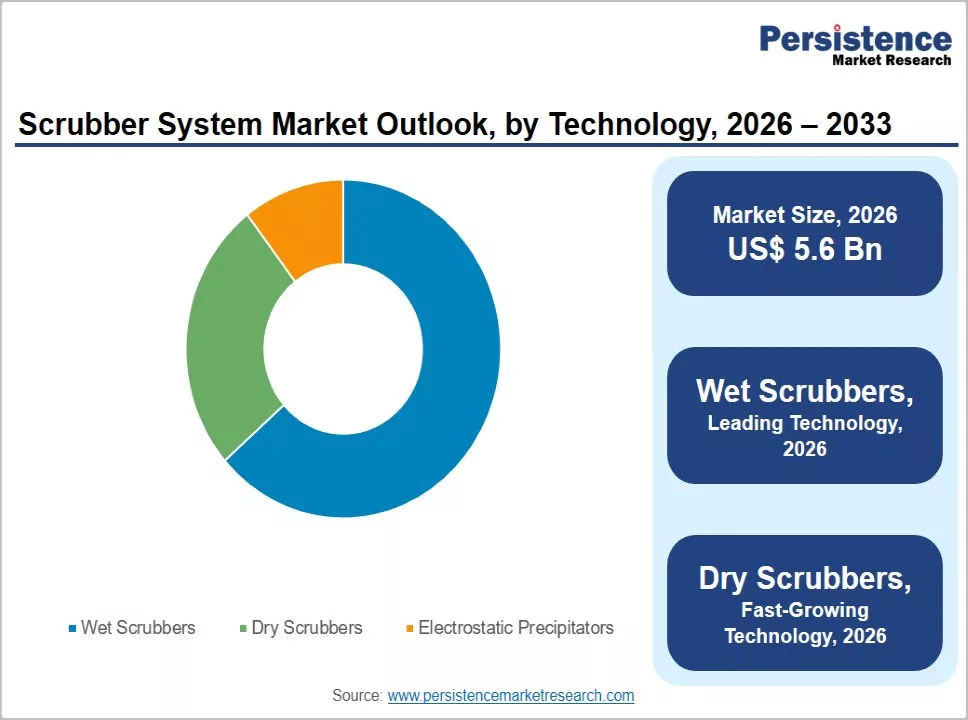
- Dominant Technology: Wet scrubbers are set to command around 56% of the revenue share in 2026, while integrated electrostatic precipitators are likely to grow the fastest at about 7.8% CAGR through 2033, as particulate limits tighten across power and industry.
- Leading Application: Industrial power generation is expected to lead with 33% in 2026, while cement and metals is likely to be the fastest-growing application at about 7.9% CAGR during 2026–2033, reflecting emission norms for kilns, furnaces, and smelters.
- Marine Segment Outlook: Marine scrubbers continue to benefit from the International Maritime Organization's sulphur limits and the expansion of emission control areas, with demand shifting toward hybrid, compact, and carbon-capture-ready designs.
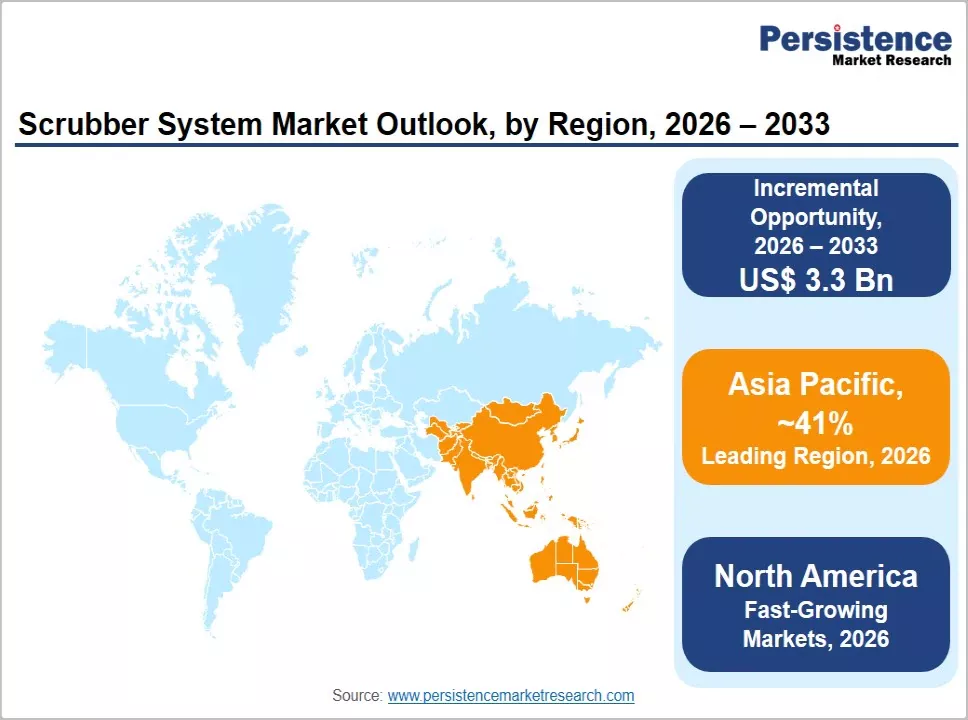
- Regional Leadership: Asia Pacific is poised to dominate with an estimated 41% share in 2026 and register a 7.8% CAGR through 2033, led by emission compliance programmes in China and India and shipbuilding strength in East Asia.
- Competitive Environment: Competitive dynamics include licensing of proven designs, expansion into marine water treatment, large air quality control contracts for utilities, and partnerships targeting integrated multi-pollutant solutions.
DRO Analysis
Drivers: Strict Emission Regulations and Industrial Expansion as Primary Growth Catalysts
Tightening air pollution regulations are the leading force driving the scrubber system market growth, as governments worldwide impose stricter limits on sulphur dioxide, acid gases, and particulate matter from power plants, industrial boilers, and ships. Coal-fired and gas-fired power units, refineries, chemical plants, cement kilns, and metal smelters all face compliance obligations that require flue gas desulfurization and related abatement technologies.
The European Union's revised Industrial Emissions Directive, India's sulphur dioxide norms for thermal power plants, and China's ultra-low emission standards continue to shape equipment demand. Operators prefer proven wet and dry scrubbing technologies to achieve high removal efficiencies and avoid penalties or curtailment.
Maritime Sulphur Rules and Expanding Emission Control Areas
In shipping, the International Maritime Organization's global fuel sulphur limit and tighter limits within emission control areas have made exhaust gas cleaning systems a major compliance option for owners that continue to use high-sulphur fuel oil. The Mediterranean Sea sulphur emission control area took effect in May 2025, and additional areas in the Canadian Arctic and Norwegian Sea have been adopted, with requirements expected to begin applying from 2027. Hybrid scrubbers, which can operate in open or closed loop modes, and designs prepared for onboard carbon capture are gaining attention as owners balance fuel cost spreads, regulations, and future decarbonization requirements.
Restraints: Regulatory Uncertainty, Washwater Concerns, and Policy Rollbacks
Regulatory fragmentation and shifting timelines can delay investment decisions in scrubber systems. Several ports and coastal states restrict or prohibit discharge of open-loop scrubber washwater, pushing owners toward costlier closed-loop or hybrid systems or toward compliant fuels. In power generation, implementation schedules for flue gas desulfurization can be extended or selectively relaxed, as seen in revised timelines and exemptions for some thermal plants in India, while federal rules in the U.S. have faced proposals for rollback. These uncertainties make capital planning difficult for utilities and heavy industry, and can temporarily suppress order intake.
High Capital and Operating Costs and Secondary Waste Streams
Scrubber systems involve substantial capital expenditure, space requirements, and ongoing operating costs for reagents, power, water, and maintenance. Wet systems generate wastewater and sludge, including gypsum and heavy metal-bearing residues that require treatment and disposal, while dry systems consume sorbents and produce solid waste. Retrofitting existing plants and vessels is technically complex, and installation on ships often requires dry docking, reducing revenue-earning time. The declining price spread between high-sulphur and compliant fuels at times reduces the economic case for marine scrubbers, causing owners to defer or avoid installations and increasing competition from alternative fuels and engine technologies.
Opportunities: Retrofits, Carbon Capture Integration, and Emerging Market Compliance
Large installed bases of industrial boilers, furnaces, and vessels create significant retrofit and upgrade opportunities. Utilities and industrial customers are awarding major air quality control contracts, as seen in Babcock & Wilcox's award in September 2026 to begin work on an approximately US$ 130 million air quality control project, and its US$ 40 million contract in December 2025 for advanced wet gas scrubbing technology at a Canadian refinery. Integration of scrubbers with carbon capture, selective catalytic reduction, and waste heat recovery is attracting interest, and marine scrubber suppliers are developing carbon-capture-ready designs, supporting higher-value, multi-pollutant solutions.
Marine Water Treatment and Localized Manufacturing
Suppliers are expanding beyond traditional scrubbers into related water treatment and emission technologies. In June 2026, LiqTech secured an order for four marine water treatment systems for vessels using exhaust gas recirculation engine technology in China, extending its silicon carbide membrane filtration beyond scrubber applications. In January 2026, Manta Marine Technologies licensed its scrubber design to Suntech Equipment for manufacture and installation, illustrating localized production and technology licensing. Emerging economies in South and Southeast Asia, the Middle East, and Africa are also tightening industrial emission standards, creating greenfield opportunities for equipment suppliers and engineering contractors.
Category-wise Insights
Technology Analysis
Why Do Wet Scrubbers Lead the Scrubber System Market?
Wet scrubbers are the leading technology segment, expected to hold about 56% of the scrubber system market revenue share in 2026. They use liquid reagents, such as limestone slurry, seawater, or caustic solutions, to absorb acid gases and capture particulates, delivering high removal efficiency for sulphur dioxide, hydrogen chloride, and other pollutants. Wet flue gas desulfurization is the preferred solution for large coal-fired power plants, refineries, and chemical facilities, while wet marine scrubbers operate in open, closed, or hybrid modes. Mature process knowledge, compatibility with diverse fuels, and ability to handle high sulphur loads sustain the segment's dominance, even as wastewater management and plume visibility demand attention.
Integrated electrostatic precipitators are likely to grow the fastest through 2033, at an estimated 7.8% CAGR. Combining electrostatic particulate removal with scrubbing delivers higher efficiency for fine particles, which is increasingly important as regulators target PM2.5 and black carbon. Pilot testing of a scrubber paired with a wet electrostatic precipitator on a marine diesel engine has reported emission reductions of up to 99%, indicating the potential of integrated designs. In power and industry, hybrid configurations of precipitators, baghouses, and scrubbers are used to comply with stricter limits for particulate matter and mercury, supporting upgrades of older units.
Dry scrubbers, including spray dry absorbers and dry sorbent injection systems, address applications where water availability is limited or where wastewater avoidance is a priority. They are widely used in medium-sized power plants, waste-to-energy facilities, cement kilns, and metal processing. In December 2025, ANDRITZ was awarded a contract to supply two spray dry absorbers for boiler units at the Tennessee Valley Authority's Shawnee Fossil Plant, reflecting continued utility investment in dry technology. Lower water consumption, simpler waste handling, and reduced plume issues make dry systems attractive, although they require careful sorbent management and may be less efficient at very high sulphur loads.
Application Analysis
Why Does Industrial Power Generation Lead Scrubber System Demand?
Industrial power generation is the leading application segment, projected to capture about 33% of the revenue share in 2026. Coal, biomass, and oil-fired boilers, together with captive power plants at industrial facilities, remain major sources of sulphur dioxide and particulate emissions and are subject to progressively stricter limits. Large power projects typically specify wet or dry flue gas desulfurization, particulate control, and associated continuous emissions monitoring, resulting in large-ticket orders. Retrofits of existing units to comply with new standards are a significant source of demand, particularly in Asia, Eastern Europe, and parts of the U.S., supported by long asset lives and utility compliance planning.
Cement and metals is the fastest-growing application segment, expected to showcase an approximate 7.9% CAGR through 2033. Kilns, sinter plants, electric arc furnaces, and smelters emit dust, sulphur oxides, and acid gases, and regulators are narrowing permissible limits. Investment in capacity expansion in India, Southeast Asia, and the Middle East is accompanied by requirements for modern emission controls, while European producers upgrade to meet revised Best Available Techniques conclusions. Scrubbers increasingly work in tandem with bag filters, precipitators, and heat recovery systems to meet multi-pollutant targets and reduce operating costs.
Marine and chemical and petrochemical applications provide complementary demand. In shipping, scrubber installations have moderated from earlier peaks, yet hybrid systems remain relevant for owners on long-haul routes, and compliance with new emission control areas keeps the pipeline active. Chemical and petrochemical plants use scrubbers for acid gas, ammonia, and volatile compound control, as well as for refinery fluid catalytic cracker units, where wet gas scrubbing technology reduces sulphur oxides and particulates. Other industrial applications, including waste incineration, glass manufacturing, and pulp and paper, contribute stable, regulation-driven demand.
Regional Insights
North America Scrubber System Market Trends and Insights
North America is anticipated to account for an estimated 22% of the global scrubber system market in 2026. The region's market is likely to benefit from retrofit and maintenance of existing power and industrial assets, refinery emission controls, and growing electricity demand supported by gas-fired and coal-fired capacity. Regulatory direction under federal air programmes has become less predictable, with proposals to revise recent power plant emission rules, yet state-level requirements and long-term operating permits continue to sustain investment. Competition among established engineering firms and specialized emission control suppliers is expected to remain strong through 2033.
U.S. Scrubber System Market Size
The U.S. is estimated to account for approximately 82% of the North America scrubber system market in 2026. Market growth is likely to be supported by upgrades at coal-fired and industrial units, refinery projects, and compliance with Clean Air Act programmes. Utilities such as the Tennessee Valley Authority are investing in flue gas treatment systems, including spray dry absorbers, while engineering firms secure large air quality control contracts. Marine scrubber demand is influenced by North American emission control areas, and the broader market is anticipated to be shaped by regulatory changes and industrial capital spending through 2033.
Canada Scrubber System Market Size
Canada is projected to represent approximately 18% of the North America scrubber system market in 2026. Market expansion is expected to be driven by refinery and petrochemical investments, oil sands operations, and metals processing in resource-producing provinces. Wet gas scrubbing projects, such as a US$ 40 million award in December 2025 for a major Canadian petroleum refinery, illustrate demand for advanced sulphur oxide and particulate control. The Canadian Arctic emission control area adopted at the International Maritime Organization is also likely to influence marine compliance planning through 2033.
Europe Scrubber System Market Trends and Insights
Europe is estimated to account for approximately 11% of the global scrubber system market in 2026. The region's market is expected to benefit from the revised Industrial Emissions Directive, strict Best Available Techniques requirements, and the strong maritime sector, including the Mediterranean emission control area that took effect in 2025. European suppliers, including Wärtsilä, Alfa Laval, Valmet, and ANDRITZ, are global leaders in marine and industrial gas cleaning. Growth is likely to be concentrated in upgrades of waste-to-energy, cement, and chemical plants, and in marine compliance and washwater treatment solutions.
Germany Scrubber System Market Size
Germany is anticipated to account for approximately 25% of the Europe scrubber system market in 2026. Demand is expected to be supported by strict emission standards for industrial installations, a large base of waste incineration, chemical, and metals facilities, and the presence of leading engineering and air pollution control companies. Industrial customers are upgrading gas cleaning systems to meet tighter limits and integrate heat recovery, while the energy transition is shifting emphasis from coal-fired power to biomass, waste, and industrial processes. Investment in carbon capture readiness is projected to support market expansion through 2033.
Why Is Asia Pacific Expected to Lead the Scrubber System Market?
Asia Pacific is projected to account for approximately 41% of the global scrubber system market in 2026, making it the largest regional market. The region is also anticipated to register the fastest growth, expanding at an estimated CAGR of 7.8% through 2033. Market expansion is likely to be driven by large thermal power capacity, heavy industry, strict air quality campaigns, and dominant shipbuilding capacity in China, South Korea, and Japan. Southeast Asian countries are also tightening emission standards as industrial output rises, while the region's vessel orders increasingly include emission-reduction technologies.
China Scrubber System Market Size
China is estimated to represent approximately 46% of the Asia Pacific scrubber system market in 2026. The country's market is expected to benefit from ultra-low emission retrofits at power and industrial plants, extension of controls to steel, cement, and glass sectors, and a large shipbuilding industry. Chinese orders for newbuild vessels are shifting toward cleaner fuels and emission-reduction technologies, creating demand for marine water treatment and related systems, as seen in orders for exhaust gas recirculation vessels. Domestic suppliers such as Fujian Longking are expected to maintain strong positions through 2033.
India Scrubber System Market Size
India is projected to account for approximately 18% of the Asia Pacific scrubber system market in 2026. The market is expected to witness strong expansion, supported by sulphur dioxide emission norms for thermal power plants, which have driven major flue gas desulfurization orders such as Thermax's contract for two 500 MW units in Uttar Pradesh. Although revised timelines and selective exemptions have moderated near-term implementation, continued additions of power capacity, cement and steel expansion, and tightening particulate regulations are likely to sustain demand. Domestic engineering firms and international suppliers are expanding local manufacturing and service capabilities.
Competitive Landscape
The global scrubber system market structure is moderately consolidated, with leading suppliers including Wärtsilä, Alfa Laval, Valmet, ANDRITZ, Babcock & Wilcox, and Mitsubishi Heavy Industries holding a significant share of large projects. These companies leverage extensive references, engineering capabilities, and global service networks, and invest in reagent efficiency, compact designs, wastewater treatment, and carbon capture integration. Long project cycles and demanding performance guarantees favor suppliers with proven track records in both marine and utility applications.
Regional and niche competitors such as Thermax, Fuel Tech, LiqTech International, Dürr, and Fujian Longking focus on specific technologies, geographies, and complementary solutions like selective catalytic reduction, membrane filtration, and precipitators. Technology licensing, as in the Manta Marine and Suntech agreement, is lowering entry barriers for regional manufacturers, particularly in Asia. Market consolidation is expected to increase gradually as larger players acquire specialists to broaden multi-pollutant portfolios, while partnerships between marine engine makers, shipyards, and scrubber suppliers support integrated compliance solutions.
Key Market Developments
- In September 2026, Babcock & Wilcox received an award to begin work on an approximately US$ 130 million air quality control project, following its December 2025 US$ 40 million contract for wet gas scrubbing technology at a Canadian refinery.
- In June 2026, LiqTech International secured an order for four marine water treatment systems for exhaust gas recirculation vessels in China, with first delivery scheduled for the fourth quarter of 2026, extending its silicon carbide membrane technology beyond scrubbers.
- In January 2026, Manta Marine Technologies licensed its scrubber design, originally sold under the Green Tech Marine and Yara Marine brands, to Suntech Equipment, which will manufacture and install SOx scrubber systems based on the design.
Frequently Asked Questions
The global scrubber system market is valued at US$ 5.6 billion in 2026 and is projected to reach US$ 8.9 billion by 2033, expanding at a CAGR of 6.9% during 2026–2033.
Tightening air quality regulations, expansion of industrial and power capacity, maritime sulphur limits and emission control areas, and retrofit demand are driving the market.
Wet scrubbers lead technologies with about 56% share, and industrial power generation leads applications with about 33% in 2026.
Asia Pacific dominates the market with an estimated 41% share in 2026 and is projected to register a 7.8% CAGR through 2033, led by emission programmes in China and India and shipbuilding strength in East Asia.
Retrofit projects, carbon-capture-ready and integrated multi-pollutant systems, marine water treatment, and tightening emission standards in emerging economies are key market opportunities.


