




- Energy & Utilities
- Rental Air Compressor Market
Rental Air Compressor Market Size, Share, and Growth Forecast 2026 – 2033
Rental Air Compressor Market by Product Type (Stationary, Portable), by Rental Type (Short-term, Long-term), Technology (Reciprocating, Rotary/Screw), End-user (Manufacturing, Construction, Mining, Oil & Gas), and Regional Analysis, 2026 – 2033

Rental Air Compressor Market Size and Trends Analysis
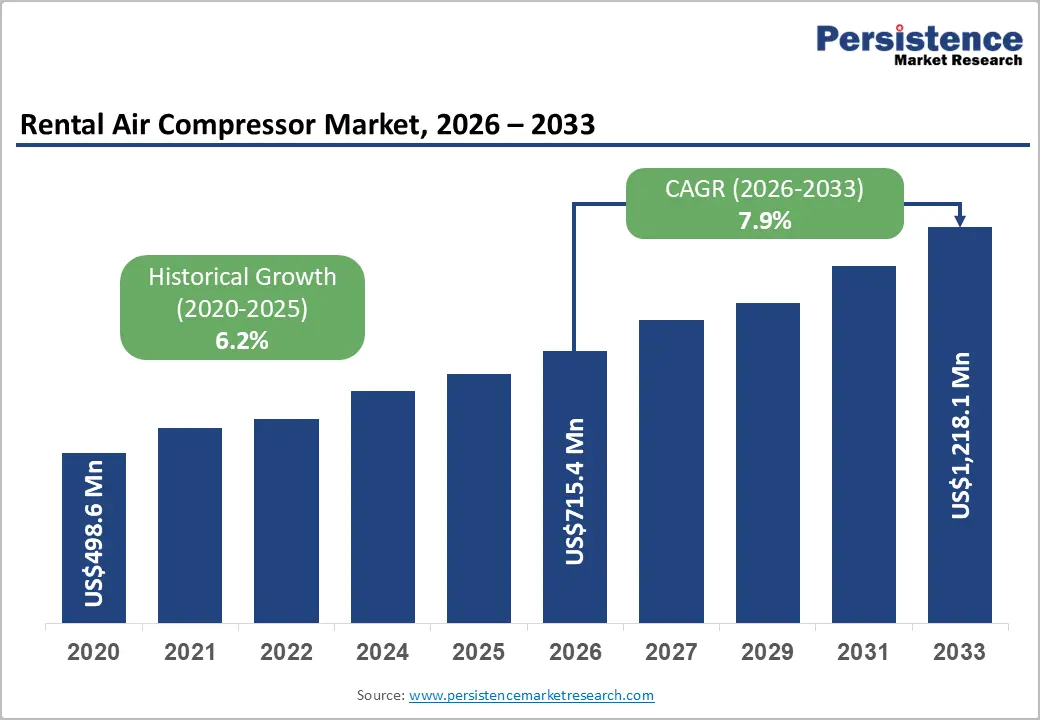
The global rental air compressor market size is likely to be valued at US$715.4 million in 2026 and is expected to reach US$1,218.1 million by 2033, growing at a CAGR of 7.9% during the forecast period from 2026 to 2033, driven by rising infrastructure and construction activities across developing economies. Growth is further supported by increasing preference for rental equipment to avoid high capital investment and maintenance costs among contractors.
Key Industry Highlights:
- Leading Product Type: Portable air compressors, approximately 66.8% share in 2026, as they can be easily transported across changing job sites.
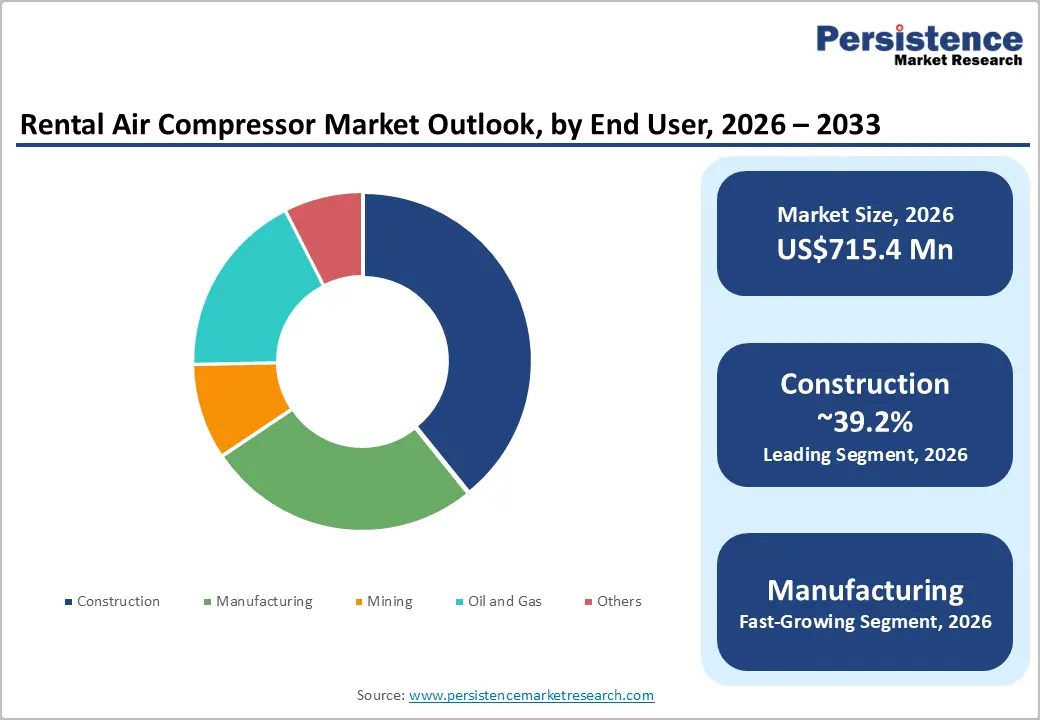
- Dominant End-user: Construction, nearly 39.2% in 2026, because compressed air is required across multiple activities such as drilling, excavation, and concrete spraying.
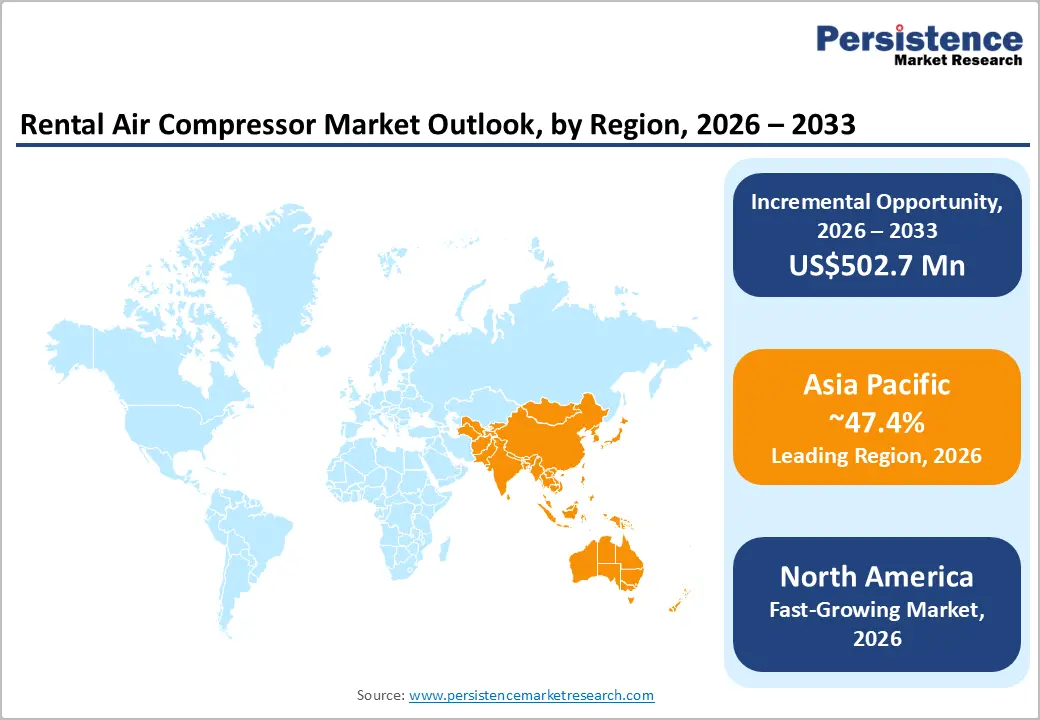
- Leading Region: Asia Pacific, with about a 47.4% share in 2026, backed by ongoing infrastructure expansion and manufacturing growth.
- Fast-growing Region: North America, owing to rising investments in energy, data centers, and industrial upgrades.
- Latest Acquisition: In January 2026, Atlas Copco announced the simultaneous acquisition of two compressor distributors, namely, Air Compressor Works in Florida and Centroar in Brazil. Both companies were integrated into Atlas Copco's Compressor Technique Business Area under the Quincy Compressor brand.
DRO Analysis
Driver - Rising Construction Activities Worldwide
Massive infrastructure buildouts across emerging markets are creating steady demand for portable and short-term compressed air equipment. In India, government programs such as Bharatmala and PM Gati Shakti have triggered a large wave of highway, port, and corridor construction. As of 2024, the National Highways Authority of India (NHAI) invested nearly US$4.93 billion into Bharatmala alone, with 19,826 km already constructed. These worksites depend on pneumatic tools, concrete spraying, and sandblasting.
All of these require compressed air on demand. Buying equipment for short-term projects makes little financial sense. India's construction firms are constantly shifting toward rentals to avoid high ownership and maintenance costs, with programs such as Gati Shakti creating a surge in demand for portable on-site equipment.
Strict Emission Norms to Push Rentals over Ownership
Strict environmental regulations are making it difficult for companies to justify owning old compressor fleets. In the U.S., the Environmental Protection Agency’s (EPA) Tier 4 standards apply directly to non-road diesel-powered equipment such as compressors, requiring engine manufacturers to integrate advanced emission control technologies to meet NOx and PM limits. Upgrading owned fleets to Tier 4 compliance involves significant capital.
Renting delivers a shortcut, i.e., rental companies absorb that upgrade cost and pass on compliant units to end-users. New rental deployments now feature oil-free, electric, hybrid, and VSD compressors designed to meet strict emission norms while cutting carbon output. In November 2021, California's Air Resources Board held its first workshop on Tier 5 standards, targeting a further 50 to 90% reduction in NOx and PM beyond current Tier 4 levels. This signals that compliance costs for owners will only keep rising.
Restraint - Surging Cumulative Rental Costs May Deter Long-Term Users
Renting makes sense for short projects, but costs stack up fast when usage extends beyond a few weeks. Rental rates for portable air compressors range from $45 to $90 per day or $100 to $200 per week. Trailer-mounted units can cost $75 to $950 per day or $220 to $2,500 per week. For a contractor running a six-month project, those figures can quickly exceed the purchase price of an equivalent unit. Industry advisors recommend calculating Total Cost of Ownership (TCO), factoring in purchase price and operating costs, before committing to a rental strategy.
This is because the return on a purchased unit can outpace long-term rental spend in several scenarios. This financial reality limits rental market growth among users with predictable and recurring demand. Short-term rentals dominated the North America market in 2025, which suggests most renters are already self-selecting for brief engagements. Frequent users, on the other hand, often migrate toward ownership.
Opportunity- Energy-Saving Motor Technology Opens New Rental Efficiency Gains
Variable Speed Drive (VSD) compressors are fast becoming the preferred choice in rental fleets as they cut operating costs without sacrificing output. Unlike fixed-speed units that run at full load regardless of actual need, VSD compressors automatically match output to real-time demand. As electricity accounts for about 70% of a compressor's total cost of ownership, VSD technology can reduce energy costs by 35 to 50% depending on application size.
Studies have also shown that a 20% reduction in motor speed alone can deliver up to 50% in energy savings. Atlas Copco's rental division has already extended VSD across its full fleet, delivering everything from small E-Air units to the trailer-mounted HNX 210 VSD oil-free compressor, citing energy savings of up to 35%. For end-users under pressure to reduce site emissions without buying new equipment, VSD rental units present a practical and low-commitment path to compliance and cost reduction.
Smart Monitoring Technology Reduces Downtime and Improves Fleet Utilization
IoT-enabled monitoring is turning rental compressors into data-generating assets that benefit both provider and end-user. Leading rental players, including Atlas Copco, United Rentals, and Aggreko, are actively integrating IoT-enabled smart compressors into their fleets, enabling remote monitoring, noise reduction, and energy efficiency improvements. Atlas Copco took an early lead with its iACCESS satellite system, which relays live data on pressures and temperatures to service teams, triggering maintenance alerts before failures occur. It also allows technicians to arrive with the right parts, cutting unplanned downtime.
The company later broadened this with its FleetLink telematics platform, designed to help users optimize fleet usage, reduce maintenance costs, and save time through centralized monitoring. As predictive maintenance becomes standard practice, rental providers delivering data-driven service agreements gain a competitive edge. End-users also gain the operational visibility required to avoid costly project delays.
Category-wise Analysis
Product Type Insights
Portable air compressors are predicted to lead with a share of approximately 66.8% in 2026, as they solve a very practical problem, i.e., mobility at job sites. Construction, mining, and oilfield work often shift locations within days. Fixed systems cannot support such operations. Portable units can be mounted on trucks or trailers and moved quickly without dismantling infrastructure. This reduces downtime between projects.
Stationary air compressors are estimated to be the fastest-growing segment in the forecast period because they are essential for continuous and high-volume operations. Industries such as chemicals, power generation, and automotive manufacturing demand uninterrupted compressed air. Portable systems cannot match this consistency. Reliability and efficiency are the main drivers. Stationary compressors are designed for optimized energy consumption and long operating hours, making them suitable for base-load applications.
End-user Insights
The construction segment is anticipated to dominate with a share of nearly 39.2% in 2026, as compressed air is required at almost every stage of a project. It is used for drilling, excavation, concrete spraying, sandblasting, and powering pneumatic tools. Few other industries use compressors as widely across tasks. Infrastructure expansion is a key driver. Governments are investing heavily in roads, railways, and urban development. For example, India’s Ministry of Road Transport and Highways continues to report large-scale highway expansion projects, where pneumatic drilling and road-breaking tools rely heavily on compressors.
The manufacturing segment is expected to remain in the second position in 2026, as compressed air is becoming central to automation. Modern factories use air systems for robotics, material handling, packaging, and precision control. As factories become more automated, air demand rises. A prominent driver is the shift toward Industry 4.0. Smart factories rely on sensors, actuators, and pneumatic systems that require clean and stable compressed air. This is pushing upgrades to advanced compressor systems.
Regional Insights
Asia Pacific Rental Air Compressor Market Trends
Asia Pacific is anticipated to dominate in 2026 with a global share of nearly 47.4%, propelled by high infrastructure spending, rising mining activity, and surging industrial demand for short-term air solutions. Multiple large economies are all in active construction and industrialization phases simultaneously. China, India, Indonesia, and Vietnam are constantly building roads, ports, factories, and urban infrastructure at the same time. The extensive growth in construction across the region reflects key public and private investment in roads, airports, smart cities, and industrial parks. All of these create exponential demand for high-performance compressors.
China Rental Air Compressor Market Trends
China is predicted to account for a regional share of approximately 37.4% in 2026 and lead in Asia Pacific. Growth is attributed to the sustained expansion of the country's chemical and mining industries. The mining sector is a big part of this growth. According to a Government of Canada report, China hosts more than 1,500 major mining operations, with about 75% conducted underground. Underground mining relies heavily on compressed air for drilling, ventilation, and pneumatic tools. Renting units for project-specific phases is far more practical than owning a large fleet.
India Rental Air Compressor Market Trends
India is estimated to hold a regional share of nearly 26.8% in 2026, fueled by large-scale infrastructure programs such as Bharatmala, Smart Cities Mission, and Gati Shakti. Construction firms are constantly renting portable compressors for short-term requirements in road, rail, and utility projects. The expansion of these programs is enormous. Gati Shakti alone carries a proposed investment of approximately US$1,190 billion and integrates 16 ministries along with schemes, including Bharatmala, Sagarmala, UDAN, and various industrial corridors. India's expanding mining and cement production activities are also generating steady demand for ruggedized compressor units.
North America Rental Air Compressor Market Trends
North America is predicted to be the fastest-growing region in 2026 with a global share of approximately 24.1%. Growth is propelled by rising infrastructure investment, widespread equipment delays, and surging demand across industrial sectors. The U.S. Infrastructure Investment and Jobs Act (IIJA) is funneling billions into ground-level projects that demand compressed air equipment on-site. Industrial reshoring and accelerated project schedules are amplifying demand for flexible and high-performance rental compressors that ensure operational continuity. Also, oil and gas operations remain a primary demand driver, especially for high-pressure applications in remote or off-grid locations.
U.S. Rental Air Compressor Market Trends
The U.S. is expected to account for a regional share of nearly 63.2% in 2026, owing to its well-established construction and industrial sectors, ongoing infrastructure developments, upsurge in oil and gas exploration, and a continuous demand for temporary power solutions. The U.S. also has the deepest and most organized rental infrastructure in North America. Companies such as United Rentals, Sunbelt Rentals, and Herc Rentals operate nationwide fleets with swift deployment capabilities. The presence of large rental players with sophisticated IoT-enabled fleets further makes the U.S. market technically more advanced than most countries.
Europe Rental Air Compressor Market Trends
Europe will likely see decent growth in the forecast period, with a global share of nearly 18.7% in 2026, backed by its mature industrial base. Hence, growth comes from equipment upgrades and regulatory compliance rather than new greenfield buildouts. Sustainability initiatives are targeting a cut in net GHG emissions by at least 55% by 2030, which is pushing the adoption of rental compressors that meet strict emission standards without requiring capital investment in new owned equipment. Strict energy efficiency regulations in Europe are also encouraging adoption of unique compressor technologies across manufacturing, automotive, food processing, healthcare, and construction industries.
Germany Rental Air Compressor Market Trends
Germany is estimated to lead the Europe market with a regional share of around 25.8% in 2026, spurred by its superior manufacturing sector, advanced industrial automation, and high demand for industrial machinery. The country's strength lies in its industrial breadth and its precision engineering culture. The market is also fueled by Germany’s Mittelstand network of small and medium-sized enterprises and large industrial conglomerates. Demand is consistently high for energy-efficient screw and centrifugal compressors that support automated production lines in the automotive, metalworking, and packaging sectors.
U.K. Rental Air Compressor Market Trends
In 2026, the U.K. is predicted to witness steady growth by accounting for a regional share of nearly 16.4%, driven by retrofit cycles in food, pharmaceutical, and advanced manufacturing sectors, where companies upgrade production lines to meet evolving safety, quality, and efficiency standards. This is creating steady demand for energy-efficient compressors. On the construction side, prominent infrastructure projects are a key driver. HS2 and utility network upgrades are prompting infrastructure developers to lock in long-term rental agreements for equipment across Greater London and northern England corridors.
Competitive Landscape
The global rental air compressor market is fragmented, with competition spread across multinational rental companies, compressor manufacturers with rental divisions, and various regional fleet operators. Leading players such as Atlas Copco, United Rentals, Sunbelt Rentals, Aggreko, and Ingersoll Rand are investing in telematics, remote monitoring, predictive maintenance, and energy-efficient compressor fleets to differentiate their portfolios. Digital platforms that enable customers to track equipment performance and rental schedules are becoming a key competitive advantage.
Strategic acquisitions and rental network expansion are influencing the competitive environment. For example, Atlas Copco integrated its North American rental businesses in 2024 to strengthen operational efficiency and customer support capabilities across industrial and construction applications. Such consolidation efforts help key companies extend regional footprint while improving fleet utilization rates.
Key Industry Developments:
- In May 2026, Atlas Copco Group completed three compressed air acquisitions, namely, PowerTech Ar Comprimido Ltda., a Brazil-based compressed air distributor; LVC Solutions N.V., a Belgium-based compressed air distributor; and Trident Compressed Air Ltd., a Canada-based compressed air distributor. All three companies became part of the Compressor Technique Business Area, showcasing the company's ongoing strategy of geographic expansion through regional distributor acquisitions.
- In March 2026, Atlas Copco Group acquired Cypress Equipment Rental, Inc., a portable compressor distributor based in Louisiana. Cypress served customers across oil and gas, petrochemicals, abrasive blasting, bridge and pipeline construction, and offshore services. The company became part of Atlas Copco's Portable Air division within the Power Technique Business Area.
- In December 2025, Rubix acquired Airflux, the most prominent independent player in France’s compressed air industry, along with its two subsidiaries, Int' Air Media and Synairgies. The acquisition was aimed at building a leading compressed air solutions platform in France.
Companies Covered in Rental Air Compressor Market
- Caterpillar Inc.
- Atlas Copco
- OTC Industrial Technologies
- United Rentals Inc.
- Sunbelt Rentals
- Texas First Rentals
- Empire Tool Rentals
- Pro Rental & Sales
- Mountain Air Compressor
- MacAllister Rentals
- Coast to Coast Equipment Rentals
- Harris Equipment Rental
- H&E Equipment Services
- Loxam Group
- Others
Frequently Asked Questions
The global rental air compressor market is projected to be valued at US$715.4 million in 2026.
The rental air compressor market is expected to reach US$1,218.1 million by 2033.
Key market trends include surging adoption of energy-efficient compressors and integration of telematics for fleet monitoring.
Portable air compressors are expected to be the leading product type with a share of nearly 66.8% in 2026, as they can operate in remote and off-grid locations using diesel power.
The rental air compressor market is expected to grow at a CAGR of 7.9% from 2026 to 2033.
Caterpillar Inc., Atlas Copco, OTC Industrial Technologies, and United Rental Inc. are a few key market players.


