




- Biotechnology
- Protein Purification and Isolation Market
Protein Purification and Isolation Market Size, Share, and Growth Forecast 2026 - 2033
Protein Purification and Isolation Market by Product Type (Instruments, Consumables), Technology (Ultrafiltration, Precipitation), Application (Drug Screening, Biomarker Discovery), and Regional Analysis, 2026 - 2033

Protein Purification and Isolation Market Size and Trends Analysis
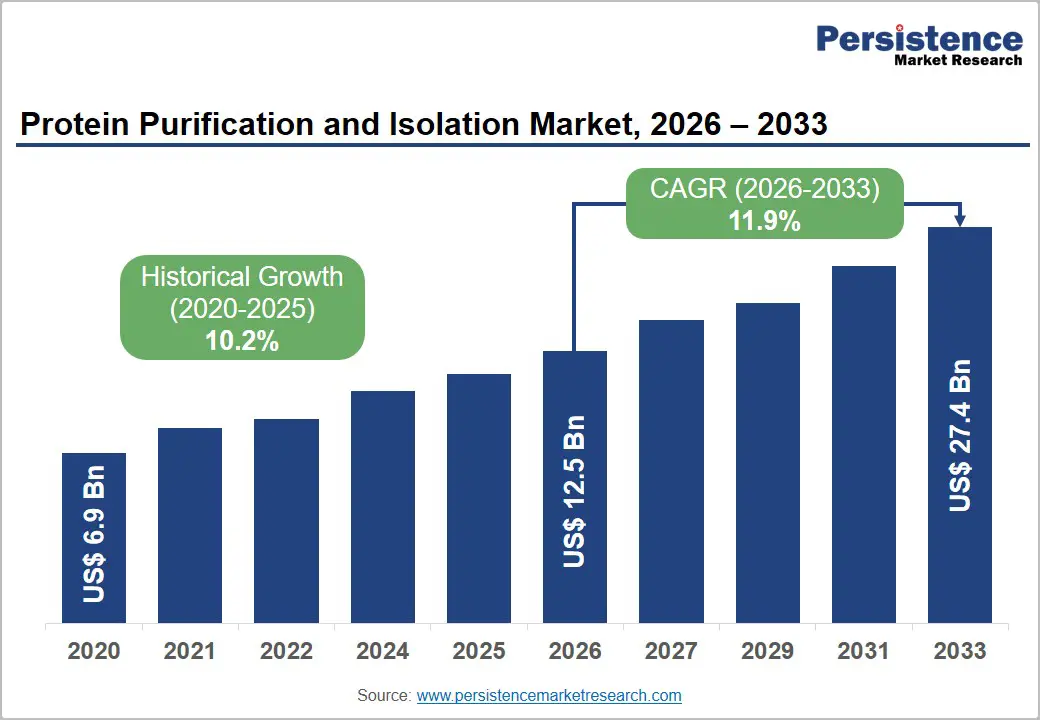
The global protein purification and isolation market size is likely to be valued at US$12.5 billion in 2026 and is estimated to reach US$27.4 billion by 2033, growing at a CAGR of 11.9% during the forecast period from 2026 to 2033, driven by rising demand for monoclonal antibodies and biosimilars across therapeutic areas. Growth is further supported by increasing investments in proteomics and drug discovery research, especially by organizations such as the National Institutes of Health (NIH).
Key Industry Highlights:
- Leading Product Type: Consumables, approximately 63.3% share in 2026, as the rise of single-use systems has increased demand for disposable filters, columns, and resins.
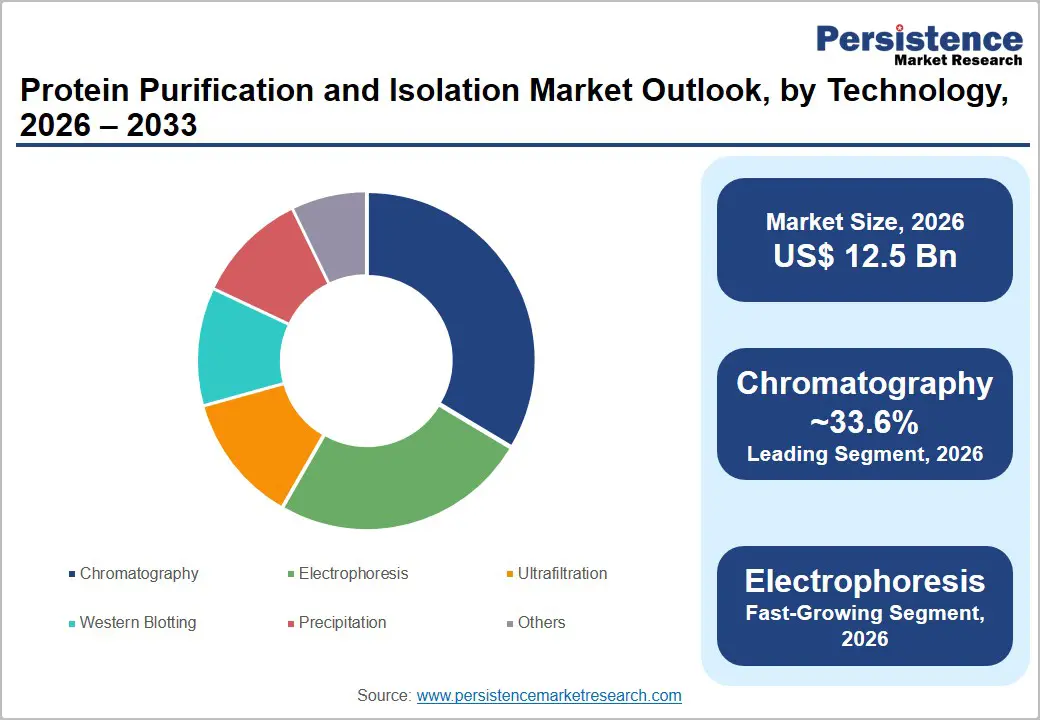
- Dominant Technology: Chromatography, nearly 33.6% share in 2026, as it delivers high-purity protein separation and can be easily expanded from research to large-scale biologics manufacturing.
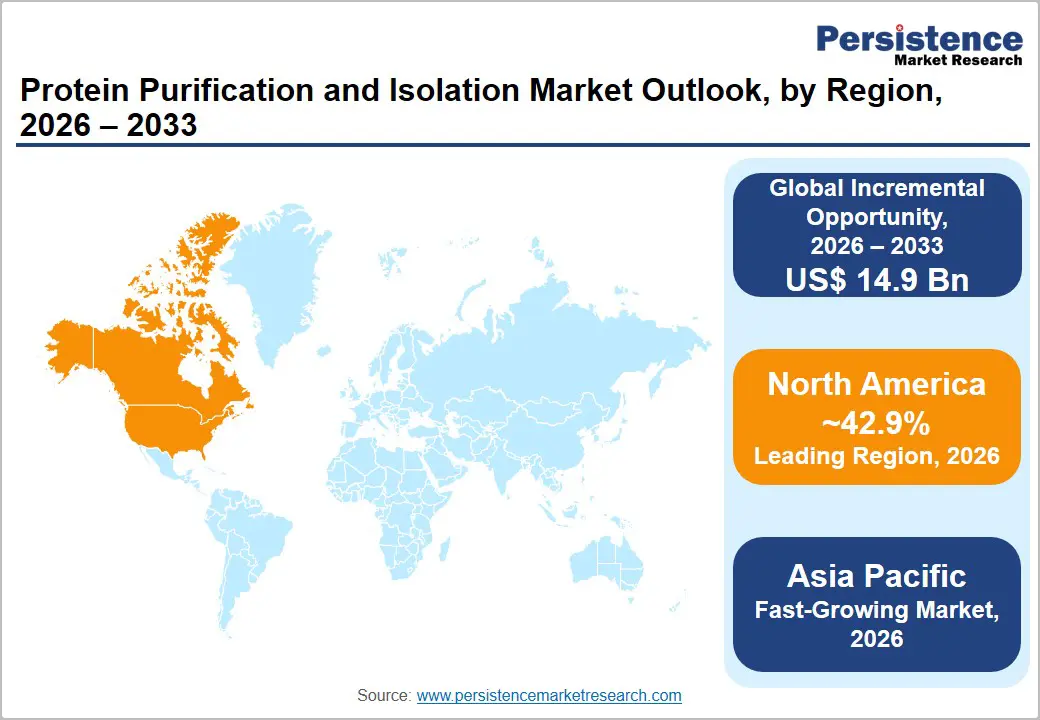
- Leading Region: North America, with about 42.9% share in 2026, owing to its extensive biologics pipeline and early adoption of advanced purification technologies.
- Fast-growing Region: Asia Pacific, owing to expanding biomanufacturing hubs and government-backed biotech programs.
- Recent Update: In February 2026, Repligen reported strong momentum in its Proteins business segment, propelled by rising adoption of chromatography resins and purification technologies used in biopharmaceutical manufacturing. The company indicated that demand was mainly high for products supporting advanced biologics and next-generation therapeutic modalities.
DRO Analysis
Driver - A Large Biologics Pipeline to Create High Demand
Every approved biologic requires a multi-step downstream purification process before it can be released for clinical use. The intensity of the current pipeline is expanding this demand. A peer-reviewed analysis published in Biomedicines (2025) confirmed that the U.S. Food and Drug Administration (FDA) approved 50 novel drugs in 2024, of which 16 were biologics. Key approvals included the highest number of Monoclonal Antibodies (mAbs) since 2015- 13 mAbs in total, with six indicated for oncology.
The standard industrial purification train for mAbs is a three-step chromatography sequence, typically Protein A affinity capture followed by two polishing steps using Ion Exchange Chromatography (IEC) and mixed-mode resins. According to a peer-reviewed report published in PMC (2025), techniques such as affinity chromatography and ion exchange chromatography are commonly used to reduce costs and improve efficiency. Synthetic affinity ligands are being developed for large-scale manufacturing due to their high stability and selectivity. As the mAb and bispecific antibody pipeline continues to extend, purification resin and consumable demand will likely grow with each new approved product.
Cell and Gene Therapy Manufacturing to Propel Purification Requirements
Cell and Gene Therapies (CGTs) introduce purification challenges that standard mAb platforms are not designed to address. These include the need to isolate intact viral vectors, modified cells, and fragile protein-nucleic acid complexes at clinical grade. In 2023 and 2024, there were reported to be more than 2,500 active Investigational New Drug (IND) applications for CGTs. There were also around 1,300 active INDs for gene therapies on file with the FDA's Office of Therapeutic Products (OTP), with at least 35 gene therapy candidates in Phase 3 trials globally.
The FDA has responded to this manufacturing pressure. On January 11, 2026, the FDA announced a more flexible approach to Chemistry, Manufacturing, and Controls (CMC) requirements for CGT products. It recognized that small patient populations and complex biologics require adaptive rather than fixed manufacturing standards. As more CGTs progress from clinical to commercial manufacturing, the demand for expandable and validated purification platforms specific to viral vectors and cell-derived products will likely intensify.
Restraint - High Purification Infrastructure Costs May Hamper Growth
Protein purification at commercial level requires substantial investment in large-format chromatography columns, high-pressure pumps, buffer preparation systems, clean-in-place (CIP) infrastructure, and associated facility modifications. The current industry focus on cell culture intensification strategies that can result in increased process efficiency and lower cost of goods is presenting challenges to the economics of chromatography processes. To ensure steady and reproducible commercial manufacturing strategies, there is always a mandate to increase the level of chromatography unit operations.
A study published in PMC and cited in the Journal of Chromatography A (2024) confirmed that Protein A affinity chromatography, the most widely used mAb capture step, contributes to approximately 70% of downstream processing costs. For new modalities such as Adeno-Associated Virus (AAV) vectors and Chimeric Antigen Receptor T-Cell (CAR-T) products, existing chromatography platforms often require complete redesign rather than simple adaptation, raising capital requirements. Small-scale biotechs and emerging-market Contract Development and Manufacturing Organizations (CDMOs) without existing infrastructure face the steepest barriers, as these systems require months of process validation before use.
Opportunity - Multi-Column Continuous Chromatography to Replace Batch Processing
Traditional batch chromatography processes protein in sequential and discrete cycles, each followed by column regeneration, thereby producing idle time and limiting throughput. Continuous chromatography eliminates this by running multiple columns in coordinated phases simultaneously. In 2023, a continuous Multi-Column Chromatography (MCC) method for purifying mAbs was developed in which the process was divided into capture and polishing phases. Results showed significant improvements in productivity and efficiency, with multiple columns performing loading, washing, and regeneration simultaneously, resulting in short processing times and high throughput.
A 2024 paper in Journal of Chromatography A further presented RC-PMCC and RC-BioSMB continuous purification methods for mAbs, advancing the field's move toward integrated continuous platforms. According to a Trends in Biotechnology (2024) review cited by Nature Research Intelligence, continuous end-to-end production of mAbs is boosting both in economic and sustainability performance. Continuous downstream processing is now demonstrating reduced facility footprints and lower cost of goods compared to traditional batch manufacturing.
Artificial Intelligence to Augment Chromatography Process Development
Selecting the right resin type, buffer composition, pH gradient, and loading conditions for a new therapeutic protein historically required months of iterative laboratory screening. Artificial Intelligence (AI) and Machine Learning (ML) are compressing this process significantly. A 2026 paper in the Journal of Chromatography A introduced ChromR, a Large Language Model (LLM)-driven platform for chromatographic process design and optimization. It has helped in addressing traditional development challenges such as reliance on expert experience, long development cycles, and labor intensity.
A gene-editing facility described in industry coverage integrated AI-based software that predicted 200 potential protein modifications, improving pipeline efficiency through smart optimization. The FDA's Process Analytical Technology (PAT) framework explicitly encourages AI-assisted real-time monitoring and control in biomanufacturing, providing regulatory compliance for AI-guided purification tools. As protein modalities become more complex, the ability to computationally predict optimal purification conditions before entering the lab is becoming a meaningful competitive and economic advantage.
Category-wise Analysis
Product Type Insights
Consumables are predicted to lead with a share of approximately 63.3% in 2026, as they are repeatedly used in every experiment and production cycle. Protein purification workflows rely heavily on resins, columns, magnetic beads, buffers, and filtration units. These items cannot be reused multiple times due to contamination risks and performance loss. This creates constant demand. For example, Protein A chromatography resins used in monoclonal antibody production degrade after multiple cycles. Hence, manufacturers recommend replacement after a defined number of runs to maintain binding efficiency.
Instruments are estimated to be the fastest-growing segment over the forecast period, as labs are upgrading to automation and high-throughput systems. While consumables propel recurring revenue, instruments are evolving with technology upgrades. Modern purification systems now include automation, real-time monitoring, and integration with digital software. This encourages labs to replace aging systems rather than continue using outdated ones. For instance, automated chromatography systems such as ÄKTA platforms are widely adopted in research and GMP manufacturing, owing to their ability to reduce manual errors and improve reproducibility.
Technology Insights
The chromatography segment is anticipated to dominate with a share of nearly 33.6% in 2026, as it delivers high purity and expandability for biologics. Chromatography can separate proteins with very high precision based on size, charge, or binding affinity. This makes it essential for producing therapeutic proteins such as monoclonal antibodies. Protein A affinity chromatography alone is used in nearly all commercial antibody purification processes. According to a whitepaper from European Medicines Agency, chromatography remains a standard step in approved biologics manufacturing, backed by its ability to meet strict purity and safety requirements.
The electrophoresis segment is expected to remain in the second position in 2026, as it is essential for protein analysis and validation. Unlike chromatography, electrophoresis is mainly used after purification to check protein size, purity, and integrity. Its growth is associated with rising research in proteomics, biomarker discovery, and personalized medicine. Techniques such as SDS-PAGE and capillary electrophoresis are now widely used in quality control. A 2025 study published in journals supported by Nature Publishing Group showed increased adoption of capillary electrophoresis in clinical labs due to its speed and accuracy in protein profiling.
Regional Insights
North America Protein Purification and Isolation Market Trends
North America is predicted to dominate in 2026 with a share of approximately 42.9%, as it has a well-established biologics manufacturing base and early technology adoption. The region hosts leading biopharma companies and CDMOs that depend heavily on protein purification. This creates continuous demand for advanced tools. The U.S. FDA approved over 15 biologics and biosimilars in 2024 alone, many of which require complex purification steps. Also, the region invests heavily in proteomics research.
U.S. Protein Purification and Isolation Market Trends
A share of nearly 58.3% is expected to be held by the U.S. in 2026, backed by expansion in biologics and cell and gene therapy pipelines. The country has one of the largest pipelines of monoclonal antibodies and advanced therapies. Each of these products requires high-purity protein isolation. The FDA reported that cell and gene therapy approvals are anticipated to cross 20 annually by 2025. This is pushing companies to invest in high-throughput purification systems. Firms such as Thermo Fisher and Danaher are broadening domestic manufacturing facilities, which further increases demand for purification technologies.
Asia Pacific Protein Purification and Isolation Market Trends
Asia Pacific is anticipated to be the fastest-growing region in 2026 with a share of nearly 31.6%, owing to rising biomanufacturing capacity and low production costs. Countries in this region are becoming global hubs for contract manufacturing. Multiple global pharma firms are shifting production to Asia Pacific to reduce costs. Governments are also supporting this growth. For example, China and India have introduced biotech incentives and funding programs. According to the World Health Organization (WHO), Asia has seen a steady increase in biologics production facilities over the past five years. This ongoing infrastructure build-up boosts demand for purification and isolation tools.
China Protein Purification and Isolation Market Trends
China will likely lead in Asia Pacific in 2026 with a share of around 39.5%, fueled by increasing government backing and domestic innovation. The government has made biotechnology a priority under its Five-Year Plans. This includes funding for biologics and protein research. The National Medical Products Administration has also accelerated approvals for biologics, encouraging local production. In 2024, several domestic firms such as WuXi Biologics extended their purification capacity with new large-scale facilities. This shows how local demand is rising alongside global outsourcing.
India Protein Purification and Isolation Market Trends
In 2026, India is projected to account for a share of approximately 18.2%, due to rising biosimilar production and research activities. The country is a prominent supplier of biosimilars, which rely on efficient protein purification. The Department of Biotechnology India has launched programs such as the National Biopharma Mission to support biologics manufacturing. Under this initiative, multiple facilities have been upgraded with modern purification systems. Also, local CDMOs are bagging global contracts, which increases demand for cost-effective purification technologies.
Europe Protein Purification and Isolation Market Trends
Europe will likely see decent growth over the forecast period with a share of nearly 14.7% in 2026, fueled by strict regulatory standards and continuous research & development support. Several countries focus on high-quality biologics production, which requires advanced purification methods. The European Medicines Agency maintains strict guidelines on protein purity and safety. This pushes companies to adopt reliable technologies such as chromatography. The region also invests in research programs such as Horizon Europe, which supports protein science and bioprocess innovation.
Germany Protein Purification and Isolation Market Trends
Germany will likely register a substantial share of approximately 42.8% in 2026, fostered by surging biopharma manufacturing and engineering expertise. The country hosts key production sites and technology providers. Companies such as Sartorius are global leaders in bioprocess solutions, including filtration and purification systems. The government also supports biotech through funding programs under the Federal Ministry of Education and Research. This combination of industrial strength and development helps maintain stable demand for purification technologies.
U.K. Protein Purification and Isolation Market Trends
A share of around 22.4% is predicted to be held by the U.K. in 2026, augmented by increasing focus on life sciences and advanced therapies. The government has identified life sciences as a key sector for growth. The U.K. Research and Innovation continues to fund protein research and biomanufacturing projects. Also, the country is investing in cell and gene therapy hubs, including the Cell and Gene Therapy Catapult. These facilities require advanced purification workflows.
Competitive Landscape
The global protein purification and isolation market is moderately consolidated, with a handful of large life science and bioprocessing companies controlling a significant portion of revenues. The market is led by key suppliers such as Thermo Fisher Scientific, Merck KGaA, Danaher Corporation, Sartorius AG, Bio-Rad Laboratories, Agilent Technologies, and QIAGEN. These benefit from extensive product portfolios, global distribution networks, and strong relationships with biopharmaceutical manufacturers and research institutes.
Another notable competitive trend is the emergence of specialized innovators challenging established leaders. Companies such as Repligen Corporation, Avantor, and GenScript Biotech are gaining traction through advanced Protein A alternatives, single-use purification technologies, and high-performance chromatography products. Rather than competing across the entire workflow, these companies focus on solving specific bottlenecks in biologics manufacturing and protein research.
Key Industry Developments
- In December 2025, Repligen Corporation launched three next-generation chromatography resins, including AVIPure HiPer AAV9, AVIPure HiPer AAV8, and HiPer QA. The company stated that the new products were designed to support viral vector purification and other emerging bioprocessing modalities, helping gene therapy developers improve process efficiency and product quality.
- In March 2025, Repligen completed the acquisition of the Process Analytical Technology (PAT) portfolio from 908 Devices for approximately US$70 million. The acquisition expanded Repligen’s real-time bioprocess monitoring capabilities and strengthened its integrated offering for downstream purification and biologics manufacturing applications.
- In February 2025, Thermo Fisher Scientific announced a definitive agreement to acquire Solventum’s Purification & Filtration business for approximately US$4.1 billion in cash. The acquisition is anticipated to strengthen Thermo Fisher’s bioprocessing portfolio by adding advanced purification and filtration technologies used in biologics manufacturing, while broadening its capabilities across both upstream and downstream workflows.
Companies Covered in Protein Purification and Isolation Market
- Thermo Fisher Scientific, Inc.
- Merck KGaA
- QIAGEN
- Bio-Rad Laboratories, Inc.
- Agilent Technologies, Inc.
- Cube Biotech GmbH
- Promega Corporation
- Norgen Biotek Corp.
- Takara Bio. Inc.
- Danaher
- Others
Frequently Asked Questions
The global protein purification and isolation market is projected to be valued at US$12.5 billion in 2026.
The protein purification and isolation market is expected to reach US$27.4 billion by 2033.
Key market trends include the shift toward single-use purification systems and launch of automated workflows.
Consumables are expected to be the leading product type with a share of nearly 63.3% in 2026, as they require frequent replacement to maintain purity.
The protein purification and isolation market is expected to grow at a CAGR of 11.9% from 2026 to 2033.
Thermo Fisher Scientific, Inc., Merck KGaA, and QIAGEN are a few key market players.


