




- Specialty & Fine Chemicals
- Piperidine Market
Piperidine Market Size, Share, and Growth Forecast, 2026 - 2033
Piperidine Market by Product Type (99% Purity, 98% Purity), End-use Industry (Pharmaceutical, Agrochemicals, Rubber, Others), and Regional Analysis for 2026 - 2033

Piperidine Market Size and Trends Analysis
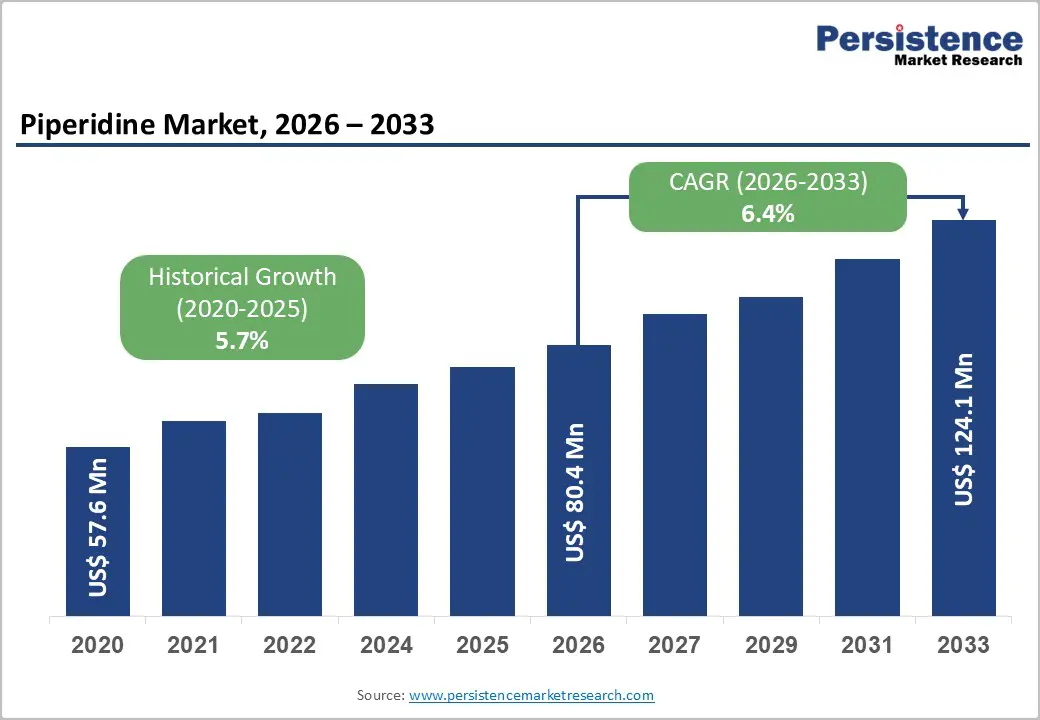
The global piperidine market size is likely to be valued at US$80.4 million in 2026, and is expected to reach US$124.1 million by 2033, growing at a CAGR of 6.4% during the forecast period from 2026 to 2033, driven by the rising demand for piperidine as a key intermediate in pharmaceutical synthesis, expanding agrochemical production, and increasing applications in specialty chemicals. The increasing use of high-purity piperidine in active pharmaceutical ingredients (APIs) and crop protection chemicals remains a major driver of the piperidine market.
Key Industry Highlights:
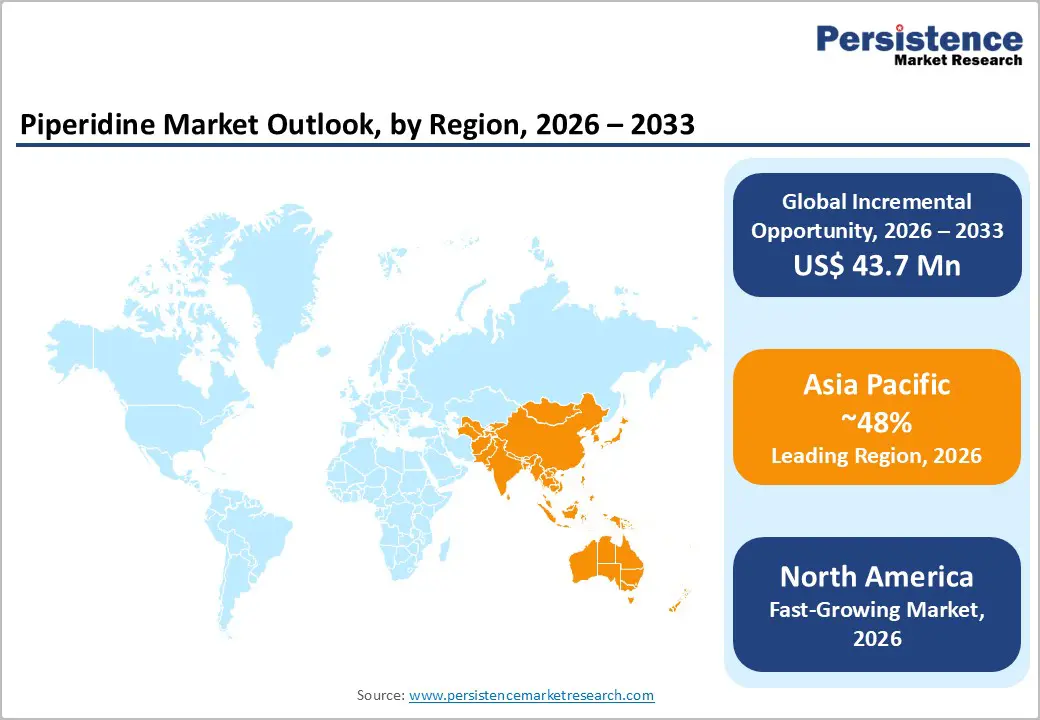
- Leading Region: Asia Pacific, anticipated to account for a 48% market share in 2026, driven by strong pharmaceutical and agrochemical manufacturing in China and India.
- Fastest-growing Region: Asia Pacific, fueled by expanding chemical production capacities and rising domestic demand.
- Dominant Product Type: 99% Purity, to hold approximately 62% of the market share, as it is preferred for high-precision applications in pharmaceuticals.
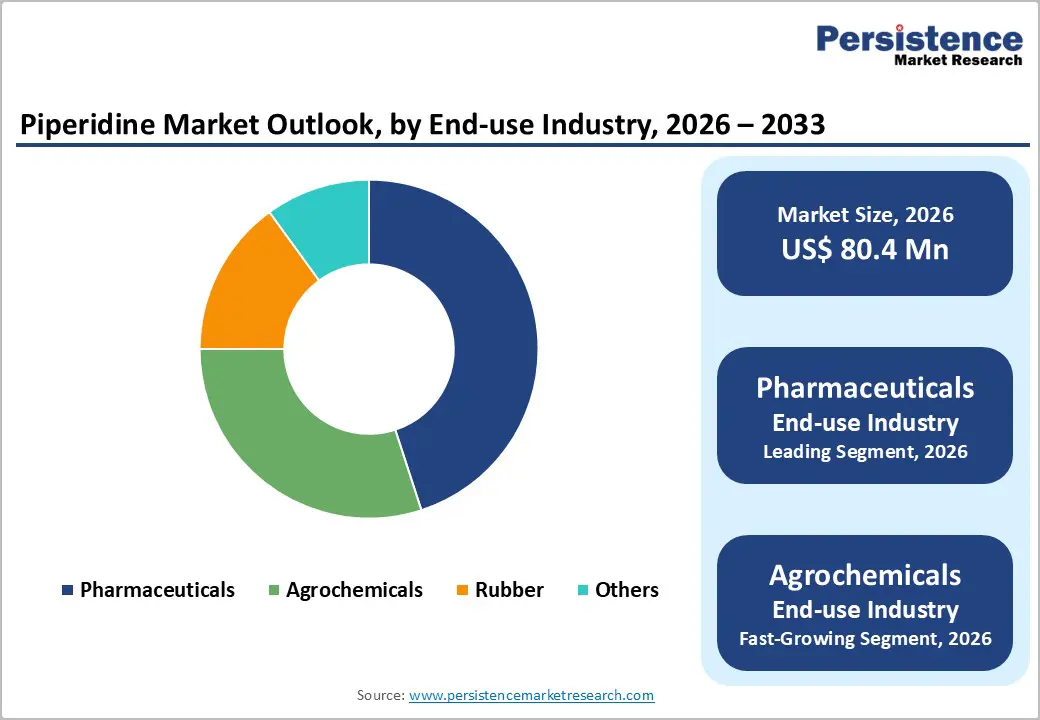
- Leading End-use Industry: Pharmaceutical, expected to dominate, with a 45% share in 2026, due to its critical role in drug synthesis.
| Key Insights | Details |
|---|---|
|
Piperidine Market Size (2026E) |
US$80.4 Mn |
|
Market Value Forecast (2033F) |
US$124.1 Mn |
|
Projected Growth CAGR (2026-2033) |
6.4% |
|
Historical Market Growth (2020-2025) |
5.7% |
Market Factors - Driver, Restraint, and Opportunity Analysis
Driver Analysis - Increasing Demand from the Pharmaceutical Industry
Piperidine plays a pivotal role as a chemical intermediate in the production of numerous pharmaceutical compounds, making it indispensable in modern drug manufacturing. Its unique chemical structure allows it to act as a building block for a wide variety of active pharmaceutical ingredients (APIs), including analgesics, antipsychotics, cardiovascular drugs, and central nervous system (CNS) treatments. As global healthcare needs expand, particularly with the rise of chronic diseases, aging populations, and lifestyle-related disorders, pharmaceutical companies are under constant pressure to develop new and effective medications. Piperidine’s versatility and stability make it ideal for synthesizing complex molecules with high purity and reliability, ensuring consistent drug quality.
Advancements in medicinal chemistry and personalized medicine have led to the creation of more targeted and sophisticated therapies, which often require piperidine-based intermediates. Its applications extend beyond traditional small-molecule drugs to specialized therapies, including oncology and antiviral medications. The ability of piperidine derivatives to enhance the pharmacological efficacy of drugs further strengthens their importance.
Expansion of the Agrochemical Sector
Piperidine serves as an essential intermediate in the formulation of many agrochemicals, including herbicides, insecticides, and fungicides, due to its chemical versatility and reactivity. Modern agriculture increasingly relies on advanced crop protection chemicals to ensure higher yields, protect against pests, and maintain crop quality. As global food demand rises with population growth, farmers and agribusinesses are adopting more efficient and effective agrochemical solutions, driving consistent demand for key intermediates such as piperidine. Its ability to form stable derivatives makes it valuable in producing compounds that are both potent and environmentally manageable, meeting the evolving regulatory standards for agricultural chemicals.
The push for precision agriculture and sustainable farming practices also contributes to the reliance on piperidine-based chemicals. This enables the development of targeted formulations, helping reduce excessive chemical usage while maintaining effectiveness, which aligns with the increasing emphasis on eco-friendly practices. The growth of high-value crops that require specialized protection boosts demand for sophisticated agrochemical solutions. Manufacturers of these chemicals depend on a reliable supply of piperidine to maintain production efficiency and innovation in new formulations.
Restraint Analysis - Stringent Regulatory and Safety Requirements
Piperidine is a highly reactive and hazardous chemical, classified as corrosive, flammable, and toxic, which necessitates strict regulatory oversight throughout its production, storage, transport, and use. Manufacturers must comply with rigorous environmental, health, and safety standards to prevent accidents, chemical spills, and worker exposure. This includes implementing specialized containment systems, ventilation, protective equipment, and emergency response measures, all of which increase operational complexity and costs.
Regulatory authorities in different regions impose specific guidelines for chemical handling, emissions, and waste disposal, making global compliance challenging for companies operating across multiple markets. Failure to meet these standards can result in legal penalties, production shutdowns, or reputational damage, limiting market expansion. The need to adhere to strict labeling, reporting, and monitoring requirements also adds administrative and logistical burdens.
Volatility in Raw Material Prices
The production of piperidine relies heavily on raw materials such as pyridine and other petrochemical derivatives, making it highly sensitive to fluctuations in their prices. Changes in crude oil markets, supply-demand imbalances, and geopolitical tensions can cause sudden increases or decreases in the cost of these essential inputs. Such volatility directly affects manufacturing expenses, profit margins, and pricing strategies for piperidine producers.
Companies may face challenges in maintaining stable pricing for customers while managing raw material cost swings, which can disrupt contracts and supply agreements. Small and mid-sized manufacturers are particularly vulnerable, as they often lack long-term supply contracts or the financial flexibility to absorb cost increases. Additionally, sudden spikes in raw material prices can delay production schedules or reduce output if procurement becomes financially unviable.
Opportunity Analysis- Expansion of High-Purity Product Segments
High-purity piperidine, typically exceeding 99%, has become increasingly critical in industries that demand stringent quality standards, particularly in pharmaceuticals and specialty chemicals. The rising complexity of drug formulations and the need for consistent, contaminant-free intermediates make high-purity piperidine essential for the synthesis of active pharmaceutical ingredients (APIs) and other advanced chemical compounds. Its superior purity ensures predictable chemical reactions, minimizes side reactions, and enhances the safety and efficacy of the final product, which is vital for regulatory compliance and patient safety.
Beyond pharmaceuticals, high-purity piperidine is also in demand for specialty applications, including advanced polymers, resins, and fine chemicals, where impurities can compromise product performance or stability. Industries are increasingly prioritizing high-quality inputs to meet performance expectations and differentiate their products in competitive markets. This shift toward high-purity requirements drives manufacturers to invest in improved purification technologies, automated production processes, and rigorous quality control measures, creating opportunities for suppliers who can deliver consistent, ultra-pure products.
Diversification into Specialty Chemicals & Polymers
Piperidine has increasingly found applications beyond traditional pharmaceutical and agrochemical uses, particularly in the specialty chemicals and polymers sector. Its chemical versatility allows it to act as a key building block in the synthesis of high-performance polymers, resins, coatings, and dyes. These derivatives are valued for their stability, reactivity, and ability to enhance the physical and chemical properties of end products, such as durability, flexibility, and resistance to heat or corrosion.
Industries that manufacture specialty chemicals and polymers are constantly seeking intermediates that can improve product performance while maintaining cost efficiency. Piperidine meets these requirements, enabling the development of innovative formulations for applications ranging from advanced adhesives and sealants to performance coatings and specialty plastics. Its adaptability also supports the creation of tailored chemical structures that meet specific functional needs, allowing manufacturers to differentiate their products in competitive markets.
Category-wise Analysis
Product Type Insights
99% purity piperidine is anticipated to dominate, accounting for 62% share in 2026, driven by its critical role in pharmaceutical and specialty chemical production. Its superior purity ensures reliable chemical reactions, minimizes impurities, and meets the stringent quality standards required for active pharmaceutical ingredients and advanced chemical syntheses. This makes it indispensable for applications where precision and safety are paramount. Pfizer has conducted research programs focused on piperidine-based compounds targeting central nervous system (CNS) diseases, such as neurological and psychiatric conditions. These research initiatives drive demand for 99% purity piperidine, as ultra-high purity is required for synthesizing intermediate compounds used in drug discovery and development, ensuring precision, safety, and regulatory compliance in API manufacturing.
The 98% purity segment is also the fastest-growing, thanks to its balance of high quality and cost-effectiveness. While slightly lower in purity than the 99% variant, it is sufficient for many industrial and chemical applications, including polymer synthesis, resins, and general specialty chemicals. Manufacturers seeking reliable performance at a lower production cost increasingly adopt 98% purity, making it attractive for large-scale operations. Span Chemie (Mumbai, India) manufactures and supplies piperidine with ~98% purity for synthesis and industrial applications. This grade is marketed for general chemical syntheses where ultra-high purity isn’t essential, but cost efficiency and consistent performance are important, such as in intermediate organic synthesis, polymer additives, or industrial processing applications where 98% purity meets process requirements.
End-use Industry Insights
Pharmaceuticals are projected to dominate, with nearly 45% share in 2026, fueled by the compound’s critical role as a chemical intermediate in drug synthesis. Piperidine derivatives are widely used in producing active pharmaceutical ingredients (APIs) for analgesics, antipsychotics, cardiovascular drugs, and central nervous system therapies. Its versatility, stability, and high-purity availability make it indispensable for ensuring consistent drug quality and regulatory compliance. Vasudha Pharma Chem Limited, a Hyderabad-based API & intermediates producer, manufactures a wide range of piperidine and piperidone derivatives that are used as building blocks in the synthesis of active pharmaceutical ingredients (APIs).
Agrochemicals represent the fastest-growing segment, propelled by increasing demand for effective crop protection solutions. Piperidine and its derivatives are used to produce herbicides, insecticides, and fungicides that enhance crop yield, protect against pests, and ensure food quality. With global population growth and rising food demand, farmers and agribusinesses are adopting more advanced agrochemicals, driving higher consumption of piperidine-based intermediates. Syngenta’s Spiropidion insecticide, developed by Syngenta Crop Protection, incorporates a spiro-piperidine (N-methoxy piperidine) structural motif in its chemical backbone. The compound is used to protect a wide range of field and specialty crops from damaging sucking pests such as aphids, whiteflies, and scales, helping improve crop quality and yields.
Regional Insights
North America Piperidine Market Trends
North America is likely to be the fastest-growing region, supported by expanding pharmaceutical and agrochemical industries. The U.S. has a high concentration of pharmaceutical research and development activities, including the development of complex active pharmaceutical ingredients (APIs) that require high-purity piperidine as a key intermediate. Companies in North America are increasingly adopting advanced piperidine derivatives to synthesize novel drugs targeting chronic, neurological, and cardiovascular diseases, reflecting a shift toward specialized and high-value therapeutics.
In addition to pharmaceuticals, the agrochemical sector is rapidly evolving, with growers adopting precision farming techniques and advanced crop protection solutions. Piperidine derivatives are essential in the formulation of herbicides, insecticides, and fungicides that enhance crop yield and quality while meeting stringent environmental and regulatory standards. This dual demand from pharmaceuticals and agrochemicals underpins the market's expansion.
Europe Piperidine Market Trends
Europe is shaped by stringent regulatory frameworks, advanced chemical manufacturing capabilities, and a strong focus on high-quality pharmaceutical and specialty chemical production. Countries such as Germany, France, and Switzerland have well-established pharmaceutical industries that rely on piperidine as a critical intermediate for synthesizing active pharmaceutical ingredients (APIs), particularly for cardiovascular, neurological, and psychiatric drugs. The emphasis on high-purity chemicals in drug development drives demand for 99% purity piperidine, ensuring consistent quality, safety, and regulatory compliance across production processes.
In addition to pharmaceuticals, Europe’s specialty chemical sector actively uses piperidine in the manufacture of polymers, resins, coatings, and fine chemicals. The region’s focus on sustainable and environmentally responsible chemical production also encourages the adoption of cleaner synthesis methods and greener piperidine derivatives. Agrochemical demand contributes to growth as well, with European farmers increasingly utilizing high-performance herbicides, insecticides, and fungicides that require piperidine-based intermediates for efficient and targeted formulations.
Asia Pacific Piperidine Market Trends
Asia Pacific is projected to dominate, capturing 48% share in 2026, propelled by rapid industrialization, expanding pharmaceutical manufacturing, and increasing agrochemical demand. Countries such as China and India have become major production hubs for active pharmaceutical ingredients (APIs), where piperidine is widely used as a key intermediate in drug synthesis. The growing burden of chronic diseases, coupled with rising healthcare investments and generic drug production, continues to boost demand for high-purity piperidine across the region.
In pharmaceuticals, the agrochemical sector plays a crucial role in market expansion. With a large agricultural base and rising food demand, farmers are increasingly adopting advanced crop protection chemicals, many of which rely on piperidine derivatives. This supports higher productivity and improved crop quality, further strengthening regional consumption. The presence of cost-efficient manufacturing, availability of raw materials, and supportive government initiatives for the chemical industry also enhances market growth. Increasing investments in specialty chemicals, polymers, and industrial applications are diversifying demand.
Competitive Landscape
The global piperidine market is moderately consolidated, with a handful of leading chemical manufacturers controlling a significant portion of production and supply. These companies compete primarily on product quality, reliability of supply, and production capacity, ensuring they can meet the demanding needs of their customers, particularly in pharmaceuticals and agrochemicals. Maintaining high-purity standards, often exceeding 99%, is critical for applications in drug synthesis and specialty chemicals, where even minor impurities can affect efficacy and safety.
Manufacturers are also investing in capacity expansion and process optimization to address growing demand and reduce lead times, particularly in high-growth regions such as Asia Pacific and North America. Strategic initiatives include enhancing purification technologies, adopting greener and more efficient synthesis methods, and developing specialty derivatives tailored to specific applications.
Key Industry Developments
- In May 2022, Avantor, Inc. established a new manufacturing and distribution hub in Singapore, integrating its existing distribution facility with new manufacturing operations. The company brought its solutions closer to regional customers and strengthened global supply chain capabilities. The hub became fully operational earlier this year, enhancing Avantor’s ability to serve life sciences, advanced technologies, and applied materials industries across the region.
Companies Covered in Piperidine Market
- BASF SE
- Huntsman Corporation
- Koei Chemical Company
- Merck KGaA
- Taminco
- Alkyl Amines Chemicals Limited
- Eastman Chemical Company
- Shandong Huachang Chemical Co., Ltd.


