




- Renewable Energy
- Paper-Based Biofuel Cell Market
Paper-Based Biofuel Cell Market Size, Share, and Growth Forecast 2026–2033
Paper-Based Biofuel Cell Market by Technology (Enzymatic Fuel Cells, Microbial Fuel Cells, Photoelectrochemical Cells), Component (Paper Substrate, Catalysts), Application (Portable Electronic Devices, Wearable Technology), and Regional Analysis, 2026–2033

Paper-Based Biofuel Cell Market Size and Trend Analysis
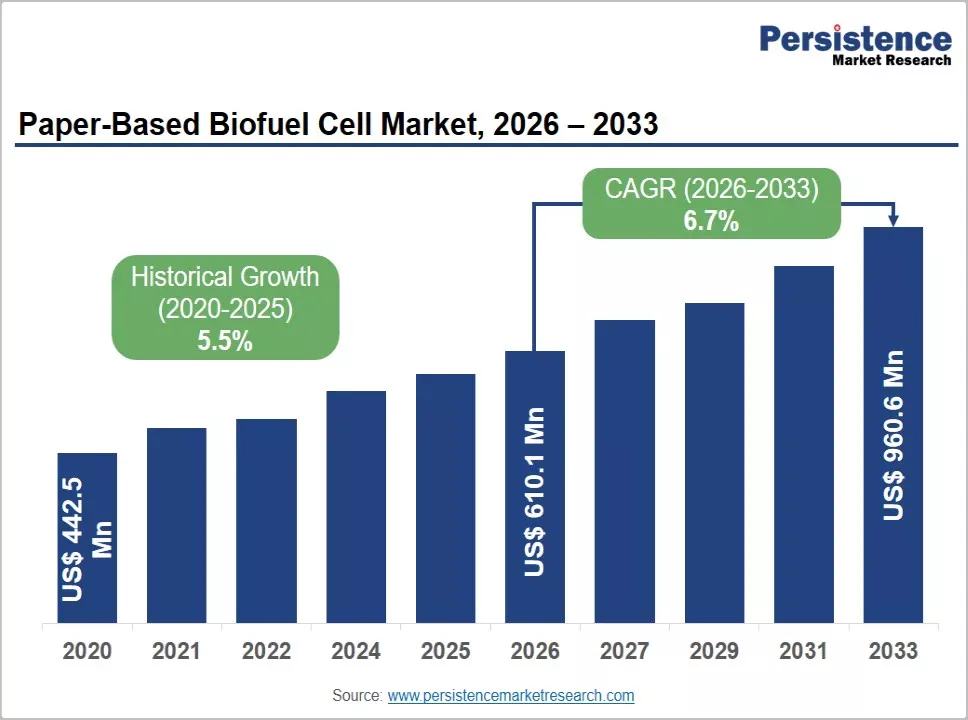
The global paper-based biofuel cell market size is likely to be valued at US$ 610.1 million in 2026, and is estimated to reach US$ 960.6 million by 2033, growing at a CAGR of 6.7% during the forecast period 2026−2033. Growth is underpinned by the rising need for low-cost, disposable, and environmentally friendly power sources for self-powered biosensors, wearable electronics, and distributed Internet of Things (IoT) devices.
The market has been experiencing moderate growth, reflecting the predominantly laboratory-scale and pilot-scale nature of the technology and challenges in power density and operational stability. However, the forecast period anticipates acceleration as printable enzyme inks, roll-to-roll manufacturing, and improved electrode materials move devices closer to commercial production in healthcare, environmental monitoring, and consumer wearables.
Key Industry Highlights
- Dominant Technology: Enzymatic fuel cells (EFCs) are set to command around 47% of the revenue share in 2026, while photoelectrochemical cells are likely to grow the fastest at about 8.4% CAGR through 2033, as hybrid light-and-biocatalyst designs mature.
- Leading Component: Paper substrates are expected to lead with 33% in 2026, while catalysts are likely to be the fastest-growing component at about 8.1% CAGR during 2026–2033, reflecting advances in enzyme immobilization and nanostructured carbon materials.
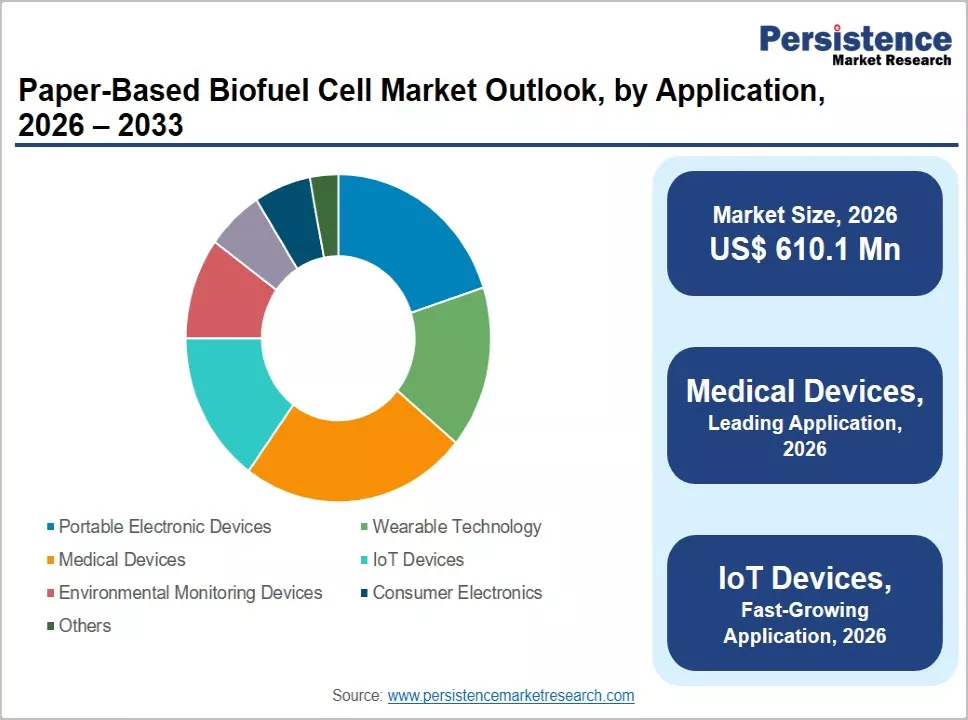
- Dominant Application: Medical devices are anticipated to lead with an estimated 28% share in 2026, while wearable technology is slated to represent the fastest-growing application segment at 9.2% CAGR from 2026 to 2033.
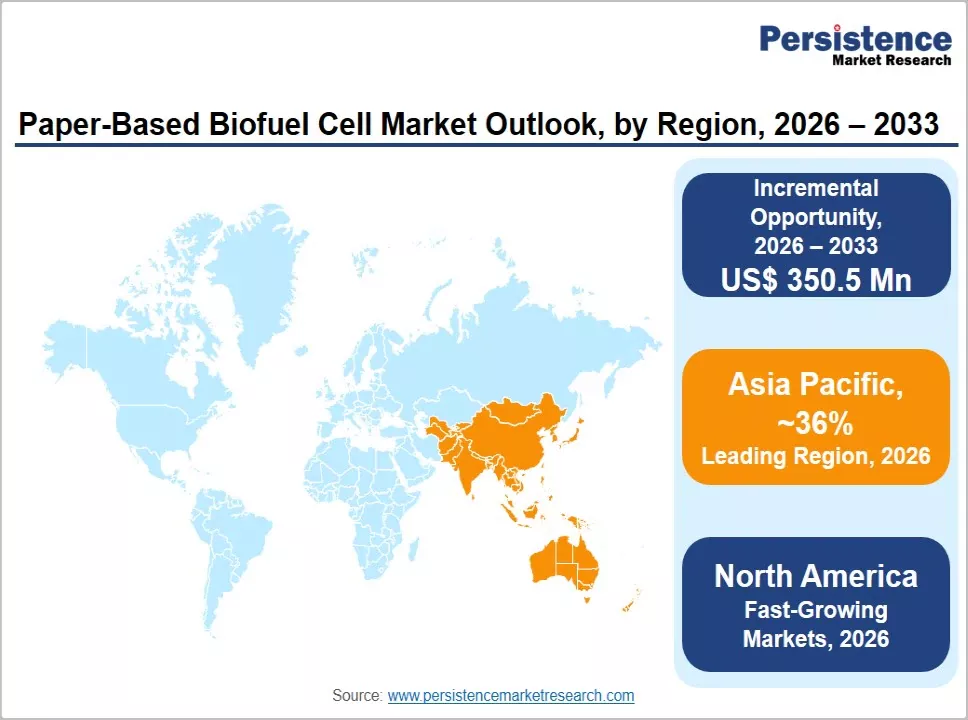
- Regional Leadership: Asia Pacific is poised to dominate with an estimated 36% share in 2026 and register a 7.6% CAGR through 2033, led by strong academic and industrial research in Japan, China, and South Korea.
- Competitive Environment: Competitive dynamics include university-led innovation, collaborations with printed electronics and conductive ink suppliers, and early commercialization efforts targeting disposable diagnostics and self-powered sensors.
DRO Analysis
Drivers: Self-Powered Biosensing and Demand for Disposable, Sustainable Power as Primary Growth Catalysts
Demand for self-powered biosensors is the leading force driving the paper-based biofuel cell market growth, as healthcare providers, environmental agencies, and consumer device makers look for inexpensive, battery-free solutions for point-of-care and on-site measurement. Paper-based biofuel cells use enzymes or microorganisms to convert chemical energy in fluids such as sweat, saliva, blood, or wastewater into electricity.
Paper's capillary wicking naturally delivers fuel to the electrodes. Screen printing allows electrodes to be produced in volume on lightweight substrates at very low cost, supporting single-use formats that avoid the contamination and disposal concerns associated with conventional batteries. These attributes align with growing interest in decentralized diagnostics, particularly in low-resource settings.
Printable Enzyme Inks and Scalable Manufacturing
Manufacturing breakthroughs are improving commercial prospects. In February 2026, researchers at Tokyo University of Science reported water-based enzyme inks that allow complete lactate and oxygen biofuel cells to be printed on paper in a single step, achieving a maximum output of 165 µW/cm² at 0.63 V, compared with about 96 µW/cm² for earlier comparable devices.
The team demonstrated roll-to-roll printing over more than 400 meters of substrate and projected device costs of around 10 yen per unit, with output sufficient to power Bluetooth Low Energy transmission without batteries. Such progress strengthens the case for scalable production of wearable and disposable sensors.
Restraints: Low Power Density and Limited Operational Stability
The most significant restraint on the paper-based biofuel cell market is the modest power output and limited lifetime of current devices. Output typically sits in the microwatt-to-milliwatt range, which suffices for low-power sensors and short-duration transmission but not for energy-intensive consumer electronics.
Enzymes and microbial cultures degrade over time, and performance can fluctuate with temperature, humidity, pH, and fuel concentration. Paper substrates are sensitive to moisture and mechanical stress, complicating storage, packaging, and handling in real-world conditions. These limitations restrict commercial deployments to niche, single-use, or intermittent-use applications until stability and shelf life are improved.
Scale-Up, Standardization, and Regulatory Barriers
Translating laboratory prototypes into reproducible products remains difficult. Variability in enzyme loading, ink formulation, and electrode porosity can produce inconsistent performance between batches, and few standardized test protocols exist for comparing devices across laboratories. Medical and wearable applications also face regulatory requirements for biocompatibility, accuracy, and quality management, which lengthen development timelines and raise costs. Because many developers are universities and start-ups with limited manufacturing capital, commercialization often depends on partnerships with printed electronics suppliers and contract manufacturers, slowing the pace at which promising designs reach the market.
Opportunities: Wearables, Environmental Monitoring, and Battery-Free IoT
Expanding applications in wearables and distributed sensing offer significant opportunities. Sweat-powered patches that monitor lactate, glucose, or electrolytes can support sports performance, rehabilitation, and chronic disease management, while paper-based sensors for water quality, pesticides, and dissolved oxygen can enable low-cost field monitoring.
In February 2026, Tokyo University of Science researchers published a paper-based enzymatic biofuel cell for self-powered detection of dissolved oxygen using screen-printed mesoporous carbon electrodes, highlighting potential in environmental and food quality monitoring. Earlier work demonstrated biofuel cell arrays powered by artificial sweat that ran a commercial activity meter for about 1.5 hours from a single drop.
Microbial and Hybrid Concepts and Regulatory Tailwinds for Battery Alternatives
Research is also broadening the technology base. In 2025, researchers at Binghamton University reported a paper-based microbial fuel cell using spore-forming whole-cell sensing for glucose monitoring, offering a stable and reactivatable alternative to enzyme-based sensors. Growing regulatory emphasis on battery sustainability and waste reduction, including the European Union's Batteries Regulation, is expected to encourage interest in biodegradable and battery-free power for single-use electronics. Collaboration between universities, ink suppliers, and diagnostic manufacturers is likely to open licensing, joint development, and localized manufacturing opportunities through 2033.
Category-wise Insights
Technology Analysis
Why Do Enzymatic Fuel Cells Lead the Paper-Based Biofuel Cell Market?
Enzymatic fuel cells (EFCs) are the leading technology segment, expected to hold about 47% of the paper-based biofuel cell market revenue share in 2026. They employ enzymes such as glucose dehydrogenase, glucose oxidase, and bilirubin oxidase to catalyze reactions at the anode and cathode, delivering high selectivity and operation at mild conditions with abundant fuels like glucose and lactate. EFCs integrate readily with screen-printed electrodes and paper microfluidics, and their suitability for body-fluid-powered sensors aligns with commercial interest in diagnostics and wearables. Progress in enzyme immobilization, mediator systems, and ink formulations continues to improve power density and shelf life.
Photoelectrochemical cells are likely to grow the fastest through 2033, at an estimated 8.4% CAGR. These devices combine light-driven processes with biocatalysis or semiconductor interfaces, enabling signal amplification and energy harvesting from ambient light in portable analytical platforms. Microbial fuel cells (MFCs) remain important for wastewater monitoring, toxicity sensing, and long-duration low-power applications, as paper-based MFCs offer simple, disposable designs that rely on inoculated bacterial cultures. Challenges for MFCs include startup time and lower power density, but pre-inoculated, spore-based, and air-dried formats are improving usability and storage stability.
Component Analysis
Why Does the Paper Substrate Lead Component Demand?
Paper substrates are the leading component segment, projected to capture about 33% of the revenue share in 2026. Cellulose-based materials offer low cost, flexibility, biodegradability, and intrinsic capillary action that moves fuels and electrolytes through the device without pumps. Specialty papers with controlled porosity, hydrophobic barriers, and surface treatments are used to improve ink adhesion and fluid control, and the wide availability of paper manufacturing capacity supports scalability. Because every device requires a substrate, demand is closely linked to overall production volumes, giving the segment stable, volume-driven revenue.
Catalysts represent the fastest-growing component segment, anticipated to achieve about 8.1% CAGR during the 2026–2033 period. Enzyme engineering, stabilizing immobilization matrices, and highly porous carbon materials such as MgO-templated mesoporous carbon are improving electron transfer and catalytic longevity. Conductive materials, including carbon inks, carbon nanotubes, and graphene, form the electrode backbone and are being optimized for printability and conductivity without noble metals. Electrolytes, which may be buffer solutions, hydrogels, or the biological fluid itself, are increasingly designed for stability and compatibility with skin contact, supporting the move toward wearable and medical formats.
Application Analysis
Which Application Dominates Paper-Based Biofuel Cells?
Medical devices dominate the application segment, projected to capture about 28% of the revenue share in 2026. Self-powered point-of-care diagnostics, glucose and lactate monitoring strips, and disposable patches benefit from the low cost and single-use nature of paper-based cells. Eliminating batteries reduces size, weight, and disposal concerns, while enabling testing in remote and resource-limited settings. Healthcare spending, growth in chronic disease monitoring, and interest in decentralized testing support sustained demand, although regulatory approval requirements and clinical validation influence the pace of commercialization.
Wearable technology represents the fastest-growing application segment, anticipated to achieve about 9.2% CAGR during the 2026–2033 period. Sweat-powered patches and skin-worn sensors can monitor biomarkers such as lactate during exercise while powering low-energy wireless communication. IoT devices and environmental monitoring equipment are also expanding adoption, using disposable biofuel cell sensors for water quality, pesticide detection, and food safety. Military and defense users are exploring lightweight, field-deployable power and sensing for soldier health monitoring and chemical or biological detection, while portable and consumer electronics currently account for smaller niches awaiting higher power densities.
Regional Insights
North America Paper-Based Biofuel Cell Market Trends and Insights
North America is anticipated to account for an estimated 29% of the global paper-based biofuel cell market in 2026. The region's market is likely to benefit from strong university research, active medical device and diagnostics industries, and defense-related funding for field-deployable sensing and power technologies. Federal research agencies and venture-backed start-ups are supporting development of wearable biosensors and self-powered diagnostics. Collaboration between academic laboratories and industry is expected to accelerate technology transfer, while established printed electronics and medical device suppliers are likely to shape early commercialization through 2033.
U.S. Paper-Based Biofuel Cell Market Size
The U.S. is estimated to account for approximately 84% of the North America paper-based biofuel cell market in 2026. Market growth is likely to be supported by federal research funding, a large digital health and wearable device ecosystem, and defense interest in low-weight, disposable power sources. Universities have been active in paper-based microbial and enzymatic fuel cell research, including work on glucose monitoring and water quality sensing. Venture investment in point-of-care diagnostics and wearable sensors is anticipated to encourage pilot production, while regulatory clarity for novel sensors is expected to be a key factor in commercial adoption through 2033.
Canada Paper-Based Biofuel Cell Market Size
Canada is projected to represent approximately 16% of the North America paper-based biofuel cell market in 2026. Market expansion is expected to be driven by university research in biosensors, printed electronics, and biomedical engineering, supported by national research councils and innovation funding. Interest in remote health monitoring and environmental surveillance across large rural and northern regions is likely to encourage adoption of low-cost, self-powered sensing devices. Partnerships with U.S. and European manufacturers are anticipated to support commercialization of Canadian innovations through 2033.
Europe Paper-Based Biofuel Cell Market Trends and Insights
Europe is estimated to account for approximately 17% of the global paper-based biofuel cell market in 2026. The region's market is expected to benefit from a strong research base in electrochemistry and biosensors, policy emphasis on sustainable and biodegradable electronics, and the circular economy objectives of the European Green Deal. The European Union's Batteries Regulation and wider electronic waste rules are likely to encourage exploration of battery-free and biodegradable power for single-use devices. Research programmes funded through Horizon Europe are supporting cross-border collaboration between universities, small enterprises, and manufacturers in printed electronics and diagnostics.
Germany Paper-Based Biofuel Cell Market Size
Germany is anticipated to account for approximately 26% of the Europe paper-based biofuel cell market in 2026. Demand is expected to be supported by a strong chemical, printing, and medical technology industry, as well as leading research institutes working on bioelectrochemistry and flexible electronics. German manufacturers of conductive inks, specialty papers, and sensor components are likely to participate in value chains for printed biofuel cells. Focus on sustainability, point-of-care diagnostics, and industrial monitoring is projected to support market expansion through 2033, while public-private research partnerships are expected to accelerate prototype development.
Why Is Asia Pacific Expected to Lead the Paper-Based Biofuel Cell Market?
Asia Pacific is projected to account for approximately 36% of the global paper-based biofuel cell market in 2026, making it the largest regional market. The region is also anticipated to register the fastest growth, expanding at an estimated CAGR of 7.6% through 2033. Market expansion is likely to be driven by deep academic research in enzymatic and printable electronics, strong electronics manufacturing capacity, and rising investment in wearable health technology. Japan, China, and South Korea are expected to remain the primary innovation centers, while India and Southeast Asian countries explore low-cost diagnostics and environmental monitoring suited to their healthcare and sanitation needs.
Japan Paper-Based Biofuel Cell Market Size
Japan is estimated to represent approximately 31% of the Asia Pacific paper-based biofuel cell market in 2026. The country's market is expected to benefit from leading research on printable enzymatic biofuel cells, including work at Tokyo University of Science on enzyme inks, sweat-powered arrays, and self-powered oxygen sensors. A well-developed printing and electronic materials industry, coupled with demand from healthcare and wearable device makers, is likely to support industrial translation. Government-backed research programmes and corporate collaborations are anticipated to sustain Japan's technological leadership through 2033.
China Paper-Based Biofuel Cell Market Size
China is projected to account for approximately 27% of the Asia Pacific paper-based biofuel cell market in 2026. The market is expected to witness strong expansion, supported by high volumes of academic publications in biosensors and flexible electronics, large-scale electronics manufacturing, and government priorities in advanced materials and in vitro diagnostics. Domestic suppliers of conductive inks, graphene, and specialty papers are well positioned to participate in the supply chain, and growing demand for wearable health monitors and environmental sensing is likely to encourage pilot commercialization through 2033.
Competitive Landscape
The global paper-based biofuel cell market structure is nascent and fragmented, with innovation led primarily by universities, research institutes, and early-stage companies rather than large-scale manufacturers. Participants span printed battery and energy-harvesting specialists, conductive ink and materials suppliers, and sensor and diagnostics developers. Leading research groups in Japan, the U.S., and Europe are shaping the technology roadmap, while companies such as Fuelium, Enfucell, and Blue Spark Technologies contribute expertise in paper-based and printed power sources.
Materials and electronics suppliers such as Henkel, DuPont, Sun Chemical, and NovaCentrix provide conductive inks and printing know-how that support scale-up. Barriers to entry include enzyme stabilization know-how, intellectual property, and the need for medical-grade quality systems, but low capital requirements for screen printing enable academic spin-offs to participate. Industry collaboration is expected to increase as developers seek manufacturing partners, and consolidation may follow once reliable, high-volume use cases such as disposable diagnostics reach commercial scale.
Key Market Developments
- In February 2026, Tokyo University of Science researchers published a paper-based enzymatic biofuel cell for self-powered cathodic detection of dissolved oxygen, using screen-printed mesoporous carbon electrodes modified with bilirubin oxidase and glucose dehydrogenase.
- In February 2026, Tokyo University of Science reported printable water-based enzyme inks that enable single-step production of lactate-oxygen biofuel cells on paper, achieving 165 µW/cm² output and demonstrating roll-to-roll printing over more than 400 meters.
- In 2025, Binghamton University researchers reported a paper-based microbial fuel cell using spore-forming whole-cell sensing for glucose monitoring, offering a self-powered, reactivatable platform for wearable and point-of-care applications.
Companies Covered in Paper-Based Biofuel Cell Market
- Fuelium
- Enfucell Oy
- Blue Spark Technologies, Inc.
- Akermin, Inc.
- Sony Corporation
- Henkel AG & Co. KGaA
- DuPont de Nemours, Inc.
- Sun Chemical Corporation
- NovaCentrix
- Ynvisible Interactive Inc.
Frequently Asked Questions
The global paper-based biofuel cell market is valued at US$ 610.1 million in 2026 and is projected to reach US$ 960.6 million by 2033, expanding at a CAGR of 6.7% during 2026–2033.
Demand for self-powered biosensors, low-cost disposable power for wearables and IoT devices, and advances in printable enzyme inks and scalable manufacturing are driving the market.
Enzymatic fuel cells lead technologies with about 47% share, paper substrates lead components with about 33%, and medical devices lead applications with an estimated 28% in 2026.
Asia Pacific dominates the market with an estimated 36% share in 2026 and is projected to register a 7.6% CAGR through 2033, led by research and manufacturing strengths in Japan, China, and South Korea.
Wearable sweat-powered sensors, environmental and food quality monitoring, battery-free IoT devices, and sustainable alternatives to disposable batteries are key market opportunities.


