




- Renewable Energy
- Solar Encapsulation Market
Solar Encapsulation Market Size, Share, and Growth Forecast 2026 - 2033
Solar Encapsulation Market by Material Type (Ethylene Vinyl Acetate, Polyolefin Elastomer), Application (Crystalline Silicon PV and Thin Film PV), End User (Utility-Scale Power Plants, Commercial & Industrial, and Residential), and Regional Analysis, 2026 - 2033

Solar Encapsulation Market Size and Trend Analysis
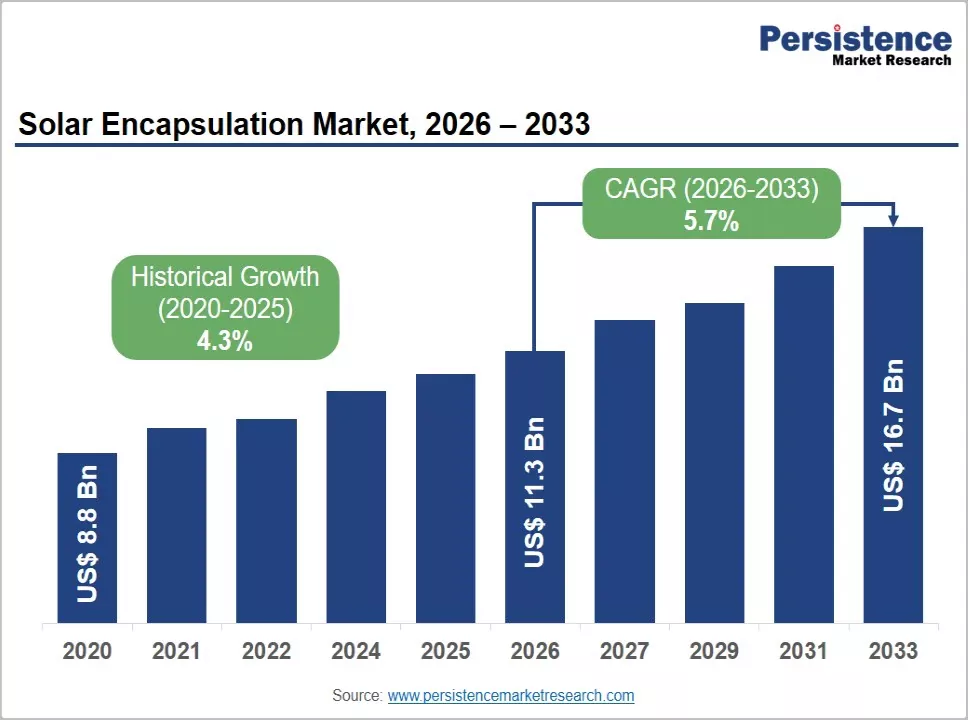
The global solar encapsulation market size is likely to be valued at US$ 11.3 billion in 2026, and is estimated to reach US$ 16.7 billion by 2033, growing at a CAGR of 5.7% during the forecast period 2026 - 2033. Growth is underpinned by sustained solar photovoltaic capacity additions, the industry-wide shift to n-type cell technologies and bifacial glass-glass modules, and rising expectations for 30-year module durability.
The market has been experiencing modest value growth, reflecting aggressive price declines across the module supply chain and periods of overcapacity. However, the forecast period anticipates steadier expansion as demand shifts toward higher-performance polyolefin and co-extruded films, regional manufacturing capacity builds out in India, the U.S., and Europe, and quality differentiation regains importance.
Key Industry Highlights
- Dominant Material Type: Ethylene vinyl acetate (EVA) is set to command around 61% of the revenue share in 2026, while polyolefin elastomer (POE) is likely to grow the fastest at about 7.6% CAGR through 2033, as n-type and bifacial modules require superior moisture resistance.
- Leading Application: Crystalline silicon PV is expected to lead with about 94% in 2026, while thin film PV is likely to be the fastest-growing application at about 6.4% CAGR during 2026 - 2033, supported by specialized glass-glass and tandem technologies.
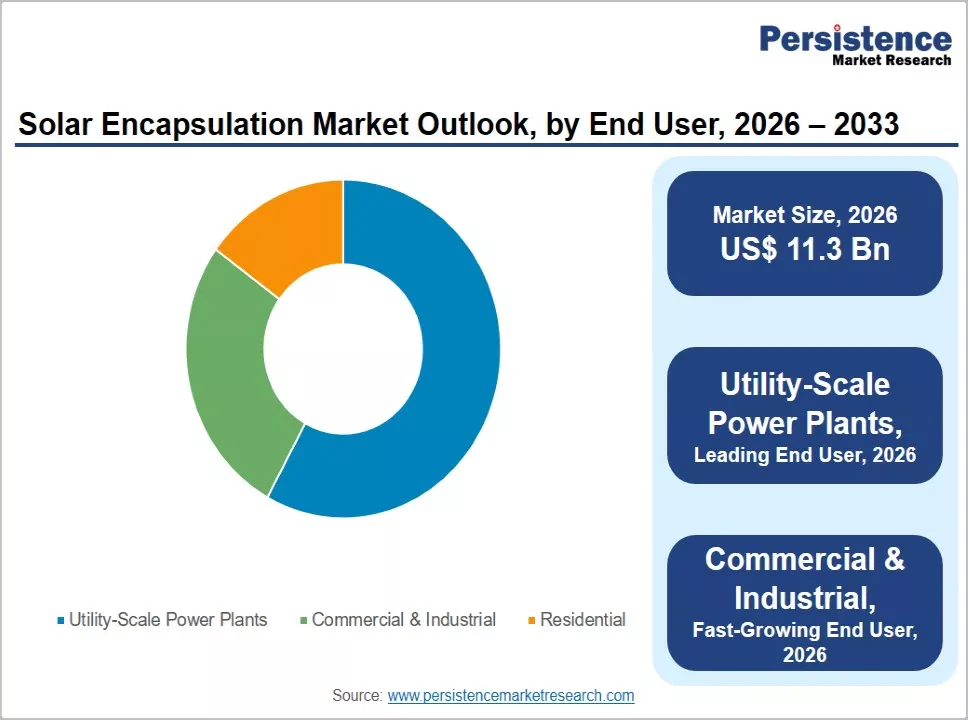
- Dominant End User: Utility-scale power plants are anticipated to lead with an estimated 63% share in 2026, while commercial and industrial users are slated to represent the fastest-growing end-user segment at 6.5% CAGR from 2026 to 2033.
- Regional Leadership: Asia Pacific is poised to dominate with an estimated 69% share in 2026 and register a 6.1% CAGR through 2033, led by the concentration of module and film manufacturing in China and fast-expanding capacity in India.
- Competitive Environment: Competitive dynamics include capacity expansions in India, integrated encapsulant and backsheet supply agreements, and the growing adoption of co-extruded EPE films alongside pure POE products.
DRO Analysis
Drivers: Solar Capacity Additions and the Shift to High-Performance Modules as Primary Growth Catalysts
Sustained global deployment of solar photovoltaic capacity is the leading force driving the solar encapsulation market growth, as every crystalline silicon module requires front and rear encapsulant layers to bond cells, glass, and backsheets while protecting against moisture, ultraviolet radiation, and mechanical stress.
Utility-scale projects, distributed generation, and national renewable targets continue to lift module shipments, and film demand scales almost directly with installed capacity. Encapsulation quality is increasingly recognized as a determinant of module lifetime and warranty performance, particularly in hot, humid, and high-irradiance environments where degradation risks are higher.
N-Type, Bifacial, and Glass-Glass Module Adoption
The industry transition from p-type PERC to n-type TOPCon, heterojunction, and back-contact technologies is raising performance requirements for encapsulants. N-type cells are more sensitive to moisture ingress and acetic acid generated by some EVA formulations, which favors POE and co-extruded EVA-POE-EVA (EPE) films with lower water vapor transmission and strong resistance to potential-induced degradation. Bifacial glass-glass modules, which are widely used in utility-scale plants, further increase demand for POE-based solutions. These shifts are expected to raise the average value per square meter of encapsulation film over the forecast period.
Restraints: Price Pressure, Overcapacity, and Raw Material Dependence
Encapsulation film prices have fallen substantially in recent years in line with module price declines and expansion of film manufacturing capacity, particularly in China. This price compression limits revenue growth even as volumes expand and squeezes margins for smaller manufacturers.
Overcapacity in the solar supply chain has prompted industry consolidation efforts and calls for more disciplined competition, which can create volatility in orders and inventory. Producers are therefore under pressure to differentiate through quality, certification, and customization, while remaining cost competitive in a market where module makers closely scrutinize bills of materials.
POE Resin Supply Concentration and Trade and Policy Uncertainty
POE resin supply has historically depended on a small number of overseas producers, creating exposure to availability, price swings, and logistics disruption, although domestic localization is accelerating. Trade measures, anti-dumping duties, and local content rules affect module flows between regions, shifting demand patterns for encapsulants.
In the U.S., changes to federal clean energy incentives and restrictions on certain foreign-sourced content are reshaping project and manufacturing pipelines. These uncertainties can delay capacity investments and complicate long-term supply agreements for film manufacturers and their customers.
Opportunities: Regional Manufacturing Buildout and Advanced Cell Technologies
Supply chain diversification is creating opportunities for encapsulant producers to establish capacity outside China. India is a prominent example, where the Approved List of Models and Manufacturers, production-linked incentives, and expanding cell and module lines are driving localized demand.
Alishan Green Energy, which operates 8 GW of encapsulant capacity, outlined plans in August 2026 to reach 10 GW, while RenewSys has announced an expansion of its encapsulant manufacturing capacity to 30 GW. The U.S. and Europe are also incentivizing domestic solar manufacturing through production credits and resilience criteria in auctions, offering opportunities for local film production and technology partnerships.
Perovskite Tandems, Thin Film, and Premium Product Segments
Next-generation cell technologies such as perovskite-silicon tandems and advanced thin films require encapsulation materials with very low moisture permeability, low-temperature processing, and strong edge sealing, creating a premium niche for specialized formulations. Value-added products, including UV-converting, high-transmittance, anti-PID, and white reflective films, enable manufacturers to differentiate and capture higher margins. Integrated supply agreements bundling encapsulants with backsheets, as signed between RenewSys and Kosol Energie, also help suppliers deepen customer relationships and improve visibility of revenue.
Category-wise Insights
Material Type Analysis
Why Does EVA Lead the Solar Encapsulation Market?
Ethylene vinyl acetate (EVA) is the leading material type segment, expected to hold about 61% of the solar encapsulation market revenue share in 2026. EVA offers a proven combination of optical transparency, adhesion to glass and cells, ease of lamination, and low cost, which has made it the industry standard for decades. Established production capacity, mature processes, and strong supplier relationships support its continued dominance, particularly for p-type and standard crystalline silicon modules.
Formulation improvements, including anti-PID and low-acetic-acid grades, are extending EVA's usability in n-type modules, helping manufacturers manage costs while meeting performance requirements.
Polyolefin elastomer (POE) is likely to grow the fastest through 2033, at an estimated 7.6% CAGR. POE delivers lower water vapor transmission, high volume resistivity, excellent resistance to potential-induced degradation, and no acetic acid by-products, making it well suited to n-type TOPCon and heterojunction cells and bifacial glass-glass modules. Field and laboratory comparisons of POE and EVA modules have supported its reliability in long-term operation. Adoption is constrained by higher resin cost and processing sensitivity, but expansion of POE resin supply and domestic production in Asia is improving availability and gradually narrowing the cost gap.
Other materials, including co-extruded EVA-POE-EVA (EPE) films, polyvinyl butyral, silicone, and thermoplastic polyurethane, serve specialized needs. EPE films combine POE's barrier performance with EVA's adhesion and processability, offering a cost-performance balance that is gaining share in n-type production, as shown by supply orders such as RenewSys' 400 MW EPE contract with ZNShine Solarworld in December 2025. Niche materials are used in building-integrated PV, flexible modules, and emerging technologies where flexibility, transparency, or specific chemical resistance is required.
Application Analysis
Why Does Crystalline Silicon PV Dominate Solar Encapsulation Demand?
Crystalline silicon PV dominates the application segment, projected to capture about 94% of the revenue share in 2026. Monocrystalline and multicrystalline silicon modules account for the overwhelming majority of global installations, and each module requires encapsulant sheets on both sides of the cell layer. The rapid rollout of TOPCon, heterojunction, and back-contact modules is increasing the share of higher-value encapsulants, and the large size and power ratings of modern modules increase film consumption per unit. Large-scale manufacturing hubs in China, and growing assembly in India, Southeast Asia, and the U.S., sustain high film volumes.
Thin film PV represents the fastest-growing application segment, anticipated to achieve about 6.4% CAGR during the 2026 - 2033 period from a smaller base. Cadmium telluride and CIGS modules, along with emerging perovskite and tandem devices, rely on glass-glass constructions with edge seals and encapsulants engineered for stringent moisture barriers. Capacity additions by thin film producers in the U.S. and India, as well as pilot lines for perovskite technologies, are expanding demand for specialized sealing and encapsulation materials, and suppliers developing low-temperature, high-barrier products are positioned for premium returns.
End User Analysis
Which End User Dominates Solar Encapsulation?
Utility-scale power plants dominate the end-user segment, projected to capture about 63% of the revenue share in 2026. Large ground-mounted projects, which prioritize low levelized cost of energy and long-term reliability, use bifacial and glass-glass modules in large volumes, driving demand for high-quality POE and EPE films. Developers and independent power producers conduct extensive qualification and bankability reviews, favoring suppliers with traceable quality and strong warranties. Government auctions and corporate power purchase agreements across the Middle East, India, China, the U.S., and Latin America continue to underpin large-scale module procurement.
Commercial and industrial users are the fastest-growing end-user segment, expected to showcase an approximate 6.5% CAGR through 2033. Rising electricity costs, sustainability commitments, and favorable policies for rooftop and carport systems are encouraging businesses to install solar, often with higher-efficiency modules suited to constrained roof space. Residential demand is supported by incentives and rooftop programmes, including India's household solar initiatives and European self-consumption policies, and favors modules with strong aesthetics and warranties. Distributed segments prize durability and long-term performance, which supports adoption of premium encapsulation materials.
Regional Insights
North America Solar Encapsulation Market Trends and Insights
North America is anticipated to account for an estimated 12% of the global solar encapsulation market in 2026. The region's market is likely to benefit from expanding domestic module and cell manufacturing, large utility-scale project pipelines, and policy support for local content. Changes to federal clean energy tax credits and trade measures are reshaping the project outlook, yet manufacturing incentives are encouraging investment in upstream materials. New cell and module factories, such as planned facilities in the south-eastern U.S., are expected to create localized demand for encapsulant films through 2033.
U.S. Solar Encapsulation Market Size
The U.S. is estimated to account for approximately 90% of the North America solar encapsulation market in 2026. Market growth is likely to be supported by domestic module assembly expansion, thin film manufacturing, and large-scale solar and storage projects. Manufacturing incentives and trade protections encourage localization of supply chains, creating opportunities for encapsulant producers to partner with module makers or establish regional capacity. Policy changes affecting project incentives and sourcing requirements are anticipated to influence the pace of installations and film demand through 2033.
Canada Solar Encapsulation Market Size
Canada is projected to represent approximately 10% of the North America solar encapsulation market in 2026. Market expansion is expected to be driven by utility-scale solar development in Alberta and Ontario, corporate renewable procurement, and clean technology investment tax credits that support domestic installations and potential manufacturing. Demand is currently met primarily through imported modules, but growing interest in local assembly and distributed solar is anticipated to support incremental encapsulant demand across the country through 2033.
Europe Solar Encapsulation Market Trends and Insights
Europe is estimated to account for approximately 10% of the global solar encapsulation market in 2026. The region's market is expected to benefit from strong installation volumes, supportive renewable policies, and efforts to rebuild resilient solar supply chains under the Net-Zero Industry Act. Non-price criteria in auctions, including resilience and sustainability considerations, are likely to encourage procurement of European-made modules and materials. Demand for high-durability encapsulants is supported by premium residential and commercial segments and by long warranty expectations, while manufacturers explore regional film production to reduce import dependence.
Germany Solar Encapsulation Market Size
Germany is anticipated to account for approximately 26% of the Europe solar encapsulation market in 2026. Demand is expected to be supported by large annual installation volumes across rooftop, commercial, and utility-scale segments, the Renewable Energy Sources Act framework, and a strong engineering and materials industry. German and European module assemblers and research institutes are working on advanced cell and module concepts, including tandem technologies, which require high-performance encapsulation. Interest in local sourcing and reliability is projected to support market expansion through 2033.
Why Is Asia Pacific Expected to Lead the Solar Encapsulation Market?
Asia Pacific is projected to account for approximately 69% of the global solar encapsulation market in 2026, making it the largest regional market by a wide margin. The region is also anticipated to register robust growth, expanding at an estimated CAGR of 6.1% through 2033. Market expansion is likely to be driven by the concentration of cell, module, and film manufacturing in China, rapid capacity additions in India and Southeast Asia, and large domestic installation programmes. Regional film producers benefit from integrated supply chains and proximity to module makers, while consolidation initiatives aim to improve profitability.
China Solar Encapsulation Market Size
China is estimated to represent approximately 72% of the Asia Pacific solar encapsulation market in 2026. The country's market is expected to benefit from the world's largest module manufacturing base, extensive film production capacity, and rapid adoption of n-type and bifacial technologies. Leading producers such as Hangzhou First Applied Material, Cybrid, and Sveck are scaling POE and EPE offerings, while domestic POE resin localization is advancing. Industry efforts to curb excessive price competition and consolidate capacity are projected to influence margins, and technology upgrades are anticipated to sustain China's regional leadership through 2033.
India Solar Encapsulation Market Size
India is projected to account for approximately 11% of the Asia Pacific solar encapsulation market in 2026. The market is expected to witness strong expansion, supported by the Approved List of Models and Manufacturers, production-linked incentives, and the build-out of integrated cell and module capacity. Domestic encapsulant suppliers including RenewSys and Alishan Green Energy are expanding capacity and signing supply agreements, such as RenewSys' 1.2 GW POE encapsulant and backsheet deal with Kosol Energie. Utility-scale auctions, rooftop programmes, and growing export ambitions are likely to sustain demand growth through 2033.
Competitive Landscape
The global solar encapsulation market structure is moderately fragmented, with a handful of large film manufacturers, led by Hangzhou First Applied Material and Cybrid Technologies, controlling a substantial portion of global supply. These companies benefit from scale, proximity to module producers, process know-how, and continuous investment in POE, EPE, and white films for n-type and bifacial modules. Raw material suppliers such as Dow, LG Chem, and Mitsui Chemicals play a significant role through POE and EVA resin supply and formulation partnerships.
Regional and niche competitors such as RenewSys, Alishan Green Energy, Sveck, and Zhejiang Feiyu are focusing on regional markets, integrated product offerings, and specialty grades. Barriers to entry include qualification cycles with module makers, resin access, and capital for extrusion lines, but trade and local content policies are enabling new regional producers. Market consolidation is expected to continue as manufacturers seek scale and technological differentiation, while collaborations between resin producers, film makers, and module assemblers support faster adoption of next-generation materials.
Key Market Developments
- In December 2025, RenewSys secured a 400 MW order for EPE encapsulant from ZNShine Solarworld, supplying co-extruded EVA-POE-EVA film for the production of high-efficiency solar modules.
- In August 2026, Alishan Green Energy outlined its roadmap to expand encapsulant manufacturing capacity to 10 GW from its existing 8 GW base, alongside 3 GW of backsheet capacity, to serve India's growing module industry.
- In November 2026, RenewSys signed a 1.2 GW supply agreement with Kosol Energie for POE encapsulants and backsheets, expanding a prior 1.1 GW POE encapsulant agreement that ran from December 2025 to September 2026.
Companies Covered in Solar Encapsulation Market
- Hangzhou First Applied Material Co., Ltd.
- Cybrid Technologies Inc.
- Changzhou Sveck Photovoltaic New Material Co., Ltd.
- Zhejiang Feiyu New Energy Co., Ltd.
- Mitsui Chemicals, Inc.
- Dow Inc.
- LG Chem Ltd.
- RenewSys India Pvt. Ltd.
- Alishan Green Energy Ltd.
Frequently Asked Questions
The global solar encapsulation market is valued at US$ 11.3 billion in 2026 and is projected to reach US$ 16.7 billion by 2033, expanding at a CAGR of 5.7% during 2026 - 2033.
Sustained solar PV capacity additions, the shift to n-type and bifacial glass-glass modules, and rising expectations for long module lifetimes and warranties are driving the market.
EVA leads material types with about 61% share, crystalline silicon PV leads applications with about 94%, and utility-scale power plants lead end users with an estimated 63% in 2026.
Asia Pacific dominates the market with an estimated 69% share in 2026 and is projected to register a 6.1% CAGR through 2033, led by manufacturing concentration in China and capacity growth in India.
Regional manufacturing buildout, growth of POE and EPE films for n-type modules, perovskite and thin film encapsulation, and integrated encapsulant-backsheet supply agreements are key market opportunities.
The market is moderately fragmented, with Hangzhou First Applied Material and Cybrid Technologies controlling a substantial share of supply, alongside regional players such as RenewSys and Alishan Green Energy.


