




- Medical Devices
- Nuclear Magnetic Resonance (NMR) Spectroscopy Market
Nuclear Magnetic Resonance (NMR) Spectroscopy Market Size, Share, and Growth Forecast, 2026 – 2033
Nuclear Magnetic Resonance (NMR) Spectroscopy Market by Product Type (Low-field NMR Spectroscopy, High-field NMR Spectroscopy), Application (Pharmaceuticals & Biotechnology, Academic & Research Institutes, Chemical & Petrochemical Analysis, Food & Beverage, Materials Science, Energy/Battery Research & Quality Control, Clinical & Diagnostic), End-User (Pharmaceutical Companies & CROs, Biotechnology Companies, Universities & Research Centers, Hospitals & Clinical Labs, Industrial R&D & Quality Control Labs), and Regional Analysis for 2026-2033
Nuclear Magnetic Resonance (NMR) Spectroscopy Market Share and Trends Analysis
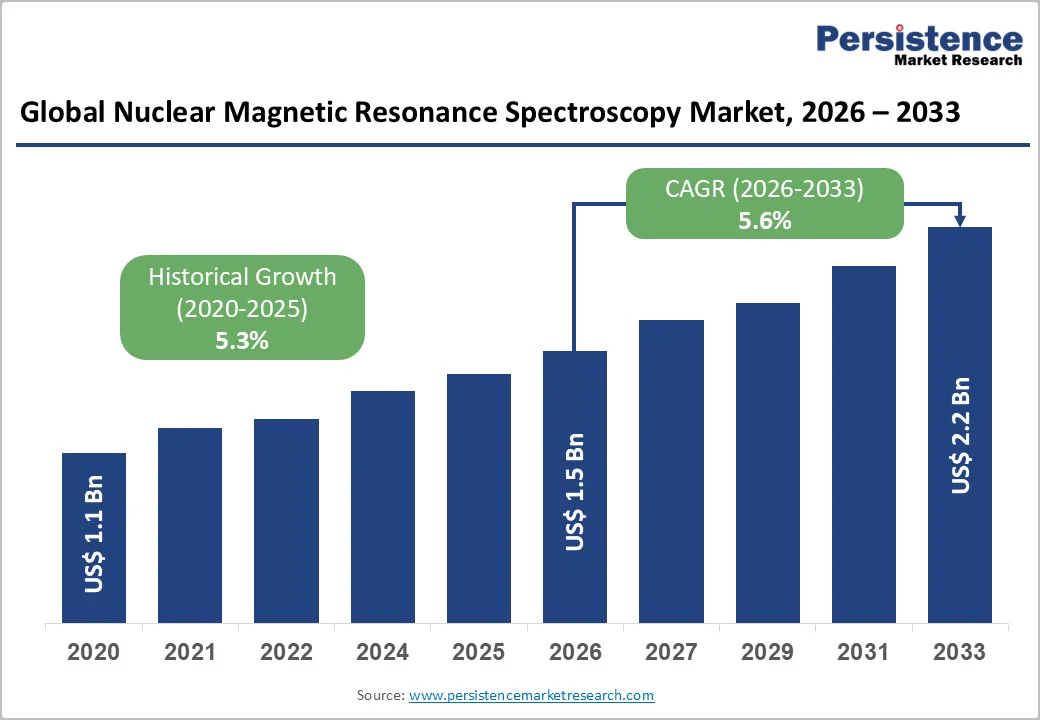
The global nuclear magnetic resonance (NMR) spectroscopy market size is likely to be valued at US$ 1.5 billion in 2026 and is estimated to reach US$ 2.2 billion by 2033, growing at a CAGR of 5.6% during the forecast period 2026−2033. Growth is supported by increasing pharmaceutical R&D spending, rising adoption of high-field NMR systems in structural biology, and expansion of battery research programs globally. Broader applications in material science, food authentication, and petrochemical analysis continue to strengthen demand. Regulatory encouragement for analytical reliability and data integrity further enhances market adoption, particularly in life sciences and industrial quality control.
Key Industry Highlights
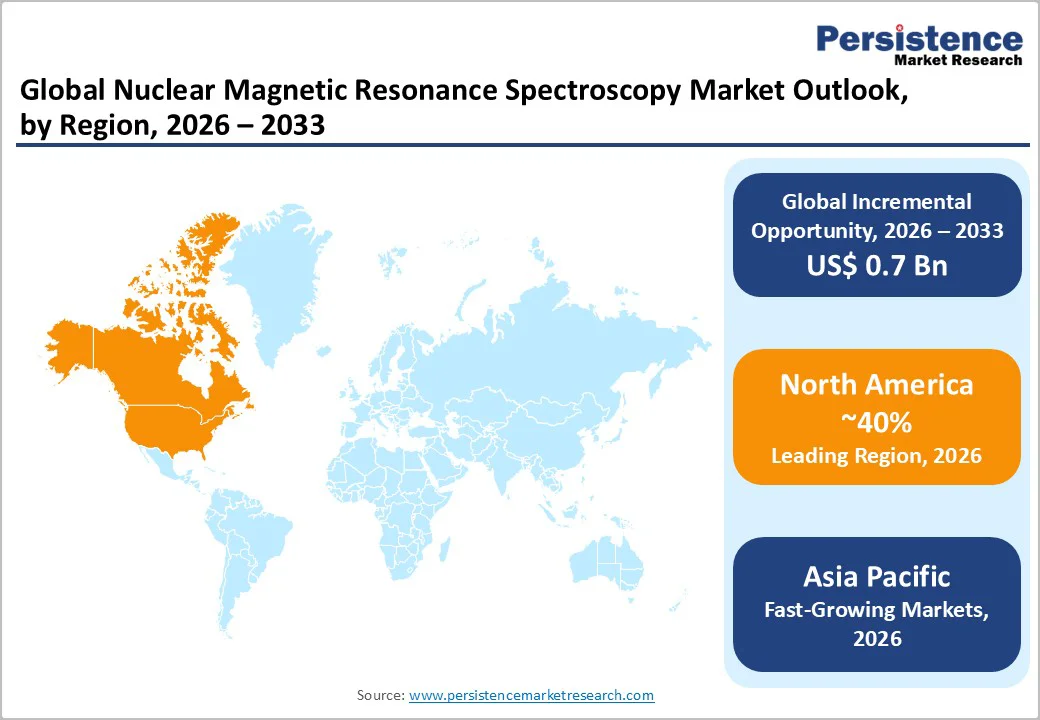
- Dominant Region: North America is set to lead in 2026 with around 40% share, driven by strong pharmaceutical R&D, major NMR manufacturers, and widespread academic networks.
- Fastest-growing Market: The Asia Pacific market is expected to grow fastest from 2026 to 2033, fueled by strengthening pharmaceutical, biotech, and academic research.
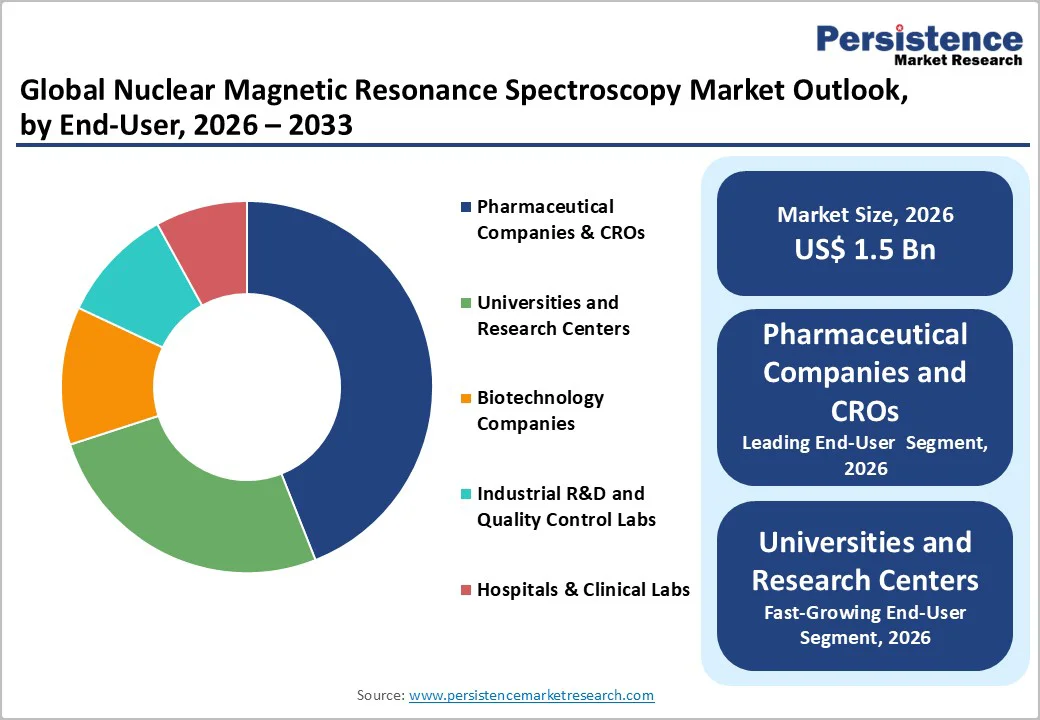
- Leading End-User: Pharmaceutical companies and contract research organizations (CROs) are set to lead in 2026 with a 44% share, owing to the extensive use of NMR in drug discovery.
- Fastest-growing End-User: Universities and research centers are the fastest-growing segment, driven by increased funding, high-field NMR adoption, and expanding research infrastructure.
- November 2025: An industry–academia collaboration introduced a tool integrating infrared and proton NMR spectroscopy data, enabling faster and more accurate chemical structure verification.
| Key Insights | Details |
|---|---|
| Nuclear Magnetic Resonance Spectroscopy Market Size (2026E) | US$ 1.5 Bn |
| Market Value Forecast (2033F) | US$ 2.2 Bn |
| Projected Growth (CAGR 2026 to 2033) | 5.3% |
| Historical Market Growth (CAGR 2020 to 2024) | 5.6% |
Market Factors – Growth, Barriers, and Opportunity Analysis
Increasing Pharmaceutical and Biotechnology R&D Expenditure
Substantial investments in pharmaceutical and biotechnology R&D are driving the demand for sophisticated analytical technologies that deliver structural accuracy, molecular clarity, and reproducible insights. The expanding complexity of drug development portfolios, which now encompass small molecules, biologics, and next-generation therapeutics such as gene therapies and cell-based treatments, has intensified the requirement for precise characterization tools capable of validating purity, confirming molecular identity, and fulfilling regulatory-driven quality requirements. As research programs become increasingly sophisticated, laboratories are strategically prioritizing analytical platforms that streamline the analysis workflow, reduce development risks, and enhance decision-making capabilities across the entire drug development lifecycle.
The ascendancy of complex biologics, metabolomics, and advanced materials employed in drug delivery systems has substantially elevated the significance of high-precision molecular spectroscopy throughout global R&D operations. Organizations pursuing competitive differentiation are investing in instrumentation specifically designed to accelerate structure elucidation, support high-resolution molecular analysis, and enhance data confidence critical for regulatory submissions and approvals. Concurrent increases in life sciences infrastructure spending, the expansion of CRO capabilities, and the strategic transition toward data-intensive research environments are collectively sustaining continuous adoption of advanced analytical technologies across both well-established research centers and emerging innovation hubs in developing markets.
Availability of Alternative Analytical Techniques
The proliferation of alternative analytical technologies offering accelerated throughput and reduced operational complexity presents a significant constraint on market expansion for specialized structural analysis tools. Established methodologies including mass spectrometry (MS), infrared spectroscopy (IR), chromatography, and X-ray diffraction techniques frequently deliver rapid analytical results, necessitate comparatively modest capital investments, and require less specialized technical expertise. Numerous industries are adopting these solutions to optimize workflows, minimize maintenance requirements, and exercise tighter budgetary control, consequently shifting organizational preferences toward platforms that integrate seamlessly into high-volume testing environments and production facilities.
These competing analytical methodologies also benefit from extensive compatibility with automated systems, which enables laboratories to achieve significant operational scaling without substantial infrastructure investments or reconfiguration. Their inherent versatility across diverse sample compositions and routine analytical applications positions them as pragmatic alternatives for organizations prioritizing accelerated decision-making capabilities. This intensifying competitive environment creates considerable pressure on high-precision structural analysis instruments, compelling procurement decision-makers to comprehensively evaluate total cost of ownership (TCO), turnaround time, operational convenience, and integration requirements prior to instrument acquisition or analytical capability expansion initiatives.
Growing Adoption in Clinical Diagnostics and Metabolomics
Heightened emphasis on precision diagnostics is substantially increasing demand for analytical platforms capable of delivering consistent biochemical insights with minimal analytical variability. Nuclear magnetic resonance spectroscopy is facilitating this strategic shift through its demonstrated spectral reproducibility and capacity to comprehensively profile a diverse range of metabolites from a single biological sample, thereby enabling clinicians to identify early disease signatures with significantly greater confidence and accuracy. Its non-destructive analytical workflow strengthens adoption trajectories in clinical diagnostic settings where molecular-level accuracy and reliable longitudinal patient monitoring are paramount to therapeutic decision-making and clinical outcomes.
The systematic expansion of metabolomics programs across clinical research centers and academic medical institutions is generating substantial commercial momentum for technologies that efficiently streamline biomarker discovery and rigorous validation protocols. NMR spectroscopy addresses these institutional requirements through its inherent high-throughput analytical capability, minimal sample preparation demands, and exceptional compatibility with standardized laboratory protocols and quality assurance frameworks. Its distinctive capacity to analyze complex biofluids including serum, cerebrospinal fluid, and urine without requiring elaborate preprocessing procedures positions NMR as a strategically valuable analytical tool for hospitals and translational research units targeting metabolic disorders, oncology applications, neurological conditions, and cardiometabolic health management.
Category-wise Analysis
Product Type Insights
High-field nuclear magnetic resonance instrumentation operating at magnetic field strengths exceeding 300 megahertz (MHz) is projected to capture a 65% revenue share in 2026, attributable to its unmatched spectral resolution and analytical sensitivity. This technology segment represents the preferred analytical platform for pharmaceutical research & development and academic research institutions, delivering the precise structural elucidation capabilities essential for characterizing complex molecular architectures and supporting drug development programs. Its adoption remains concentrated within specialized applications including drug discovery workflows, protein structural analysis, and advanced materials research, where analytical accuracy directly influences development timelines, regulatory compliance outcomes, and commercial viability.
Low-field NMR spectroscopy is projected to emerge as the fastest-expanding segment through 2033, driven by compelling advantages encompassing cost-effectiveness, compact physical design, and straightforward integration into existing quality control (QC) workflows and manufacturing environments. Its significantly reduced capital requirements are encouraging broader adoption across diverse industrial sectors including food and beverage processing, petroleum and energy applications, and chemical manufacturing operations. Benchtop NMR instrument deployment is expected to accelerate substantially, particularly within industrial facilities and smaller analytical laboratories, reflecting a strategic organizational shift toward accessible, decentralized analytical solutions that enable routine process monitoring and facilitate rapid operational decision-making.
Application Insights
Pharmaceuticals and biotechnology applications are predicted to dominate, commanding an estimated 37% of the nuclear magnetic resonance spectroscopy market revenue share in 2026. The leading position of this segment is driven by extensive institutional reliance on NMR spectroscopy for structural analysis, impurity profiling, and formulation development activities. Stringent regulatory mandates imposed by authoritative agencies including the U.S. Food and Drug Administration (FDA) and European Medicines Agency (EMA) actively reinforce organizational adoption of high-precision analytical technologies throughout drug development workflows. The substantial capital allocation directed toward pharmaceutical R&D is systematically integrating NMR spectroscopy across the complete drug development continuum, encompassing early-stage molecular discovery, process chemistry optimization, manufacturing scale-up, and comprehensive quality assurance (QA) protocols.
Energy & battery research is anticipated to represent the fastest-expanding application segment during 2026-2033, propelled by accelerating global initiatives targeting electric vehicle (EV) adoption, grid-scale energy storage deployment, and next-generation advanced materials development. NMR spectroscopy enables indispensable analytical capabilities for evaluating critical performance parameters including lithium-ion dynamics, electrolyte solution performance characteristics, and solid-state structural properties, thereby supporting both academic research institutions and commercial energy companies pursuing technological innovation. Concurrent expansion of clean-energy policy frameworks and substantial governmental funding commitments for sustainable technology development are systematically accelerating NMR uptake across research ecosystems.
End-User Insights
Pharmaceutical companies and CROs are projected to maintain their position as the dominant end-user segment, capturing an estimated 46% of the NMR spectroscopy market revenue share in 2026. Their dominance is primarily aided by the extensive utilization of NMR spectroscopy throughout drug discovery initiatives, structural analysis workflows, and quality assurance (QA) operations. CROs are systematically expanding their strategic deployment of high-field NMR instrumentation to broaden their service portfolios, satisfy increasingly stringent regulatory compliance standards, and effectively manage extensive research pipelines for pharmaceutical and biotechnology clients. This institutional investment trajectory is establishing NMR spectroscopy as an indispensable analytical instrument integral to comprehensive pharmaceutical operations spanning from initial compound screening through final regulatory submissions.
Universities and research centers are anticipated to grow the fastest between 2026 and 2033, catalyzed by substantial increases in national science funding allocations and strategic governmental investments directed toward research infrastructure modernization. High-field NMR instrumentation adoption is enabling academic institutions to conduct advanced molecular investigations, sophisticated materials research, and comprehensive biological studies that establish competitive advantages in publishing and grant competitiveness. Emerging economies, particularly throughout Asia Pacific, are accelerating their acquisition of cutting-edge NMR instrumentation through government-supported research initiatives and institutional funding, thereby positioning academic and research institutions as a rapidly expanding commercial market for NMR applications, technological deployment, and ancillary service offerings in developing research ecosystems.
Regional Insights
North America Nuclear Magnetic Resonance (NMR) Spectroscopy Market Trends
North America is projected to command with an estimated 40% of the nuclear magnetic resonance spectroscopy market share in 2026, fueled by the region's highly concentrated pharmaceutical and biotechnology industrial base characterized by R&D intensity among the highest globally. The geographic presence of major multinational NMR instrument manufacturers, sophisticated analytical service providers, and well-established academic research networks collectively strengthens the region's analytical infrastructure and facilitates accelerated adoption of both high-field and benchtop NMR technologies. Furthermore, the stringent regulatory frameworks established by the U.S. FDA necessitate the implementation of precision analytical workflows throughout pharmaceutical development, positioning NMR spectroscopy as an indispensable tool for validation across the complete drug discovery and development lifecycle.
Another prominent regional driver is the systematic integration of NMR spectroscopy within translational medicine and personalized medicine (PM) research programs spanning hospitals, clinical research centers, and academic medical institutions. These organizations increasingly rely on NMR capabilities for metabolomics investigations, biomarker discovery initiatives, and advanced materials characterization supporting precision diagnostics and therapeutics development. Strategic organizational investments in state-of-the-art analytical facilities, complemented by exceptionally high R&D expenditure levels, are accelerating NMR instrument procurement and deployment across institutional settings. Robust collaborative partnerships between commercial enterprises and academic research institutions further facilitate early adoption of emerging NMR technologies and methodologies, entrenching North America's position as the market leader.
Europe Nuclear Magnetic Resonance (NMR) Spectroscopy Market Trends
Europe is projected to maintain a substantial share within the NMR spectroscopy market throughout 2026, driven by the region's robust concentration of pharmaceutical and chemical manufacturing centers, internationally recognized research institutions, and well-established analytical service providers. Strategic countries including Germany, Switzerland, and the U.K. are actively investing in high-field NMR systems to support drug discovery initiatives, structural elucidation workflows, and QC operations, thereby facilitating both industrial commercialization and advanced academic research applications across pharmaceutical and materials science domains.
The region's sustained market growth is further helped by stringent regulatory standards promulgated by the EMA, which systematically encourage organizational adoption of high-precision analytical technologies throughout pharmaceutical development and manufacturing operations. Collaborative research frameworks institutionalized between universities, government research laboratories, and commercial enterprises are actively fostering innovation across metabolomics investigations, materials science applications, and advanced chemical analysis methodologies. In tandem, the expansion of CROs and specialized analytical service laboratories is progressively enhancing accessibility to sophisticated NMR technologies for smaller enterprises and emerging biotech companies lacking dedicated internal capabilities. As pharmaceutical companies increasingly prioritize advanced therapeutic modalities, sustainable materials development, and energy-related research initiatives, Europe is likely to remain a strategically important market for nuclear magnetic resonance spectroscopy.
Asia Pacific Nuclear Magnetic Resonance (NMR) Spectroscopy Market Trends
Asia Pacific is anticipated to emerge as the fastest-growing market for NMR spectroscopy through 2033, propelled by rapidly accelerating pharmaceutical, biotechnology, and academic research sectors across the region. China, India, Japan, and South Korea are directing substantial capital investments toward advanced research infrastructure development, thereby facilitating an accelerated adoption of both high-field and benchtop NMR instrumentation across diverse institutional settings. Market expansion is substantially catalyzed by increasing domestic pharmaceutical manufacturing operations, expanding materials research initiatives, and substantial governmental funding allocations directed toward scientific research programs and technology infrastructure modernization.
Emerging economies throughout the region are strategically prioritizing investment in advanced analytical technologies to strengthen QC workflows, optimize manufacturing processes, and accelerate advanced materials development initiatives. Universities and research institutes are systematically expanding institutional NMR capabilities to support metabolomics investigations, structural biology research, and comprehensive chemical characterization applications. The rapid proliferation of CROs and specialized analytical service laboratories is generating sustained demand for versatile and cost-effective NMR instrumentation tailored to diverse industrial applications and research requirements. Partnerships established between commercial enterprises and academic institutions, combined with intensifying regional emphasis on EV technology, grid-scale energy storage systems, and innovative materials development, collectively reinforce Asia Pacific as an increasingly vital geographic hub for concentrated NMR technology adoption, innovation, and commercial expansion throughout the coming decade.
Competitive Landscape
The global nuclear magnetic resonance spectroscopy market structure exhibits moderate consolidation characterized by a limited cohort of dominant companies generating the preponderance of aggregate market revenue through specialized instrumentation and integrated analytical solutions. These established market leaders concentrate their strategic focus on high-field NMR instruments, sophisticated magnet technologies, advanced cryogenic systems, and benchtop platforms, collectively offering comprehensive analytical solutions spanning pharmaceutical research and development, academic research institutions, and diverse industrial applications.
Competitive differentiation among these dominant vendors is systematically achieved through demonstrated superiority in spectral resolution capabilities, integrated automation functionality, extensive global service networks, and sophisticated data analytics platforms, thereby ensuring operational reliability and analytical efficiency for demanding molecular and materials characterization applications requiring precision and reproducibility. New market participants are strategically targeting expanding commercial opportunities through development of compact, cost-efficient NMR systems specifically engineered for industrial manufacturers, QC laboratories, and routine analytical workflows operating within constrained budget parameters.
Key Industry Developments
- In December 2025, researchers at the Max Planck Institute for Intelligent Systems developed a quantum sensing approach enabling nanotesla (nT) sensitivity for wireless magnetic tracking with millimeter-scale accuracy, overcoming miniaturization limitations of existing tracking technologies. The technique demonstrates versatile NMR applications including submillimeter-diameter guidewire and optic fiber trackers, positioning NMR-based wireless tracking as a promising technology for minimally invasive medical procedures conducted within MRI scanners.
- In August 2025, Purdue University researchers achieved atomic-scale NMR spectroscopy by embedding carbon 13 isotopes into hexagonal boron nitride (hBN) 2D materials, enabling single-spin NMR detection with superior resolution beyond conventional 100-micrometer limitations. The experiment also demonstrated extended coherence times advantageous for quantum computing and quantum sensing applications.
- In April 2025, Bruker Corporation unveiled the Fourier 80 'Multi-Talent' benchtop Fourier-transform (FT) NMR spectrometer, a significant advancement in permanent magnet-based multinuclear NMR technology. The system enables observation of protons and selection from 15 different X-nuclei through software-selectable capabilities without requiring probe retuning, supports diverse analytical applications, from pharmaceuticals to battery materials research.
Companies Covered in Nuclear Magnetic Resonance (NMR) Spectroscopy Market
- Bruker Corporation
- JEOL Ltd.
- Oxford Instruments plc
- Agilent Technologies
- Magritek
- Nanalysis Scientific
- Anasazi Instruments
- Spinlock
- Cryogenic Ltd.
- QOneTec
- Thermo Fisher Scientific
- Shimadzu Corporation
- HITACHI High-Tech
- Waters Corporation
Frequently Asked Questions
The global nuclear magnetic resonance (NMR) spectroscopy market is projected to reach US$ 1.5 billion in 2026.
Rising pharmaceutical R&D, increasing materials and energy research, and growing demand for precise structural and quality analysis are key growth drivers.
The market is poised to witness a CAGR of 5.6% from 2026 to 2033.
Adoption of NMR technologies in clinical diagnostics, expansion of advanced diagnostics in emerging economies, and integration with AI and automation present key growth opportunities.
Some of the key market players include Bruker Corporation, JEOL Ltd., Oxford Instruments plc, Agilent Technologies, Magritek, and Nanalysis Scientific.


