Nitrogenated Coffee Market Size, Share, Growth, and Regional Forecast, 2026 to 2033

Nitrogenated Coffee Market by Product (Cold Brew, Hot Brew, Ready-to-Drink (RTD), Flavor (Vanilla, Cascara, Fruit & nut, Others), Packaging Format (Cans, Mugs, Others), and Regional Analysis from 2026 to 2033

ID: PMRREP36291
Calendar

March 2026

220 Pages

Author : Amol Patil

Key Industry Highlights:

  • Dominant Segment: Cold brew nitrogenated coffee accounted for 58.0% share in 2025, fueled by growing consumer preference for smooth, low-acid, and ready-to-drink premium coffee experiences, particularly among urban professionals seeking convenient, on-the-go beverage options. Its popularity is reinforced by café culture, innovative flavors, and increasing availability in retail and quick-service channels.
  • Dominant Region: North America dominated with 38.0% share in 2025, supported by café culture, strong quick-service presence, and advanced cold-chain distribution infrastructure.
  • Growth Indicators: Growth fueled by rising café and quick-service adoption, demand for premium ready-to-drink coffee, and consumer preference for convenient, on-the-go beverages.
  • Opportunities: Innovation in flavored, organic, and specialty nitrogenated coffee, expansion in emerging markets, and increasing adoption in retail and foodservice channels.
Key Insights Details
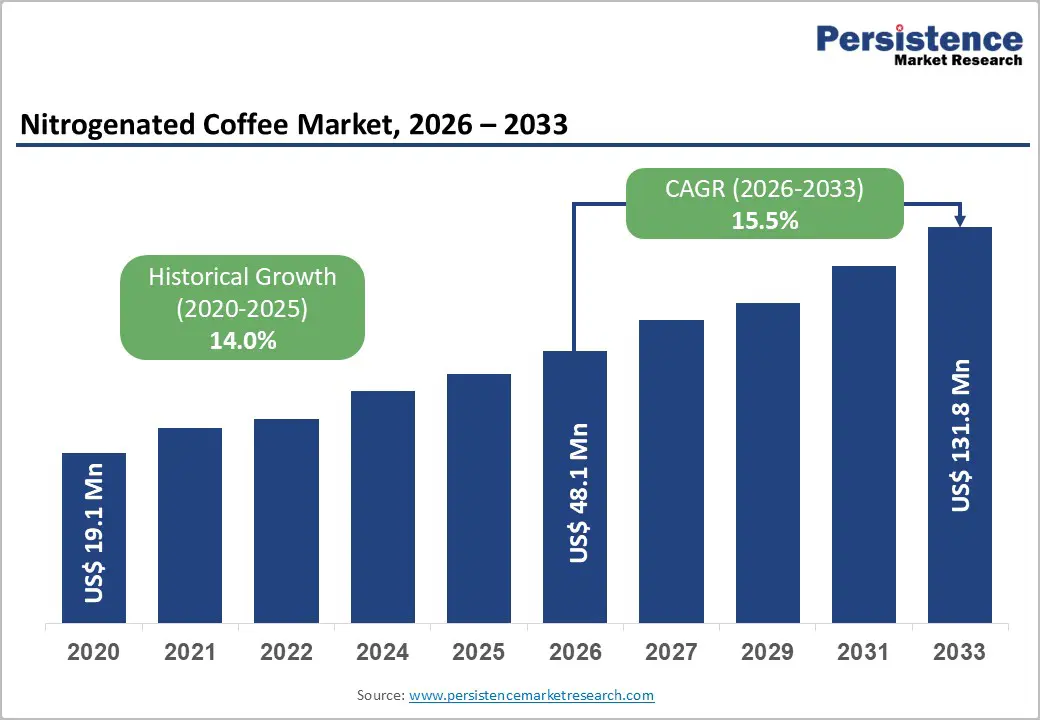
Global Nitrogenated Coffee Market Size (2026E) US$ 48.1 Mn
Market Value Forecast (2033F) US$ 131.8 Mn
Projected Growth (CAGR 2026 to 2033) 15.5%
Historical Market Growth (CAGR 2020 to 2025) 14.0%

nitrogenated-coffee-market-2026-2033

Market Dynamics

Driver: Growth of café and quick-service chains

The proliferation of cafés and quick-service restaurants (QSRs) significantly fuels nitrogenated coffee demand. Global coffeehouse expansion reflects broader foodservice growth; the Foodservice Coffee Market saw over 5,000 new coffee outlets added globally between 2022-2024, driven by consumer preference for specialty beverages like cold brew and nitro-infused coffee. Specialty cold formats (cold brew/nitro) now represent about 30% of café transactions in mature markets like North America and Europe, demonstrating strong integration of nitrogenated offerings into mainstream menus.

Further supporting this, specialty coffee shops are innovating rapidly: research shows 33% of urban café sales now come from cold beverages, including nitrogenated products, and digital/loyalty features are enabling cafés to capture repeat consumers. Café culture, particularly among millennials and Gen Z is a major factor, with specialty drinks often commanding higher price points and boosting average check values. This trend aligns with broader global coffee consumption growth, where rising specialty and cold beverage demand augments nitrogenated coffee’s visibility in retail and on-premise formats.

Together, these dynamics illustrate how QSR/café expansion directly drives nitrogenated coffee adoption by enhancing access, consumer familiarity, and frequent trial of premium, textured beverages.

Restraint: Short shelf life of nitrogenated coffee products

One key restraint for nitrogenated coffee is product shelf life limitations, especially for specialty and craft variants. Unlike many ready-to-drink (RTD) beverages with extended refrigerated shelf stability, nitrogenated coffee often relies on cold chain logistics post-production because it lacks preservatives, constraining distribution outside urban retail and café channels. Proper cold storage is essential since nitrogen-infused coffee can lose texture and flavor quality if not maintained at low temperatures, and traditional cold brew without stabilizers may only retain optimal sensory attributes for a few days once brewed. Industry practitioners note that refrigerated cold brew without preservatives may be best consumed within 3-7 days for quality retention, indicating the technological challenge in extending shelf life.

This short lifespan increases logistics and inventory management costs, limiting reach into mass retail and impeding economies of scale that benefit more shelf-stable beverages. Smaller producers particularly struggle with these costs, as nitrogen infusion equipment and cold storage add complexity. The requirement for specialized pressurization and nitrogen systems further elevates production expenses, restricting pricing competitiveness versus traditional coffee drinks. These factors collectively restrain broader market penetration, especially in emerging regions where cold supply infrastructure is less developed, ultimately slowing rapid scale-up of nitrogenated coffee distribution.

Opportunity: Development of organic, clean-label, and specialty variants

The rising consumer focus on health, sustainability, and premium experiences presents a substantial opportunity for organic, clean-label, and specialty nitrogenated coffee variants. Globally, organic coffee sales have shown consistent growth with organic options accounting for around 15% of café purchases and rising consumer prioritization of ethically sourced, natural products. This trend underscores growing demand for beverages perceived as healthier, transparently sourced, and aligned with clean eating lifestyles.

Moreover, research in cold brew and specialty coffee reveals that nearly 46% of urban coffee drinkers now prefer nitrogen-infused brews, driven by the appeal of smoother texture and reduced acidity with no added sugars. Craft and organic nitrogenated offerings tap directly into this preference by combining premium sensory attributes with “clean-label” credentials. Producers can also leverage organic certification, fair-trade sourcing, and low-calorie profiles to differentiate products in retail and café segments.

The opportunity is amplified by younger demographics who are more willing to pay a premium for sustainable and novel drinks. With ready-to-drink (RTD) product launches increasingly incorporating innovative, health-oriented formulations, organic and clean-label nitrogenated coffee can expand both retail presence and consumer loyalty. This positions the segment for long-term growth as consumers shift toward products that reflect wellness values and environmental consciousness.

Category-wise Analysis

By Product

Cold brew’s dominance in nitrogenated coffee stems from strong consumer preference for smooth, low-acid, premium coffee experiences that pair effectively with nitrogen infusion. Surveys show that over 20% of U.S. coffee drinkers regularly consume cold brew, reflecting rapid adoption of chilled coffee formats that offer less bitterness and greater drinkability than traditional hot brews. Cold brewing extracts flavor over extended steeping without heat, resulting in approximately 67% lower acidity, making it appealing to health-conscious consumers and those with sensitive stomachs. Ready-to-drink (RTD) cold brew consumption is increasing significantly because it delivers café-style experiences without preparation, and nitro infusion enhances this by adding a creamy texture. This combination of smoother taste, functional benefits, and convenience underpins cold brew’s leadership in nitrogenated coffee portfolios globally.

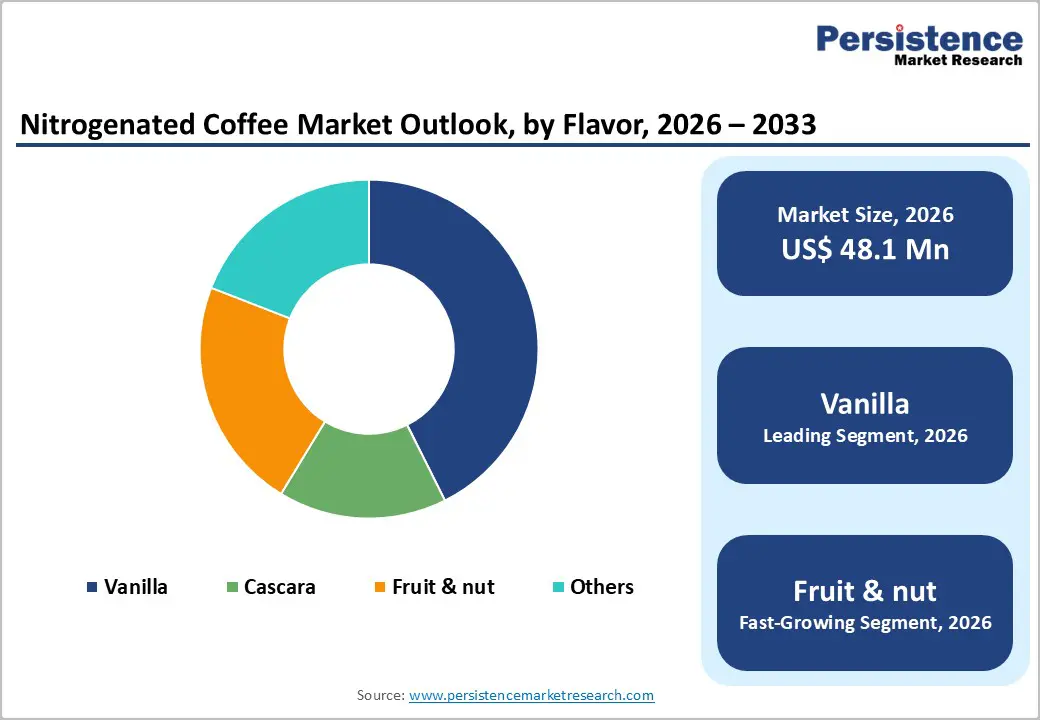
By Flavor, Vanilla Dominates the Cane Sugar Market

Vanilla dominates flavored nitrogenated coffee because it blends seamlessly with coffee’s natural profile, delivering sweetness and aroma without overpowering the base beverage. Around 30-40% of flavored coffee consumers express a preference for vanilla, making it one of the top-rated flavor profiles in global coffee surveys. In the broader flavored coffee segment, vanilla coffee accounts for a significant share of total flavored sales, driven by consumers, particularly millennials and Gen Z who seek approachable, dessert-inspired beverages that balance indulgence with familiar tastes. Vanilla also performs well in ready-to-drink and café menus, including vanilla cold brew and nitro variants that capitalize on both creamy mouthfeel and aromatic sweetness, reinforcing its popularity in nitrogenated product lines.
nitrogenated-coffee-market-outlook-by-flavor-2026-2033

Regional Insights

North America Nitrogenated Coffee Market Trends

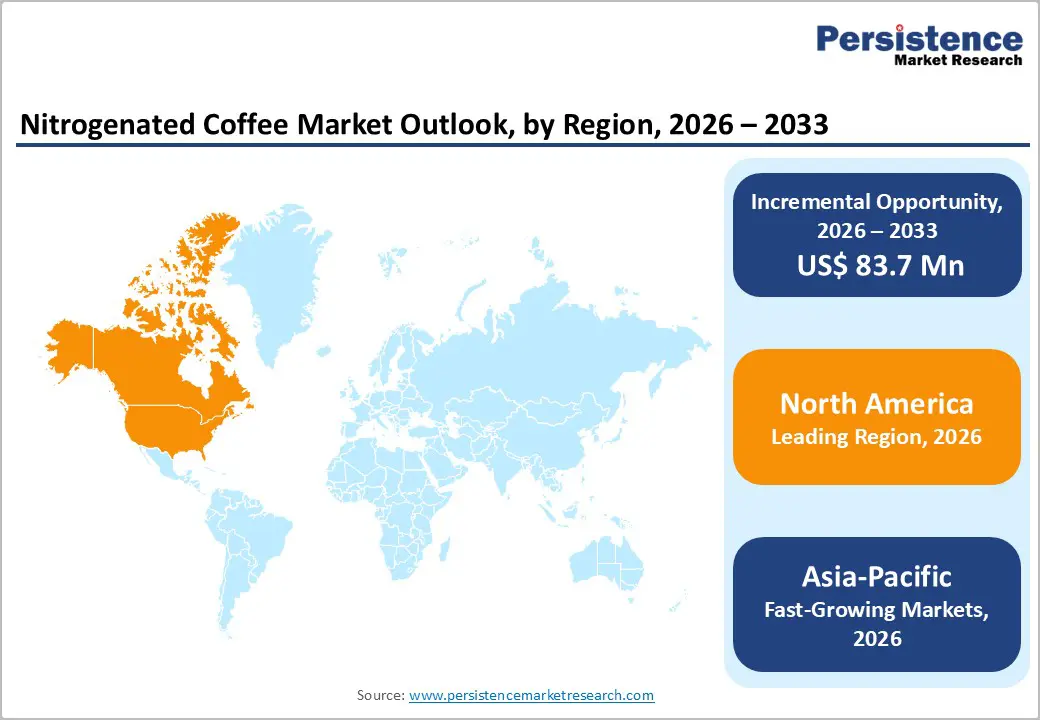
North America leads the nitrogenated coffee market due to its mature specialty coffee culture, high consumer awareness of innovative beverages, and established retail and café infrastructure, making it the largest regional adopter globally. In 2025, North America accounts for about 38% of global nitrogenated coffee consumption, with the United States contributing roughly 82% of regional demand due to strong urban café density and cold beverage preference. Additionally, specialty coffee sales in North America have grown 8-10% annually, supported by consumer willingness to pay premiums for novel formats like cold brew and nitrogenated options.

Europe Nitrogenated Coffee Market Trends

Europe is a key region for nitrogenated coffee thanks to deep-rooted coffee traditions and high per-capita consumption. Europe is the world’s largest coffee consumption market, accounting for about 30.7% of global coffee consumption, with consumers averaging 5.7 kg per person annually, higher than North America’s 4.8 kg. This broad base underpins demand for specialty beverages such as nitrogenated coffee, which cafés and retail outlets increasingly adopt. Urban centers across the United Kingdom, Germany, France, and the Netherlands are expanding specialty café offerings, with a rising number of outlets incorporating on-tap and packaged nitro options. Europe’s strong interest in premium, artisanal, and low-acid coffee styles aligns closely with nitrogenated coffee’s sensory appeal, making it strategically vital in the global market.

Asia-Pacific Nitrogenated Coffee Market Trends

Asia Pacific is the fastest-growing region for nitrogenated coffee due to rapid urbanization, rising disposable incomes, and a growing café culture among younger consumers. Urban markets such as China, Japan, and South Korea are driving expansion, with countries like China recording substantial growth in specialty beverage adoption among consumers aged 20-40. The region’s appetite for western beverage trends and premium, on-the-go coffee formats has surged, supported by an expanding middle class and increasing café chain penetration. Additionally, the rising adoption of ready-to-drink coffee and cold brew formats in metropolitan areas accelerates nitrogenated coffee acceptance. These structural shifts, coupled with high growth potential in emerging markets like India and Southeast Asia, position Asia-Pacific for the fastest regional CAGR in the nitrogenated coffee market.
nitrogenated-coffee-market-outlook-by-region-2026-2033

Competitive Landscape

The nitrogenated coffee market is competitive, led by major players emphasizing innovation, premium ready-to-drink offerings, and strong distribution. Key companies focus on expanding product portfolios, introducing specialty flavors, and enhancing market presence to meet rising consumer demand for convenient, high-quality nitrogenated coffee, maintaining leadership in a growing global market.

Key Industry Developments:

  • In October 2025, Nitro Coffee Co, a nitrogen-infused cold brew producer based in Comber, enhanced its product development and processes with technical assistance from CAFRE’s Food Technologists under the Invest NI Innovation Voucher Programme.

Companies Covered in Nitrogenated Coffee Market

  • Starbucks Corporation
  • International Coffee & Tea, LLC
  • RISE Brewing Co.
  • Dunkin'
  • McDonald's
  • Stumptown Coffee Roasters
  • NITRO Beverage Co.
  • Blackeye Roasting Co.
  • Bona Fide Nitro Coffee and Tea
  • Califia Farms
  • Others
Frequently Asked Questions

The global nitrogenated coffee market is projected to be valued at US$ 48.1 Mn in 2026.

Rising demand for convenient, premium, and ready-to-drink coffee, café expansion, and innovative flavored offerings.

The global nitrogenated coffee market is poised to witness a CAGR of 15.5% between 2026 and 2033.

Development of organic, clean-label, and specialty nitrogenated coffee, emerging markets expansion, and innovative flavor introductions.

Starbucks Corporation, International Coffee & Tea, LLC, RISE Brewing Co., Dunkin', McDonald's, Stumptown Coffee Roasters.

Nitrogenated Coffee Market Report Scope
Report Attribute Details
Historical Data/Actuals 2020 - 2025
Forecast Period 2026 - 2033
Market Analysis Value: US$ Mn
Geographical Coverage
  • North America
  • Europe
  • East Asia
  • South Asia & Oceania
  • Latin America
  • Middle East and Africa
Segmental Coverage
  • Product
  • Flavor
  • Packaging Format
  • Region
Competitive Analysis
  • Starbucks Corporation
  • International Coffee & Tea, LLC
  • RISE Brewing Co.
  • Dunkin'
  • McDonald's
  • Stumptown Coffee Roasters
  • NITRO Beverage Co.
  • Blackeye Roasting Co.
  • Bona Fide Nitro Coffee and Tea
  • Califia Farms
  • Others
Report Highlights
  • Market Forecast and Trends
  • Competitive Intelligence & Share Analysis
  • Growth Factors and Challenges
  • Strategic Growth Initiatives
  • Pricing Analysis
  • Future Opportunities and Revenue Pockets
  • Market Analysis Tools
Market Segmentation

By Product

  • Cold Brew
  • Hot Brew
  • Ready-to-Drink (RTD)

By Flavor

  • Vanilla
  • Cascara
  • Fruit & nut
  • Others

By Distribution Channel

  • Cans
  • Mugs
  • Others

By Region

  • North America
  • Europe
  • East Asia
  • South Asia & Oceania
  • Latin America
  • Middle East and Africa

Related Reports

  1. Executive Summary
    1. Global Nitrogenated Coffee Market Snapshot, 2026 and 2033
    2. Market Opportunity Assessment, 2026 - 2033, US$ Bn
    3. Key Market Trends
    4. Future Market Projections
    5. Premium Market Insights
    6. Industry Developments and Key Market Events
    7. PMR Analysis and Recommendations
  2. Market Overview
    1. Market Scope and Definition
    2. Market Dynamics
      1. Drivers
      2. Restraints
      3. Opportunity
      4. Challenges
      5. Key Trends
    3. Macro-Economic Factors
      1. Global Sectorial Outlook
      2. Global GDP Growth Outlook
    4. COVID-19 Impact Analysis
    5. Forecast Factors - Relevance and Impact
  3. Value Added Insights
    1. Regulatory Landscape
    2. Product Adoption Analysis
    3. Value Chain Analysis
    4. Key Deals and Mergers
    5. PESTLE Analysis
    6. Porter’s Five Force Analysis
  4. Global Nitrogenated Coffee Market Outlook:
    1. Key Highlights
      1. Market Size (US$ Bn) and Y-o-Y Growth
      2. Absolute $ Opportunity
    2. Market Size (US$ Bn) Analysis and Forecast
      1. Historical Market Size (US$ Bn) Analysis, 2020-2025
      2. Market Size (US$ Bn) Analysis and Forecast, 2026-2033
    3. Global Nitrogenated Coffee Market Outlook: Product
      1. Introduction / Key Findings
      2. Historical Market Size (US$ Bn) Analysis, By Product, 2020 - 2025
      3. Market Size (US$ Bn) Analysis and Forecast, By Product, 2026 - 2033
        1. Cold Brew
        2. Hot Brew
        3. Ready‑to‑Drink (RTD)
      4. Market Attractiveness Analysis: Product
    4. Global Nitrogenated Coffee Market Outlook: Flavor
      1. Introduction / Key Findings
      2. Historical Market Size (US$ Bn) Analysis, By Flavor , 2020 - 2025
      3. Market Size (US$ Bn) Analysis and Forecast, By Flavor , 2026 - 2033
        1. Vanilla
        2. Cascara
        3. Fruit & nut
        4. Others
      4. Market Attractiveness Analysis: Flavor
    5. Global Nitrogenated Coffee Market Outlook: Packaging Format
      1. Introduction / Key Findings
      2. Historical Market Size (US$ Bn) Analysis, By Packaging Format, 2020 - 2025
      3. Market Size (US$ Bn) Analysis and Forecast, By Packaging Format, 2026 - 2033
        1. Cans
        2. Mugs
        3. Others
      4. Market Attractiveness Analysis: Packaging Format
  5. Global Nitrogenated Coffee Market Outlook: Region
    1. Key Highlights
    2. Historical Market Size (US$ Bn) Analysis, By Region, 2020 - 2025
    3. Market Size (US$ Bn) Analysis and Forecast, By Region, 2026 - 2033
      1. North America
      2. Europe
      3. East Asia
      4. South Asia and Oceania
      5. Latin America
      6. Middle East & Africa
    4. Market Attractiveness Analysis: Region
  6. North America Nitrogenated Coffee Market Outlook:
    1. Key Highlights
    2. Historical Market Size (US$ Bn) Analysis, By Market, 2020 - 2025
      1. By Country
      2. By Product
      3. By Flavor
      4. By Packaging Format
    3. Market Size (US$ Bn) Analysis and Forecast, By Country, 2026 - 2033
      1. U.S.
      2. Canada
    4. Market Size (US$ Bn) Analysis and Forecast, By Product, 2026 - 2033
      1. Cold Brew
      2. Hot Brew
      3. Ready‑to‑Drink (RTD)
    5. Market Size (US$ Bn) Analysis and Forecast, By Flavor, 2026 - 2033
      1. Vanilla
      2. Cascara
      3. Fruit & nut
      4. Others
    6. Market Size (US$ Bn) Analysis and Forecast, By Packaging Format, 2026 - 2033
      1. Cans
      2. Mugs
      3. Others
    7. Market Attractiveness Analysis
  7. Europe Nitrogenated Coffee Market Outlook:
    1. Key Highlights
    2. Historical Market Size (US$ Bn) Analysis, By Market, 2020 - 2025
      1. By Country
      2. By Product
      3. By Flavor
      4. By Packaging Format
    3. Market Size (US$ Bn) Analysis and Forecast, By Country, 2026 - 2033
      1. Germany
      2. France
      3. U.K.
      4. Italy
      5. Spain
      6. Russia
      7. Rest of Europe
    4. Market Size (US$ Bn) Analysis and Forecast, By Product, 2026 - 2033
      1. Cold Brew
      2. Hot Brew
      3. Ready‑to‑Drink (RTD)
    5. Market Size (US$ Bn) Analysis and Forecast, By Flavor, 2026 - 2033
      1. Vanilla
      2. Cascara
      3. Fruit & nut
      4. Others
    6. Market Size (US$ Bn) Analysis and Forecast, By Packaging Format, 2026 - 2033
      1. Cans
      2. Mugs
      3. Others
    7. Market Attractiveness Analysis
  8. East Asia Nitrogenated Coffee Market Outlook:
    1. Key Highlights
    2. Historical Market Size (US$ Bn) Analysis, By Market, 2020 - 2025
      1. By Country
      2. By Product
      3. By Flavor
      4. By Packaging Format
    3. Market Size (US$ Bn) Analysis and Forecast, By Country, 2026 - 2033
      1. China
      2. Japan
      3. South Korea
    4. Market Size (US$ Bn) Analysis and Forecast, By Product, 2026 - 2033
      1. Cold Brew
      2. Hot Brew
      3. Ready‑to‑Drink (RTD)
    5. Market Size (US$ Bn) Analysis and Forecast, By Flavor, 2026 - 2033
      1. Vanilla
      2. Cascara
      3. Fruit & nut
      4. Others
    6. Market Size (US$ Bn) Analysis and Forecast, By Packaging Format, 2026 - 2033
      1. Cans
      2. Mugs
      3. Others
    7. Market Attractiveness Analysis
  9. South Asia & Oceania Nitrogenated Coffee Market Outlook:
    1. Key Highlights
    2. Historical Market Size (US$ Bn) Analysis, By Market, 2020 - 2025
      1. By Country
      2. By Product
      3. By Flavor
      4. By Packaging Format
    3. Market Size (US$ Bn) Analysis and Forecast, By Country, 2026 - 2033
      1. India
      2. Southeast Asia
      3. ANZ
      4. Rest of South Asia & Oceania
    4. Market Size (US$ Bn) Analysis and Forecast, By Product, 2026 - 2033
      1. Cold Brew
      2. Hot Brew
      3. Ready‑to‑Drink (RTD)
    5. Market Size (US$ Bn) Analysis and Forecast, By Flavor, 2026 - 2033
      1. Vanilla
      2. Cascara
      3. Fruit & nut
      4. Others
    6. Market Size (US$ Bn) Analysis and Forecast, By Packaging Format, 2026 - 2033
      1. Cans
      2. Mugs
      3. Others
    7. Market Attractiveness Analysis
  10. Latin America Nitrogenated Coffee Market Outlook:
    1. Key Highlights
    2. Historical Market Size (US$ Bn) Analysis, By Market, 2020 - 2025
      1. By Country
      2. By Product
      3. By Flavor
      4. By Packaging Format
    3. Market Size (US$ Bn) Analysis and Forecast, By Country, 2026 - 2033
      1. Brazil
      2. Mexico
      3. Rest of Latin America
    4. Market Size (US$ Bn) Analysis and Forecast, By Product, 2026 - 2033
      1. Cold Brew
      2. Hot Brew
      3. Ready‑to‑Drink (RTD)
    5. Market Size (US$ Bn) Analysis and Forecast, By Flavor, 2026 - 2033
      1. Vanilla
      2. Cascara
      3. Fruit & nut
      4. Others
    6. Market Size (US$ Bn) Analysis and Forecast, By Packaging Format, 2026 - 2033
      1. Cans
      2. Mugs
      3. Others
    7. Market Attractiveness Analysis
  11. Middle East & Africa Nitrogenated Coffee Market Outlook:
    1. Key Highlights
    2. Historical Market Size (US$ Bn) Analysis, By Market, 2020 - 2025
      1. By Country
      2. By Product
      3. By Flavor
      4. By Packaging Format
    3. Market Size (US$ Bn) Analysis and Forecast, By Country, 2026 - 2033
      1. GCC Countries
      2. Egypt
      3. South Africa
      4. Northern Africa
      5. Rest of Middle East & Africa
    4. Market Size (US$ Bn) Analysis and Forecast, By Product, 2026 - 2033
      1. Cold Brew
      2. Hot Brew
      3. Ready‑to‑Drink (RTD)
    5. Market Size (US$ Bn) Analysis and Forecast, By Flavor, 2026 - 2033
      1. Vanilla
      2. Cascara
      3. Fruit & nut
      4. Others
    6. Market Size (US$ Bn) Analysis and Forecast, By Packaging Format, 2026 - 2033
      1. Cans
      2. Mugs
      3. Others
    7. Market Attractiveness Analysis
  12. Competition Landscape
    1. Market Share Analysis, 2025
    2. Market Structure
      1. Competition Intensity Mapping By Market
      2. Competition Dashboard
    3. Company Profiles (Details - Overview, Financials, Strategy, Recent Developments)
      1. Starbucks Corporation
        1. Overview
        2. Segments and Products
        3. Key Financials
        4. Market Developments
        5. Market Strategy
      2. International Coffee & Tea, LLC
      3. RISE Brewing Co.
      4. Dunkin'
      5. McDonald's
      6. Stumptown Coffee Roasters
      7. NITRO Beverage Co.
      8. Blackeye Roasting Co.
      9. Bona Fide Nitro Coffee and Tea
      10. Califia Farms
      11. Others
  13. Appendix
    1. Research Methodology
    2. Research Assumptions
    3. Acronyms and Abbreviations

Research Methodology Framework for Market Research Excellence

At Persistence Market Research, we implement a comprehensive, validated, and multi-dimensional approachto market analysis that delivers actionable insights across complex market landscapes. Our methodology combines the analytical rigor of leading consulting firms with innovative research techniques, ensuring robust market assessments that guide strategic decision-making with confidence.

Core Research Philosophy

Our methodology is built on four foundational pillars:

Research Philosophy Image

At Persistence Market Research, our methodology is designed to transcend conventional market studies by combining analytical rigor, multi-source validation, and future-focused insights.

We integrate advanced research frameworks, robust data collection strategies, cutting-edge analytics, and innovative technologies to deliver a 360-degree view of complex markets.

We integrate advanced research frameworks, robust data collection strategies, cutting-edge analytics, and innovative technologies to deliver a 360-degree view of complex markets.

Each stage spanning from strategic scoping and hypothesis-building to competitive intelligence, quality validation, and actionable recommendations is engineered to provide clients with unmatched clarity, precision, and confidence in decision-making.

By embedding innovation and technology at the core, our approach ensures that insights are not only comprehensive but also predictive, empowering businesses to seize opportunities, mitigate risks, and achieve sustainable growth

Research Philosophy Image

Capturing Key Information and Events

During this phase, key research objectives focus on essential information and data points for assessing the market, including:

Research Philosophy Image

TAM-SAM-SOM Framework Implementation

We employ both top-down and bottom-up approaches to ensure accurate market sizing.

Top-Down Market SizingBottom-Up Market Sizing
Universe Definition: Total global/regional market identificationUnit Economics: Average transaction values, purchase frequencies, customer lifecycle
Segmentation Filters: Geographic, demographic, and behavioral constraintsCustomer Segmentation: Detailed buyer persona development and sizing
Market Share Analysis: Competitive landscape assessment and share allocationPenetration Analysis: Market penetration rates by segment and geography
Growth Rate Application: Historical trends and forward-looking growth assumptionsScaling Methodology: Extrapolation techniques with confidence intervals

Validation & Cross-Verification

  • Triangulation: Comparing top-down and bottom-up results for consistency
  • Sensitivity Analysis: Testing key assumptions and parameter variations
  • Peer Benchmarking: Comparison with analogous markets and industry benchmarks
  • Expert Review: External validation through industry specialist consultation

Research Philosophy Image

Forecasting & Projection Modeling

Our proprietary forecasting models incorporate multiple variables and scenarios.

Forecasting Components

  • Historical Trend Analysis: 10-year historical growth patterns and cyclical variations
  • Driver-Based Modeling: Economic indicators, demographic shifts, technology adoption
  • Scenario Planning: Base case, optimistic, and conservative projections
  • Monte Carlo Simulations: Probability-weighted outcomes and risk assessments

Model Validation

  • Back-Testing: Historical accuracy assessment over 3–5-year periods
  • Cross-Validation: Multiple modeling approaches for result comparison
  • External Benchmarking: Comparison with established market forecasts
  • Continuous Calibration: Quarterly model updates based on new data

Comprehensive Data Collection Strategy

Our secondary research phase establishes a robust knowledge base utilizing diverse, credible sources.

Secondary Data Sourcess

  • Industry Publications & Reports
  • Government & Regulatory Data
  • Financial Intelligence (filings & reports)
  • Academic Research & Digital Intelligence

Quality Assurance Protocol

  • Source credibility assessment and publication date validation
  • Data consistency checks across multiple sources
  • Bias identification and neutralization techniques
  • Information gap tracking for primary research prioritization

Research Philosophy Image

Primary Research Excellence

Our primary research methodology employs best-in-class techniques to capture unique market insights.

Quantitative Research Methods

  • Large-Scale Surveys: Statistically representative samples with 95% confidence intervals
  • Survey Methodology: Multi-channel deployment (online, telephone, in-person)
  • Question Architecture and Response Optimization

Qualitative Research Methods

  • Executive Interviews
  • Focus Groups
  • Expert Consultations

Quality Assurance & Validation Framework

Multi-Stage Validation Process

  • Source Verification and Consistency Testing
  • Outlier Detection and Bias Assessment
  • Peer Review Process and External Validation
  • Sensitivity Analysis and Confidence Intervals

Research Philosophy Image

Methodology Validation & Credibility

Our research methodology has been extensively validated through:

  • Academic Partnerships: Collaborations with top-tier business schools and research institutions
  • Client Success Stories: Documented case studies demonstrating research impact and ROI
  • Continuous Benchmarking: Performance comparison with leading global research firms

This comprehensive methodology framework positions Persistence Market Research at the forefront of market intelligence, combining the analytical sophistication of top-tier consulting firms with innovative research techniques. Our approach ensures that every market assessment delivers precise, actionable, and strategically valuable insights that drive business success in competitive market environments.

Ready to unlock your market potential? Contact our research experts to discuss how our validated methodology can transform your strategic decision-making with data-driven market intelligence.

Copyright © 2026 Persistence Market Research. All Rights Reserved

Connect With Us -