




- Energy Storage Solutions
- Mobile Energy Storage Systems Market
Mobile Energy Storage Systems Market Size, Share, and Growth Forecast 2026 - 2033
Mobile Energy Storage Systems Market by Capacity (Below 3,000 KWh, 3,000-10,000 KWh, Above 10,000 KWh), by Classification (Towable Systems, Float-in, and Others), by Battery Type (Lithium-ion, Lead-acid, Nickel-cadmium, Others), by System (Off-grid, On-grid), by End Use (Commercial, Industrial, Residential), by Regional Analysis, 2026 - 2033

Mobile Energy Storage Systems Market Size and Trend Analysis
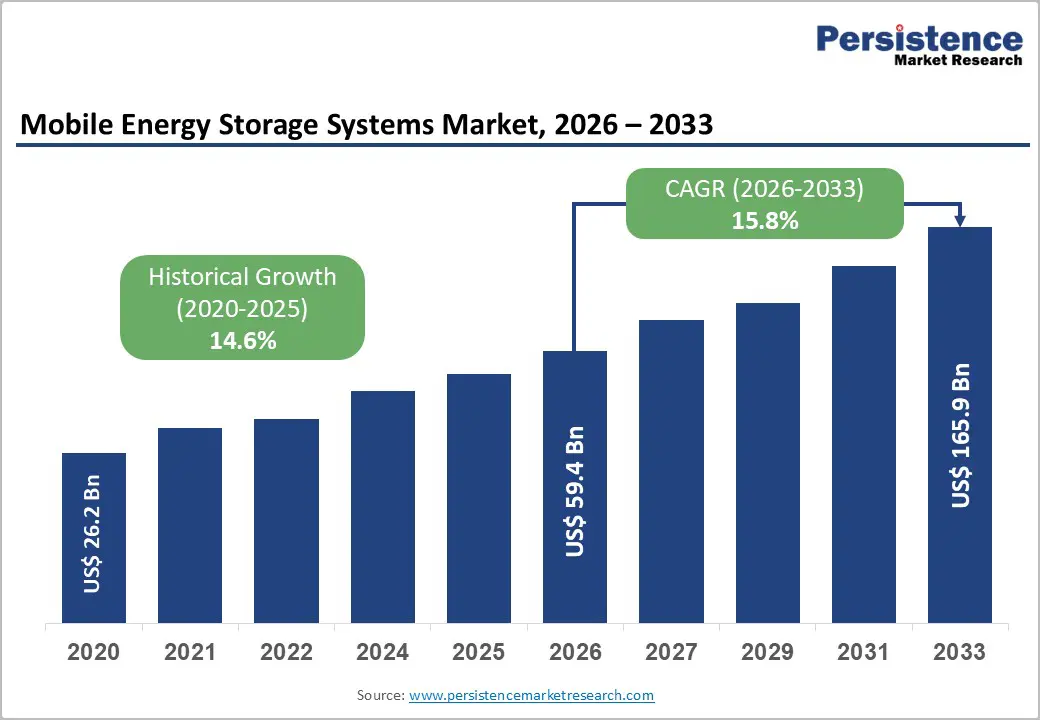
The global mobile energy storage systems market size is likely to be valued at US$ 59.4 Billion in 2026 and is expected to reach US$ 165.9 Billion by 2033, growing at a CAGR of 15.8% during the forecast period from 2026 to 2033. The market's exceptional growth is propelled by a confluence of accelerating renewable energy integration, rapid battery cost declines, and escalating grid instability demanding flexible, deployable power solutions.
Key Market Highlights
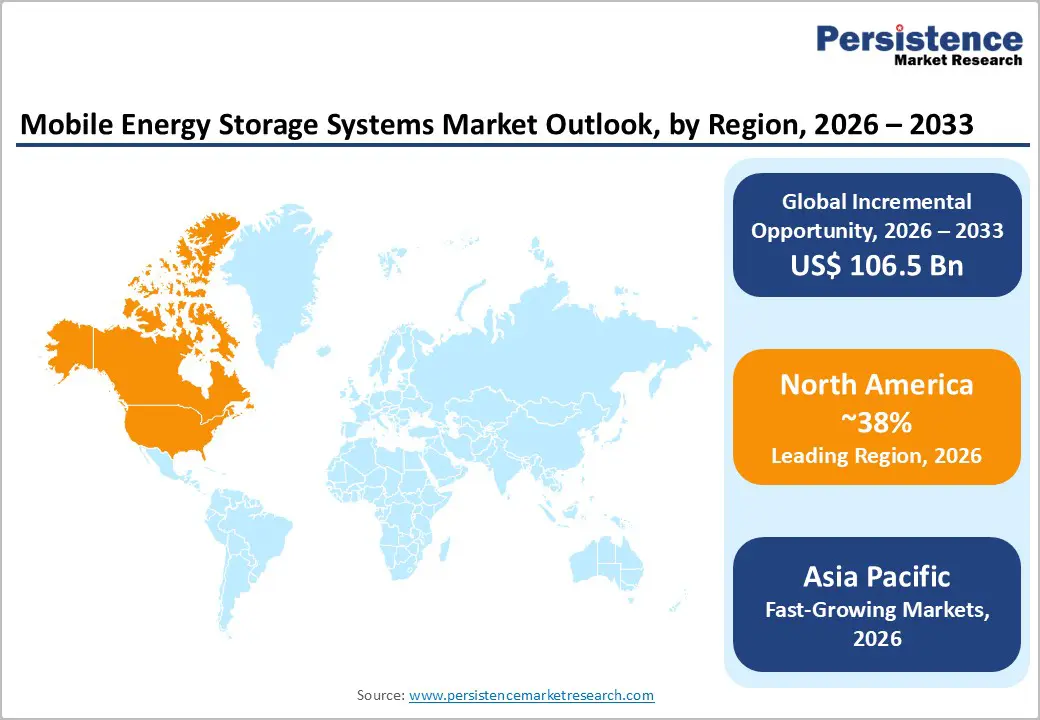
- Leading Region: North America leads the global Mobile Energy Storage Systems Market holding 38%, powered by the U.S. Inflation Reduction Act's up to 70% Investment Tax Credit for standalone BESS, data center expansion, and strong utility-scale grid modernization investment driving sustained demand.
- Fastest-Growing Region: Asia Pacific is the fastest-growing regional market, with China achieving 21% year-on-year growth in cumulative energy storage installations and India scaling production capacity rapidly under its Production Linked Incentive (PLI) scheme for advanced battery manufacturing.
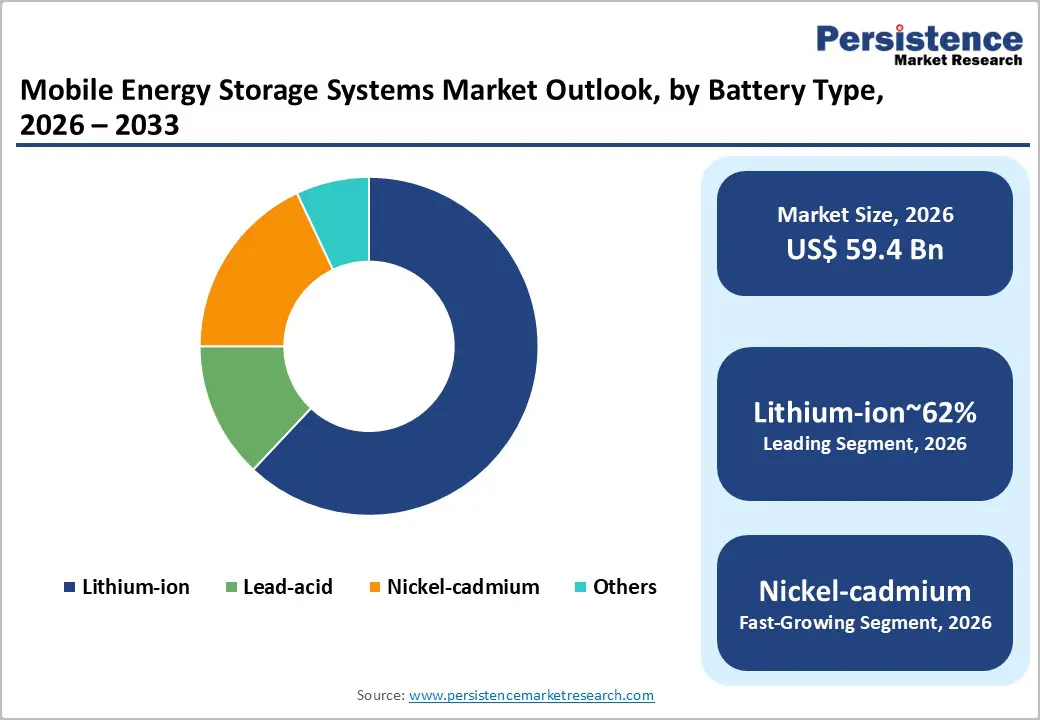
- Leading Segment: Lithium-ion is the dominant battery type segment with approximately 62% market share, propelled by a 20% price drop in 2024 to US$ 115/kWh, accelerating mass adoption across commercial, industrial, and off-grid mobile energy storage configurations worldwide.
- Fastest-Growing Segment: The Electric and Hybrid on-grid mobile energy storage configuration is the fastest-growing system segment, driven by utility mandates, California Resource Adequacy rules, and the EU Green Deal's progressive phase-out of diesel generator use at urban construction and industrial sites.
- Key Opportunity: The electrification of remote industrial and mining sites, combined with EaaS rental models, represents the most significant market opportunity, with Aggreko's US$ 200 million fleet investment in 2024 signaling the commercial scale and profitability of this emerging high-growth vertical.
| Key Insights | Details |
|---|---|
| Mobile Energy Storage Systems Market Size (2026E) | US$ 59.4 Billion |
| Market Value Forecast (2033F) | US$ 165.9 Billion |
| Projected Growth CAGR (2026 - 2033) | 15.8% |
| Historical Market Growth (2020 - 2025) | 14.6% |
Market Dynamics
Drivers - Record-Breaking Battery Storage Deployment and Falling Costs Unlocking Mass Adoption
The rapid global expansion of battery energy storage systems is the most significant structural driver of the Mobile Energy Storage Systems Market. According to the International Energy Agency (IEA), utility-scale battery storage additions reached 63 GW in 2024, setting a new record and increasing total installed capacity to 124 GW, nearly 12 times higher than in 2020.
At the same time, BloombergNEF reported that lithium-ion battery pack prices declined by 20% in 2024, reaching a historic low of US$115 per kWh, marking the steepest drop since 2017. Battery energy storage system prices alone fell by 19% to US$125 per kWh. These consistent cost reductions are making mobile energy storage solutions more affordable and practical for a wide range of applications, including construction sites, disaster recovery operations, and remote industrial projects, significantly expanding the overall market potential.
Policy-Driven Investment Momentum: U.S. Inflation Reduction Act and Global Clean Energy Commitments
Government policies continue to play a crucial role in accelerating the Mobile Energy Storage Systems Market. The U.S. Inflation Reduction Act (IRA) of 2022 introduced strong financial incentives by offering a base Investment Tax Credit (ITC) of 30% for standalone battery storage systems, which can rise to 70% with additional benefits such as domestic content incentives and community-based bonuses.
The U.S. Environmental Protection Agency (EPA) and Department of Energy (DOE) have also set ambitious goals to expand global energy storage capacity sixfold to 1,500 GW by 2030. These initiatives are encouraging large-scale investments in mobile and flexible battery storage solutions across utilities, construction firms, and emergency response sectors. Similar supportive policies in Europe, India, and Australia are further strengthening investor confidence, ensuring sustained long-term demand growth across major global markets.
Restraints - High Upfront Capital Costs and Limited Financing Accessibility for Small Operators
Despite declining battery prices, the high initial investment required for mobile energy storage systems remains a major challenge, especially for small and medium-sized businesses. Systems in the 3,000-10,000 KWh capacity range still involve significant upfront costs, making them less accessible without strong financial support. In many emerging economies, access to affordable financing is limited, further restricting adoption.
The IEA’s Electricity 2026 report highlights that financing challenges, combined with lengthy project approval timelines and uncertain revenue streams, continue to delay investments. For businesses operating in developing regions, where mobile energy solutions are often most needed for reliable power, the return on investment may not be attractive without subsidies or policy support. As a result, market penetration remains constrained in high-potential regions such as sub-Saharan Africa and parts of Southeast Asia.
Supply Chain Concentration and Critical Mineral Dependency
The mobile energy storage systems market faces significant risks due to its heavy reliance on concentrated supply chains and critical raw materials. According to the IEA, a large portion of global battery manufacturing is concentrated in China, creating potential supply security concerns. China also benefits from the lowest battery pack prices at around US$94 per kWh, while prices in the U.S. and Europe are significantly higher by 31% and 48%, respectively.
This imbalance highlights global manufacturing dependency and cost disparities. Additionally, the industry depends heavily on key minerals such as lithium, cobalt, and nickel, which are subject to price volatility and geopolitical risks. Fluctuations in the availability or cost of these materials can directly impact production costs, profit margins, and overall pricing of mobile energy storage systems, creating uncertainty for manufacturers and investors.
Opportunities - Electrification of Remote and Off-Grid Industrial Sites, Mining, Construction, and Telecoms
The electrification of remote and off-grid industrial locations presents a major growth opportunity for mobile energy storage systems. Industries such as mining, construction, and telecom operations in regions like Western Australia, sub-Saharan Africa, and the Canadian Arctic are increasingly shifting from diesel generators to hybrid energy solutions that combine solar power with mobile battery storage. This transition helps reduce fuel costs while supporting environmental sustainability goals.
Aggreko invested around US$200 million in mobile battery systems in 2024 and deployed projects such as a 4.4 MW solar and 2 MW battery system for a mining operation in Australia. Additionally, the IEA estimates that over 600 million people in sub-Saharan Africa still lack access to electricity, creating a strong demand for portable and rapidly deployable energy solutions capable of supporting microgrid development and rural electrification initiatives.
Data Center Backup Power and Critical Infrastructure Resilience as an Emerging High-Value End Use
The rapid growth of AI-driven data centers is creating a new and high-value application area for mobile energy storage systems. Companies like LG Energy Solution have highlighted that energy storage demand in North America is increasingly driven by investments in data center infrastructure, supported by clean energy incentives under the U.S. IRA. Data centers require highly reliable and uninterrupted power supply, making mobile battery systems an ideal solution for backup and emergency power needs.
These systems can be quickly deployed during grid outages, ensuring operational continuity. In addition, major cities such as London, New York, and Tokyo are implementing strict regulations that require zero-emission and low-noise power sources for urban construction, especially during nighttime operations. This is further driving the adoption of mobile energy storage systems as an effective alternative to diesel generators.
Category-wise Analysis
By Capacity Insights
The 3,000-10,000 KWh capacity segment leads the Mobile Energy Storage Systems Market, accounting for approximately 42% of total market share. This segment offers an ideal balance between energy capacity, cost efficiency, and ease of transportation, making it suitable for a wide range of applications. These systems are commonly used for temporary grid support, renewable energy integration, and industrial power requirements.
Companies like Aggreko are actively launching products within this range, including mid-sized battery systems designed for flexible deployment. The IEA also notes that storage systems with durations of two hours or more, closely aligned with this capacity range, are experiencing the fastest cost reductions globally. This trend enhances their commercial attractiveness and supports continued adoption across industries. As a result, this segment is expected to maintain strong growth due to its versatility and cost-performance advantages.
By Classification Insights
Towable systems dominate the Mobile Energy Storage Systems Market, holding around 65% of the total share due to their high flexibility and ease of use. These systems can be easily transported using standard vehicles and deployed quickly without requiring complex installation or heavy equipment. Their plug-and-play functionality allows users to move them between sites as needed, making them highly suitable for construction projects, events, emergency services, and temporary industrial operations.
Companies such as Aggreko offer advanced towable battery systems equipped with integrated components such as inverters, cooling systems, and safety features, enabling quick setup and efficient performance. The ability to fully charge these systems within a few hours further enhances their operational efficiency. Their adaptability across both grid-connected and off-grid environments continues to drive strong demand globally.
By Battery Type Insights
Lithium-ion batteries dominate the Mobile Energy Storage Systems Market, accounting for approximately 62% of the total share. This strong position is driven by their high energy density, long operational life, improving safety features, and continuous cost reductions compared to traditional battery technologies. According to the IEA, global lithium-ion battery deployment in 2025 was six times higher than in 2020, reflecting rapid growth in production and adoption.
Battery energy storage systems alone represent a significant portion of this demand. BloombergNEF also reported a 19% drop in battery storage system prices in 2024, further strengthening adoption. Within this category, lithium iron phosphate (LFP) batteries are gaining popularity due to their enhanced safety, longer lifespan, and cost advantages. These benefits make lithium-ion batteries the preferred choice for mobile energy storage applications across commercial and industrial sectors.
By System Insights
On-grid systems lead the Mobile Energy Storage Systems Market, accounting for approximately 58% of the total market share. These systems are primarily used to support grid operations by providing services such as frequency regulation, peak load management, voltage control, and renewable energy balancing. The IEA reports that global battery storage capacity reached 124 GW by the end of 2024, with most installations connected to the grid, highlighting the dominance of this segment.
In the United States, policies such as California’s Resource Adequacy requirements encourage the deployment of battery systems capable of delivering power for extended durations, further supporting market growth. Additionally, commercial and industrial users are increasingly adopting on-grid mobile storage solutions to manage energy costs and improve efficiency. This expanding range of applications continues to strengthen the segment’s leading position.
By End-user Insights
The industrial sector is the largest end-user of mobile energy storage systems, contributing approximately 45% of total market revenue. Industries such as mining, oil and gas, construction, manufacturing, and telecommunications require reliable and high-capacity power solutions, especially in remote locations where grid access is limited. The IEA highlights industrial off-grid applications as a key driver of demand, particularly in regions like Africa, Australia, and Latin America.
Companies like Aggreko have made significant investments, including a US$200 million commitment in 2024, to expand their mobile battery fleets targeting industrial users. As environmental regulations become stricter and fuel costs continue to rise, industries are increasingly shifting away from diesel generators. Hybrid systems combining solar energy with battery storage are gaining traction, offering fuel savings of up to 30-50% while reducing emissions and improving operational efficiency.
Regional Insights
North America Mobile Energy Storage Systems Trends
North America leads the Mobile Energy Storage Systems Market, with the United States playing a central role in driving growth. The Inflation Reduction Act (IRA) has significantly boosted investment by offering tax credits of up to 70% for qualifying energy storage projects. This has encouraged widespread adoption across utility, commercial, and industrial sectors.
Companies like LG Energy Solution have indicated that energy storage will account for a large share of battery demand in the region, particularly driven by data center expansion and clean energy initiatives. Additionally, Aggreko has expanded its mobile battery offerings in North America, introducing new mid-sized systems to meet growing demand for sustainable temporary power solutions. Strict environmental regulations, especially in states like California, are pushing industries to replace diesel generators with cleaner battery systems, creating strong long-term growth opportunities.
Europe Mobile Energy Storage Systems Trends
Europe represents the second-largest market and is rapidly expanding due to strong regulatory support and sustainability goals. Initiatives such as the European Green Deal and REPowerEU are driving investments in energy storage technologies across the region. Updated regulations, including stricter emission standards for non-road mobile machinery, are encouraging the adoption of zero-emission mobile power solutions.
According to Solar Power Europe, battery storage installations reached 29.7 GWh in 2025, reflecting strong growth momentum. Key markets such as Germany, the United Kingdom, France, and Spain are leading adoption due to national decarbonization targets. Urban policies in cities like London are also promoting the use of battery systems for clean construction activities. These regulatory and market factors are collectively accelerating the deployment of mobile energy storage solutions across Europe.
Asia Pacific Mobile Energy Storage Systems Trends
Asia Pacific is both the largest and fastest-growing market for mobile energy storage systems, led by China’s strong manufacturing and deployment capabilities. The China Energy Storage Alliance reported that installed energy storage capacity in China reached over 111 GW by 2024, showing rapid year-on-year growth. China’s low battery production costs make it a key supplier to global markets.
India is emerging as a high-growth market, driven by ambitious renewable energy targets and government incentives such as the Production Linked Incentive (PLI) scheme. Local manufacturers are expanding capacity to meet rising demand. Countries across Southeast Asia are also adopting mobile energy storage solutions to support rural electrification and industrial growth. With increasing investments and strong policy support, the region is expected to remain a major driver of global market expansion.
Competitive Landscape
The Mobile Energy Storage Systems Market is moderately fragmented, with several key players competing based on technology, product flexibility, and service offerings. Leading companies such as Aggreko, Delta Electronics, LG Energy Solution, Panasonic, and CALB focus on developing scalable and modular systems integrated with advanced energy management software. Companies are increasingly investing in expanding their mobile battery fleets and entering new geographic markets to strengthen their presence.
New business models such as Energy-as-a-Service (EaaS) and rental-based solutions are gaining popularity, allowing customers to access mobile energy storage without high upfront costs. These flexible models are helping companies generate recurring revenue while making advanced energy solutions more accessible to a wider customer base.
Key Market Developments
- In August 2024: Aggreko introduced two mid-size battery energy storage systems (500 kW/250 kWh and 250 kW/575 kWh) in North America under its Greener Upgrades program, supporting cleaner temporary power solutions while advancing its US$200 million global mobile BESS fleet expansion strategy.
- In January 2024: LG Energy Solution Vertech revealed plans to develop 10 grid-scale battery storage projects totaling 10 GWh capacity in the U.S., utilizing Inflation Reduction Act tax incentives to accelerate large-scale energy storage deployment and strengthen grid reliability.
Companies Covered in Mobile Energy Storage Systems Market
- Power Edison
- Greener Power Solutions
- Quanta Technology
- Renewable Energy Systems Ltd
- Nomad Transportable Power System
- Socomec
- Hamedata Technology
- Delta Electronics
- NEC Corporation
- Aggreko
- Jauch Quartz America, Inc.
- LG Energy Solution
- Panasonic
- CALB
- BYD Company Ltd.
- Samsung SDI Co., Ltd.
- Northvolt AB
- Ampd Energy
- Wärtsilä Energy
- Rolls-Royce Power Systems
Frequently Asked Questions
The global Mobile Energy Storage Systems Market is estimated at US$ 59.4 Billion in 2026 and is projected to reach US$ 165.9 Billion by 2033, expanding at a high-growth CAGR of 15.8% over the 2026-2033 forecast period.
The market is primarily driven by the record-breaking deployment of battery energy storage globally, 63 GW of utility-scale additions in 2024 per the IEA, combined with the U.S. Inflation Reduction Act's up to 70% Investment Tax Credit for standalone BESS and a 20% decline in lithium-ion battery pack prices in 2024, collectively accelerating mobile storage adoption.
Lithium-ion batteries dominate the market with approximately 62% share, owing to superior energy density, declining costs to US$ 125/kWh for BESS applications in 2024, long operational cycle life, and the global scaling of LFP chemistry manufacturing, particularly in China, making lithium-ion the preferred battery technology across all mobile energy storage applications.
North America holds regional market leadership, anchored by strong U.S. policy support through the Inflation Reduction Act, growing data center energy storage demand, and active fleet expansion by key players including Aggreko, which committed US$ 200 million to mobile battery energy storage deployment in 2024.
The electrification of remote industrial and mining sites represents the most compelling growth opportunity, as operators transition from diesel generators to hybrid mobile solar-BESS systems to reduce fuel costs by almost 50% and meet ESG commitments. The Energy-as-a-Service (EaaS) rental model further accelerates adoption by eliminating customers' upfront capital expenditure barriers.
Key companies operating in the global Mobile Energy Storage Systems Market include Aggreko, LG Energy Solution, Delta Electronics, Panasonic, CALB, BYD Company Ltd., Samsung SDI Co., Ltd., Socomec, Renewable Energy Systems Ltd (RES), Northvolt AB, NEC Corporation, and Power Edison, among others, collectively driving innovation in modular, scalable, and plug-and-play mobile energy storage configurations worldwide.


