




- Biotechnology
- Microcarrier Beads Market
Microcarrier Beads Market Size, Share, and Growth Forecast 2026 - 2033
Microcarrier Beads Market by Product Type (Collagen Coated Beads, Cationic Beads), Material (Natural, Synthetic), Target Cell (CHO, HEK, Vero), Application (Biopharmaceutical Production, Regenerative Medicine), and Regional Analysis, 2026 - 2033

Microcarrier Beads Market Size and Trends Analysis
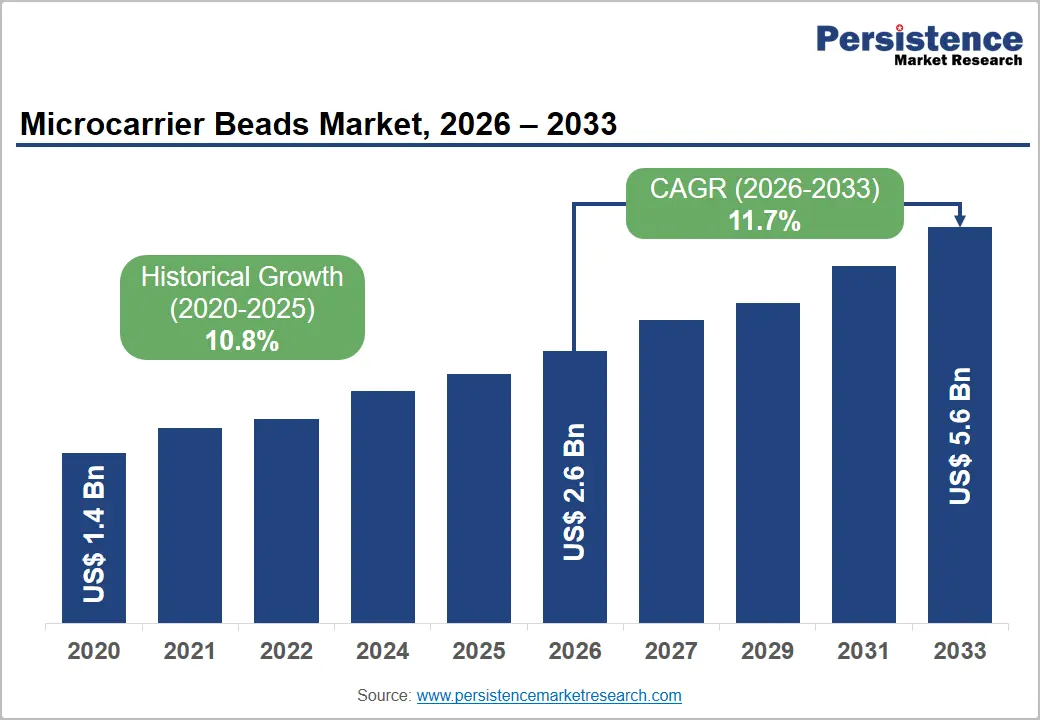
The global microcarrier beads market size is likely to be valued at US$2.6 billion in 2026 and is estimated to reach US$5.6 billion by 2033, growing at a CAGR of 11.7% during the forecast period from 2026 to 2033, driven by increasing commercialization of cell and gene therapies, which require large-scale expansion of adherent cells.
Rising biologics and vaccine production activities are further spurring the adoption of microcarrier-based bioprocessing systems.
Key Industry Highlights
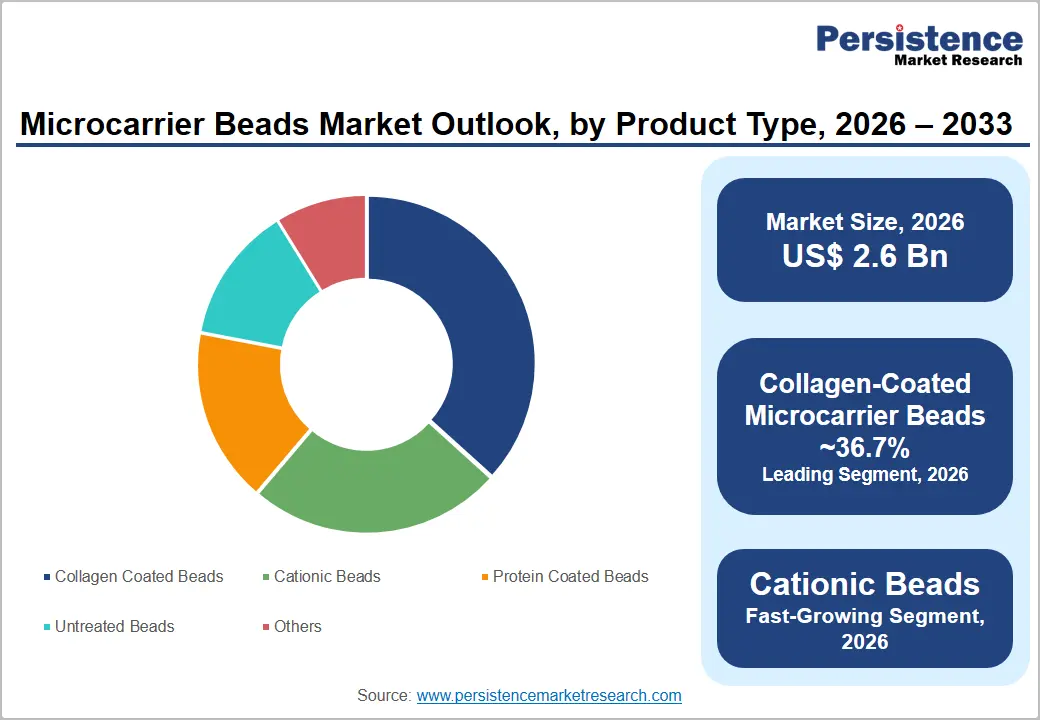
- Leading Product Type: Collagen-coated microcarrier beads, approximately 36.7% share in 2026, as they closely mimic the natural extracellular matrix.
- Dominant Target Cell: Chinese Hamster Ovary (CHO), nearly 35.2% share in 2026, as they provide reliable production of therapeutic proteins with human-like glycosylation patterns.
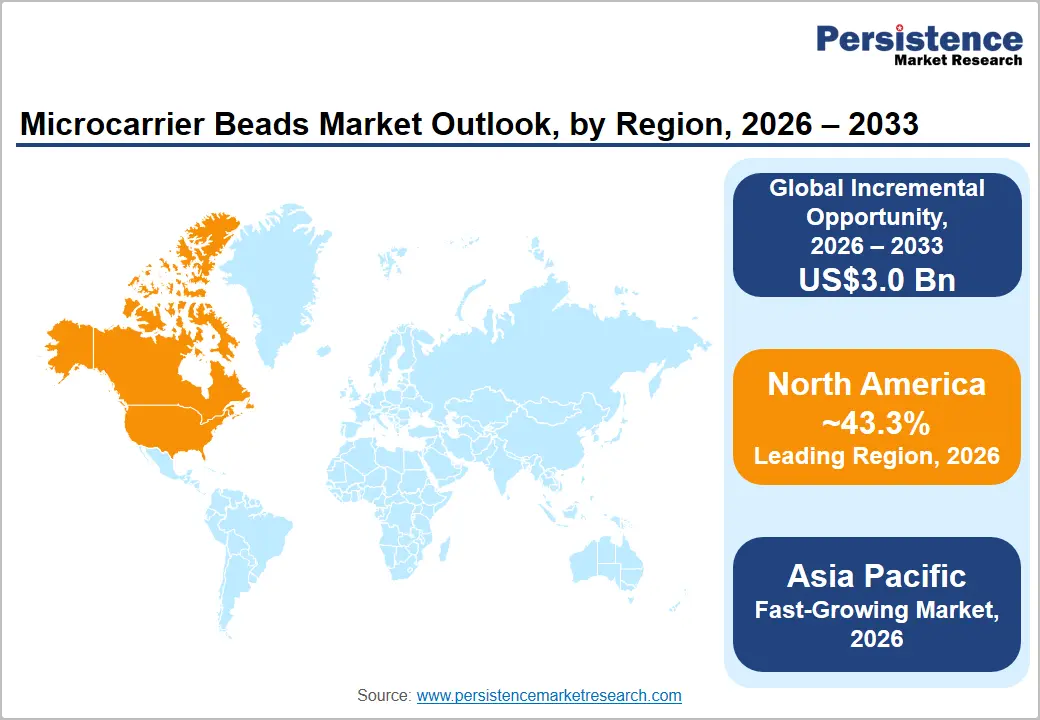
- Leading Region: North America, with about 43.3% share in 2026, backed by rising number of cell therapy developers and advanced bioprocessing facilities.
- Fast-growing Region: Asia Pacific, fueled by increasing investments in regenerative medicine and expanding biopharmaceutical manufacturing capacity.
- New Study: In December 2025, researchers from the University of Puerto Rico published a study introducing Cryogenic Microcarrier-Assisted Stem Cell Storage (Cryo-MASCS). The technology enables Mesenchymal Stem Cells (MSCs) to be cryopreserved on microcarriers. It eliminates several post-thaw processing steps and simplifies large-scale cell therapy manufacturing workflows.
DRO Analysis
Driver - Increasing Cell and Gene Therapy Manufacturing
Chimeric Antigen Receptor T-Cell (CAR-T) therapies and stem cell-based treatments require large numbers of viable and functional cells. Achieving that scale in standard two-dimensional flasks is neither practical nor economical. Microcarriers solve this by providing a high surface area for three-dimensional cell expansion inside stirred-tank bioreactors. According to a peer-reviewed paper published in the Journal of Experimental Medicine (2024), current CAR-T manufacturing protocols typically utilize magnetic beads or polymeric nanomatrices coated with anti-CD3 and anti-CD28 antibodies.
These aim to simultaneously activate and isolate T cells during expansion. This makes microcarrier-type platforms a standard step in the manufacturing chain. As of March 2025, the Food and Drug Administration (FDA) had approved 44 cell therapy products, with a pipeline of over 1,192 genetically modified cell therapies in active development globally. Each requires unique cell expansion infrastructure where microcarriers play a key role.
High Viral Vector and Vaccine Production
A rising number of viral vaccines are transitioning from traditional egg-based manufacturing to cell culture systems. Microcarriers are at the center of this shift. Vero cells, the most widely accepted adherent cell line for human viral vaccine production, are grown on microcarriers in stirred-tank bioreactors to manufacture vaccines against polio, rabies, yellow fever, and COVID-19. A 2025 study published in Frontiers in Bioengineering and Biotechnology (PMC) confirmed that optimizing the adherence of Vero cells to microcarriers in a wave bioreactor successfully increased final cell concentration.
It is important for producing vaccines against polio, rabies, yellow fever, and COVID-19. A peer-reviewed paper in Vaccine (2025) specifically described upstream process development for Sabin Inactivated Polio Vaccine (sIPV) using fixed-bed bioreactor technology incorporating microcarrier-based Vero cell culture. It confirmed that cell culture-based microcarrier systems are now the technical foundation for next-generation vaccine manufacturing.
Restraint - Extraction Difficulties May Hinder Growth
Harvesting cells from conventional and non-biodegradable microcarriers at the end of a culture run is one of the most technically challenging steps in cell-based bioprocessing. The standard approach involves enzymatic treatment using trypsin, Accutase, or collagenase to detach adherent cells from the bead surface. Each of these reagents carries risks. A review published in PMC (2023) confirmed that commercially available microcarriers necessitate additional harvesting steps to extract cells and dissociation reagents, which reduces cell yield and quality.
The problem is worsened in Chimeric Antigen Receptor T-Cell (CAR-T) manufacturing. A 2024 paper published in the Journal of Experimental Medicine noted that magnetic beads used in CAR-T cell activation are prone to engulfment by myeloid cells. A separate debeading step through magnetic separation is required to generate a pure CAR-T cell product prior to reinfusion. This additional separation step adds time, cost, and regulatory complexity to an already demanding manufacturing process.
Opportunity - Biodegradable and Dissolvable Microcarriers
Biodegradable and dissolvable microcarriers address the harvesting challenge by removing the need to separate cells from the bead entirely. When dissolution is triggered by a simple change in pH, temperature, or through the addition of a mild enzyme such as pectinase, the carrier breaks down and cells are released as a single-cell suspension without mechanical disruption. A study published in ScienceDirect (2025) developed xeno-free, fast-dissolving P2 microcarriers for cell therapy applications. It found that dissolvable microcarriers provide a compelling solution by enabling easier and gentler cell harvesting through controlled dissolution, further minimizing mechanical stress, contamination, and preserving cell quality.
It addresses the industry's biggest downstream bottleneck. Independent validation comes from a study published in Tissue Engineering Part C (2022). It reported that a 500-fold multiplication of adipose-derived Mesenchymal Stem Cells (AdMSCs) in a 1L bioreactor system was achieved with a final yield of 1.05 ± 0.11 × 10? cells and a 98.6% recovery rate over 11 days under serum-free conditions. It was done by using dissolvable microcarriers under Good Manufacturing Practice (GMP)-compatible conditions.
Emergence of Magnetic and Stimuli-Responsive Beads
Magnetic microcarriers add a layer of process control that conventional beads cannot deliver. These have the ability to mix cultures using magnetic field-induced agitation instead of mechanical impellers and to separate beads from harvested cells rapidly using an external magnet. According to a U.S. patent (No. 11,667,906) filed by researchers developing next-generation microcarrier technology, magnetic microcarriers enable effective cell growth with customized surface modifications for different cell types. Magnetic field-induced agitation replaces impeller-based mixing, reducing physical damage to cells. The same magnetic properties allow easy separation for harvesting cells or purifying conditioned media.
In CAR-T manufacturing, anti-CD3 and anti-CD28 antibody-coated magnetic beads serve a dual purpose. A 2024 study published in IUBMB Life confirmed that adjusting the CD3/CD28 antibody ratio on magnetic beads affects T cell differentiation and expansion efficiency during adoptive cell transfer therapy. This demonstrates that magnetic bead design is not just a separation tool but an active variable in the quality of the final CAR-T cell product. A peer-reviewed review in PMC (2024) further confirmed that magnetic and electroactive microcarriers have the functions of directional movement, targeted enrichment, and material release control.
Category-wise Analysis
Product Type Insights
Collagen-coated microcarrier beads are predicted to lead with a share of approximately 36.7% in 2026, as collagen is one of the main proteins found in the natural extracellular matrix (ECM) of human tissues. Several anchorage-dependent cells recognize collagen through integrin receptors and attach to it more easily than to synthetic surfaces. This reduces the adaptation time required when cells are transferred into bioreactors and often improves cell viability.
Cationic beads are estimated to be the fastest-growing segment over the forecast period, as these possess a positively charged surface. Most mammalian cell membranes carry a net negative charge. The electrostatic attraction between the two promotes rapid cell attachment without requiring complex surface modifications. Another factor is cost-effectiveness. Compared with biologically coated microcarriers, cationic beads often require fewer expensive biological materials. This makes them attractive for large-scale vaccine and biologics manufacturing where production costs are carefully controlled.
Target Cell Insights
The Chinese Hamster Ovary (CHO) segment is anticipated to dominate with a share of nearly 35.2% in 2026, as they have become the industry's most trusted platform for producing therapeutic proteins and monoclonal antibodies. Their biggest advantage is the ability to perform human-like post-translational modifications, mainly glycosylation. These modifications are essential for the safety and effectiveness of multiple biologic drugs. Regulatory familiarity is another prominent factor. Health authorities have decades of experience evaluating CHO-derived products. Hence, pharmaceutical companies face lower development and regulatory risks when using CHO cells compared with new cell lines.
Mesenchymal Stem Cells (MSCs) are expected to remain in the second position in 2026, as they are among the most versatile cell types in regenerative medicine. They can differentiate into bone, cartilage, muscle, and fat tissues while also releasing bioactive molecules that promote tissue repair. This dual mechanism makes them attractive for a wide range of diseases. Their strongest commercial advantage is immunomodulation. MSCs can regulate excessive immune responses and reduce inflammation. This has created opportunities in autoimmune diseases, graft-versus-host disease (GvHD), inflammatory disorders, and tissue injury treatments.
Regional Insights
North America Microcarrier Beads Market Trends
North America is predicted to dominate in 2026 with a share of approximately 43.3%, as it has the world's most well-established biologics, cell therapy, and vaccine manufacturing hub. The region hosts a large concentration of biopharmaceutical companies, CDMOs, academic research centers, and biotechnology start-ups that require new cell expansion technologies. Since microcarrier beads are widely used for adherent cell culture in bioreactors, demand remains steady across commercial manufacturing and research settings.
U.S. Microcarrier Beads Market Trends
A share of nearly 77.3% is expected to be held by the U.S. in 2026, as it is the global center for biologics development. Most leading pharmaceutical companies conduct extensive biologics and cell therapy manufacturing activities in the country. These products require large-scale cell culture systems where microcarrier beads play an important role. The country's regulatory pathway also supports innovation. The FDA has approved various cellular and gene therapy products, encouraging companies to invest in manufacturing capacity and process development. Every new commercial therapy increases the demand for the latest cell expansion technologies.
Asia Pacific Microcarrier Beads Market Trends
Asia Pacific is anticipated to be the fastest-growing region in 2026 with a share of nearly 34.9%, as governments and private companies are investing heavily in regenerative medicine, biologics production, and advanced manufacturing technologies. The region is now moving from being a consumer of biopharmaceutical products to becoming a key production hub. China, Japan, South Korea, Singapore, and India are extending their cell therapy research capabilities. The number of clinical trials involving stem cells, gene therapies, and regenerative medicine continues to increase across the region. This supports demand for microcarrier beads as these therapies require large-scale cell expansion.
China Microcarrier Beads Market Trends
China will likely lead in Asia Pacific in 2026 with a share of around 45.2%, as it has become one of the world's largest biotechnology investment destinations. The government has prioritized biopharmaceutical development through funding programs, industrial parks, and supportive policies for advanced therapies. Large multinational companies are also increasing their presence in the country. For example, in 2026, AstraZeneca announced plans to establish a cell therapy manufacturing and supply base in Shanghai. The facility is expected to support CAR-T production for China and other markets across Asia. Such investments create additional demand for cell expansion technologies, including microcarrier beads.
Japan Microcarrier Beads Market Trends
In 2026, Japan is projected to account for a share of approximately 28.3%, supported by its leadership in regenerative medicine. The country introduced one of the world's earliest regulatory frameworks specifically designed for regenerative medical products. This has fueled commercialization and encouraged investment in cell-based therapies. Japan achieved another milestone in 2026 when it became the first country to approve therapies derived from induced pluripotent stem cells (iPSCs). These approvals highlight the country's long-term commitment to cell-based innovation and create new opportunities for large-scale cell manufacturing.
Europe Microcarrier Beads Market Trends
Europe will likely see decent growth over the forecast period with a share of nearly 12.8% in 2026, owing to its well-established biologics manufacturing base and research network. Countries across the region have invested heavily in stem cell research, vaccine development, and regenerative medicine over the past decade. The region also benefits from close collaboration between universities, biotechnology firms, and pharmaceutical companies. These partnerships help fuel the transition of laboratory research into commercial manufacturing. As more therapies progress through clinical development, demand for cell expansion technologies increases.
Germany Microcarrier Beads Market Trends
Germany will likely register a substantial share of approximately 39.5% in 2026, owing to its advanced biopharmaceutical manufacturing infrastructure and superior engineering expertise. The country hosts several biotechnology firms, research institutes, and pharmaceutical manufacturers involved in cell therapy and biologics production. Research organizations such as the Fraunhofer Institutes and key universities are actively involved in regenerative medicine and bioprocessing research. Their work supports development in large-scale cell culture technologies, including microcarrier-based manufacturing.
U.K. Microcarrier Beads Market Trends
A share of around 20.2% is predicted to be held by the U.K. in 2026, backed by its dominant position in cell and gene therapy research. The country is home to leading academic institutions, biotechnology companies, and manufacturing centers specializing in advanced therapies. Government-backed initiatives continue to support commercialization. Organizations such as the Cell and Gene Therapy Catapult have played a key role in helping companies move from research to large-scale manufacturing. This has strengthened the country's advanced therapy hub and increased demand for expandable cell culture solutions.
Competitive Landscape
The global microcarrier beads market is moderately consolidated, with a handful of large bioprocessing and life sciences companies controlling a significant share of industry revenue. Companies such as Thermo Fisher Scientific, Merck KGaA, Danaher Corporation (through Cytiva and Pall), Sartorius AG, and Corning Incorporated dominate the market. This is attributed to their extensive product portfolios, established relationships with biopharmaceutical manufacturers, and integrated bioprocessing capabilities.
Manufacturers are also focusing on animal-origin-free, xeno-free, and chemically defined microcarriers to meet the stringent requirements of cell and gene therapy production. Surface engineering technologies that improve cell attachment, harvesting efficiency, and expandability are receiving significant investment. Companies are further developing specialized microcarriers for Mesenchymal Stem Cells (MSCs), Induced Pluripotent Stem Cells (iPSCs), and viral vector production, targeting high-growth therapeutic applications.
Key Industry Developments:
- In January 2026, Kuraray Co., Ltd. announced the U.S. launch of its SCAPOVA CL and SCAPOVA AS PVA microcarriers. The products were developed for regenerative medicine applications and feature animal-origin-free technology to support xeno-free and serum-free cell culture systems. These address the high demand from stem cell and cell therapy manufacturers.
- In November 2025, Kuraray Co., Ltd. introduced SCAPOVA AS in Japan, a new uncoated PVA microcarrier designed for customizable surface modification. The product can be coated with adhesion molecules such as laminin, fibronectin, collagen, and synthetic peptides. It would enable the culture of a broad range of cell types, including induced pluripotent stem cells (iPSCs).
- In May 2025, Merck and imec entered a strategic partnership to develop an advanced MicroPhysiological Systems (MPS) platform. The collaboration combines organoid biology, microfluidics, and next-generation cell culture technologies to improve preclinical drug development models, creating additional opportunities for advanced cell expansion platforms and microcarrier-based culture systems.
Companies Covered in Microcarrier Beads Market
- Danaher Corporation
- Sartorius AG
- Corning Incorporated
- Merck KGaA
- Bio-Rad Laboratories, Inc.
- HiMedia Laboratories Pvt. Ltd.
- Repligen (Tantti)
- Percell Biolytica
- Darling Ingredients
- KURARAY CO., LTD
- Others
Frequently Asked Questions
The global microcarrier beads market is projected to be valued at US$2.6 billion in 2026.
The microcarrier beads market is expected to reach US$5.6 billion by 2033.
Key market trends include rising adoption of cell and gene therapies and increasing use of xeno-free and chemically defined microcarriers.
Collagen-coated microcarrier beads are expected to be the leading product type with a share of nearly 36.7% in 2026, owing to their ability to maintain cell viability and functionality.
The microcarrier beads market is expected to grow at a CAGR of 11.7% from 2026 to 2033.
Danaher Corporation, Sartorius AG, and Corning Incorporated are a few key market players.


