Industrial Metal Detector Market Size, Share, and Growth Forecast 2025 - 2032

Industrial Metal Detection Market by End-use (Food & Beverages, Pharmaceuticals, Chemicals, Mining, Plastic & Rubber, Others), Product Type (Conveyorized Metal Detector, Gravity Feed Metal Detector, Pipeline Metal Detector, Pharma Metal Detector, Others), Capability Type (Ferrous, Non-Ferrous, Non-Magnetic), and Regional Analysis for 2025 - 2032

ID: PMRREP21310
Calendar

October 2025

171 Pages

Author : Rajat Zope

Key Market Highlights

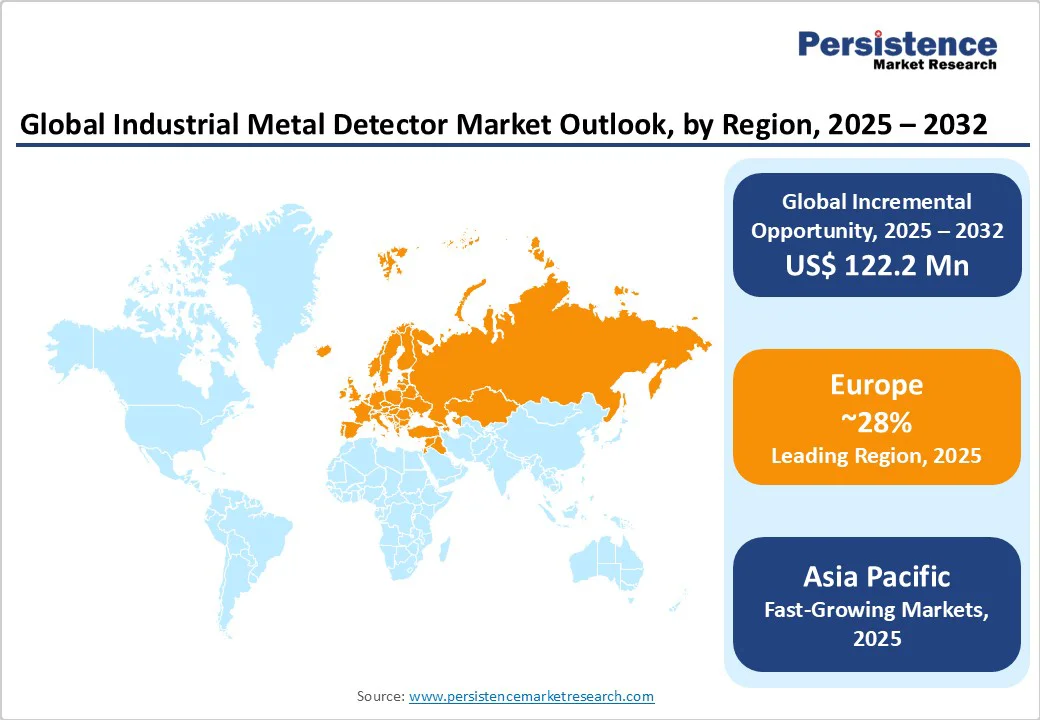
  • Leading Region: Europe is slated to hold around 28% share in 2025, driven by strong regulatory harmonization under the European Union (EU) framework, a mature manufacturing infrastructure, and stringent contamination control standards.
  • Fastest-Growing Regional Market: Asia Pacific is likely to expand at an estimated CAGR of 5.3% through 2032, propelled by rapid industrialization, developing infrastructure, increasing regulatory scrutiny, and rising quality expectations in food, pharmaceutical, and mining sectors across China, Japan, India, and ASEAN countries.
  • Investment Plans: Manufacturers are integrating AI and smart sensor technologies, establishing R&D hubs, and launching digitally adjustable systems with Ethernet and Wi-Fi connectivity, as well as automated product effect learning.
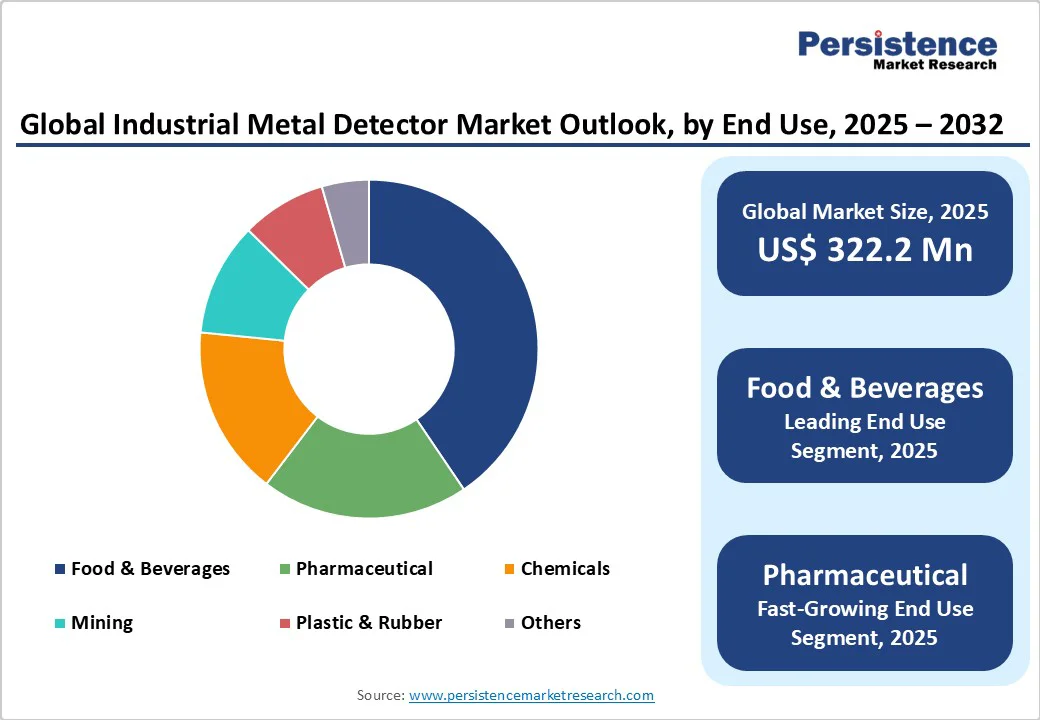
  • Dominant End-Use Segment: The food & beverages segment is expected to capture approximately 66% market revenue share in 2025, driven by contamination prevention needs in vegetables, fruits, dairy, meat, seafood, and processed foods.
  • Leading Product Type: Conveyorized metal detectors, with an approximately 47% share in 2025, are widely preferred for their seamless integration with production lines, automated rejection systems, and multi-spectrum detection capabilities for ferrous, non-ferrous, and stainless steel contaminants.
Key Insights Details
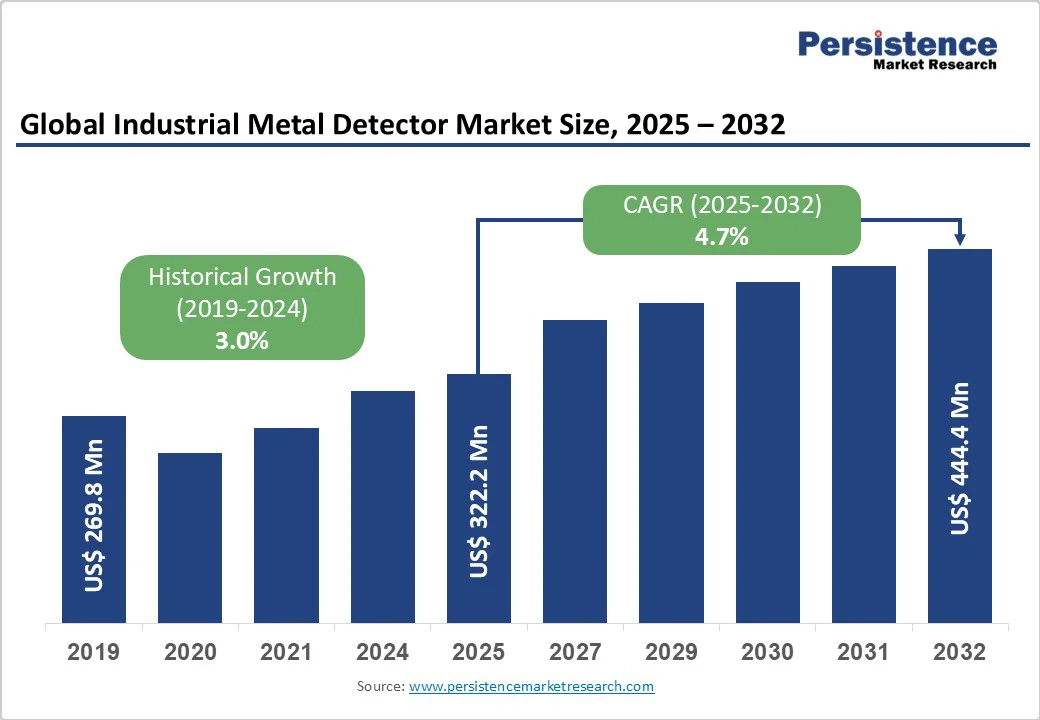
Industrial Metal Detector Market Size (2025E) US$322.2 Mn
Market Value Forecast (2032F) US$ 444.4 Mn
Projected Growth CAGR (2025 - 2032) 4.7%
Historical Market Growth (2019-2024) 3.0%

global-industrial-metal-detector-market-size-2025-2032

Market Factors - Growth, Barriers, and Opportunity Analysis

Stringent Food Safety Regulations and Compliance Mandates

Government regulatory bodies worldwide have intensified enforcement of contamination control standards, creating substantial demand for industrial metal detection systems. The FDA has outlined specific metal detection critical limits to be implemented across the food industry by 2024, emphasizing the importance of critical control points in manufacturing processes.

In Europe, Regulation EC 2023/915 establishes maximum levels for certain contaminants in foodstuffs, while the EU Directive on Food Hygiene 93/43/EEC obligates food producers to establish self-control systems based on HACCP principles.

These regulatory frameworks mandate that metal detectors be positioned at critical control points, particularly before packaging stages, with standards such as BRC requiring equipment capable of identifying metal particles smaller than 1.5 mm in certain food types.

The regulatory pressure extends beyond food to pharmaceuticals, where contamination-led recalls have driven widespread adoption of sensitive detection systems to maintain compliance with quality assurance standards established by the FDA and EMA.

Rising Product Contamination Incidents to Drive Preventive Investments

Rising contamination incidents are driving the adoption of metal detectors across various industries. In 2024, food recalls sickened 1,392 people, with hospitalizations doubling from 230 in 2023 to 487 and deaths rising from 8 to 19. Foreign material, including metal and plastic, caused 12 recalls, highlighting persistent production and packaging risks.

Metal detectors are developed to meet safety standards in food and pharmaceutical manufacturing, as contamination is a leading concern. For example, devices such as Mettler-Toledo's M30 R-Series metal detectors focus on novel contamination detection with digital integration.

On the other hand, Loma Systems' IQ4 series offers highly accurate sensitivity and real-time monitoring. High-profile cases, such as the Boar’s Head deli meat recall (resulting in 61 illnesses and 10 deaths) and the McDonald’s Quarter Pounders incident (leading to 104 illnesses), have further heightened industry vigilance.

High Initial Capital Investment and Maintenance Expenses

Industrial metal detectors come with substantial upfront costs that create adoption barriers, particularly for small and medium-sized enterprises. Basic metal detection units start at approximately US$3,000, while advanced systems from leading manufacturers such as Mettler-Toledo and Thermo Fisher Scientific can exceed US$45,000.

Beyond initial purchase prices, these systems incur annual maintenance expenses ranging from 10% to 15% of the equipment cost, alongside additional expenditures for calibration, validation protocols, and potential production downtime during equipment servicing. Integration with existing production lines adds further financial burden, as manufacturers must modify conveyor systems, install reject mechanisms, and implement supporting infrastructure.

Even larger corporations face budgetary constraints and prolonged capital approval cycles that delay equipment upgrades, while price-sensitive emerging markets experience particularly acute financial barriers that hinder the widespread adoption of technology.

Integration of Artificial Intelligence and Smart Sensor Technologies

The pharmaceutical sector offers significant growth potential, with the metal detector segment projected to achieve the fastest CAGR during the forecast period. AI and smart sensor integration are enhancing detection accuracy and operational efficiency through advanced signal processing, automatic product effect learning, and reduced manual calibration.

For instance, Illinois Tool Works’ IQ4M Metal Detector, launched in April 2025, delivers high-precision contamination detection with minimized false rejects. Another notable development occurred in September 2024, when Eriez partnered with Cardiff University to establish an R&D hub that advances detection technologies.

The adoption of digitally adjustable systems with Ethernet/Wi-Fi connectivity, barcode support, and integrated I/O communication is driving new opportunities as manufacturers seek comprehensive, high-performance contamination control solutions in pharmaceutical production.

Manufacturers’ Focus on Consumer Safety to Foster Growth Avenues

Over the next ten years, the global demand for industrial metal detectors is expected to increase due to heightened consumer awareness of safety. Surging scrutiny of industries such as food processing, pharmaceuticals, and packaging necessitates the development of effective detection systems. To identify pollutants and preserve product integrity, businesses are investing heavily in sophisticated metal detection technologies.

They prioritize their usage to protect customers, improve brand reputation, and ensure regulatory compliance. Modern advances in technology are driving the market for industrial metal detectors by providing high standards of safety and operational efficiency. It is anticipated to, in turn, improve public health and customer confidence.

Category-wise Analysis

End-use Insights

The food & beverages segment is expected to lead the industrial metal detector market in revenue, with a share of around 66% in 2025, driven by the need for contamination prevention in processing operations. Regulatory agencies such as the FDA, USDA, CFIA, and EFSA mandate metal detection at critical control points.

The U.K. food and beverage industry contributed £30 billion in 2021, with 93% consumer trust in food safety, reflecting the effectiveness of detection protocols. High-risk products include vegetables, fruits, dairy, meat, seafood, and processed foods due to mechanical processing with blades, conveyors, and sealing equipment.

The pharmaceutical sub-segment is adopting detection systems for tablets, capsules, liquids, and ampules. At the same time, the chemical industry uses metal detectors in agrochemicals, paints, dyes, and petrochemicals to ensure product purity and protect equipment.

Product Type Insights

Conveyorized metal detectors are poised to lead the market, with an estimated 47% share in 2025, driven by their versatility and seamless integration with production lines. Designed to detect metal contaminants on conveyor belts, these systems employ automated rejection mechanisms, including pushers, air blasts, or belt stops.

CEIA systems combine conveyor integration with multi-spectrum technology, detecting magnetic, non-magnetic, and stainless steel metals while minimizing product effects, achieving precision comparable to hundreds of conventional transits.

Bunting detectors handle ferrous, non-ferrous, stainless, and manganese steel in food processing, plastics, recycling, and bulk handling industries. Flexible installation around or beneath belts, coupled with automatic rejection, ensures effective metal control, preventing equipment damage, recalls, and production downtime.

Capability Type Insights

Ferrous metal detection is likely to hold approximately 45% market share in 2025, driven by the prevalence of iron-based contaminants in industrial production. Ferrous materials’ strong magnetic properties enable reliable detection of iron fragments from worn machinery, processing equipment, and conveyors.

Advanced algorithms target iron and manganese steel, protecting crushers, screens, and conveyor belts in the mining and aggregates industries. For example, Eriez’s MetAlarm system automates detection, improving productivity and safety by reducing manual inspection risks.

Non-ferrous detection covers aluminum, brass, copper, and other non-magnetic metals in food packaging and pharmaceuticals. Detecting non-magnetic stainless steel is technically challenging, requiring multi-spectrum technology to differentiate metals from conductive products while maintaining high detection performance across all contaminant types.
global-industrial-metal-detector-market-outlook-by-end-use-2025-2032

Regional Insights

North America Industrial Metal Detector Market Trends

North America is forecasted to capture around 20% share of the metal detection market in 2025, on account of the strict food safety and pharmaceutical regulations enforced by the FDA and CFIA. Widespread adoption spans food processing, pharmaceuticals, and chemical manufacturing to ensure product quality.

The presence of leading pharmaceutical companies, including Pfizer, Johnson & Johnson, Merck, AbbVie, Bristol Myers Squibb, Eli Lilly, Amgen, Gilead, and Regeneron, accelerates adoption and innovation in contamination detection.

U.S. growth is fueled by supply chain strengthening and regulatory compliance, with systems featuring digital signal processing for high-speed accuracy under HACCP, FSMA, FDA, USDA, and GFSI standards.

Canada’s pharmaceutical sector further supports market expansion through rigorous control of contamination. Innovation in the region, exemplified by Advanced Detection Systems’ ProScan Conveyor, enhances detection accuracy, user interfaces, and reliability in packaged and dry food inspection.

Europe Industrial Metal Detector Market Trends

Europe is expected to account for a dominant 28% of the industrial metal detector market share in 2025, driven by strong regulatory harmonization under the EU framework, which ensures consistent contamination control across member states.

Key regulations include EC 2023/915 on maximum contaminant levels, EC 333/2007 on sampling and analysis methods, and Directive 93/43/EG mandating HACCP-based self-control systems, with metal detectors as critical hazard control points.

Germany, the U.K., and France lead adoption due to mature manufacturing infrastructures and quality assurance systems. The U.K.’s 1,685 food processing plants contributed £ 30?billion in 2021, relying on metal detectors to meet a 93% consumer trust threshold.

Compliance with standards such as DIN ISO 9000, IFS, BRC, and ISO 22000 drives demand for high-precision, hygienic metal detection systems featuring traceability, validation, and washdown-compatible designs.

Asia Pacific Industrial Metal Detector Market Trends

The Asia Pacific is set to emerge as the fastest-growing regional market, driven by rapid industrial expansion, developing infrastructure, and an increased focus on security measures across the manufacturing sector.

The regional metal detector market is expanding at a CAGR of about 5.3% through 2032, driven by growing regulatory scrutiny, strong industrial expansion, and mounting security concerns. China, Japan, India, and ASEAN countries demonstrate particularly dynamic growth trajectories as manufacturers across food, pharmaceutical, and mining industries invest heavily in quality control procedures to guarantee product integrity and safety.

China's senior citizen population, growing by 10 million annually, creates expanding demand for pharmaceutical products requiring stringent contamination control, while rising disposable incomes among the middle class drive increased medical care spending and heightened quality expectations.

India's growing manufacturing sector benefits from government policies established by the Food Safety and Standards Authority of India (FSSAI) that regulate metal detector implementation across food processing operations. Japan contributes through advanced technological capabilities and mature manufacturing standards that emphasize precision detection systems.
global-industrial-metal-detector-market-outlook-by-region-2025-2032

Competitive Landscape

The global industrial metal detector market structure exhibits moderate consolidation with established global players maintaining significant market presence through extensive product portfolios, technological innovation, and comprehensive distribution networks.

Leading manufacturers deploy strategic initiatives including product innovations, partnerships with research institutions, and geographic expansion to strengthen competitive positions. Companies prioritize R&D investments to introduce cutting-edge detection systems incorporating artificial intelligence, multi-spectrum technology, and automated learning capabilities that differentiate their offerings in increasingly competitive markets.

Key differentiators employed by market leaders include superior washdown construction, exclusive auto-learn systems, comprehensive connectivity options, and industry-specific customization capabilities that address unique contamination challenges across food, pharmaceutical, chemical, and mining applications.

Emerging business model trends emphasize integration of metal detectors with complementary inspection technologies, remote monitoring capabilities, and predictive maintenance features that enhance overall equipment effectiveness and reduce total cost of ownership.

Key Market Developments

  • In October 2025, Eriez showcased its latest inspection and magnetic separation technologies at Pack Expo 2025 in Las Vegas, including the PrecisionGuard X8 Metal Detector and SenseGuard X-ray Inspection Systems. The X8 detector offers high sensitivity across ferrous, nonferrous, and stainless-steel contaminants, featuring an intuitive touchscreen and auto-learn capabilities for ease of use. The X-ray systems provide high-resolution imaging and adaptable software to detect a wide range of foreign objects and product flaws, enhancing product safety and brand protection.
  • In July 2025, Mettler-Toledo displayed its latest pharmaceutical manufacturing solutions at the PPMA Total Show 2025. The company presented advanced weighing, inspection, and analytical technologies aimed at enhancing production efficiency and ensuring regulatory compliance. Highlights included equipment designed to improve quality control, streamline processes, and support digital transformation in pharmaceutical manufacturing.
  • In April 2025, Loma Systems introduced the IQ4M Metal Detector in North America, designed to enhance food safety by detecting contaminants while reducing false rejects. The system utilizes patented Variable Frequency and advanced Multi-Spectrum technologies for effective detection across various products including meat, bakery, and snacks. It features Dynamic Data Screen+ (DDS+) for improved signal analysis and Quick Recovery for faster product changeover, minimizing downtime.

Companies Covered in Industrial Metal Detector Market

  • Mettler-Toledo International Inc.
  • Eriez Manufacturing Co. Inc.
  • Illinois Tool Works Inc.
  • Anritsu Corporation
  • Sesotec GmbH
  • Mesutronic Gerätebau GmbH
  • Thermo Fisher Scientific Inc.
  • Fortress Technology Inc.
  • Nikka Densok Limited
  • Cassel Messtechnik GmbH
  • Foremost Machine Builders Inc.
  • Technofour Electronics Pvt. Ltd.
  • Das Electronics
  • CEIA S.p.A.
  • Bunting Magnetics Co.
  • Loma Systems Ltd.
  • Minebea Intec GmbH
Frequently Asked Questions

The global industrial metal detector market size is projected to reach US$ US$ 322.2 million in 2025.

Market growth is primarily driven by stringent regulatory requirements from agencies such as the FDA, USDA, CFIA, and EFSA mandating contamination control, along with rising product recall incidents that increased by 114% in 2022, compelling manufacturers to invest in advanced detection systems to prevent financial losses and reputational damage.

The industrial metal detector market is poised to witness a CAGR of 4.7% from 2025 to 2032.

Key opportunities include integration of AI and smart sensor technologies in pharmaceutical applications and an increasing demand from mining and aggregates industries requiring protection for crushers and conveyor systems.

Leading market players include Mettler-Toledo International Inc., Thermo Fisher Scientific Inc., Eriez Manufacturing Co. Inc., and Illinois Tool Works Inc.

Global Industrial Metal Detector Market Report Scope
Report Attribute Details
Historical Data/Actuals 2019 - 2024
Forecast Period 2025 - 2032
Market Analysis Units Value: US$ Mn, Volume: As Applicable
Geographical Coverage
  • North America
  • Europe
  • East Asia
  • South Asia & Oceania
  • Latin America
  • Middle East and Africa
Segmental Coverage
  • End-use
  • Product Type
  • Capability Type
Competitive Analysis
  • Mettler-Toledo International Inc.
  • Eriez Manufacturing Co. Inc.
  • Illinois Tool Works Inc.
  • Anritsu Corporation
  • Sesotec GmbH
  • Mesutronic Gerätebau GmbH
  • Thermo Fisher Scientific Inc.
  • Fortress Technology Inc.
  • Nikka Densok Limited
  • Cassel Messtechnik GmbH
  • Foremost Machine Builders Inc.
  • Technofour Electronics Pvt. Ltd.
  • Das Electronics
  • CEIA S.p.A.
  • Bunting Magnetics Co.
  • Loma Systems Ltd.
  • Minebea Intec GmbH
Report Highlights
  • Market Forecast and Trends
  • Competitive Intelligence and Share Analysis
  • Growth Factors and Challenges
  • Strategic Growth Initiatives
  • Pricing Analysis
  • Future Opportunities and Revenue Pockets
  • Market Analysis Tools
Market Segmentation

By End-use

  • Food & Beverages
    • Vegetables and Fruits
    • Alcoholic and Non-alcoholic Beverages
    • Dairy, Bakery and Confectionery
    • Processed and Packaged Foods
    • Meat and Seafood
    • Others.
  • Pharmaceutical
    • Tablet/Capsules
    • Liquid/Syrup/Bottles
    • Ampules/Vials
    • Others
  • Chemicals
    • Agrochemicals
    • Paints & Coatings
    • Textile & Dyes
    • Petrochemical
    • Intermediate and Fine Chemicals
    • Others
  • Mining
  • Plastic & Rubber
  • Others

By Product Type

  • Conveyorized Metal Detector
  • Gravity Feed Metal Detector
  • Pipeline Metal Detector
  • Pharma Metal Detector
  • Others

By Capability Type

  • Ferrous
  • Non-Ferrous
  • Non-Magnetic

By Region

  • North America
  • Europe
  • East Asia
  • South Asia & Oceania
  • Latin America
  • Middle East & Africa

Related Reports

  1. Executive Summary
    1. Global Industrial Metal Detector Market Snapshot 2025 and 2032
    2. Market Opportunity Assessment, 2025-2032, US$ Bn
    3. Key Market Trends
    4. Industry Developments and Key Market Events
    5. Demand Side and Supply Side Analysis
    6. PMR Analysis and Recommendations
  2. Market Overview
    1. Market Scope and Definitions
    2. Value Chain Analysis
    3. Macro-Economic Factors
      1. Global GDP Outlook
      2. Global Metal Industry Overview
      3. Global Chemical Industry Overview
      4. Global Pharmaceutical Industry Overview
    4. Forecast Factors - Relevance and Impact
    5. COVID-19 Impact Assessment
    6. PESTLE Analysis
    7. Porter's Five Forces Analysis
    8. Geopolitical Tensions: Market Impact
    9. Regulatory and Technology Landscape
  3. Market Dynamics
    1. Drivers
    2. Restraints
    3. Opportunities
    4. Trends
  4. Price Trend Analysis, 2019 - 2032
    1. Region-wise Price Analysis
    2. Price by Segments
    3. Price Impact Factors
  5. Global Industrial Metal Detector Market Outlook: Historical (2019 - 2024) and Forecast (2025 - 2032)
    1. Key Highlights
    2. Global Industrial Metal Detector Market Outlook: End Use
      1. Introduction/Key Findings
      2. Historical Market Size (US$ Bn) and Volume (Units) Analysis by End Use, 2019-2024
      3. Current Market Size (US$ Bn) and Volume (Units) Forecast, by End Use, 2025-2032
        1. Food & Beverages
          1. Vegetables and Fruits
          2. Alcoholic and Non-alcoholic Beverages
          3. Dairy, Bakery, and Confectionery
          4. Processed and Packaged Foods
          5. Meat and Seafood
          6. Misc. (Grocery Items, etc.)
        2. Pharmaceutical
          1. Tablet/Capsules
          2. Liquid/Syrup/Bottles
          3. Ampules/Vials
          4. Others
        3. Chemicals
          1. Agrochemicals
          2. Paints & Coatings
          3. Textile & Dyes
          4. Petrochemical
          5. Intermediate and Fine Chemicals
          6. Others
        4. Mining
        5. Plastic & Rubber
        6. Others
      4. Market Attractiveness Analysis: End Use
    3. Global Industrial Metal Detector Market Outlook: Product Type
      1. Introduction/Key Findings
      2. Historical Market Size (US$ Bn) and Volume (Units) Analysis by Product Type, 2019-2024
      3. Current Market Size (US$ Bn) and Volume (Units) Forecast, by Product Type, 2025-2032
        1. Conveyorised Metal Detector
        2. Gravity Feed Metal Detector
        3. Pipeline Metal Detector
        4. Pharma Metal Detector
        5. Others
      4. Market Attractiveness Analysis: Product Type
    4. Global Industrial Metal Detector Market Outlook: Capability Type
      1. Introduction/Key Findings
      2. Historical Market Size (US$ Bn) and Volume (Units) Analysis by Capability Type, 2019-2024
      3. Current Market Size (US$ Bn) and Volume (Units) Forecast, by Capability Type, 2025-2032
        1. Ferrous
        2. Non-Ferrous
        3. Non-Magnetic
      4. Market Attractiveness Analysis: Capability Type
  6. Global Industrial Metal Detector Market Outlook: Region
    1. Key Highlights
    2. Historical Market Size (US$ Bn) and Volume (Units) Analysis by Region, 2019-2024
    3. Current Market Size (US$ Bn) and Volume (Units) Forecast, by Region, 2025-2032
      1. North America
      2. Europe
      3. East Asia
      4. South Asia & Oceania
      5. Latin America
      6. Middle East & Africa
    4. Market Attractiveness Analysis: Region
  7. North America Industrial Metal Detector Market Outlook: Historical (2019 - 2024) and Forecast (2025 - 2032)
    1. Key Highlights
    2. Pricing Analysis
    3. North America Market Size (US$ Bn) and Volume (Units) Forecast, by Country, 2025-2032
      1. U.S.
      2. Canada
    4. North America Market Size (US$ Bn) and Volume (Units) Forecast, by End Use, 2025-2032
      1. Food & Beverages
        1. Vegetables and Fruits
        2. Alcoholic and Non-alcoholic Beverages
        3. Dairy, Bakery and Confectionery
        4. Processed and Packaged Foods
        5. Meat and Seafood
        6. Misc. (Grocery Items, etc.)
      2. Pharmaceutical
        1. Tablet/Capsules
        2. Liquid/Syrup/Bottles
        3. Ampules/Vials
        4. Others
      3. Chemicals
        1. Agrochemicals
        2. Paints & Coatings
        3. Textile & Dyes
        4. Petrochemical
        5. Intermediate and Fine Chemicals
        6. Others
      4. Mining
      5. Plastic & Rubber
      6. Others
    5. North America Market Size (US$ Bn) and Volume (Units) Forecast, by Product Type, 2025-2032
      1. Conveyorised Metal Detector
      2. Gravity Feed Metal Detector
      3. Pipeline Metal Detector
      4. Pharma Metal Detector
      5. Others
    6. North America Market Size (US$ Bn) and Volume (Units) Forecast, by Capability Type, 2025-2032
      1. Ferrous
      2. Non-Ferrous
      3. Non-Magnetic
  8. Europe Industrial Metal Detector Market Outlook: Historical (2019 - 2024) and Forecast (2025 - 2032)
    1. Key Highlights
    2. Pricing Analysis
    3. Europe Market Size (US$ Bn) and Volume (Units) Forecast, by Country, 2025-2032
      1. Germany
      2. Italy
      3. France
      4. U.K.
      5. Spain
      6. Russia
      7. Rest of Europe
    4. Europe Market Size (US$ Bn) and Volume (Units) Forecast, by End Use, 2025-2032
      1. Food & Beverages
        1. Vegetables and Fruits
        2. Alcoholic and Non-alcoholic Beverages
        3. Dairy, Bakery and Confectionery
        4. Processed and Packaged Foods
        5. Meat and Seafood
        6. Misc. (Grocery Items, etc.)
      2. Pharmaceutical
        1. Tablet/Capsules
        2. Liquid/Syrup/Bottles
        3. Ampules/Vials
        4. Others
      3. Chemicals
        1. Agrochemicals
        2. Paints & Coatings
        3. Textile & Dyes
        4. Petrochemical
        5. Intermediate and Fine Chemicals
        6. Others
      4. Mining
      5. Plastic & Rubber
      6. Others
    5. Europe Market Size (US$ Bn) and Volume (Units) Forecast, by Product Type, 2025-2032
      1. Conveyorised Metal Detector
      2. Gravity Feed Metal Detector
      3. Pipeline Metal Detector
      4. Pharma Metal Detector
      5. Others
    6. Europe Market Size (US$ Bn) and Volume (Units) Forecast, by Capability Type, 2025-2032
      1. Ferrous
      2. Non-Ferrous
      3. Non-Magnetic
  9. East Asia Industrial Metal Detector Market Outlook: Historical (2019 - 2024) and Forecast (2025 - 2032)
    1. Key Highlights
    2. Pricing Analysis
    3. East Asia Market Size (US$ Bn) and Volume (Units) Forecast, by Country, 2025-2032
      1. China
      2. Japan
      3. South Korea
    4. East Asia Market Size (US$ Bn) and Volume (Units) Forecast, by End Use, 2025-2032
      1. Food & Beverages
        1. Vegetables and Fruits
        2. Alcoholic and Non-alcoholic Beverages
        3. Dairy, Bakery and Confectionery
        4. Processed and Packaged Foods
        5. Meat and Seafood
        6. Misc. (Grocery Items, etc.)
      2. Pharmaceutical
        1. Tablet/Capsules
        2. Liquid/Syrup/Bottles
        3. Ampules/Vials
        4. Others
      3. Chemicals
        1. Agrochemicals
        2. Paints & Coatings
        3. Textile & Dyes
        4. Petrochemical
        5. Intermediate and Fine Chemicals
        6. Others
      4. Mining
      5. Plastic & Rubber
      6. Others
    5. East Asia Market Size (US$ Bn) and Volume (Units) Forecast, by Product Type, 2025-2032
      1. Conveyorised Metal Detector
      2. Gravity Feed Metal Detector
      3. Pipeline Metal Detector
      4. Pharma Metal Detector
      5. Others
    6. East Asia Market Size (US$ Bn) and Volume (Units) Forecast, by Capability Type, 2025-2032
      1. Ferrous
      2. Non-Ferrous
      3. Non-Magnetic
  10. South Asia & Oceania Industrial Metal Detector Market Outlook: Historical (2019 - 2024) and Forecast (2025 - 2032)
    1. Key Highlights
    2. Pricing Analysis
    3. South Asia & Oceania Market Size (US$ Bn) and Volume (Units) Forecast, by Country, 2025-2032
      1. India
      2. Southeast Asia
      3. ANZ
      4. Rest of SAO
    4. South Asia & Oceania Market Size (US$ Bn) and Volume (Units) Forecast, by End Use, 2025-2032
      1. Food & Beverages
        1. Vegetables and Fruits
        2. Alcoholic and Non-alcoholic Beverages
        3. Dairy, Bakery and Confectionery
        4. Processed and Packaged Foods
        5. Meat and Seafood
        6. Misc. (Grocery Items, etc.)
      2. Pharmaceutical
        1. Tablet/Capsules
        2. Liquid/Syrup/Bottles
        3. Ampules/Vials
        4. Others
      3. Chemicals
        1. Agrochemicals
        2. Paints & Coatings
        3. Textile & Dyes
        4. Petrochemical
        5. Intermediate and Fine Chemicals
        6. Others
      4. Mining
      5. Plastic & Rubber
      6. Others
    5. South Asia & Oceania Market Size (US$ Bn) and Volume (Units) Forecast, by Product Type, 2025-2032
      1. Conveyorised Metal Detector
      2. Gravity Feed Metal Detector
      3. Pipeline Metal Detector
      4. Pharma Metal Detector
      5. Others
    6. South Asia & Oceania Market Size (US$ Bn) and Volume (Units) Forecast, by Capability Type, 2025-2032
      1. Ferrous
      2. Non-Ferrous
      3. Non-Magnetic
  11. Latin America Industrial Metal Detector Market Outlook: Historical (2019 - 2024) and Forecast (2025 - 2032)
    1. Key Highlights
    2. Pricing Analysis
    3. Latin America Market Size (US$ Bn) and Volume (Units) Forecast, by Country, 2025-2032
      1. Brazil
      2. Mexico
      3. Rest of LATAM
    4. Latin America Market Size (US$ Bn) and Volume (Units) Forecast, by End Use, 2025-2032
      1. Food & Beverages
        1. Vegetables and Fruits
        2. Alcoholic and Non-alcoholic Beverages
        3. Dairy, Bakery and Confectionery
        4. Processed and Packaged Foods
        5. Meat and Seafood
        6. Misc. (Grocery Items, etc.)
      2. Pharmaceutical
        1. Tablet/Capsules
        2. Liquid/Syrup/Bottles
        3. Ampules/Vials
        4. Others
      3. Chemicals
        1. Agrochemicals
        2. Paints & Coatings
        3. Textile & Dyes
        4. Petrochemical
        5. Intermediate and Fine Chemicals
        6. Others
      4. Mining
      5. Plastic & Rubber
      6. Others
    5. Latin America Market Size (US$ Bn) and Volume (Units) Forecast, by Product Type, 2025-2032
      1. Conveyorised Metal Detector
      2. Gravity Feed Metal Detector
      3. Pipeline Metal Detector
      4. Pharma Metal Detector
      5. Others
    6. Latin America Market Size (US$ Bn) and Volume (Units) Forecast, by Capability Type, 2025-2032
      1. Ferrous
      2. Non-Ferrous
      3. Non-Magnetic
  12. Middle East & Africa Industrial Metal Detector Market Outlook: Historical (2019 - 2024) and Forecast (2025 - 2032)
    1. Key Highlights
    2. Pricing Analysis
    3. Middle East & Africa Market Size (US$ Bn) and Volume (Units) Forecast, by Country, 2025-2032
      1. GCC Countries
      2. South Africa
      3. Northern Africa
      4. Rest of MEA
    4. Middle East & Africa Market Size (US$ Bn) and Volume (Units) Forecast, by End Use, 2025-2032
      1. Food & Beverages
        1. Vegetables and Fruits
        2. Alcoholic and Non-alcoholic Beverages
        3. Dairy, Bakery and Confectionery
        4. Processed and Packaged Foods
        5. Meat and Seafood
        6. Misc. (Grocery Items, etc.)
      2. Pharmaceutical
        1. Tablet/Capsules
        2. Liquid/Syrup/Bottles
        3. Ampules/Vials
        4. Others
      3. Chemicals
        1. Agrochemicals
        2. Paints & Coatings
        3. Textile & Dyes
        4. Petrochemical
        5. Intermediate and Fine Chemicals
        6. Others
      4. Mining
      5. Plastic & Rubber
      6. Others
    5. Middle East & Africa Market Size (US$ Bn) and Volume (Units) Forecast, by Product Type, 2025-2032
      1. Conveyorised Metal Detector
      2. Gravity Feed Metal Detector
      3. Pipeline Metal Detector
      4. Pharma Metal Detector
      5. Others
    6. Middle East & Africa Market Size (US$ Bn) and Volume (Units) Forecast, by Capability Type, 2025-2032
      1. Ferrous
      2. Non-Ferrous
      3. Non-Magnetic
  13. Competition Landscape
    1. Market Share Analysis, 2024
    2. Market Structure
      1. Competition Intensity Mapping
      2. Competition Dashboard
    3. Company Profiles
      1. Mettler-Toledo International Inc.
        1. Company Overview
        2. Product Portfolio/Offerings
        3. Key Financials
        4. SWOT Analysis
        5. Company Strategy and Key Developments
      2. Eriez Manufacturing Co. Inc.
      3. Illinois Tool Works Inc.
      4. Anritsu Corporation
      5. Sesotec GmbH
      6. Mesutronic Gerätebau GmbH
      7. Thermo Fisher Scientific Inc.
      8. Fortress Technology Inc.
      9. Nikka Densok Limited
      10. Cassel Messtechnik GmbH
      11. Foremost Machine Builders Inc.
      12. Technofour Electronics Pvt. Ltd.
      13. Das Electronics
      14. ERIEZ MAGNETICS
      15. Foremost Machine Builders Inc.
  14. Appendix
    1. Research Methodology
    2. Research Assumptions
    3. Acronyms and Abbreviations

Research Methodology Framework for Market Research Excellence

At Persistence Market Research, we implement a comprehensive, validated, and multi-dimensional approachto market analysis that delivers actionable insights across complex market landscapes. Our methodology combines the analytical rigor of leading consulting firms with innovative research techniques, ensuring robust market assessments that guide strategic decision-making with confidence.

Core Research Philosophy

Our methodology is built on four foundational pillars:

Research Philosophy Image

At Persistence Market Research, our methodology is designed to transcend conventional market studies by combining analytical rigor, multi-source validation, and future-focused insights.

We integrate advanced research frameworks, robust data collection strategies, cutting-edge analytics, and innovative technologies to deliver a 360-degree view of complex markets.

We integrate advanced research frameworks, robust data collection strategies, cutting-edge analytics, and innovative technologies to deliver a 360-degree view of complex markets.

Each stage spanning from strategic scoping and hypothesis-building to competitive intelligence, quality validation, and actionable recommendations is engineered to provide clients with unmatched clarity, precision, and confidence in decision-making.

By embedding innovation and technology at the core, our approach ensures that insights are not only comprehensive but also predictive, empowering businesses to seize opportunities, mitigate risks, and achieve sustainable growth

Research Philosophy Image

Capturing Key Information and Events

During this phase, key research objectives focus on essential information and data points for assessing the market, including:

Research Philosophy Image

TAM-SAM-SOM Framework Implementation

We employ both top-down and bottom-up approaches to ensure accurate market sizing.

Top-Down Market SizingBottom-Up Market Sizing
Universe Definition: Total global/regional market identificationUnit Economics: Average transaction values, purchase frequencies, customer lifecycle
Segmentation Filters: Geographic, demographic, and behavioral constraintsCustomer Segmentation: Detailed buyer persona development and sizing
Market Share Analysis: Competitive landscape assessment and share allocationPenetration Analysis: Market penetration rates by segment and geography
Growth Rate Application: Historical trends and forward-looking growth assumptionsScaling Methodology: Extrapolation techniques with confidence intervals

Validation & Cross-Verification

  • Triangulation: Comparing top-down and bottom-up results for consistency
  • Sensitivity Analysis: Testing key assumptions and parameter variations
  • Peer Benchmarking: Comparison with analogous markets and industry benchmarks
  • Expert Review: External validation through industry specialist consultation

Research Philosophy Image

Forecasting & Projection Modeling

Our proprietary forecasting models incorporate multiple variables and scenarios.

Forecasting Components

  • Historical Trend Analysis: 10-year historical growth patterns and cyclical variations
  • Driver-Based Modeling: Economic indicators, demographic shifts, technology adoption
  • Scenario Planning: Base case, optimistic, and conservative projections
  • Monte Carlo Simulations: Probability-weighted outcomes and risk assessments

Model Validation

  • Back-Testing: Historical accuracy assessment over 3–5-year periods
  • Cross-Validation: Multiple modeling approaches for result comparison
  • External Benchmarking: Comparison with established market forecasts
  • Continuous Calibration: Quarterly model updates based on new data

Comprehensive Data Collection Strategy

Our secondary research phase establishes a robust knowledge base utilizing diverse, credible sources.

Secondary Data Sourcess

  • Industry Publications & Reports
  • Government & Regulatory Data
  • Financial Intelligence (filings & reports)
  • Academic Research & Digital Intelligence

Quality Assurance Protocol

  • Source credibility assessment and publication date validation
  • Data consistency checks across multiple sources
  • Bias identification and neutralization techniques
  • Information gap tracking for primary research prioritization

Research Philosophy Image

Primary Research Excellence

Our primary research methodology employs best-in-class techniques to capture unique market insights.

Quantitative Research Methods

  • Large-Scale Surveys: Statistically representative samples with 95% confidence intervals
  • Survey Methodology: Multi-channel deployment (online, telephone, in-person)
  • Question Architecture and Response Optimization

Qualitative Research Methods

  • Executive Interviews
  • Focus Groups
  • Expert Consultations

Quality Assurance & Validation Framework

Multi-Stage Validation Process

  • Source Verification and Consistency Testing
  • Outlier Detection and Bias Assessment
  • Peer Review Process and External Validation
  • Sensitivity Analysis and Confidence Intervals

Research Philosophy Image

Methodology Validation & Credibility

Our research methodology has been extensively validated through:

  • Academic Partnerships: Collaborations with top-tier business schools and research institutions
  • Client Success Stories: Documented case studies demonstrating research impact and ROI
  • Continuous Benchmarking: Performance comparison with leading global research firms

This comprehensive methodology framework positions Persistence Market Research at the forefront of market intelligence, combining the analytical sophistication of top-tier consulting firms with innovative research techniques. Our approach ensures that every market assessment delivers precise, actionable, and strategically valuable insights that drive business success in competitive market environments.

Ready to unlock your market potential? Contact our research experts to discuss how our validated methodology can transform your strategic decision-making with data-driven market intelligence.

Copyright © 2026 Persistence Market Research. All Rights Reserved

Connect With Us -