




- Technology
- Mainframe Modernization Services Market
Mainframe Modernization Services Market Size, Share, and Growth Forecast, 2026 - 2033
Mainframe Modernization Services Market by Service Type (Application Modernization Services, Assessment & Consulting Services, Migration Services, Data Modernization Services, Integration & Implementation Services, Managed & Support Services, Others), Deployment (On-Premises, Cloud-based, Hybrid), Industry and Regional Analysis for 2026 - 2033

Mainframe Modernization Services Market Size and Trends
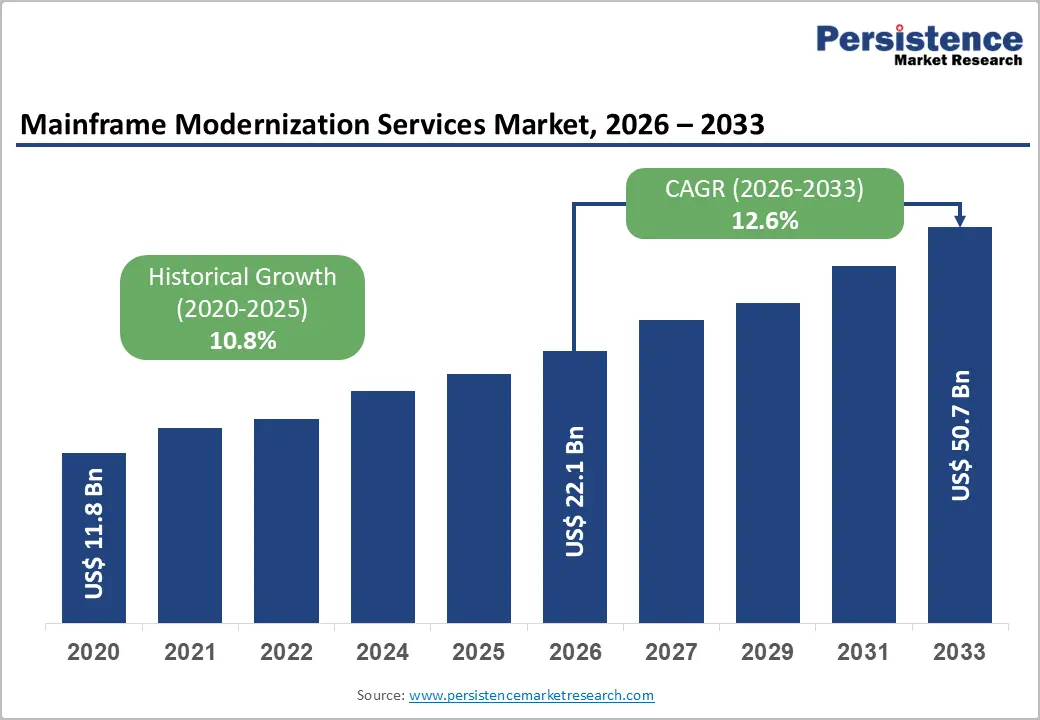
The global mainframe modernization services market size is projected to rise from US$22.1 Bn in 2026 to US$50.7 Bn by 2033. It is anticipated to witness a CAGR of 12.6% during the forecast period from 2026 to 2033.
The accelerating shift of enterprise workloads from legacy mainframe systems to modern architectures, driven by the need for enhanced agility, cost optimization, and digital transformation readiness, underpins this rapid expansion. The growing reliance on automation and AI-enabled modernization tools is enabling organizations to unlock operational efficiencies, reduce technical debt, and improve time-to-market for mission-critical applications.
Key Industry Highlights:
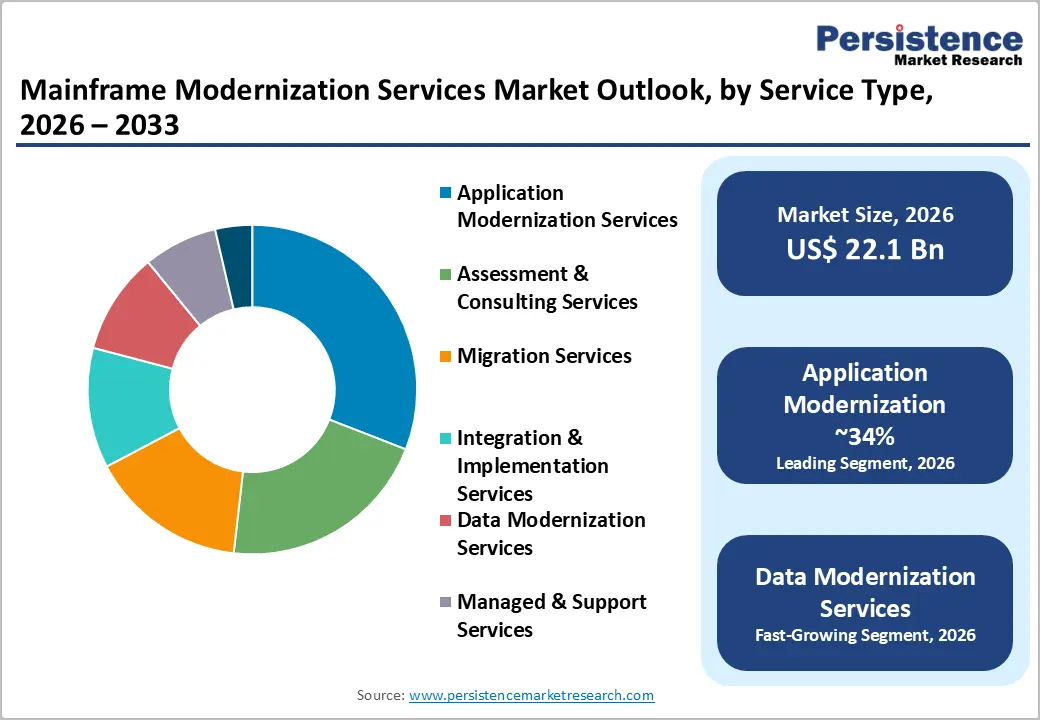
- Leading Service Type: Application modernization dominates with over 34% market share in 2026, valued at more than US$ 7.5 Bn, driven by enterprises updating legacy applications for efficiency, cost reduction, and integration with AI, analytics, and cloud platforms. Data modernization is the fastest-growing service, enabling real-time analytics, AI insights, and regulatory compliance.
- Leading Deployment: On-Premises holds over 30% market share in 2026, valued at more than US$ 6.6 Bn, due to concerns over data security, regulatory compliance, and latency-sensitive operations. Cloud-based deployment is growing rapidly, offering scalability, cost efficiency, and AI-enabled modernization with hybrid and fully cloud-ready environments.
- Leading Industry: BFSI commands the largest market share at over 28% in 2026, valued at more than US$ 6.2 Bn, driven by digital banking, transaction processing, and regulatory compliance needs. IT & Telecom is expanding at a CAGR of 15.7%, fueled by digital transformation, network automation, and cloud-native service delivery.
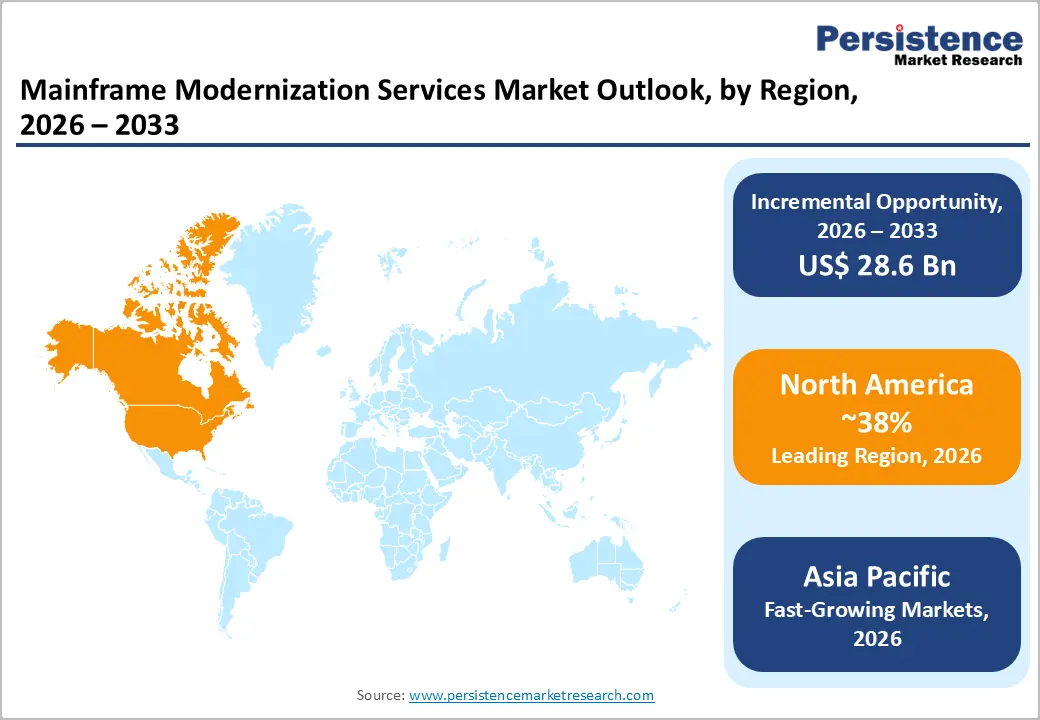
- Leading Region: North America leads with over 38% share in 2026, valued at US$ 8.4 Bn, due to strong investment in modernization by federal agencies, advanced financial institutions, and early adoption of AI-assisted mainframe tools. Asia Pacific is the fastest-growing region with a CAGR of 17.5%, driven by rapid digitalization, IT infrastructure expansion, and growing modernization demand in large enterprises.
| Global Market Attribute | Key Insights |
|---|---|
| Mainframe Modernization Services Market Size (2026E) | US$22.1 Bn |
| Market Value Forecast (2033F) | US$50.7 Bn |
| Projected Growth (CAGR 2026 to 2033) | 12.6% |
| Historical Market Growth (CAGR 2020 to 2025) | 10.8% |

Market Dynamics
Driver
Rising Cost Burden of Legacy Mainframe Maintenance and Cloud Migration Mandates
Enterprises spend large portions of their IT budgets, often exceeding 25-30% of total IT expenditure, on mainframe operations, including hardware upkeep, software licensing, and specialized workforce retention. Regulatory and organizational mandates for cloud adoption and digital transformation are compelling companies to migrate workloads to modern infrastructures. Cloud-based modernization not only reduces capital expenditure but also enhances scalability, agility, and operational efficiency. Providers like IBM, AWS, and Accenture are enabling organizations to adopt hybrid or fully cloud-ready environments, allowing enterprises to reduce technical debt and optimize IT costs while complying with industry-specific regulations.
Rising Adoption of AI, Automation, and DevOps Practices
The integration of AI-powered automation, DevOps practices, and advanced analytics is driving the need to modernize legacy mainframes. Modernized systems enable seamless deployment of AI workloads, predictive analytics, and automated testing pipelines. Enterprises leveraging AI-based modernization report up to 40-50% faster application updates and improved accuracy in business-critical operations. Companies are leveraging AI and automation frameworks to accelerate modernization projects, thereby boosting adoption across sectors such as BFSI, healthcare, and retail.
Restraint
Modernization Risk and Downtime Sensitivity
Mainframe modernization is constrained by the operational risk of mission-critical systems that support banking, payments, claims, and public services. Companies highlight that modernization projects disrupt normal business processes and create compliance and data security risks if execution is poorly managed. That makes buyers cautious and often extends decision cycles, especially in regulated sectors. Even when the business case is strong, enterprises typically choose phased programs rather than broad big bang migrations, which slows revenue recognition for service providers and raises the importance of testing, governance, and implementation discipline.
Talent Scarcity and Integration Complexity
The complexity of integrating older mainframe environments with modern cloud-native stacks, DevOps pipelines, and analytics layers is creating a significant barrier. Legacy systems often present a confusing blend of old and new technologies, making modernization difficult without causing disruption. This complexity increases project costs and creates a dependency on specialized consultants and partner ecosystems. It also limits adoption among mid-sized enterprises that lack internal modernization capabilities, which is why demand often concentrates in large enterprises with deeper budgets and stronger digital transformation mandates.
Opportunity
AI-Powered Code Refactoring and Automated Modernization Platforms
The emergence of generative AI and large language models (LLMs) is creating a transformative opportunity in automated code translation and refactoring. Amazon Web Services (AWS) launched AWS Mainframe Modernization with built-in automated refactoring capabilities, while IBM introduced WatsonX Code Assistant for Z, specifically designed to modernize COBOL applications using AI. An AI-assisted approach reduces code understanding time by up to 30-40%. These innovations lower the barrier to entry for modernization projects, enabling faster timelines and reduced costs. As AI tooling matures, service providers offering AI-augmented modernization frameworks stand to capture significant market share.
Rising Focus on Customer Experience and Digital Services
Modern enterprises are increasingly prioritizing customer-centric digital services, which require flexible and agile IT infrastructures. Legacy mainframes often constrain the deployment of real-time customer applications or personalized services, limiting responsiveness. By modernizing core systems, companies in retail, healthcare, and BFSI can enhance operational agility, launch digital services faster, and improve overall customer satisfaction. Modernization often involves decomposing monolithic mainframe applications into modular, cloud-native components, which enhances scalability, reduces deployment cycles, and supports integration with modern digital platforms. This is driving demand for application modernization and integration services, creating high-margin opportunities for service providers.
Category-wise Analysis
Service Type Analysis
Application modernization services dominate the market, capturing more than 34% market share in 2026 with a value exceeding US$ 7.5 Bn, due to enterprises striving to update legacy applications to improve efficiency, reduce operational costs, and support modern architectures like microservices and containerization. Organizations increasingly require scalable, flexible systems that integrate with emerging technologies such as AI, analytics, and cloud platforms. Modernizing applications also addresses security vulnerabilities in outdated systems while enhancing user experience and business agility.
Data modernization services are expected to grow rapidly as businesses are generating massive volumes of data, and the need to modernize storage, processing, and analytics frameworks is critical. Legacy databases often cannot support real-time analytics, AI-driven insights, or compliance with data governance regulations. Upgrading data infrastructure ensures faster decision-making, better customer insights, and cost optimization in storage and processing.
Deployment Insights
On-Premises holds over 30% market share in 2026, with a value exceeding US$ 6.6 Bn, due to concerns around data security, regulatory compliance, and latency-sensitive operations. Critical systems in sectors like BFSI, government, and healthcare require robust control over infrastructure and seamless integration with existing legacy systems. It allows enterprises to leverage existing investments in hardware and data centers while ensuring continuity of mission-critical operations.
Cloud-based is expected to grow rapidly due to the need for scalability, cost-efficiency, and flexibility. Organizations increasingly prefer cloud platforms to reduce infrastructure costs, support hybrid environments, and enable remote access. Cloud adoption also accelerates modernization projects by offering automated updates, global accessibility, and integration with AI and analytics tools without heavy upfront capital expenditure.
Industry Insights
BFSI commands the largest market share at over 28% in 2026, with a value exceeding US$ 6.2 Bn. The sector relies heavily on mainframes for transaction processing, risk management, and regulatory compliance. The need for modernization is driven by increasing customer expectations for digital services, faster processing, and secure, reliable operations. Modernization helps BFSI firms reduce downtime, improve scalability, and integrate with digital banking platforms.
IT & Telecom is expected to grow at a CAGR of 15.7% due to the rapid digital transformation in service delivery and network operations. It enables telecom and IT firms to handle increasing data traffic, automate operations, and deploy new services quickly. The need also stems from improving system performance, reducing technical debt, and supporting cloud-native and edge computing environments for enhanced customer experience.
Regional Insights
North America Mainframe Modernization Services Market Trends
North America holds over 38% share in 2026, reaching US$ 8.4 Bn value, driven by the United States’ extensive mainframe infrastructure across federal agencies, financial institutions, and large enterprises. The U.S. GAO High-Risk List flags legacy IT as a critical vulnerability, prompting sustained funding through the Technology Modernization Fund and NDAA programs for modernization across DoD, IRS, and SSA systems. Canada contributes through banking sector modernization, with institutions investing in hybrid cloud migration. The region’s innovation hubs in Silicon Valley, New York, and Toronto foster start-ups and service providers offering AI-based code refactoring and DevSecOps integration, reinforcing market leadership.
Asia Pacific Mainframe Modernization Services Market Trends
Asia Pacific is expected to grow at a significant rate with a CAGR of 17.5%, fueled by economic expansion, digitalization, and IT infrastructure development in China, Japan, India, and ASEAN countries. Large enterprises in the BFSI, healthcare, and manufacturing sectors are investing in modernization to enhance system scalability, support e-commerce growth, and meet regulatory requirements. India is emerging as a hub for modernization services due to a strong IT talent pool and the presence of global service providers like TCS, Wipro, and HCLTech. In China and Japan, modernization projects focus on upgrading legacy mainframes for real-time analytics, AI integration, and improved cybersecurity compliance, creating a substantial market opportunity for both local and international service providers.
Europe Mainframe Modernization Services Market Trends
Europe is expected to hold more than 25% share by 2026, led by countries such as Germany, the U.K., France, and Spain. Enterprises face regulatory pressures like the EU’s NIS2 Directive, driving modernization for cybersecurity compliance and operational resilience. Germany and France, in particular, are investing in modernization initiatives to enhance system performance and digital service delivery. The focus on digital transformation and integration of AI and analytics capabilities in legacy systems is accelerating demand. European organizations are adopting API-driven modernization and data modernization services to support real-time processing and regulatory compliance, which reinforces the region’s growth.
Competitive Landscape
The Mainframe Modernization Services market exhibits a moderately consolidated structure, with tier-1 global IT service majors commanding a combined market share exceeding 40%. These leaders leverage proprietary modernization frameworks, AI-powered tools, and deep industry relationships to differentiate. Key strategies include forming hyperscaler alliances, acquiring niche modernization specialists, and building dedicated Centers of Excellence. The market is also seeing more platform-led delivery, AI-assisted code conversion, and outcome-based commercialization, which reduces risk for customers and helps vendors secure longer transformation programs.
Key Developments:
- In June 2025, Kyndryl launched new Mainframe Modernization Services leveraging AWS’s generative AI capabilities to accelerate modernization of legacy mainframe applications and data. The service aims to help enterprises streamline modernization projects, integrate with the cloud, and reduce timelines using AI-driven automation and analysis.
- In May 2025, Amazon Web Services (AWS) updated AWS Transform for Mainframe with new Reimagine capabilities and automated testing functionality, enabling enterprises to accelerate modernization of legacy mainframe applications. These enhancements simplify transforming monolithic workloads into modern architectures while reducing testing effort and project timelines.
Companies Covered in Mainframe Modernization Services Market
- TCS
- Accenture
- Wipro
- Rocket Software
- Micro Focus
- IBM
- Amazon Web Services (AWS)
- Cognizant
- Capgemini
- HCLTech
- DXC Technology
- NTT Data
- Hexaware
- Atos
- Others
Frequently Asked Questions
The global mainframe modernization services market is projected to be valued at US$22.1 Bn in 2026.
The need for enterprises to enhance operational agility, reduce legacy system costs, and integrate digital technologies for improved scalability and efficiency are key driver of the market.
The mainframe modernization services market is expected to witness a CAGR of 12.6% from 2026 to 2033.
Leveraging AI and automation for legacy system modernization and expanding services for hybrid and multi-cloud integration across industries is creating strong growth opportunities.
TCS, Accenture, Wipro, Rocket Software, Micro Focus, IBM, Amazon Web Services (AWS), Cognizant, Capgemini, HCLTech, DXC Technology are among the leading key players.


