




- Electrical Equipment & Services
- Low Voltage Insulator Market
Low Voltage Insulator Market Size, Share, and Growth Forecast, 2026 - 2033
Low Voltage Insulator Market by Product Type (Ceramic Insulators, Glass Insulators, Polymer Insulators, Composite Insulators), Voltage Rating (Up to 1 kV, 1 kV to 3 kV, 3 kV to 6 kV, 6 kV to 10 kV), Application (Overhead Lines, Others), and Regional Analysis for 2026 - 2033

Low Voltage Insulator Market Size and Trends Analysis
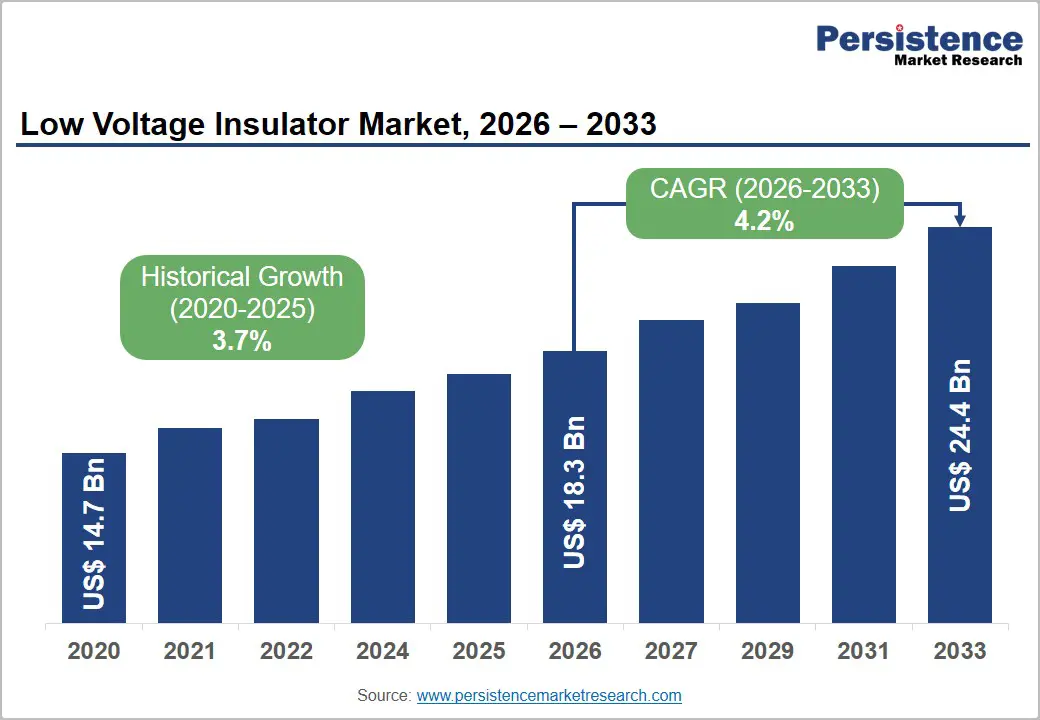
The global low-voltage insulator market size is likely to be valued at US$18.3 billion in 2026 and is estimated to reach US$24.4 billion by 2033, growing at a CAGR of 4.2% during the forecast period 2026 - 2033, driven by the steady modernization of electricity distribution networks, rising urban electricity demand, and the replacement of aging line hardware across low-voltage overhead and distribution infrastructure.
Growth is being reinforced by demographic expansion in urban and peri-urban zones, where new housing, commercial buildings, and public utilities increase demand for distribution boards, service lines, and compact substations. Regulatory pressure to reduce technical losses, improve service reliability, and harden networks against climate stress is accelerating utility spending on insulated and maintenance-efficient distribution components.
Key Industry Highlights:
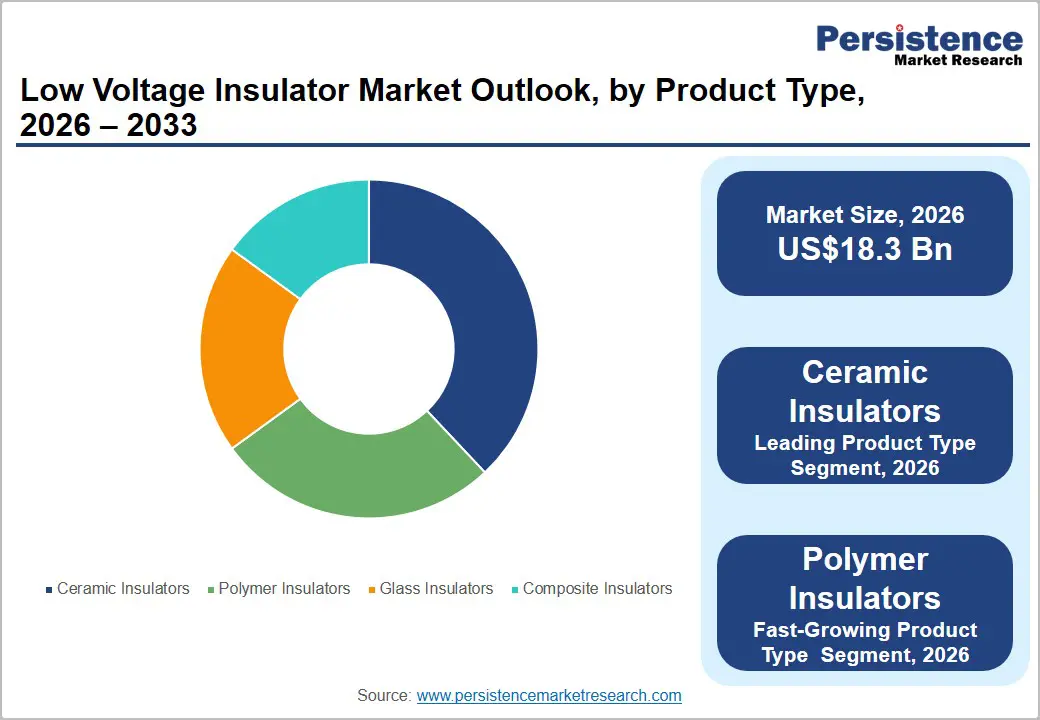
- Leading Product Type: Ceramic insulators are set to hold around 38% revenue share in 2026, driven by installed-base compatibility across utility overhead distribution lines.
- Fastest-Growing Product Type: Polymer insulators are projected as the fastest-growing segment, driven by lower installation costs and stronger contamination resistance.
- Leading Application: Overhead lines are estimated to hold roughly 36% revenue share in 2026, driven by the large installed base of last-mile distribution feeders and service lines.
- Fastest-growing Application: Distribution boards are forecast to record the fastest growth, driven by building electrification and panel modernization in commercial and residential infrastructure.
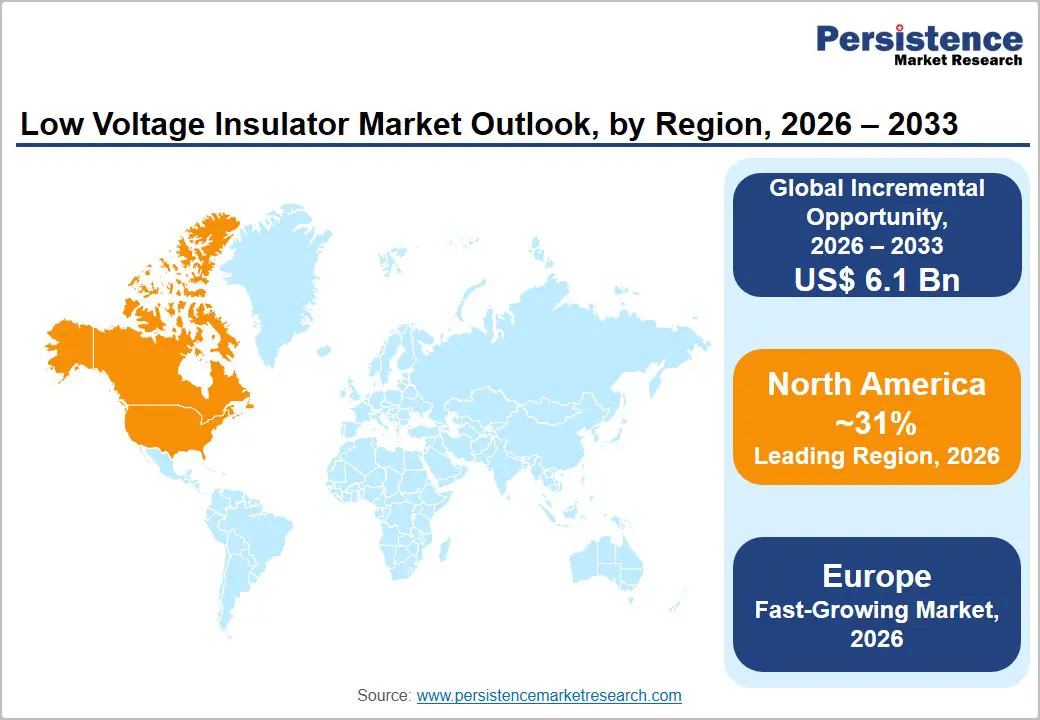
- Regional Leadership: North America is projected to capture roughly 31% of the market share by 2026, driven by distribution hardening, replacement demand, and federally backed grid resilience investment.
- Competitive Environment: The market reflects a moderately fragmented structure, with companies such as Hubbell, NGK Insulators, TE Connectivity, and MacLean Power Systems competing through qualification depth, utility relationships, and portfolio breadth.
- Innovation Trends: Polymer conversion, compact insulation systems for modern distribution boards, and grid-resilience-led utility procurement are shaping long-term product development and investment direction.
DRO Analysis
Driver - Large-Scale Grid Modernization and Electrification Programs
Utilities are upgrading aging distribution networks to reduce technical losses, improve voltage stability, and strengthen service reliability across low-voltage feeders. This process typically includes replacement of conductors, poles, transformers, connectors, and insulation hardware within the same capital cycle, which creates direct demand for low-voltage insulators. Grid modernization also shifts procurement from reactive maintenance toward planned asset renewal, giving suppliers stronger order visibility.
Electrification programs expand the reach and complexity of local power delivery systems, increasing the number of service connections, compact substations, distribution boards, and low-voltage circuits that require insulation support. Rising electricity access, urban construction, and industrial power use place greater stress on downstream networks, which raises the need for reliable insulating components across both new installations and retrofit projects.
Restraint - Raw Material Price Volatility and Supply Chain Fragility
Ceramic insulators depend on refined alumina and feldspar, while polymer insulators rely on silicone rubber and fiberglass composites, all of which are subject to commodity price fluctuations. Supply disruptions in silicone rubber markets, exacerbated by energy cost escalation in chemical production, directly compress manufacturer margins and limit the ability to absorb procurement cost increases without passing them to buyers.
Margin erosion from input cost volatility reduces capital available for capacity expansion and quality certification, constraining the ability of mid-tier manufacturers to scale output in line with rising demand. Utilities operating under fixed-price long-term supply contracts face sourcing pressure when spot material costs exceed contracted insulator pricing, forcing renegotiation or substitution.
Opportunity - Smart Grid Deployment and Advanced Metering Infrastructure Rollout
The global transition to smart grids is creating a generation of insulator demand tied to digital-ready distribution infrastructure. Smart meter installations, remote fault isolation systems, and automated switching devices all require insulated mounting and isolation components compliant with updated voltage and environmental ratings. Policy mandates from the European Commission under the Energy Efficiency Directive 2023 revision are compelling member states to accelerate advanced metering deployment, with each installation creating an incremental insulator demand point.
Manufacturers that develop insulators pre-engineered for smart grid compatibility including resistance to electromagnetic interference and modular mounting designs will capture preferential positioning in utility tenders. The convergence of digital infrastructure investment and physical grid expansion creates a compounding demand environment where insulator procurement is tied to both replacement cycles and new capacity addition, extending addressable market boundaries beyond traditional replacement-only procurement models.
Category-wise Analysis
Product Type Insights
Ceramic insulators are anticipated to secure around 38% of the low voltage insulator market share in 2026, reflecting broad utility acceptance, cost efficiency, and strong mechanical stability across conventional overhead distribution systems. The segment continues to benefit from compatibility with legacy infrastructure and standardized procurement practices across public utilities and industrial power networks. High-volume usage in shackle, spool, and pin-type installations further supports segment leadership across large-scale distribution refurbishment programs.
Polymer insulators are expected to be the fastest-growing segment, propelled by lower weight, easier installation, and stronger contamination resistance across modern distribution environments. Utilities are increasingly adopting polymer formats to reduce transportation losses, improve field handling efficiency, and lower maintenance requirements in dense urban and high-humidity operating conditions. Their favorable lifecycle economics and suitability for compact network configurations are supporting faster penetration across both new installations and replacement projects
Voltage Rating Insights
Up to 1 kV is poised to dominate with a forecast market share of over 41% in 2026, powered by extensive deployment across residential electricity delivery, commercial service lines, low-load industrial circuits, and building-level distribution systems. This voltage band serves the broadest installed base within low-voltage power infrastructure and remains central to service connections, panel boards, and local feeder networks. Continued urban construction and rising electricity access are reinforcing procurement volumes across this rating range.
1 kV to 3 kV is estimated to be the fastest-growing segment, fueled by increasing use in light industrial feeders, utility distribution auxiliaries, and commercial facilities requiring stronger insulation margins than standard residential circuits. Growth is supported by modernization of mixed-load distribution systems and the expansion of compact electrical infrastructure in industrial parks, logistics facilities, and commercial campuses. Rising emphasis on operational reliability and safer load handling is further accelerating adoption within this voltage category.
Application Insights
Overhead lines are likely to be the leading segment with a projected 36% of the low voltage insulator market share in 2026 due to the large installed base of service lines, last-mile distribution feeders, and pole-mounted electricity delivery infrastructure. Overhead systems remain a primary mode of low-voltage power distribution across urban extensions, semi-urban grids, and rural service networks. Ongoing replacement of aging line hardware and utility focus on service continuity continue to sustain strong demand in this segment.
Distribution boards are anticipated to be the fastest-growing segment, fueled by rapid building electrification, commercial construction, and modernization of low-voltage power management systems across residential, institutional, and industrial facilities. Demand is rising as panel systems become more compact, digitally integrated, and thermally demanding, increasing the need for reliable insulation support within enclosed electrical assemblies. Retrofit activity in existing buildings is also contributing to stronger replacement demand for board-level insulating components.
Regional Insights
North America Low Voltage Insulator Market Trends
North America is expected to lead with an estimated 31% of the low voltage insulator market share in 2026, supported by large-scale replacement of aging distribution infrastructure, rising utility spending on grid resilience, and steady investment in feeder hardening across weather-exposed service territories. The region benefits from a mature installed base of overhead and board-level low-voltage equipment, which sustains recurring replacement demand.
U.S. Low Voltage Insulator Market Insights
The U.S. is projected to account for nearly 81% of the North America market share in 2026, driven by high utility capital expenditure on distribution modernization, storm hardening, and local grid reinforcement. Demand is concentrated in overhead line refurbishment, distribution board upgrades, and substation renewal programs serving residential and commercial load centers. Utilities are prioritizing durable low-voltage components that reduce maintenance cycles and improve network uptime.
Canada Low Voltage Insulator Market Insights
Canada is likely to hold around 19% of the North America market share in 2026, supported by ongoing replacement of overhead distribution assets and resilience spending across remote and weather-sensitive utility networks. Snow exposure, temperature cycling, and long service routes increase the need for reliable low-voltage insulation hardware with strong mechanical performance. Utilities are expected to maintain procurement for service-line upgrades, pole-top assemblies, and compact substation equipment as part of local network reliability programs.
Europe Low Voltage Insulator Market Trends
Europe is forecast to be the fastest-growing market for low-voltage insulators, stimulated by rapid electrification planning, aging distribution infrastructure, and regulatory pressure to accelerate local grid upgrades. The modernization of low-voltage feeders, distribution boards, and compact substations serving rising building, transport, and industrial electricity demand.
Germany Low Voltage Insulator Market Insights
Germany is expected to account for about 23% of the Europe market share in 2026, driven by industrial electrification, distributed solar integration, and continued pressure on municipal and regional grids to expand low-voltage capacity. Utilities are upgrading feeder infrastructure, compact substations, and service interfaces to manage rising local connection density and improve operating efficiency.
U.K. Low Voltage Insulator Market Insights
The U.K. is projected to represent nearly 16% of the Europe market share in 2026, supported by investment in distribution automation, service reliability, and local network capacity upgrades. Distribution operators are strengthening low-voltage infrastructure to accommodate electric vehicle charging, heat electrification, and higher commercial power density in urban corridors.
Asia Pacific Low Voltage Insulator Market Trends
Asia Pacific is expected to account for 29% of the global market share in 2026, supported by rapid urban expansion, utility loss-reduction programs, industrial capacity growth, and continued investment in last-mile distribution networks. The region combines large-volume demand from overhead service connections with rising consumption in distribution boards, underground cable interfaces, and compact substations.
China Low Voltage Insulator Market Insights
China is projected to account for roughly 38% of the Asia Pacific market in 2026, reflecting the scale of its power distribution network, ongoing urban grid reinforcement, and heavy fixed-asset investment in electricity infrastructure. State Grid is advancing extensive network construction, equipment upgrades, and supporting infrastructure, which strengthens downstream demand for low-voltage insulators used in service distribution and compact substation applications.
India Low Voltage Insulator Market Insights
India is likely to hold close to 24% of the Asia Pacific market in 2026, driven by feeder strengthening, smart metering rollout, substation augmentation, and broader distribution efficiency programs. Demand is rising across overhead lines, service connections, and low-voltage panel infrastructure as utilities upgrade aging assets and extend reliable supply to mixed urban and semi-urban networks.
Competitive Landscape
The global low-voltage insulator market is moderately fragmented, with a mix of multinational electrical infrastructure suppliers and regionally strong ceramic and polymer insulator manufacturers. Competition is shaped by utility qualification history, product durability, price discipline, and the ability to serve both overhead distribution and low-voltage equipment applications. Key participants include Hubbell Incorporated, NGK Insulators Ltd., TE Connectivity Ltd., MacLean Power Systems, and Hitachi Energy.
Scale matters because low-voltage products are often tender-driven and margin-sensitive, yet utility buyers still value proven field performance and delivery reliability. Large suppliers hold an advantage through broader catalogs, testing capability, and channel reach, while regional specialists remain relevant in price-sensitive ceramic categories and local utility contracts. Competitive positioning increasingly depends on polymer innovation, localized manufacturing, and the ability to bundle accessories, connectors, and installation hardware with insulator products.
Key Industry Developments:
- In March 2026, MacLean Power Systems completed its merger with Power Grid Components, reinforcing product breadth and manufacturing scale across utility infrastructure components.
Companies Covered in Low Voltage Insulator Market
- Hubbell Incorporated
- NGK Insulators Ltd.
- TE Connectivity Ltd.
- MacLean Power Systems
- Hitachi Energy Ltd.
- PFISTERER Holding SE
- Aditya Birla Insulators
- Victor Insulators Inc.
- PPC Insulators
- Winwin Speciality Insulators Ltd.
- LAPP Insulators Holding GmbH
Frequently Asked Questions
The global low-voltage insulator market is projected to reach US$18.3 billion in 2026.
The low-voltage insulator market is driven by distribution grid modernization, the rising electrification of residential and commercial infrastructure, and the replacement of ageing low-voltage overhead and board-level network components.
The low-voltage insulator market is poised to witness a CAGR of 4.2% from 2026 to 2033.
The key market opportunities lie in polymer insulator adoption, expansion of underground and compact distribution infrastructure, and utility investment in smart, resilient low-voltage power networks.
Some of the key market players include Hubbell Incorporated, NGK Insulators Ltd., TE Connectivity Ltd., MacLean Power Systems, and Hitachi Energy.


