




- Smart Packaging
- Live Package Tracking Market
Live Package Tracking Market Size, Share, and Growth Forecast 2026 - 2033
Live Package Tracking Market by Component (Hardware, Software, Services), by Technology (GPS, RFID, Barcode, Sensors, Others), Industry (Retail & E-commerce, Logistics & Transportation, Healthcare, Manufacturing, Automotive, Food & Beverages, Aerospace & Defense, Others), by Regional Analysis, 2026 - 2033

Live Package Tracking Market Size and Trend Analysis
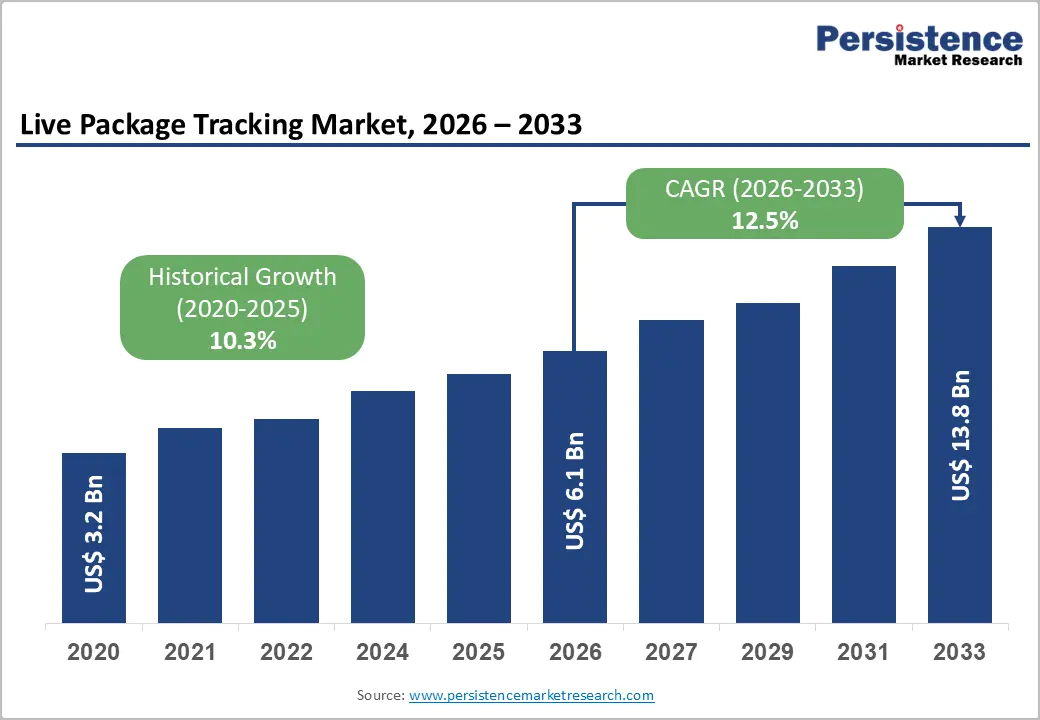
The global live package tracking market size is expected to be valued at US$ 6.1 billion in 2026 and is projected to reach US$13.8 billion by 2033, growing at a CAGR of 12.5% between 2026 and 2033, driven by accelerating e-commerce volumes, rising consumer expectations for real-time visibility, and rapid adoption of IoT-enabled logistics infrastructure across global supply chains.
The expansion reflects a shift in how retailers and logistics operators manage last-mile delivery visibility, moving from periodic status updates to continuous, sensor-driven location intelligence. Regulatory pressure to ensure cold-chain integrity in pharmaceutical and food distribution is adding a compliance-driven demand layer, further accelerating the growth of the live package tracking market.
Key Industry Highlights:
- Leading Component: Software dominates the market with over 42% share in 2026, valued at more than US$ 2.6 Bn, driven by real-time shipment visibility, predictive delivery updates, API-based integration, and end-to-end logistics ecosystem connectivity.
- Leading Technology: GPS leads with over 35% share in 2026, valued at more than US$ 2.1 Bn, due to its high accuracy, global coverage, and widespread use in fleet and shipment tracking systems.
- Fastest Growing Technology: Sensors are the fastest-growing technology segment, driven by rising demand for condition monitoring, such as temperature, humidity, and shock detection in sensitive logistics.
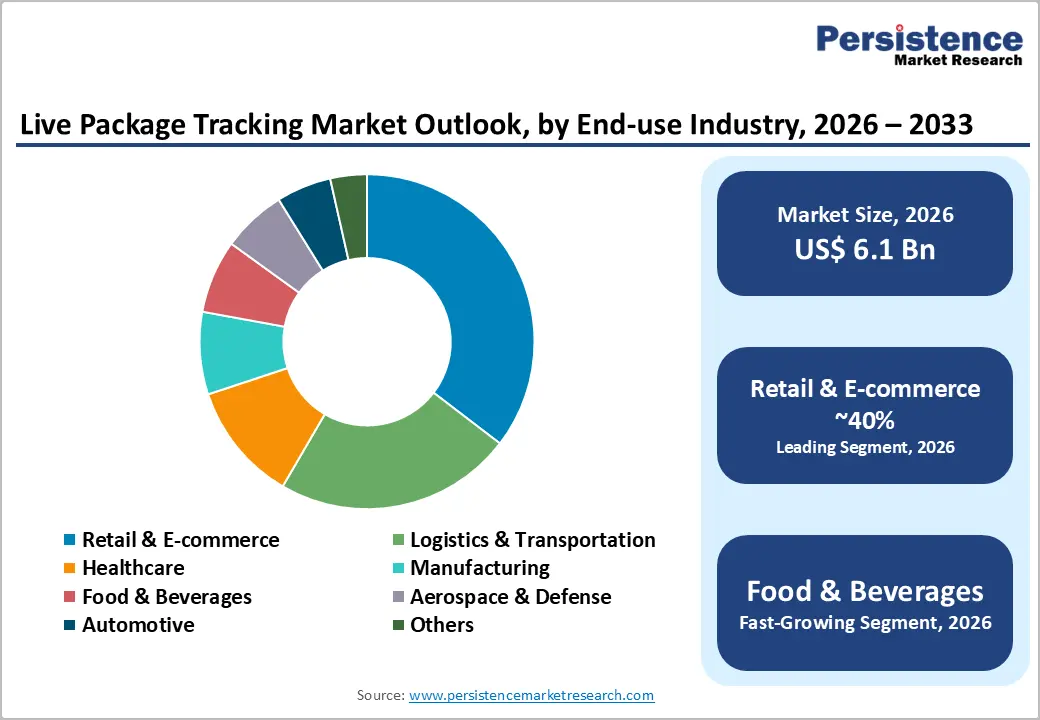
- Leading Industry: Retail & E-commerce dominates with over 40% share in 2026, valued at more than US$ 2.4 Bn, supported by high shipment volumes and strong consumer demand for real-time delivery visibility and transparent order tracking.
- Fastest-Growing Industry: Food & Beverages are the fastest-growing, driven by cold-chain expansion, freshness requirements, and rapid growth in online grocery and food delivery platforms.
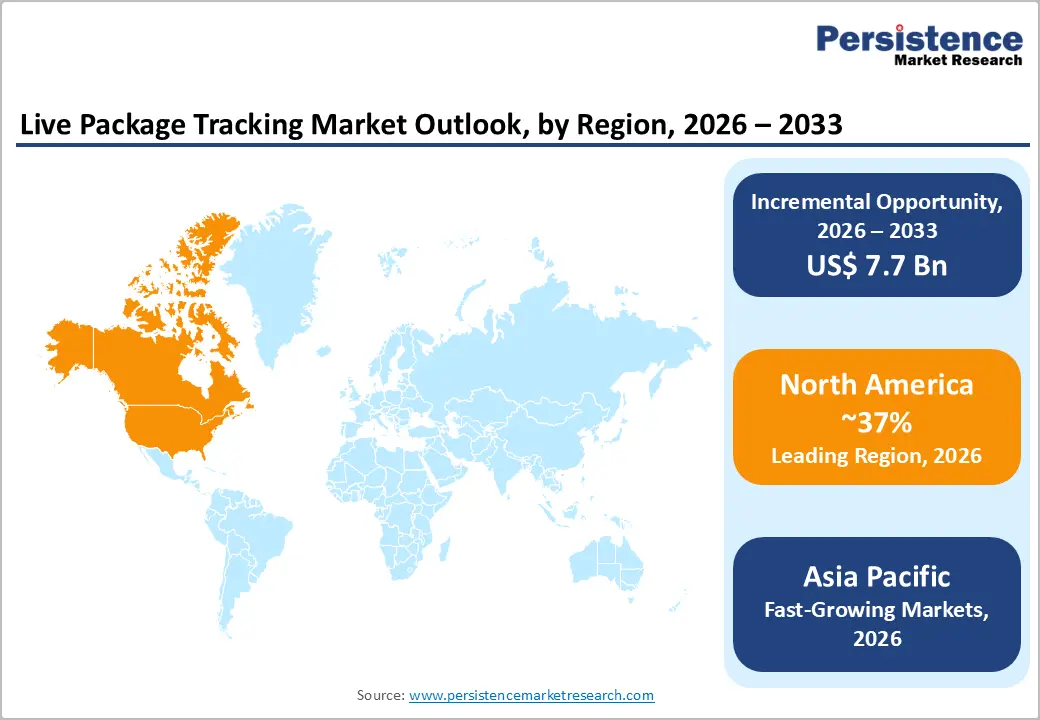
- Leading Region: North America leads with around 37% market share in 2026, valued at approximately US$ 2.3 Bn, driven by advanced logistics infrastructure, strong e-commerce penetration, and rapid adoption of AI-enabled tracking platforms.
- Fastest-Growing Region: Asia Pacific is the fastest-growing region with a CAGR of 17.1%, supported by large-scale e-commerce expansion, government digital logistics initiatives, and rising internet penetration.
Market Dynamics
Drivers - Explosive E-Commerce Growth Fueling Unprecedented Demand for Real-Time Delivery Visibility
The structural expansion of global e-commerce has permanently elevated consumer expectations around shipment transparency. Shoppers now treat live tracking not as a premium feature but as a baseline service, compelling retailers and third-party logistics providers to invest heavily in continuous monitoring solutions.
According to a study, global parcel volumes are expected to exceed 430 billion shipments by 2026, creating an enormous operational imperative for scalable tracking infrastructure. Enterprises that fail to deploy real-time package visibility risk measurable customer attrition.
Proliferation of IoT Devices and Connectivity Infrastructure Across Logistics Networks
The rapid deployment of 5G networks and low-power wide-area network (LPWAN) protocols, including NB-IoT and LoRaWAN, is dramatically expanding the operational envelope for live package tracking across warehouses, transit hubs, and last-mile delivery routes. IoT-connected logistics assets are projected to grow at a double-digit rate through 2030, enabling granular, real-time sensor telemetry for temperature, humidity, shock, and location. This connectivity infrastructure lowers the per-unit cost of deploying tracking hardware, accelerating adoption among mid-market shippers who previously found enterprise tracking solutions cost-prohibitive. As sensor miniaturization continues and connectivity costs decline, the economic case for pervasive live tracking across all shipment tiers strengthens considerably.
Restraints - High Implementation Costs and Integration Complexity Create Adoption Barriers for Small and Mid-Size Operators
Deploying a full-stack live tracking solution encompassing hardware sensors, software platforms, API integrations with existing warehouse management systems, and staff training requires six-figure investments that many regional carriers cannot easily absorb. Integration with legacy enterprise resource planning (ERP) and transportation management systems (TMS) often requires bespoke middleware development, which extends timelines and increases project costs. This slows market penetration in emerging economies and among independent logistics operators, tempering what would otherwise be even more aggressive growth in the live package-tracking market.
Data Privacy Regulations and Cybersecurity Vulnerabilities Constrain Platform Deployment
Compliance with frameworks such as the General Data Protection Regulation (GDPR) in Europe, the California Consumer Privacy Act (CCPA) in the United States, and equivalent legislation across the Asia Pacific adds compliance overhead that raises platform development and operational costs. The interconnected nature of tracking networks creates cybersecurity attack surfaces, with a single breach exposing shipment schedules, customer addresses, and inventory data, generating material liability and reputational damage. These dual pressures force vendors to invest disproportionately in security and compliance infrastructure, constraining margins and slowing the pace of feature deployment.
Opportunities - Integrating Artificial Intelligence and Predictive Analytics to Transition from Reactive Tracking to Proactive Logistics Intelligence
Vendors that move beyond displaying current shipment location to anticipating delays, proactively rerouting shipments, and optimizing carrier selection in real time will command significant pricing premiums over commoditized tracking solutions. AI-enhanced logistics platforms already demonstrate a 20-30% reduction in delivery exception rates in early enterprise deployments, validating the commercial case for this capability upgrade. Platform providers should prioritize building predictive delay algorithms and customer-facing notification engines as their primary product differentiation vectors. Strategic partnerships with major cloud providers will accelerate the data infrastructure needed to operationalize these capabilities on a scale.
Expanding Cold-Chain Tracking Demand in Pharmaceutical and Food & Beverage Sectors
Stringent regulatory requirements governing temperature-sensitive shipments in the pharmaceutical and food sectors are creating a structurally distinct, high-value growth vertical. Regulatory bodies, including the U.S. Food and Drug Administration (FDA) and the European Medicines Agency (EMA) mandate continuous temperature and humidity monitoring for pharmaceutical shipments, effectively making live tracking a compliance requirement rather than a market choice.
The global pharmaceutical cold-chain logistics market is expanding rapidly, and each shipment in this segment requires sensor-enabled tracking infrastructure that commands a significant premium over standard parcel-tracking solutions. Vendors with existing IoT sensor portfolios and compliance-grade data logging capabilities are best positioned to capture this opportunity, particularly if they invest in purpose-built dashboards that generate audit-ready compliance documentation.
Category-wise Analysis
Component Insights
Software dominates the component segment, accounting for approximately 42% share and likely to exceed US$2.6 billion in 2026, as it enables real-time shipment visibility, predictive delivery updates, route optimization, and seamless communication among logistics stakeholders. The growing complexity of global supply chains and the rapid expansion of e-commerce have increased reliance on cloud-based platforms that integrate carriers, warehouses, and last-mile delivery partners into a single ecosystem.
Businesses prefer software solutions for their scalability, ease of integration via APIs, and ability to enhance the customer experience through automated notifications and tracking dashboards.
Services are emerging as the fastest-growing segment, as companies increasingly seek end-to-end support for deployment, integration, and maintenance of tracking systems. Many logistics providers are shifting toward outsourced managed services to reduce operational burden and improve system efficiency. The growing need for customization, real-time monitoring, and continuous optimization of tracking platforms is further accelerating demand for specialized service offerings.
Technology Insights
GPS dominates over 35% share in 2026 due to its ability to provide accurate and continuous real-time location tracking across long distances. It is widely deployed in delivery fleets, mobile devices, and logistics infrastructure, making it a foundational technology for global shipment visibility. Its compatibility with mapping systems, fleet management tools, and geofencing capabilities further strengthens its role in enabling efficient logistics operations. The maturity, reliability, and global coverage of GPS make it the default tracking technology for most transport applications.
Sensors are witnessing the fastest growth, as industries increasingly demand detailed shipment condition monitoring alongside location tracking. IoT-enabled sensors are being widely adopted to track temperature, humidity, vibration, and shock, particularly in sensitive supply chains such as pharmaceuticals and perishable goods. Advancements in miniaturization and cost reduction are also making sensor-based tracking more accessible across a broader range of applications.
Industry Insights
Retail & e-commerce dominate with over 40% share in 2026 due to high reliance on real-time delivery visibility and customer expectations for transparent order tracking. With the surge in online shopping, businesses must handle large shipment volumes while ensuring timely updates, accurate delivery estimates, and smooth return processes. Live tracking has become a critical differentiator in improving customer experience and operational efficiency, especially in highly competitive digital retail environments.
Food & Beverages is the fastest-growing segment, with a 15.8% CAGR, driven by increasing demand for fresh, time-sensitive deliveries and the expansion of online grocery and food delivery platforms. Strict requirements for temperature control, freshness, and delivery speed are driving the adoption of advanced tracking solutions. Cold-chain logistics expansion and regulatory compliance requirements are also driving greater adoption of real-time monitoring systems. Short delivery cycles and high consumer expectations for quality and transparency are further accelerating growth.
Regional Insights
North America Live Package Tracking Market Trends and Insights
North America holds a significant position in the live package tracking market, with an estimated share of around 37% in 2026, exceeding US$ 2.3 Bn value, driven by its highly consolidated parcel carrier ecosystem, advanced 5G connectivity rollout, and a retail landscape where next-day and same-day delivery has become a competitive standard. Enterprise adoption of AI-driven tracking platforms is notably accelerating in the region, and growing regulatory interest in supply chain transparency standards signals that compliance-driven investment will sustain demand through the forecast period.
The United States Live Package Tracking market accounted for 80.0% of the North American market in 2026, totaling US$1.8 billion. The demand is anchored by the world's most developed e-commerce infrastructure, with Amazon, Walmart, and a dense ecosystem of third-party logistics providers continuously investing in real-time shipment visibility to protect customer retention metrics. The United States market is increasingly characterized by platform consolidation, as shippers demand unified multi-carrier tracking dashboards rather than siloed carrier-specific solutions, creating rapid growth opportunities for independent visibility platform vendors.
Europe Live Package Tracking Market Trends and Insights
Europe holds a significant share of over 25% in 2026, representing US$1.5 billion, driven by robust e-commerce growth and an increasingly stringent regulatory environment that mandates supply chain transparency. The EU's Corporate Sustainability Reporting Directive (CSRD) and pharmaceutical serialization requirements are compelling European enterprises to invest in tracking infrastructure that goes beyond commercial convenience into regulatory compliance.
Germany's live package tracking market is expected to hold over 23.0% of share in 2026, exceeding US$0.4 billion in value, anchored by the country's adoption of Industry 4.0 frameworks, which is accelerating the integration of live tracking data into smart factory and warehouse management systems.
The United Kingdom represents 19.0% of the market share in 2026, supported by one of Europe's highest per-capita online shopping rates and a competitive last-mile delivery ecosystem that prioritizes real-time consumer communication. Investment in AI-powered delivery exception management platforms is growing rapidly among UK carriers, and this capability-driven spending will be a primary growth engine for the UK market through the forecast period.
Asia Pacific Live Package Tracking Market Trends and Insights
Asia Pacific is expected to grow at a CAGR of 17.1%. Government-led digital infrastructure programs across the region, including India's PM Gati Shakti initiative and China's smart logistics national standards framework, are compressing the timeline for the adoption of enterprise-grade tracking platforms.
China holds 43.0% share of the Asia Pacific regional Live Package Tracking market in 2026, equivalent to US$800 million, reflecting the country's position as the world's largest parcel delivery market by volume, processing over 200 billion parcels in 2025. China's ongoing investment in smart warehousing and autonomous delivery infrastructure will sustain its dominance.
Japan's live package tracking market is expected to exceed the value of US$ 200 million in 2026, anchored by a premium-quality logistics culture in which near-perfect delivery precision is an industry standard and real-time tracking is a consumer expectation rather than a differentiator. Japan's acute labor shortage in logistics is accelerating automation and sensor-based tracking adoption as operators seek technology to offset workforce constraints, sustaining steady market growth.
India is expected to surpass US$ 300 million in the coming years, making it one of the fastest-growing markets, propelled by over 950 million active internet users and the world’s fastest-growing e-commerce sector. Continued smartphone penetration, expansion of 4G/5G infrastructure into Tier-2 and Tier-3 cities, and government-backed digital commerce initiatives under the Open Network for Digital Commerce (ONDC) will further sustain market growth.
Competitive Landscape
The global live package tracking market is moderately fragmented, with a relatively small group of global logistics giants with embedded tracking capabilities coexisting with a dynamic layer of pure-play visibility platform specialists and hardware-focused IoT vendors. Scale-based players derive competitive advantage from proprietary network density and direct carrier integration, while software-native competitors compete primarily on platform breadth, AI capability, and ecosystem connectivity.
Mergers and strategic partnerships are intensifying as established players move to close capability gaps, and the shift toward subscription-based SaaS models is reshaping how vendors price, package, and retain enterprise customers.
Key Developments:
- In April 2026, Zebra Technologies showcased its latest supply chain visibility solutions at MODEX 2026, highlighting innovations in RFID, mobile computing, and AI-powered data capture. These technologies are designed to enhance real-time tracking, operational efficiency, and decision-making across warehouse and logistics operations. The solutions aim to strengthen end-to-end supply chain visibility and automation.
- In August 2025, project44 introduced its new Intelligent TMS (Transportation Management System), an AI-driven platform designed to enhance freight management through real-time visibility, predictive insights, and automated decision-making. The solution aims to improve agility and efficiency across modern supply chains by integrating transportation planning with live tracking capabilities.
Live Package Tracking Market Report - Key Insights & Details
| Key Insights | Details |
|---|---|
| Historical Market Value (2020) | US$ 3.2 Bn |
| Current Market Value (2026) | US$ 6.1 Bn |
| Projected Market Value (2033) | US$ 13.8 Bn |
| CAGR (2026 - 2033) | 12.5% |
| Leading Region | North America, 37% share |
| Dominant Technology | GPS, 35% share |
| Top-ranking Industry | Retail & E-commerce, 40% |
| Incremental Opportunity | US$ 7.7 Bn |
Companies Covered in Live Package Tracking Market
- DHL Group
- FedEx Corporation
- United Parcel Service (UPS)
- Maersk
- Honeywell International
- Tive
- Zebra Technologies
- Geotab
- ORBCOMM
- FourKites
- project44
- Descartes Systems Group
- Detrack Systems
- HyperTrack
- Others
Frequently Asked Questions
The global Live Package Tracking market is valued at US$ 6.1 Billion in 2026 and is projected to reach US$ 13.8 Billion by 2033, growing at a CAGR of 12.5%, driven by surging e-commerce parcel volumes and demand for real-time shipment visibility.
IoT and 5G adoption enable real-time, scalable shipment monitoring and regulatory compliance requirements in pharma and food cold-chain logistics, strengthening demand.
North America dominates with about 37% market share in 2026, driven by advanced logistics networks led by UPS, FedEx, and Amazon Logistics. High consumer expectations for real-time delivery visibility also support adoption.
AI-powered predictive logistics platforms that enable proactive exception management, these systems reduce delivery disruptions by 20-30% and command premium pricing. Early adopters are expected to gain a strong competitive advantage.
Leading players include DHL Group, FedEx Corporation, United Parcel Service (UPS), Maersk, Honeywell International, Tive, and Zebra Technologies.


