




- Food Ingredients & Additives
- Kelp Market
Kelp Market Size, Share, and Growth Forecast 2026 - 2033
Kelp Market by Product Form (Dried Kelp, Fresh and Frozen Kelp, Kelp Powder and Flakes), Source (Wild-Harvested, Farmed), Application (Food and Beverages, Agriculture and Biostimulants, Animal Feed), and Regional Analysis, 2026 - 2033

Kelp Market Size and Trends Analysis
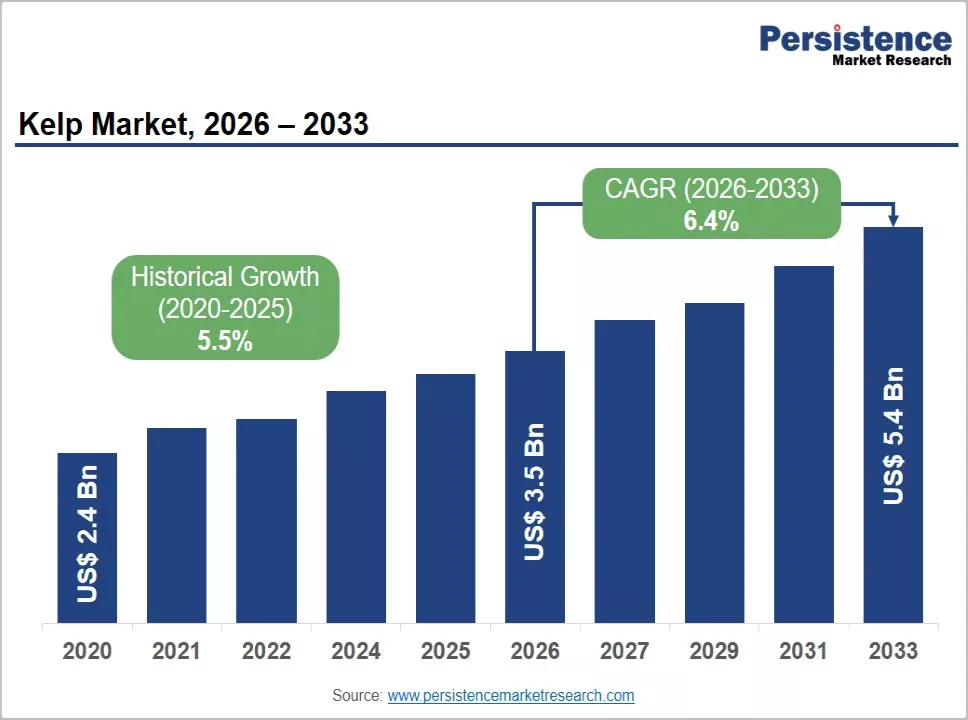
The global kelp market size is likely to be valued at US$ 3.5 billion in 2026 and is estimated to reach US$ 5.4 billion by 2033, growing at a CAGR of 6.4% during the forecast period 2026 to 2033, driven by the rising use of kelp-based biostimulants and steady food demand across Asia Pacific. Expanding farm capacity in North America and Europe is further widening the raw material base.
Key Industry Highlights
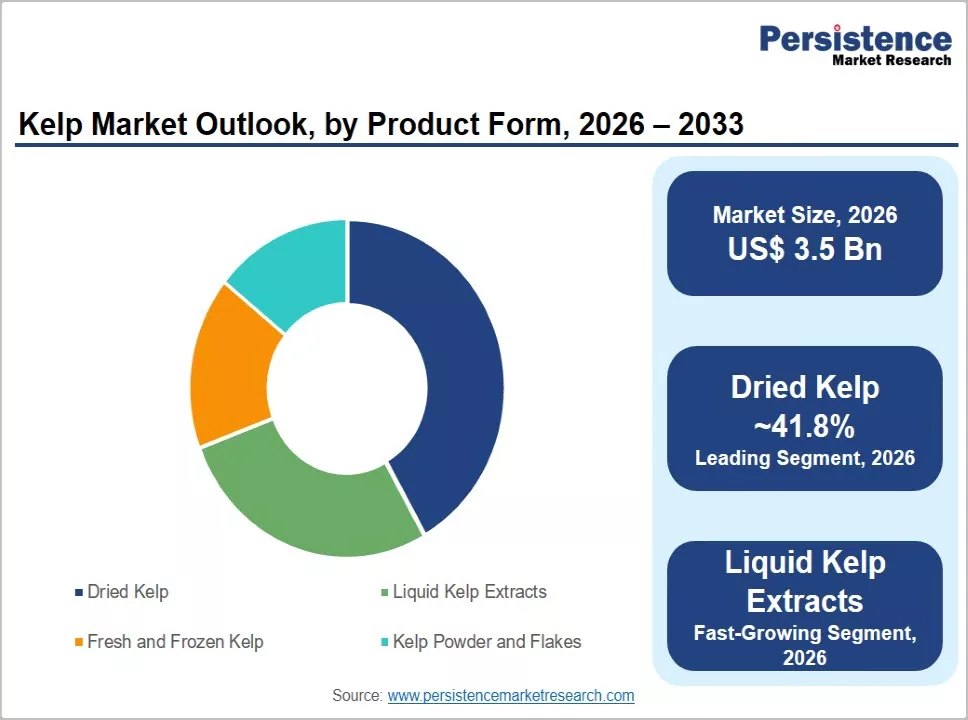
- Leading Product Form: Dried kelp, about 41.8% share in 2026, because drying extends shelf life, lowers transport costs, and suits food, feed, and extraction uses.
- Dominant Application: Food and beverages, around 37.9% share in 2026, as kombu, dashi stock, noodles, and seasonings remain staples in East Asian diets.
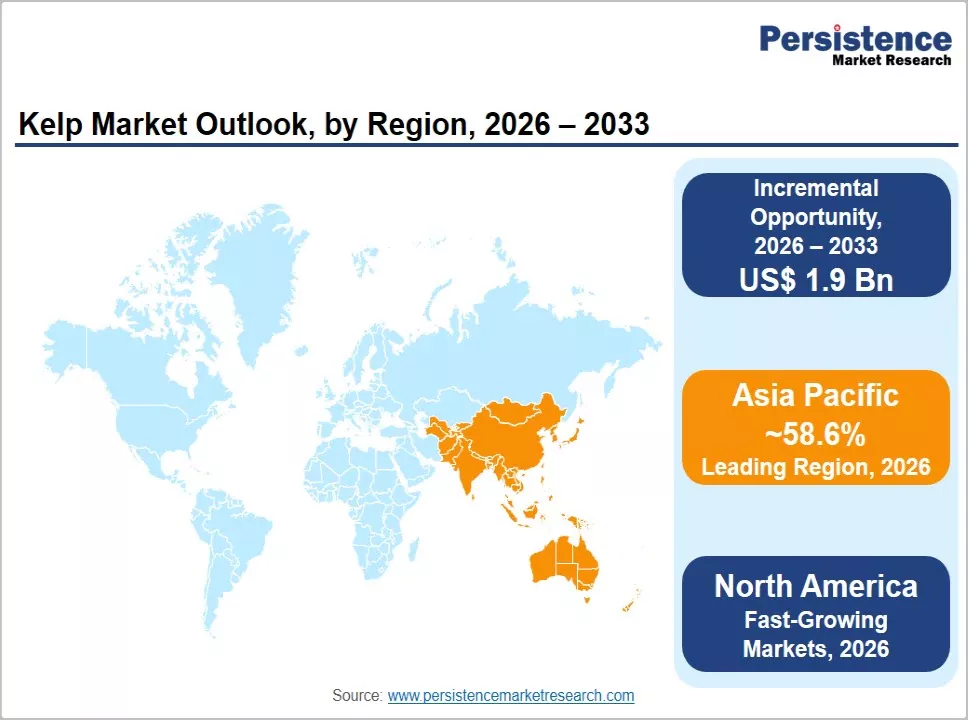
- Leading Region: Asia Pacific, with about 58.6% share in 2026, because of large-scale kelp farming in China, long culinary use in Japan, and well-established drying and processing networks.
- Fast-growing Region: North America, owing to new farm permits, rising biostimulant demand, and efforts to build domestic kelp supply chains.
- Latest Initiative: In February 2026, GreenWave and Macro Oceans launched Kelp CoLab, a research and development initiative bringing together nine beauty brands, including Credo Beauty, True Botanicals, Krave Beauty, and Sonsie. The programs designed to help participating brands develop skincare and personal-care formulations using ingredients derived from regeneratively farmed kelp. It aims to connect kelp farmers and ingredient suppliers with consumer brands, creating new commercial applications for cultivated kelp in beauty products.
DRO Analysis
Driver- Rising Biostimulant Use to Fuel Demand for Kelp Extracts
Farmers want inputs that improve nutrient use and help crops tolerate stress. Kelp extracts fit this need well. Hatch Blue, a blue economy innovation group, notes that seaweed extracts are growing at about 13% annually, slightly faster than the broader biostimulant market at about 12%. It also estimates that these extracts will need roughly 700,000 tons of seaweed by 2027.
Regulation is giving the category more structure. The EU Fertilizing Products Regulation allows CE-marked plant biostimulants to move freely across the single market. Cascadia Seaweed, which produces liquid kelp extracts for North American farms, reports trials on wheat, barley, and canola that showed higher yields with reduced fertilizer rates. Such results encourage growers to test kelp-based products.
Expanding Kelp Farms to Strengthen Raw Material Supply
Cultivated kelp is reducing reliance on wild harvests. Hatch Blue notes that most current seaweed biostimulant production still depends on wild kelp, and that higher wild harvesting could eventually require caps to protect ecosystems. Farming offers a traceable alternative. In Maine, Sea Grant data show farmers landed more than 1 million pounds of seaweed in 2023.
Companies are scaling this model. Atlantic Sea Farms harvested a record 1.3 million pounds of farmed seaweed in 2024. It works with fishing families in Maine, Rhode Island, and Alaska. Kelp farming also needs no land, fresh water, or fertilizer, which supports its appeal for regenerative agriculture and food supply chains. More farms and nurseries give processors steadier biomass for food, extract, and ingredient lines.
Restraint- Iodine and Heavy Metal Limits May Restrict Food and Supplement Use
Kelp absorbs minerals from seawater. These include iodine and, in some cases, metals such as arsenic and cadmium. The European Food Safety Authority sets an adequate iodine intake of 150 micrograms per day for adults and an upper level of 600 micrograms. A 2026 Nordic review notes that only about 1 gram or less of unprocessed dried kelp may fit within these limits, depending on the species.
In the U.S., FDA rules under 21 CFR 172.365 limit kelp supplements to 225 micrograms of iodine per daily serving. UConn Sea Grant also notes that there are no U.S. federal standards for heavy metals in seaweed. Nordic food authorities have called for harmonized seaweed legislation in Europe. Hence, testing costs and uneven rules can slow product launches and limit inclusion levels, particularly in supplements and concentrated ingredients.
Climate pressure adds another risk. The Kelp Forest Alliance reported in October 2026 that 60% of assessed kelp forest regions are degraded. Warmer seas have cut wild kombu harvests in Hokkaido and shifted kelp species in Brittany. Kelp also grows best in cold water of around 10°C, so farms are concentrated in northern coastal regions. Such variability can make supply less predictable for processors.
Opportunity- Cultivated Kelp to Spur Local Biostimulant Supply Chains
Local farms can supply nearby crop regions. Ocean Rainforest plans to land giant kelp at Ventura Harbor for use on farms in Ventura and Santa Barbara counties. The company has already tested open-ocean cultivation at an 86-acre demonstration farm off Santa Barbara. An avocado farm executive told California regulators that kelp used in agriculture today comes from the Atlantic Ocean, which he called financially and environmentally impractical.
Alaska shows a similar push. In 2026, the Alaska Mariculture Cluster funded additional testing of three Alaska kelp-based biostimulants by Pacific Kelp Company. It also supported GreenWave in buying containers so that farmers can process and store more kelp-derived product. This creates room for regional brands built on traceable supply.
Problem-solving Ingredients to Open New Uses for Kelp
Kelp is moving from a front-of-pack hero ingredient to a functional input. GreenWave's 2026 report highlights uses such as replacing petroleum-derived compounds in cosmetics and reducing sodium in processed foods. Maine producers already sell kelp flakes, powders, seasonings, and snack products.
Support programs are building the pipeline. GreenWave runs Kelp CoLab, which connects consumer brands with kelp-based ingredients and product research. It also runs the Kelp Climate Fund, which pays ocean farmers for the climate impact of their farms. These programs give food and personal care brands a clearer path to test kelp ingredients.
Category-wise Analysis
Product Form Insights
Dried kelp is predicted to lead with a share of about 41.8% in 2026, because drying reduces weight, extends shelf life, and simplifies shipping. It also suits cooking, powder milling, animal feed, and extract production. Kelp powder and flakes are gaining ground too, since Maine producers sell them as seasoning and ingredient products. Japan shows how central the format is. The Hokkaido inspection association reports kombu output in dried tons, and fiscal 2025 production reached 9,907 tons.
Liquid kelp extracts are estimated to be the fastest-growing segment in the forecast period, as growers apply them as foliar sprays and soil treatments. Ocean Rainforest says it has launched seaweed biostimulants in California for strawberries, avocados, and wine grapes. Cascadia Seaweed's new Port Edward facility is also built to make liquid extracts with chemical-free extraction.
Application Insights
Food and beverages is anticipated to dominate with a share of around 37.9% in 2026, because kelp is a core ingredient in Japanese dashi, Chinese soups, and Korean cooking. FAO data show that about 70% of global seaweed production goes to food use. North American brands are also widening the base with kelp noodles, seasonings, burgers, and snacks. In Maine, kelp is sold fresh, frozen, and dried to restaurants, breweries, and processors.
Agriculture and biostimulants is expected to remain in the second position in 2026, as growers look for tools that cut fertilizer use and manage climate stress. Growth depends on cultivated supply and consistent product standards. Hatch Blue points to inconsistent standards, patchy regulation, and limited efficacy proof as current barriers. Ocean Rainforest adds that seaweed biostimulants help plants use nutrients more efficiently.
Regional Insights
Asia Pacific Kelp Market Trends
Asia Pacific is predicted to dominate in 2026 globally with a share of approximately 58.6%, supported by large kelp farms, strong culinary demand, and mature drying and processing industries. FAO and UNCTAD data show that East and Southeast Asia produced about 99.5% of global seaweed in 2021. Global seaweed production tripled from 11.9 million tons in 2002 to 36.3 million tons in 2022. Brown seaweed farming in the region centers on kelp and wakame. This gives Asia Pacific a deep and reliable supply base.
China Kelp Market Trends
China will likely lead in Asia Pacific in 2026 with a share of about 47.3%, supported by its enormous kelp farming base. FAO data show that China produced about 11 million tons of kelp (wet weight) in 2020. Shandong, Fujian, and Liaoning are the main production areas. Official reports from Rongcheng, Shandong, put expected output of 1.7 million tons from about 10,000 hectares of kelp in 2024. In Xiapu, Fujian, kelp covered about 6,613 hectares in 2025 and yielded 169,000 tons, valued at 1.84 billion yuan. Local governments are also upgrading seedling bases and farming platforms. These developments keep China central to dried kelp, extract, and feed supply.
Japan Kelp Market Trends
In 2026, Japan is projected to account for a share of just about 15.6% in Asia Pacific, as demand for kombu remains strong but wild supply is shrinking. Hokkaido produces about 95% of Japan's kombu, and natural kombu made up 69.5% of the national harvest in 2023. Output fell to 8,213 tons in fiscal 2024, the first time below 10,000 tons since records began in 1981. It recovered 20.6% to 9,907 tons in fiscal 2025. Warmer seas are a major cause, so cultivated kombu and imports are gaining importance.
North America Kelp Market Trends
North America is anticipated to be the fastest-growing region globally in 2026 with a share of around 19.7%, because it is building a farmed kelp industry from a small base. GreenWave counts nearly 250 permitted farms across Alaska, Atlantic Canada, British Columbia, the Gulf of Maine, and Southern New England. British Columbia alone has 20 kelp farms covering 441 hectares. Cascadia Seaweed opened its Port Edward processing facility in May 2026 to serve this growth. In Alaska, the Kodiak Ocean Growers Cooperative, launched in March 2025, unites five farmers managing over 300 acres. Output remains uneven, as less than 35% of approved farm area is in use.
U.S. Kelp Market Trends
A share of nearly 71.4% is expected to be held by the U.S. in 2026 in North America, because of permitting progress, farm investment, and demand from agriculture. In September 2026, the California Coastal Commission unanimously approved Ocean Rainforest's 2,000-acre giant kelp farm. NOAA also identified Aquaculture Opportunity Areas off Southern California in September 2025. Maine and Alaska remain the main farming hubs. Supply is still volatile. Pew reports that Alaska grew about 240,000 pounds of seaweed in 2025, well below its 2022 level of about 872,000 pounds.
Europe Kelp Market Trends
Europe will likely see steady growth in the forecast period with a share of roughly 17.1% in 2026 globally, as it relies mainly on wild harvests and a small farming base. Cold-water species such as Laminaria hyperborea and Laminaria digitata supply alginate makers along the Atlantic coast. Demand is also supported by cosmetics and biostimulants. The EU Fertilizing Products Regulation gives seaweed-based biostimulants a single route to market through CE marking. At the same time, the European Food Safety Authority has flagged seaweed intake as an emerging risk to monitor for iodine and heavy metals.
Norway Kelp Market Trends
Norway is predicted to register a substantial share of approximately 31.6% in 2026 in Europe, owing to its large wild harvest of tangle kelp. A Norwegian Institute for Nature Research report shows that about 149,506 tons of kelp were harvested annually between 2016 and 2023. Most of it is used to make alginate. Harvesting follows a five-year rotation plan. Farming is still early, with 221 tons of cultivated seaweed sold in 2022. Hence, Norway leads on wild supply while farmed volumes stay small.
France Kelp Market Trends
A share of nearly 22.4% is predicted to be held by France in 2026 in Europe, backed by the kelp harvest in Brittany. Boats from Lanildut usually land 40,000 to 55,000 tons of Laminaria digitata between May and September. Industry reports say recent harvests have dropped to about half the usual loads. Warmer water is shifting the species mix. About 30 harvesters and 160 plant workers depend on this chain, which raises interest in new farming.
Competitive Landscape
The global kelp market is fragmented, with wild harvesters, extract makers, ingredient suppliers, and new farm-based companies competing on supply security, extraction quality, traceability, and regulatory approvals. Acadian Plant Health, Kelpak, Seasol International, Ocean Rainforest, Atlantic Sea Farms, and Cascadia Seaweed are among the active participants. Ocean Rainforest, based in the Faroe Islands, also operates in California and Baja California, Mexico. Asian producers dominate dried kelp volumes, while Western companies focus on branded extracts and traceable farmed supply.
Competition is shifting from raw biomass toward proven performance. Companies are investing in field trials, CE marking, and local processing. Atlantic Sea Farms has built a partnership model with fishing families, which paid out more than US$1 million in its 2024 season. Cascadia Seaweed has integrated farming and processing in British Columbia. Partnerships with coastal communities are also common, as seen in Cascadia Seaweed's farms with First Nations in British Columbia. These moves help firms secure biomass and shorten the path from ocean to customer.
Key Industry Developments
- In August 2026, Acadian Plant Health received European Union CE Mark certification for Ready for Stress, its first product from a new abiotic stress management portfolio to receive this certification. The formulation combines proprietary seaweed extracts with additional bioactive components and is designed to help crops tolerate environmental stresses such as drought and salinity. The certification enables commercial sales across all 27 EU member states, expanding the potential market for seaweed-derived agricultural biostimulants.
- In May 2026, Sustainable Agro Solutions (SAS Group) acquired a majority stake in South African company Afrikelp, a producer of seaweed-based agricultural biostimulants. Afrikelp specializes in products derived from Ecklonia maxima, a brown seaweed harvested under an exclusive concession, and uses a patented cold-micronization process to produce concentrated extracts. SAS said the acquisition would strengthen its seaweed-based biosolutions portfolio, add research and extraction capabilities, and expand its international customer reach. Financial terms were not disclosed.
- In May 2026, Cascadia Seaweed officially opened an advanced seaweed-processing facility in Port Edward, British Columbia, Canada. Developed in partnership with Metlakatla Development Corporation, the facility completes the company's Northern Hub and enables it to process locally cultivated brown seaweed into liquid kelp extracts for agricultural applications. The facility is designed to process hundreds of wet tons of seaweed annually using chemical-free extraction technology intended to preserve naturally occurring bioactive compounds.
Companies Covered in Kelp Market
- Acadian Plant Health
- Kelpak
- Seasol International
- Ocean Rainforest
- Atlantic Sea Farms
- Cascadia Seaweed
- Algaia
- Qingdao Gather Great Ocean
- Mara Seaweed
- Kelp Blue
- Others
Frequently Asked Questions
The global kelp market is projected to be valued at US$ 3.5 billion in 2026.
The market is expected to reach US$ 5.4 billion by 2033.
Key market trends include rising use of kelp-based biostimulants, expanding farmed supply in North America and Europe, and growing use of kelp as a functional food and personal care ingredient.
Dried kelp is expected to be the leading product form with a share of around 41.8% in 2026, because it offers long shelf life, easy transport, and wide use across food, feed, and extraction.
The market is expected to grow at a CAGR of 6.4% from 2026 to 2033.
Acadian Plant Health, Kelpak, and Ocean Rainforest are a few key market players.


