




- Food Ingredients & Additives
- Hops Market
Hops Market Size, Share, and Growth Forecast, 2026 - 2033
Hops Market by Product Type (Pellet Hops, Whole Leaf Hops, Extract Hops, Others), Variety (Chinook Hops, Aroma Hops, Centennial Hops, Others), Application (Alcoholic Beverages, Pharmaceuticals, Cosmetics & Personal Care, Food & Other Uses), and Regional Analysis for 2026 - 2033

Hops Market Share and Trends Analysis
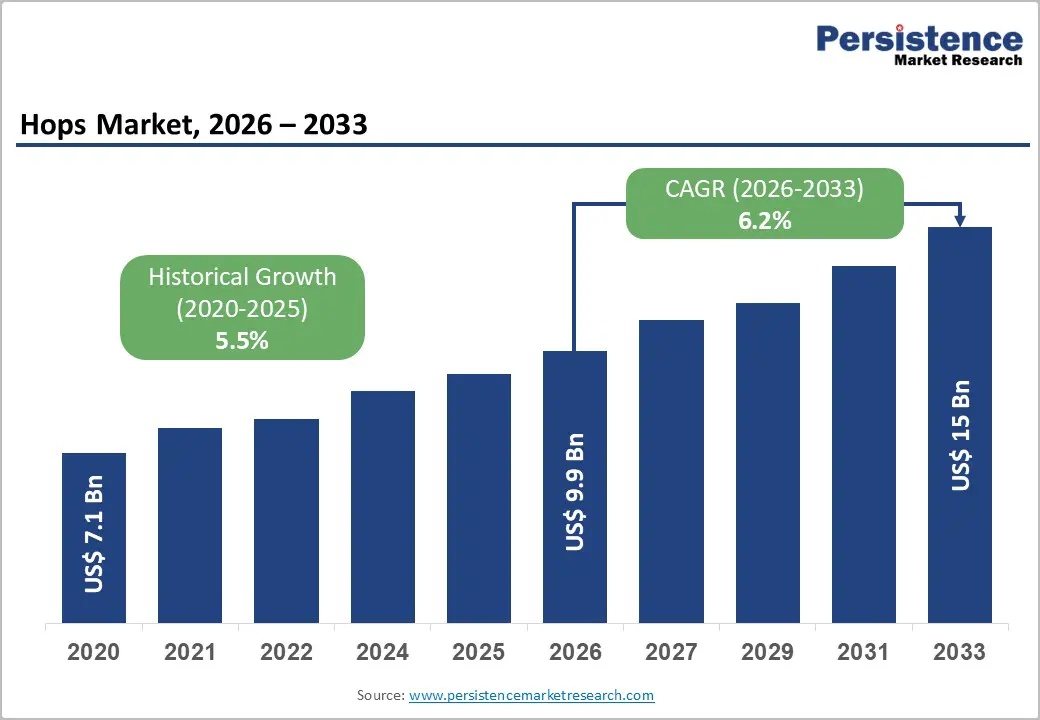
The global hops market size is likely to be valued at US$ 9.9 billion in 2026 and is estimated to reach US$ 15 billion by 2033, growing at a CAGR of 6.2% during the forecast period 2026 - 2033.
Rising global demand for craft and commercial beverages, particularly beer, drives steady revenue growth as producers prioritize high-quality hops for flavor, aroma, and stability. Adoption of precision agriculture and automated pelletization improves yield consistency and reduces losses, enhancing market scalability.
Urbanization and higher disposable income support premium beverage consumption, boosting hops demand locally and for export. Compliance with safety and quality regulations facilitates certified supplier entry, encouraging investment. Innovations in hop derivatives, including extracts and oils, expand use in pharmaceuticals, cosmetics, and nutraceuticals. Improved distribution and cold-chain logistics increase accessibility to emerging markets, strengthening overall growth potential.
Key Industry Highlights
- Leading Variety: Aroma hops are anticipated to hold roughly 40% of the revenue share in 2026, powered by trusted sensory profiles and strong retail penetration.
- Fastest-Growing Variety: Chinook hops are predicted to record the fastest growth between 2026 and 2033, with rising adoption in craft and specialty beer, and derivative product applications.
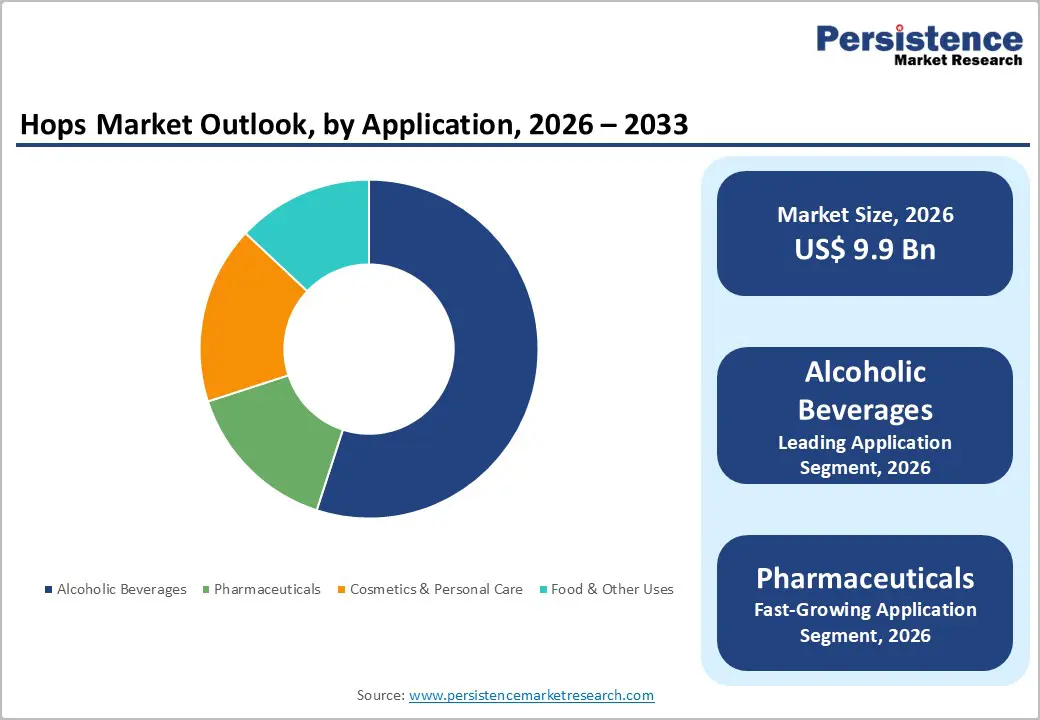
- Leading Application: Alcoholic beverages are poised to dominate with an estimated 55% share in 2026, driven by their integral role in brewing and consistent product quality.
- Fastest-Growing Application: Pharmaceuticals is forecasted to record the fastest growth between 2026 and 2033, fueled by functional extracts, regulatory alignment, and wellness product demand.
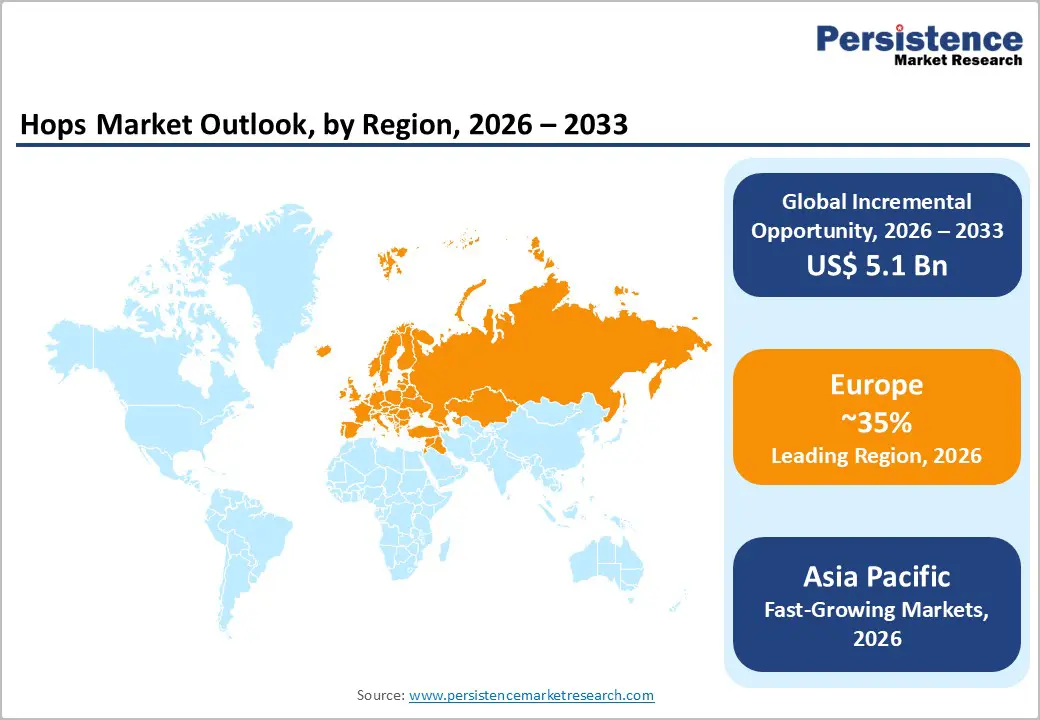
- Regional Leadership: Europe is projected to hold 35% of the wheat syrup market share in 2026, driven by craft beer demand and advanced cultivation. Asia Pacific is likely to witness fast growth driven by emerging economies, urbanization, and premium beverage consumption.
- Competitive Environment: Market is moderately fragmented with top players controlling 40-45% share; strategies focus on innovation, technology integration, and multi-sector diversification.
- Innovation Trends: Emphasis on precision agriculture, automated processing, and derivative product development enhances scalability, multi-sector applicability, and global market penetration.
| Key Insights | Details |
|---|---|
| Hops Market Size (2026E) | US$ 9.9 Bn |
| Market Value Forecast (2033F) | US$ 15 Bn |
| Projected Growth (CAGR 2026 to 2033) | 6.2% |
| Historical Market Growth (CAGR 2020 to 2025) | 5.5% |
DRO Analysis
Driver - Rising Demand for Craft and Commercial Beverages
Consumer demand for artisanal and mainstream beverages has expanded global ingredient requirements, creating structural uplift in hops utilization throughout brewing operations. Breweries are scaling production to satisfy diversified flavor preferences, prompting greater purchase volumes of aromatic and bittering hops that underpin product differentiation and quality consistency. US agricultural exports of hop products to major markets including Germany reached $68.3 million in 2024, reflecting broad demand for premium brewing inputs in international supply chains. Domestic beverage producers target niche segments such as India Pale Ale and seasonal brews, driving incremental hops contracts and long-term procurement planning to secure raw material availability.
Retail and on-premise beverage channels exhibit shifting consumption patterns that bolster quality-oriented brewing investments, lifting hops usage intensity per output unit. Craft and commercial producers allocate capital toward recipe innovation and small-batch runs, which depend on diverse hop varietals to achieve distinct sensory profiles and brand positioning. Operational buyers factor hops variety and supply reliability into production scheduling, influencing cost structures and cellar efficiency. Broader beverage portfolio expansion into low-alcohol and specialty categories further enhances aggregate hops demand across tiered manufacturing tiers.
Hop Derivatives Expand Applications in Pharma, Cosmetics, and Nutraceuticals
Growing use of bioactive hop derivatives in pharmaceuticals, cosmetics, and nutraceuticals drives hops demand by expanding applications beyond brewing. Extracts containing flavonoids, α- and β-acids, and essential oils exhibit antioxidant, anti-inflammatory, and antimicrobial properties suitable for therapeutic and dermatological formulations. Manufacturers incorporate these compounds to enhance product efficacy, extend shelf life, and differentiate portfolios in competitive markets. Broad sector adoption increases procurement volumes, supports value-added processing, and enables premium pricing. Rising demand for natural and functional ingredients encourages investment in extraction technologies and cultivation optimization, creating structural incentives for growers and processors to expand production and improve operational efficiency.
Expanded applications reduce reliance on brewing and diversify revenue streams, stabilizing market exposure to fluctuations in beverage demand. Scientific validation of biological properties supports regulatory acceptance and stimulates research, development, and product innovation. Nutraceutical and personal care companies require consistent, high-quality raw material, promoting sustainable cultivation practices. The integration of bioactive ingredients enhances brand positioning for health-conscious consumers. Cross-sector demand drives incremental derivative consumption, strengthens supply chain resilience, and encourages strategic investment in advanced processing, creating long-term growth potential for growers and processors.
Restraint - Climate Sensitivity and Pest Vulnerability
Hops cultivation is highly susceptible to fluctuations in temperature, rainfall, and seasonal patterns, creating instability in crop yields and production planning. Extreme weather events, including droughts, frosts, and excessive rainfall, disrupt growth cycles and reduce overall output quality. Pest infestations, such as aphids, mites, and fungal pathogens, can spread rapidly across plantations, causing significant losses in both quantity and chemical composition. Crop protection measures increase operational costs, including investment in pesticides, monitoring systems, and labor. Yield variability impacts supply consistency, creating challenges for beverage producers relying on stable raw material availability for flavor, aroma, and brewing efficiency.
Unpredictable climatic conditions affect long-term investment decisions for plantation expansion and technological adoption. High vulnerability to environmental stress reduces profitability for small and medium-scale growers, limiting scalability. Pest outbreaks increase reliance on chemical interventions, raising production expenses and environmental compliance obligations. Supply uncertainty can inflate raw material prices, affecting cost structures for downstream beverage manufacturing. Regions with frequent climate extremes face barriers to entry for new cultivators, slowing geographic expansion. Operational inefficiencies caused by pest and climate exposure can constrain contract farming arrangements and disrupt global distribution, limiting growth potential in premium and export-oriented segments.
High Cultivation and Processing Costs
Rising expenses in cultivation and processing create a significant barrier to growth. Investments in land preparation, irrigation systems, and high-quality seed varieties increase upfront capital requirements. Labor-intensive activities, including planting, pruning, and harvesting, drive operational costs. Processing operations, such as drying, pelletization, and extraction, demand energy-intensive equipment and specialized technology. Maintaining consistent quality standards across batches requires continuous monitoring and control, further elevating expenditures. Small and medium producers face financial strain in scaling operations, limiting capacity expansion. Price pressures from buyers restrict profit margins, reducing incentive to invest in advanced cultivation techniques or modern processing infrastructure.
Cost intensity affects supply reliability and efficiency. Producers may delay or reduce production volumes to manage budgets, creating potential supply fluctuations. High operating expenses can hinder the adoption of automated systems, which improve yield and reduce post-harvest losses. Access to credit or financing becomes critical, constraining entry for new participants. International competition from regions with lower production costs intensifies, challenging domestic producers. Elevated financial requirements influence strategic planning, investment prioritization, and operational efficiency, restricting the ability to respond to rising demand trends across premium beverage and derivative product segments.
Opportunity - Development of Innovative Hop-based Products
Innovation in hop-based products presents a strategic growth opportunity rooted in structural demand expansion and economic diversification. Hop derivatives such as concentrated extracts and essential oils extend the input value beyond traditional brewing into food, beverage, nutraceutical, cosmetic, and therapeutic sectors where demand for natural flavor and functional ingredients is rising. This shift can elevate unit revenues per raw material ton, reducing dependency on commodity sales while capturing premium applications in high-growth segments. U.S. hop output value reached $447 million in 2025, indicating strong agronomic base support for derivative development and signaling capacity for forward integration into value-added processing. As manufacturers invest in extraction technologies and formulation science, operational efficiency gains can lower cost per active compound and enhance competitive positioning against synthetic alternatives.
Demand-side drivers strengthen this opportunity by broadening customer bases and stabilizing revenue streams. Craft beverage consumers increasingly expect differentiated sensory experiences, encouraging brewers and ingredient suppliers to adopt innovative hop concentrates that deliver nuanced flavor profiles with consistent quality. Extracts also meet formulation needs in wellness products where functional botanicals attract premium pricing and loyal consumers seeking plant-derived bioactives. These developments can stimulate investment in processing infrastructure and enable product portfolio expansion into adjacent markets with higher margins, supporting long-term growth pathways anchored in diversified demand rather than single-sector reliance.
Advanced Cultivation and Pelletization Technologies
Investment in advanced cultivation and pelletization technologies presents a strategic opportunity for the hops market by improving efficiency and product consistency. Precision irrigation, sensor-based nutrient management, and controlled environment systems reduce variability in yields and enhance the predictability of output. Mechanized pelletizing compresses hops into uniform forms preferred by brewers, reducing degradation and transportation losses. These technologies enhance lot-to-lot consistency, extend shelf life, and attract investment through measurable performance, enabling acreage expansion and improved contract fulfillment. Operational gains lower input waste, stabilize quality, and strengthen production planning, supporting scalability and reliable supply chains for domestic and export demands.
Breweries and beverage producers prioritize predictable flavor and alpha acid content, increasing demand for standardized pellets. Technology-driven pelletization improves extraction efficiency, minimizes variability, and supports precise recipe formulation. Digital tracking from field to product enhances supply chain transparency, aligning production and purchase schedules while reducing speculative inventory. Operational improvements lower costs and enable competitive pricing, facilitating entry into new regional and international markets. These systems reduce exposure to weather and labor disruptions, strengthen resilience, and support consistent supply for expanding brewing and beverage operations.
Category-wise Analysis
Variety Insights
Aroma hops extracts are poised to dominate with a forecasted market share of over 40% in 2026, powered by strong demand in craft and commercial beer production for distinct flavor and aromatic profiles. Producers favor aroma varieties for enhancing sensory qualities without increasing bitterness, enabling consistent product differentiation. Adoption is reinforced in Europe and North America, where trusted varieties support brand consistency. Established supplier networks and distributor partnerships ensure retail availability. Innovations in pelletization and extract preparation improve stability and usability. Digital commerce platforms expand access to small and medium breweries, while regulatory compliance supports cross-border distribution.
Chinook hops is estimated to be the fastest-growing segment from 2026 to 2033, fueled by increasing adoption in specialty and high-alcohol by volume beer production. Chinook varieties provide high alpha acid content and distinctive pine, spice, and citrus notes, appealing to craft breweries seeking premium differentiation. Expansion of digital commerce and direct-to-brewery channels improves accessibility in emerging markets, enabling smaller producers to adopt premium varieties efficiently. Controlled cultivation and automated processing ensure consistent alpha acid levels, building brewer trust. Partnerships with brewing associations and demonstration projects support adoption. Trend-driven demand for bold flavors and use in extracts and nutraceuticals further enhances commercial potential.
Application Insights
Alcoholic beverages is likely to be the leading segment with a projected 55% of the hops market share in 2026 due to extensive adoption in beer production and increasing consumer preference for diverse flavor profiles. Hops provide essential bitterness, aroma, and preservative qualities, supporting consistent brewing outcomes. Breweries prioritize traceable, high-quality hops to maintain batch reliability. Regulatory compliance with food safety and export standards enables global distribution. Pellet and extract integration improves production efficiency and formulation precision. Supplier partnerships and contract farming secure steady supply. Industry certifications, best agricultural practices, and digital commerce platforms strengthen trust and reduce lead time, while derivative applications expand usage.
Pharmaceuticals is anticipated to be the fastest-growing segment from 2026 to 2033, fueled by increasing exploration of hops extracts for therapeutic properties, including anti-inflammatory, antioxidant, and sleep-regulating effects. Functional ingredients from hops support supplements, herbal remedies, and nutraceutical formulations. Regulatory frameworks for natural health products, including Food and Drug Administration and European Food Safety Authority guidelines, enable adoption of standardized, high-purity extracts. Partnerships with pharmaceutical manufacturers and research institutions facilitate co-development of targeted formulations. Controlled cultivation and precision extraction enhance bioactive compound stability, improving efficacy. Consumer interest in plant-based therapeutics and digital commerce platforms further expand accessibility and participation in high-margin markets.
Regional Insights
North America Hops Market Trends
North America is projected to maintain a significant position in the hops market, driven by a strong craft and commercial beer industry. High consumer demand for diverse flavor profiles and premium products encourages breweries to source high-quality aroma and bittering varieties. Advanced cultivation practices, including precision irrigation, soil monitoring, and pest management, ensure consistent alpha acid content and enhanced yield. Breweries increasingly rely on pellet and extract technologies to improve formulation precision, reduce storage requirements, and streamline production. Strategic partnerships with suppliers and contract farming agreements secure a steady supply, mitigating production volatility. Regulatory alignment with food safety and export standards facilitates reliable cross-border distribution.
Urbanization and rising disposable income continue to expand specialty and flavored beer segments, strengthening demand for hop varieties with unique aromatic and bittering properties. Investments in automated processing and quality control systems enhance consistency across batches and build trust among craft and commercial producers. Digital commerce platforms enable direct sourcing for small and medium breweries, reducing lead time and operational complexity. Collaborations with research institutions and brewing associations drive innovation in derivative applications, including extracts for nutraceutical and functional beverage products. Consumer preference for experimental flavors and premium offerings supports the adoption of novel hop varieties, while integrated supply chains ensure timely availability and strengthen overall market growth potential.
Europe Hops Market Trends
Europe is expected to lead with an estimated 35% of the hops market share in 2026, supported by extensive adoption in craft and commercial beer production. Established brewing infrastructure in Germany, the Czech Republic, and Poland enables large-scale procurement of premium and specialty varieties. Advanced cultivation practices, including controlled irrigation, pest management, and soil optimization, ensure high alpha acid and aroma consistency. Strong presence of certified suppliers and compliance with food safety standards reinforce trust among brewers. Well-integrated supply chains and distributor networks reduce lead time and improve product availability. Investment in pelletization and extract technologies enhances stability, storage efficiency, and formulation precision. Concentrated industrial clusters enable collaboration with research institutions, supporting innovation in derivative products.
Consumer preference for diverse flavor profiles and premium beverages drives sustained demand. Brewing associations in Germany, Belgium, and the Netherlands promote standardization and adoption of recognized varieties, ensuring consistent quality across batches. Urbanization and disposable income growth support expansion of specialty beer segments. Regulatory alignment with export standards facilitates cross-border trade, increasing market penetration. Digital commerce and direct-to-brewery channels provide small-scale producers with access to high-quality hops. Controlled cultivation and automated processing reduce variability and strengthen reliability in supply. Investments in research and demonstration projects highlight functional advantages, reinforcing commercial adoption and confidence among brewers.
Asia Pacific Hops Market Trends
Asia Pacific is forecasted to be the fastest-growing market for hops stimulated by rising craft and specialty beer production in urban centers. In China and India, increasing disposable income and expanding premium beverage consumption drive adoption of high-quality and aroma-focused hop varieties. Brewing companies invest in modern cultivation, pelletization, and extract technologies to maintain consistent alpha acid content and flavor profiles. In Japan and South Korea, growing demand for flavored and low-alcohol beer supports expansion of specialty hops. Digital commerce and direct-to-brewery distribution channels improve accessibility for small and medium producers, enabling rapid penetration of emerging markets.
Investment in supply chain infrastructure and local partnerships enhances market reach and reduces lead time. Controlled cultivation techniques, automated processing, and quality monitoring ensure reliable production and standardization for diverse applications. Consumers’ preference for experimental flavors and trend-driven beverages accelerates demand for aroma and bittering varieties. Expansion of derivative applications, such as hop extracts in nutraceuticals and functional beverages, broadens revenue potential. Collaborative projects with research institutions and brewing associations support innovation and knowledge transfer. Promotional activities, demonstration programs, and industry engagement increase adoption of premium varieties across urban and semi-urban centers.
Competitive Landscape
The global hops market is moderately fragmented, with leading players controlling an estimated 40-45% of the global market share in 2026. Key players include Yakima Chief Hops, Hops Hof, John I. Haas, BASF SE, BarthHaas Group, and Great Western Malting Company. Major producers operate across cultivation, processing, and distribution, ensuring consistent alpha acid content and product quality. Small and medium suppliers contribute to regional supply, focusing on niche segments such as aroma hops, pelletized forms, and extract derivatives.
Competition emphasizes variety differentiation and operational efficiency. Strategic positioning involves supply chain integration, technological adoption, and regulatory compliance to secure partnerships with breweries, beverage manufacturers, and derivative product companies. Niche players leverage specialization in high-demand varieties to gain market traction. Integrated operations and consistent quality reinforce trust among commercial and craft producers, while investment in processing technology and extract development supports expansion across premium and derivative applications, strengthening long-term commercial positioning.
Key Developments:
- In February 2026, Hopsteiner introduced “Nobella,” a next-generation aroma hop variety combining classic noble flavour with consistent alpha acid levels and climate resilience, supporting efficient brewing and reliable sensory performance.
- In January 2026, Yakima Chief Hops and Indie Hops launched Strata-Cryo-Hops, bringing enhanced concentrated flavor and aroma from the popular Strata variety to brewers through patented cryogenic pellet technology, expanding options for craft and IPA production.
- In September 2025, John I. Haas introduced LupoCORE™ Enhanced T90 Pellet, a next-generation hop pellet engineered for consistent sensory performance, reliable brewhouse efficiency, and scalable brewing applications that delivers true-to-type flavor impact with reduced process loss.
Companies Covered in Hops Market
- Yakima Chief Hops
- Hops Hof
- John I. Haas, Inc.
- BASF SE
- BarthHaas Group
- Great Western Malting Company
- Hopsteiner, Inc.
- Global Hops, LLC
- FrieslandCampina Ingredients
- Canadian Hops Growers
- Sakata Seed Corporation
- Frederiksen Hops
- Lallemand Inc.
- Hop Products & Chemicals, Inc.
- Humulus Labs
Frequently Asked Questions
The hops market is projected to reach US$ 9.9 billion in 2026.
Rising demand for craft and commercial beer, premium flavor diversity, and adoption of advanced cultivation and processing technologies drive the hops market.
The hops market is poised to witness a CAGR of 6.2% from 2026 to 2033.
Expansion of craft and specialty beverages, development of hop-based derivatives, and entry into emerging markets present key opportunities in the hops market.
Some of the key market players include Yakima Chief Hops, Hops Hof, John I. Haas, BASF SE, BarthHaas Group, and Great Western Malting Company.


