




- Specialty & Fine Chemicals
- High-performance Silica Market
High-performance Silica Market Size, Share, and Growth Forecast 2026 - 2033
High-performance Silica Market by Product Type (Precipitated Silica, Fumed Silica, Colloidal Silica, Fused Silica, Silica Gel, Spherical Silica, Quartz-based High-Purity Silica), Purity Level (≥ 99%, ≥ 99.5%, ≥ 99.9%, ≥ 99.99%, ≥ 99.999%), Form (Powder, Granules, Pellets, Dispersion, Gel, Fibers), by Application, End-user, and Regional Analysis, 2026 - 2033

High-performance Silica Market Size and Trend Analysis
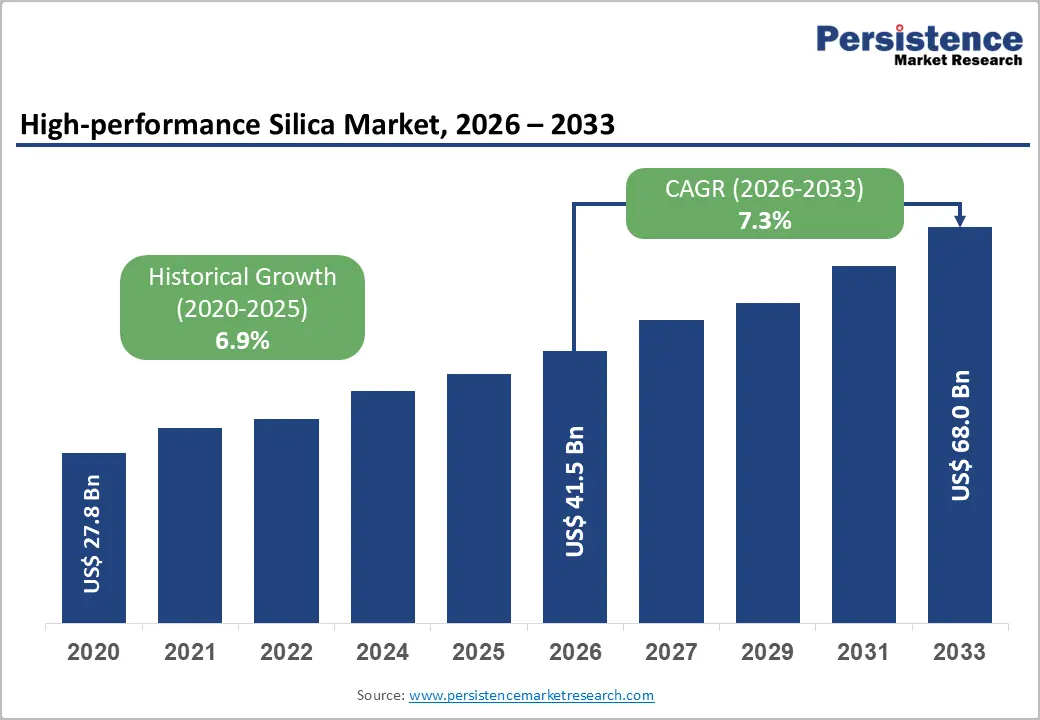
The global High-performance Silica market size is likely to be valued at US$ 41.5 billion in 2026 and is expected to reach US$ 68.0 billion by 2033, growing at a CAGR of 7.3% during the forecast period from 2026 to 2033.
The high-performance silica market is on a sustained upward trajectory, primarily driven by surging demand from the tire and rubber industry for fuel-efficient silica compounds, rapid expansion in semiconductor fabrication that requires ultra-high-purity silica, and accelerating adoption in battery and energy applications.
Key Industry Highlights:
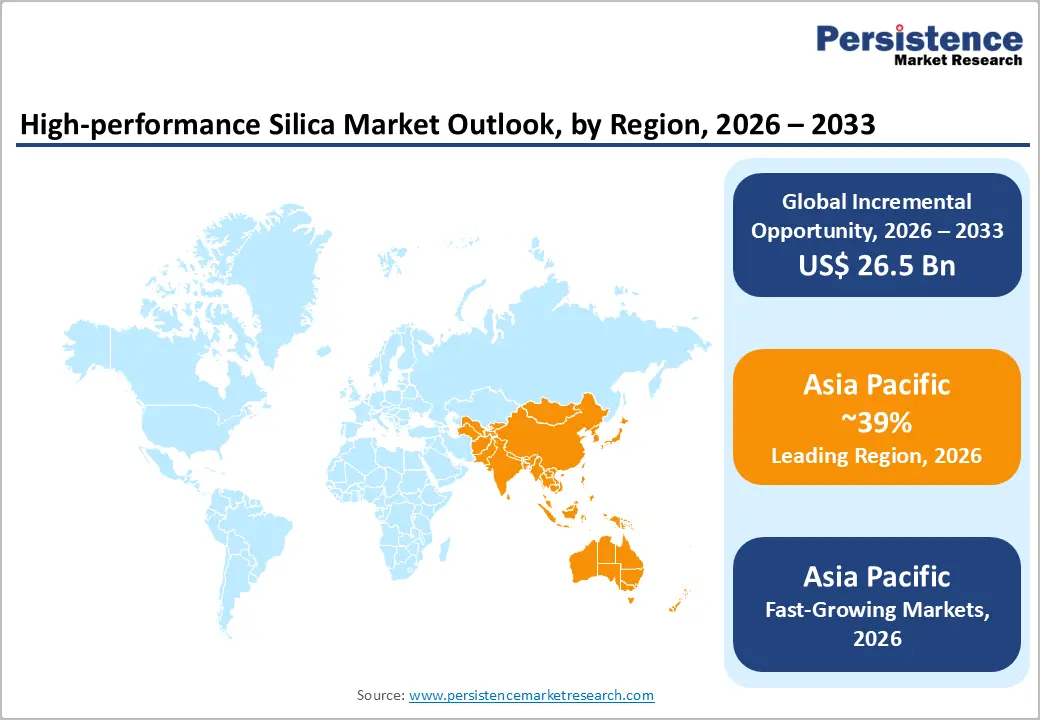
- Leading Region: Asia Pacific leads the global high-performance silica market holding 39% share, with China as the world's largest producer and consumer, supported by Japan's ultra-high purity silica technology leadership and India's rapidly expanding tire and electronics manufacturing base.
- Fastest Growing Region: Asia Pacific also registers the fastest growth with riing CAGR of 8.3%, driven by China's 14th Five-Year Plan investments in specialty chemicals, India's PLI-backed electronics and tire sector expansion, and growing ASEAN automotive and consumer goods manufacturing activities.
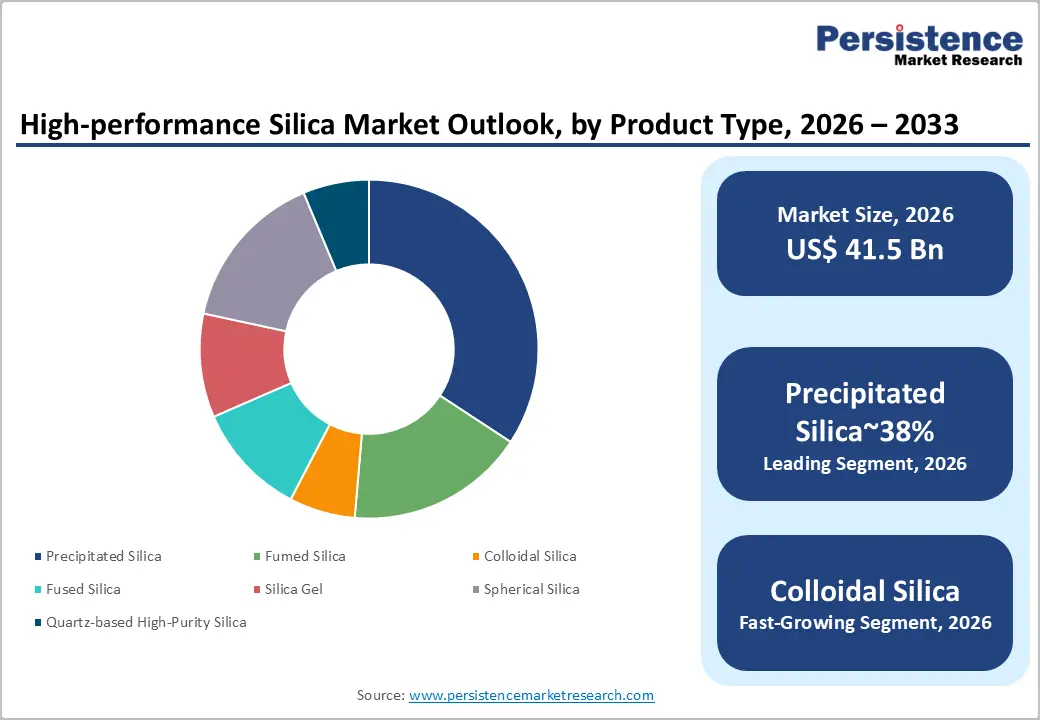
- Dominant Product Segment: Precipitated silica dominates by product type with approximately 38% market share, driven by its indispensable role as a reinforcing agent in green tire formulations aligned with EU tire labeling and global fuel efficiency regulations.
- Fastest Growing Segment: The electronics & semiconductors application segment is the fastest growing, powered by massive global fab construction investments under the U.S. CHIPS Act and EU Chips Act, driving demand for ultra-high purity silica in CMP slurries and encapsulants.
- Key Opportunity: Silicon-silica composite anode materials for EV lithium-ion batteries represent a high-growth opportunity, with IEA data showing 14 million EV sales in 2023 and battery manufacturers actively qualifying silicon-based anodes for next-generation cell platforms.
Market Dynamics
Drivers - Stringent Fuel Efficiency and Tire Labeling Regulations Fueling Precipitated Silica Demand
Global regulatory mandates targeting vehicle fuel efficiency and carbon emissions are a powerful structural driver for high-performance precipitated silica in the tire industry. The European Union's tire labeling regulation (EU) No. 1222/2009, updated in 2021, grades tires on rolling resistance, wet grip, and noise, pushing tire manufacturers to adopt silica-reinforced compounds.
Silica-reinforced tires reduce rolling resistance by up to 20% compared to carbon-black alternatives, thereby improving fuel economy. The International Energy Agency (IEA) reports that road transport accounts for approximately 16% of global CO2 emissions, intensifying pressure on tire performance standards. Leading players, including Evonik Industries AG and Solvay S.A., supply dedicated high-performance precipitated silica grades specifically engineered for green tire applications.
Explosive Growth in Semiconductor and Advanced Electronics Manufacturing
The global semiconductor industry's unprecedented capital investment cycle is driving outsized demand for ultra-high-purity fumed and spherical silica. According to the Semiconductor Industry Association (SIA), global semiconductor sales exceeded US$ 520 billion in 2023, with hundreds of new fab projects announced globally through 2030.
Silica with purity levels of ≥ 99.99% and above is indispensable in chemical mechanical planarization (CMP) slurries, semiconductor encapsulants, and high-purity crucibles for silicon wafer production. The U.S. CHIPS and Science Act (allocating US$ 52 billion for domestic chip manufacturing) and the EU Chips Act are catalyzing greenfield fab construction that will require sustained high-purity silica supply, making this one of the most strategically important demand pillars for market participants.
Restraints - Energy-Intensive Production Processes and Volatile Raw Material Costs
Manufacturing high-performance silica, particularly fumed and fused silica grades, is highly energy-intensive, requiring high-temperature synthesis above 1,000°C. Rising natural gas and electricity prices, which surged across Europe by over 200% during the 2021–2022 energy crisis, per Eurostat, directly compress producer margins.
Silica production is also dependent on raw quartz and silicon tetrachloride feedstocks, which are subject to supply chain disruptions and price volatility. These input cost pressures create significant operational challenges for manufacturers, especially in Western markets competing against lower-cost Asian producers, limiting the pace of capacity expansions.
Occupational Health Concerns Related to Silica Dust Exposure
Regulatory scrutiny of crystalline silica dust exposure poses a compliance burden on manufacturers and downstream processors. The U.S. Occupational Safety and Health Administration (OSHA) lowered the permissible exposure limit (PEL) for respirable crystalline silica to 50 µg/m³ (as an 8-hour TWA) in 2016, requiring significant investment in engineering controls, respiratory protection programs, and medical surveillance.
These compliance requirements increase total operating costs, particularly for smaller manufacturers and end-users in rubber processing, construction, and coatings. Negative health perceptions also influence purchasing decisions in certain end-use sectors, creating substitution pressure in some applications.
Opportunities - Rising Adoption of Silica in Lithium-Ion Battery Anodes for EVs
The transition to electric vehicles (EVs) is unlocking a transformative demand opportunity for high-performance silica in next-generation battery anode materials. Silicon-based anodes incorporating silica compounds offer a theoretical energy density up to 10 times that of conventional graphite, enabling a longer driving range. The International Energy Agency (IEA) reported that global EV sales surpassed 14 million units in 2023, with the installed base continuing to expand rapidly through 2030.
Battery manufacturers such as Panasonic, Samsung SDI, and CATL are actively qualifying silicon-silica composite anode materials. For silica producers, developing battery-grade, ultra-high purity spherical and colloidal silica products tailored for anode applications represents a high-growth, premium-priced market segment that could contribute significantly to revenue by the end of the forecast period.
High-Purity Silica Demand in Photovoltaic and Semiconductor-Grade Crucibles
The global solar energy boom is driving strong demand for high-purity quartz, used to manufacture fused quartz crucibles for Czochralski silicon crystal growth, a critical step in solar wafer and semiconductor production. The International Renewable Energy Agency (IRENA) projects global solar PV capacity to reach 5,000 GW by 2030, driving massive scale-up of silicon wafer production.
High-purity quartz with ≥99.99% SiO2 content is a scarce, specialized input, and securing a long-term supply is a strategic priority for solar and semiconductor manufacturers. Companies such as Tokuyama Corporation and AGC Inc. are expanding their high-purity silica production capacities to capture this structural demand wave, presenting a compelling growth avenue for market participants with specialized processing capabilities.
Category-wise Analysis
By Product Type Insights
Precipitated Silica leads the high-performance silica market by product type, commanding an estimated market share of approximately 38%. Its dominance is anchored in the tire and rubber industry, where it is the primary reinforcing filler in green tire formulations. The European Tire & Rubber Manufacturers' Association (ETRMA) notes that precipitated silica has increasingly displaced carbon black as the preferred reinforcing agent in passenger car tire treads, driven by requirements for rolling resistance and wet grip performance.
Precipitated silica's scalable wet-chemistry synthesis route, functional surface chemistry (enabling silane coupling), and compatibility with diverse rubber matrices make it the most commercially versatile and widely produced silica grade. Evonik's ULTRASIL and Solvay's Zeosil product lines exemplify premium precipitated silica offerings for this segment.
By Purity Level Analysis
The ≥99% purity segment holds the largest share of the high-performance silica market by purity level, at approximately 42%. This segment encompasses the broadest range of industrial applications, including rubber reinforcement, coatings, adhesives, and general-purpose plastics, where ultra-high purity is not a prerequisite. The high volume demand from tire manufacturing, the single largest application, is the primary driver.
However, the ≥ 99.99% and ≥ 99.999% purity segments are the fastest-growing, fueled by semiconductor CMP, solar crucible, and pharmaceutical applications that require minimal trace metal contamination. Increasing semiconductor fab investments under the CHIPS Act are accelerating the adoption of specification upgrades toward these ultra-high-purity grades.
By Form Analysis
Powder is the dominant form segment in the high-performance silica market, holding an estimated 45% share. Powdered silica offers superior handling versatility, ease of incorporation into rubber, polymer, and coating formulations, and compatibility with conventional mixing equipment used across industries. Precipitated and fumed silica are most commonly supplied in powder form, making this the default commercial presentation for the largest application segments, including rubber & tires and plastics & polymers.
The ASTM International classifies various powder silica grades by particle size distribution and BET surface area, enabling precise specification for different end-use requirements. Advances in low-dust and compacted powder technologies from suppliers such as Cabot Corporation and Wacker Chemie AG are further reinforcing this segment's market position.
By Application Insights
Rubber & Tires dominates the application segment with an estimated market share of approximately 35%, reflecting the critical role of high-performance silica as a reinforcing filler in modern tire compounds. Silica reinforcement improves tear strength, abrasion resistance, and dynamic properties, while its unique contribution to reducing rolling resistance is irreplaceable in fuel-efficient and electric vehicle tire designs.
The World Tire Market Report by the German Association of the Rubber Industry (WdK) indicates global tire production exceeds 2.5 billion units annually, creating a vast and recurring demand base. The Electronics & Semiconductors application is the fast-growing sub-segment, driven by rising fab capacity and CMP slurry demand, positioning it as a key future revenue contributor for silica manufacturers.
By End-user Insights
The Automotive end-use segment leads the high-performance silica market, representing an estimated 33% share of the overall market. Automotive demand encompasses tire manufacturing, under-hood rubber components, gaskets and seals, silica-filled engineering plastics, and noise-damping coatings.
The accelerating EV transition is amplifying automotive silica consumption. EVs require low-rolling-resistance tires (higher silica loading), battery components (silicon-silica anode composites), and lightweight structural materials. According to the International Organization of Motor Vehicle Manufacturers (OICA), global vehicle production exceeded 93 million units in 2023. The Electrical & Electronics end-use is the fastest-growing segment, with semiconductor fab investments driving demand for high-purity silica at an above-average growth rate.
Regional Insights
North America High-performance Silica Market Trends & Analysis
North America represents ~24% of the global high-performance silica market in 2026, translating to an estimated US$ 10.8 billion. Growth is driven by semiconductor investments under the CHIPS Act, strong green tire adoption, and advanced healthcare applications. Increasing domestic sourcing of high-purity quartz and silica processing is strengthening supply chain resilience.
- U.S. High-performance Silica Market Size
The U.S. dominates North America with ~85% regional share, valued at approximately US$ 8.5 billion in 2026. Semiconductor fabrication expansion, EV-driven tire demand, and regulatory support for fuel efficiency are key growth drivers. Demand for high-purity silica for CMP and encapsulation is rising significantly.
Europe High-performance Silica Market Trends, Drivers & Insights
Europe accounts for ~22% of the global market, reaching approximately US$ 8.3 billion in 2026. Strong regulatory frameworks such as the European Green Deal and REACH are accelerating the adoption of premium silica grades. Growth is supported by tire innovation, semiconductor investments, and expanding demand for composites in the aerospace and automotive sectors.
- Germany High-performance Silica Market Size
Germany leads Europe with ~30% regional share, estimated at US$ 2.7 billion in 2026. Its dominance stems from a strong automotive and tire manufacturing base, coupled with advanced chemical production capabilities. Demand for precipitated silica in high-performance tires and industrial rubber applications remains robust.
- U.K. High-performance Silica Market Size
The U.K. holds ~14% of the European market, valued at US$ 1.0 billion in 2026. Growth is supported by increasing semiconductor design activities, specialty coatings, and healthcare applications. Sustainability initiatives and advanced materials research are further driving demand for high-purity silica grades.
- France High-Performance Silica Market Size
France accounts for ~15% share, estimated at US$ 1.3 billion in 2026. The market benefits from strong growth in the aerospace, automotive, and specialty chemicals industries. Rising demand for silica in coatings, adhesives, and composites, along with sustainability-driven innovation, supports steady growth.
Asia Pacific High-performance Silica Market Drivers & Analysis
Asia Pacific dominates with ~39% global share, reaching US$ 17.5 billion in 2026. Rapid industrialization, large-scale tire manufacturing, and electronics production are key growth drivers. Government support for specialty chemicals and semiconductor ecosystems further accelerates demand for high-performance silica.
- China High-performance Silica Market Size
China leads globally with ~55% of the Asia Pacific share, estimated at US$ 9.8 billion in 2026. Strong domestic production, government-backed industrial policies, and large-scale tire and electronics manufacturing drive demand. Capacity expansions in precipitated and fumed silica reinforce its global leadership.
- India High-performance Silica Market Size
India accounts for ~10% of Asia Pacific, valued at US$ 1.8 billion in 2026. Growth is fueled by its rapidly expanding tire industry, increasing automotive production, and government incentives such as PLI schemes. Rising pharmaceutical and electronics manufacturing also contribute to silica demand.
- Japan High-performance Silica Market Size
Japan holds ~12% regional share, estimated at US$ 2.1 billion in 2026. The country leads in ultra-high purity silica technology, supporting the semiconductor and electronics industries. Strong innovation capabilities and advanced material applications sustain demand for premium silica products.
Competitive Landscape
The high-performance silica market is moderately consolidated at the top tier, with Evonik Industries AG, Solvay S.A., Wacker Chemie AG, and Cabot Corporation collectively commanding significant global share in precipitated and fumed silica. The ultra-high purity and specialty silica segments are more fragmented, featuring niche specialists such as Tokuyama and AGC Inc.
Key differentiation strategies include proprietary surface treatment technologies, application-specific product portfolios, and long-term supply agreements with tier-1 tire and semiconductor customers. R&D investment is focused on battery-grade silica, electronic CMP slurry grades, and sustainable manufacturing processes. Strategic capacity expansions in Asia and supply chain localization are dominant growth strategies among leading players.
Key Market Developments
- February, 2025: Evonik Industries AG announced the expansion of its ULTRASIL precipitated silica production capacity in Asia to meet rising demand from the green tire segment and electric vehicle battery component markets across the region.
- October, 2024: Wacker Chemie AG launched a new line of high-purity pyrogenic silica grades specifically designed for semiconductor CMP slurry applications, targeting the growing fab construction pipeline in the U.S. and Europe under CHIPS Act programs.
- June, 2024: Tokuyama Corporation commenced commercial production of advanced spherical silica for semiconductor packaging underfill and molding compound applications, catering to the rising demand from advanced chip packaging technology transitions.
Global High-performance Silica Market- Key Insights
| Key Insights | Details |
|---|---|
|
Historical Market Value (2020) |
US$ 27.8 Bn |
|
Current Market Value (2026) |
US$ 41.5 Bn |
|
Projected Market Value (2033) |
US$ 68.0 Bn |
|
CAGR (2026-2033) |
7.3% |
|
Leading Region |
Asia Pacific, 39% share |
|
Dominant Product Type |
Precipitated Silica, 38% share |
|
Top-ranking End Use |
Automotive, 33% |
|
Incremental Opportunity |
US$ 26.5 Bn |
Companies Covered in High-performance Silica Market
- Evonik Industries AG
- Solvay S.A.
- Wacker Chemie AG
- Cabot Corporation
- W.R. Grace & Co.
- PPG Industries Inc.
- Tokuyama Corporation
- Tosoh Silica Corporation
- Nouryon
- OCI Company Ltd.
- Fuji Silysia Chemical Ltd.
- Quechen Silicon Chemical Co., Ltd.
- Madhu Silica Pvt. Ltd.
- AGC Inc.
- Mitsubishi Chemical Corporation
- Shin-Etsu Chemical Co., Ltd.
- Oriental Silicas Corporation
- Elkem ASA
Frequently Asked Questions
The global high-performance silica market is estimated to reach US$ 41.5 billion in 2026 and is projected to grow to US$ 68.0 billion by 2033, expanding at a CAGR of 7.3% during the forecast period. Historically, the market recorded a CAGR of 6.9% between 2020 and 2025, underpinned by consistent demand from tire, electronics, and chemicals industries.
The primary drivers include stringent global tire labeling and fuel efficiency regulations (such as the EU tire labeling regulation), accelerating adoption of precipitated silica in green tires, and rapid semiconductor industry expansion, with the U.S. CHIPS Act committing US$ 52 billion to domestic chip manufacturing, generating strong demand for ultra-high purity fumed and spherical silica grades.
Precipitated Silica leads the market by product type with an estimated 38% share. Its dominance is driven by widespread adoption in the tire and rubber industry, where it is the preferred reinforcing filler in fuel-efficient green tire formulations. The ETRMA highlights its increasingly central role in passenger car tire tread compounds meeting EU rolling resistance standards.
Asia Pacific is the leading region, accounting for the largest share of global high-performance silica consumption and production. China is the dominant force, supported by Japan's specialized high-purity silica capabilities and India's expanding tire and electronics manufacturing sectors. China's 14th Five-Year Plan investment in specialty chemicals further reinforces the region's market leadership.
The most significant near-to-medium term opportunity is in battery-grade silica for EV lithium-ion anode applications. With global EV sales exceeding 14 million units in 2023 per the IEA, battery manufacturers are scaling silicon-silica composite anode materials that offer up to 10 times higher energy density than graphite, opening a high-margin, rapidly growing premium product category for specialty silica producers.
Major companies include Evonik Industries AG, Solvay S.A., Wacker Chemie AG, Cabot Corporation, W.R. Grace & Co., PPG Industries Inc., Tokuyama Corporation, Tosoh Silica Corporation, Nouryon, OCI Company Ltd., Fuji Silysia Chemical Ltd., Quechen Silicon Chemical Co., Ltd., Madhu Silica Pvt. Ltd., AGC Inc., and Mitsubishi Chemical Corporation, among other regional and specialist producers.


