




- Off-Road Equipment & Machinery
- Heavy Construction Equipment Market
Heavy Construction Equipment Market Size, Share, and Growth Forecast, 2026 - 2033
Heavy Construction Equipment Market By Equipment Type (Earthmoving Equipment, Material Handling Equipment), Machinery Type (Excavators, Loaders), Application, End User and Regional Analysis for 2026 - 2033

Heavy Construction Equipment Market Size and Trends Analysis
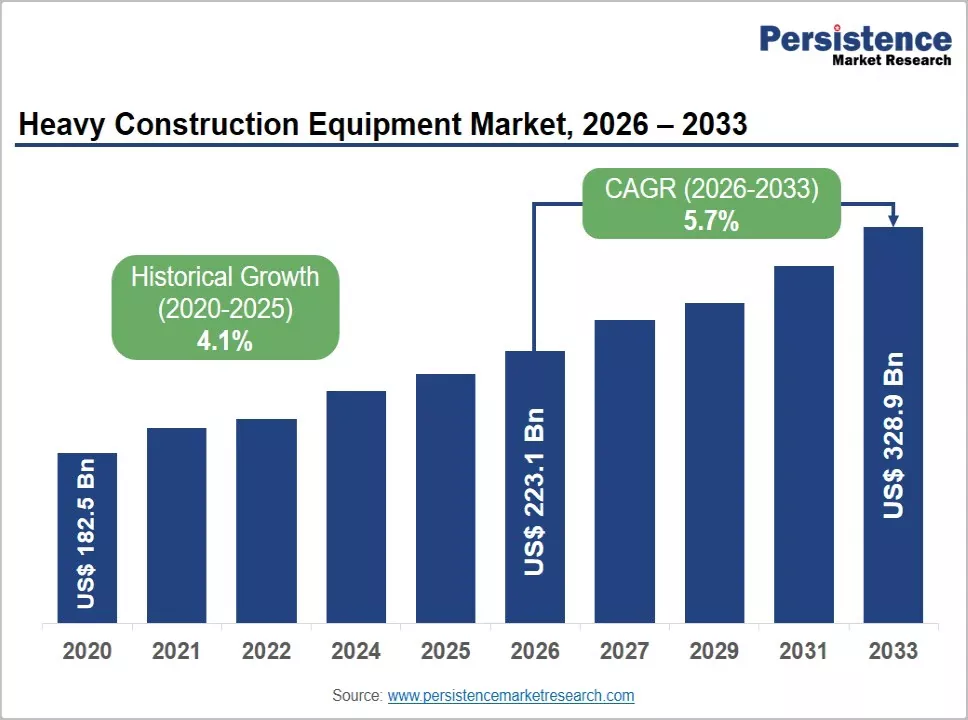
The global heavy construction equipment market size is likely to be valued at US$ 223.1 billion in 2026 and is expected to reach US$ 328.9 billion by 2033, growing at a CAGR of 5.7% between 2026 and 2033, driven by sustained infrastructure investment, equipment replacement cycles, and rising adoption of electrified, connected, and autonomous machinery.
Contractors and mining operators are increasingly prioritizing fleet productivity, fuel efficiency, and lower lifecycle costs, which supports demand for advanced earthmoving, lifting, and material handling equipment.
Key Industry Highlights
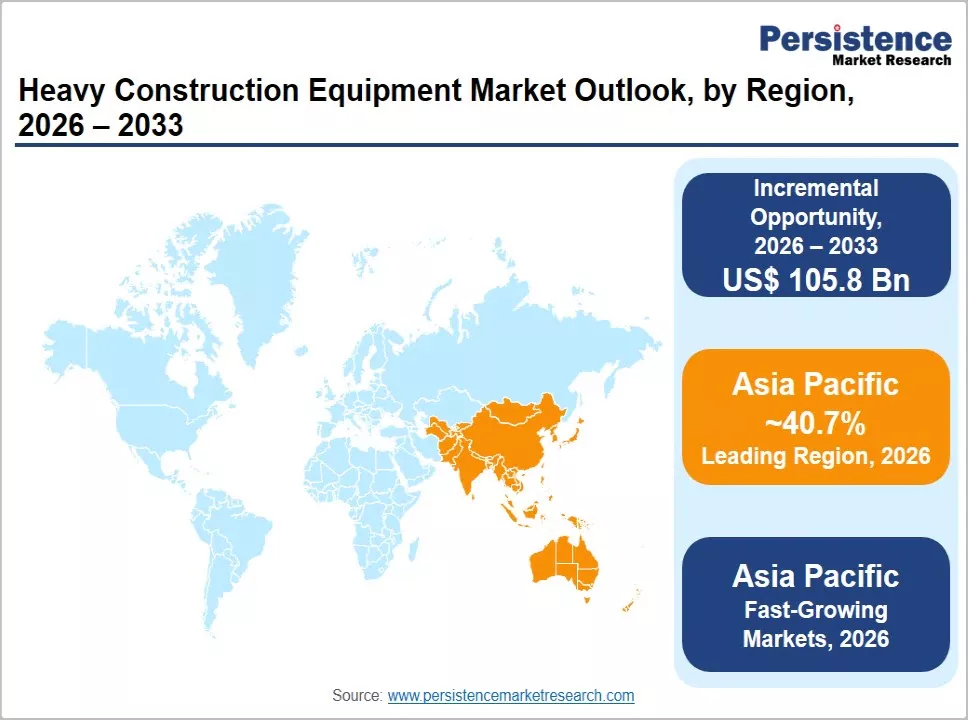
- Leading and Fastest-growing Region: Asia Pacific, anticipated to account for approximately 40.7% of the market share, supported by large-scale infrastructure programs, strong equipment production capacity, and expanding mining and urban development activity.
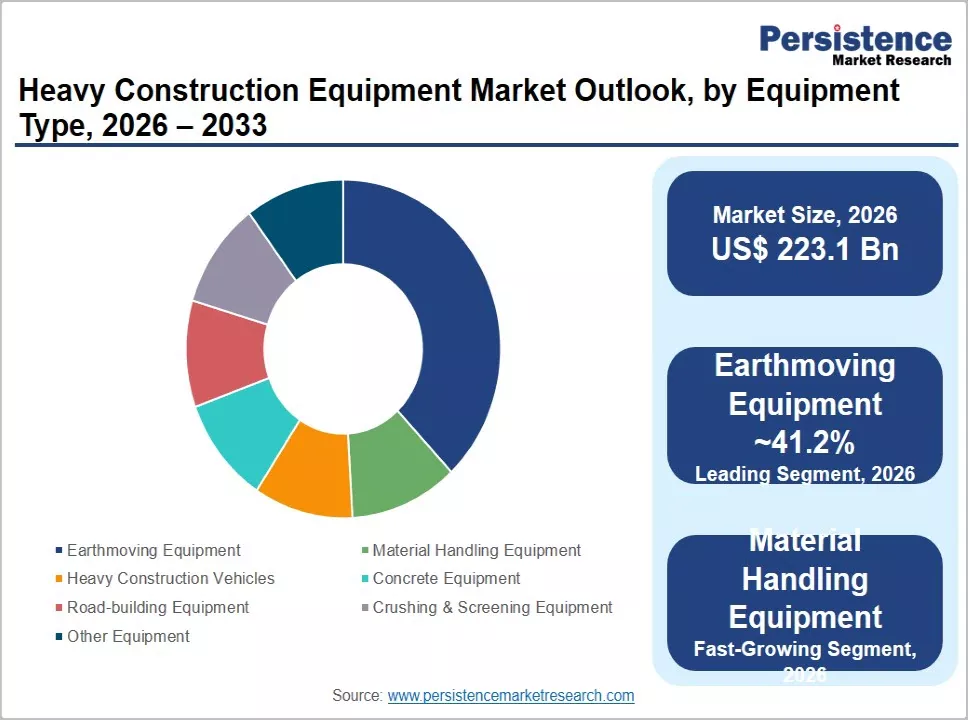
- Dominant Equipment Type: Earthmoving equipment, anticipated to hold approximately 41.2% of the market in 2026, driven by continuous demand for excavators, loaders, dozers, and graders across construction, mining, and road projects.
- Leading Application: Excavation and demolition, anticipated to account for approximately 36.5% of the market share in 2026, supported by site preparation, urban redevelopment, and foundation work.
DRO Analysis
Drivers - Infrastructure Investment and Fleet Replacement Are Sustaining Equipment Demand
Public infrastructure programs are the largest structural source of demand for heavy construction equipment. The U.S. Infrastructure Investment and Jobs Act, with US$1.2 trillion in total funding for roads, bridges, rail, ports, and water systems, continues to support machinery utilization across North America. Germany's EUR 500 billion infrastructure and climate special fund and the U.K.'s ten-year infrastructure strategy are expected to extend this pattern across Europe.
Large civil projects require excavators, loaders, dozers, cranes, and road-building machinery in sequence, which lengthens equipment utilization cycles. Rising rental and replacement demand is also anticipated as contractors renew aging fleets to meet emission standards and productivity targets.
Electrification, Automation, and Connected Fleet Technologies Are Raising Equipment Value
Manufacturers are integrating electric drivetrains, telematics, machine control, and artificial intelligence into heavy equipment. In January 2026, Caterpillar introduced Cat AI Assistant to support equipment purchasing, maintenance, and operation, while its fleet platform draws on data from approximately 1.6 million connected assets. Such tools help owners manage uptime and support less experienced operators amid skilled labor shortages.
Electrification is also advancing, with Volvo Construction Equipment delivering the world's first electric articulated haulers for a hydropower project in Norway. Advanced machines carry higher purchase prices, but lower fuel and maintenance costs are anticipated to improve total ownership economics and support replacement demand.
Restraint - High Capital Costs and Supply Chain Volatility Constrain Equipment Investment
High capital costs remain a structural challenge for the heavy construction equipment market. Large excavators, cranes, and haul trucks require substantial upfront investment, and financing costs directly influence fleet purchase decisions among contractors and rental companies. Trade measures, steel price movements, and component shortages add further uncertainty to manufacturing costs and delivery schedules.
Demand cycles in construction also affect order volumes. India's domestic construction equipment sales declined approximately 7% in fiscal year 2026, while exports grew more than 30%, which illustrates how regional demand swings influence manufacturer revenue. Lower-emission engine requirements also raise development and compliance costs.
Opportunities - Electric and Autonomous Equipment Create New Product Categories
Electric and autonomous machinery represents a significant opportunity as contractors seek lower emissions and improved jobsite safety. Compact and mid-size electric loaders and excavators are reaching commercial availability faster than larger categories, while manufacturers including Volvo Construction Equipment, Caterpillar, Komatsu, and Hitachi Construction Machinery are expanding battery-electric portfolios.
Autonomy is advancing in quarry and mining applications, where Komatsu and Pronto launched an autonomy solution for quarry trucks. Urban projects in low-emission zones are expected to favor electric machines, creating demand for charging infrastructure, battery services, and software. Manufacturers that combine battery systems, software, and service contracts are expected to secure longer-term customer relationships.
Remanufacturing, Rental, and Aftermarket Services Offer Recurring Revenue Potential
Lifecycle services are an expanding opportunity as fleet owners seek to reduce total cost of ownership. Komatsu's remanufacturing transaction volume increased approximately fourfold from fiscal year 2010 to fiscal year 2024, and its remanufacturing network reached 45 locations across 16 countries by 2025. Components recovered from used equipment are restored to like-new condition at lower cost and shorter lead times than new parts.
Digital maintenance platforms, equipment rental, and used-equipment channels are also expanding as contractors manage utilization more carefully. Manufacturers with strong dealer networks and data platforms are positioned to capture service revenue across the machine lifecycle.
Category-wise Analysis
Equipment Type Insights
Earthmoving equipment is anticipated to account for approximately 41.2% of the market share in 2026. The segment includes excavators, loaders, dozers, and graders, which are used in nearly every construction, mining, and road project. Excavators alone represent approximately 29% of the market by machinery type, reflecting their versatility across site preparation, trenching, demolition, and material loading. For example, a highway project typically deploys excavators for cut-and-fill work, dozers for grading, and loaders for aggregate handling within a single construction phase. Rental fleets also favor earthmoving machines because of their high utilization across multiple project types. Replacement of aging fleets and growth in infrastructure spending continue to support demand, while telematics and machine control are increasing the value of each unit sold. Dealer networks and parts availability remain important purchase criteria, particularly for contractors operating in remote locations.
Material handling equipment is projected to be the fastest-growing equipment type, expanding at a CAGR of approximately 8.5%. The segment includes cranes, telescopic handlers, and lifting equipment, with demand driven by high-rise construction, industrial facilities, renewable energy installations, and logistics infrastructure. For example, wind farm and data center projects require large crawler cranes and telescopic handlers for the placement of heavy components. Loaders are also among the fastest-growing machine classes, as compact and mini loaders gain adoption on urban and space-constrained sites. Electrification and remote operation features are expected to further broaden adoption in the segment. Crane demand is further supported by power transmission, port, and renewable energy projects that involve heavy lifts.
Application Insights
Excavation and demolition is anticipated to account for approximately 36.5% of the market share in 2026. The segment benefits from continuous site preparation, urban redevelopment, foundation work, and building renewal across residential, commercial, and infrastructure projects. The construction industry remains the largest end user, representing approximately 50.3% of the market in 2026. For example, redevelopment of dense urban areas requires compact and mid-size excavators fitted with hydraulic breakers and demolition attachments, which increases the use of high-precision, low-emission equipment. Rental companies are also adding demolition-ready machines to meet short-duration project requirements. Growth in building renovation and brownfield redevelopment is also increasing the number of demolition projects in mature economies.
Recycling and waste management is projected to be the fastest-growing application, expanding at a CAGR of approximately 9.3%, driven by sustainability regulations and circular economy initiatives. Material handlers, wheel loaders, and crushing and screening equipment are used to sort, process, and move construction and demolition waste at recycling facilities. For example, recycled aggregate plants increasingly use mobile crushers and high-capacity loaders to process concrete and asphalt into reusable material. Mining is the fastest-growing end user at approximately 9% projected growth, supported by resource demand and equipment upgrades, which also increases demand for large excavators, haul trucks, and loaders. Mining operators are also upgrading equipment fleets to improve productivity and fuel efficiency.
Regional Insights
North America Heavy Construction Equipment Market Trends
North America is anticipated to remain a leading regional market, supported by infrastructure renewal, mining activity, and a large installed base of earthmoving equipment. Fleet modernization, rental market growth, and demand for technology-enabled machines are shaping purchasing decisions. A shortage of skilled operators is increasing interest in automation, telematics, and machine-control systems that improve productivity per operator. Rental companies continue to expand fleets of compact and mid-size machines, which supports steady unit demand outside large project cycles.
U.S. Heavy Construction Equipment Market Trends
The U.S. is the dominant market in North America, supported by federal infrastructure funding under the Infrastructure Investment and Jobs Act, strong rental markets, and sustained mining and quarry activity. In January 2026, Caterpillar introduced Cat AI Assistant at CES 2026, a conversational tool built on its Helios data platform to support equipment buying, maintenance, and operation. The launch reflects the industry shift toward digital services that improve uptime and reduce dependence on scarce skilled labor.
In February 2026, Komatsu North America agreed to acquire the assets of SRC of Lexington, a Kentucky-based remanufactured components supplier, to expand remanufacturing capacity in the U.S.. Komatsu is also building a new service facility in Mesa, scheduled for completion in 2026, to support mining customers. Separately, Fayat Group announced the acquisition of road equipment manufacturer LeeBoy from ST Engineering, pending regulatory approval, which expands its presence in U.S. road construction and maintenance equipment.
Canada Heavy Construction Equipment Market Trends
Canada represents an important secondary market, supported by mining, energy, and infrastructure projects across its resource-driven economy. Komatsu announced an Edmonton parts distribution center, scheduled to open in early 2026, which transitions from a regional depot to a fully integrated hub within its North American logistics network. Contractors and mining companies increasingly require strong parts availability and service coverage across remote regions, which supports demand for dealer networks and remanufacturing services.
Europe Heavy Construction Equipment Market Trends
Europe is a mature market characterized by strict emission regulations, high adoption of electric machinery, and active infrastructure renewal programs. The EU Stage V regulation for non-road mobile machinery engines continues to influence product development and replacement decisions. Manufacturers are prioritizing the region for the launch of larger battery-electric excavators and loaders, supported by urban low-emission requirements. Noise and emission limits increasingly apply to urban worksites, which supports adoption of electric machinery. Volvo Construction Equipment delivered the world's first electric articulated haulers, the Volvo A30 Electric, to LNS in Norway for use on a hydropower project.
Germany Heavy Construction Equipment Market Trends
Germany is the largest construction equipment market in Europe, supported by a strong construction sector and a domestic manufacturing base that includes Liebherr's earthmoving and crane production and Deere & Company's Wirtgen Group road-building operations. The government's EUR 500 billion special fund for infrastructure and climate neutrality is expected to increase public spending on roads, bridges, railways, and energy networks, which supports demand for earthmoving, road-building, and lifting equipment.
U.K. Heavy Construction Equipment Market Trends
The U.K. is an important market for heavy equipment, supported by transport, energy, and housing infrastructure projects under its ten-year infrastructure strategy. The country is also a manufacturing base, as JCB produces backhoe loaders, telescopic handlers, and excavators in the UK. Rental-led equipment distribution and low-emission requirements are increasing demand for electric and hybrid machinery, while service expansion by global manufacturers is strengthening aftersales coverage.
Asia Pacific Heavy Construction Equipment Market Trends
Asia Pacific is the leading and fastest-growing regional market, holding approximately 40.7% of the market share. Urbanization, large infrastructure programs, mining expansion, and strong local manufacturing capacity support regional demand. Manufacturers in China, Japan, South Korea, and India are also expanding exports, which strengthens the region's role as both a demand center and a production hub. Government investment in transport corridors, housing, and industrial parks further supports equipment purchases across the region.
China Heavy Construction Equipment Market Trends
China is one of the two largest equipment markets globally and the main production base in the region. According to the China Construction Machinery Association, excavator sales reached 235,257 units in 2025, up 17% year-on-year, and construction machinery exports reached US$60.169 billion, up 13.8%. In the first half of 2026, excavator sales increased 26.4% year-on-year to 152,320 units, with exports growing 33.5% to 73,295 units and domestic sales rising 20.4% to 79,025 units.
The industry has entered an equipment renewal cycle, and manufacturers such as XCMG, SANY, and Zoomlion are expanding in overseas markets, supported by Belt and Road cooperation, while introducing electric excavators and loaders.
India Heavy Construction Equipment Market Trends
India is the third-largest construction equipment market globally, with sales of 136,995 units in fiscal year 2026, according to the Indian Construction Equipment Manufacturers Association. Government incentives for manufacturing investment are expected to support supply chain migration to India, strengthening its position as a manufacturing and export hub for excavators and other equipment. Rising demand from road construction, mining, and urban infrastructure projects is also supporting sales of backhoe loaders, excavators, and cranes in the domestic market.
Competitive Landscape
The global heavy construction equipment market is moderately consolidated, with a group of global manufacturers holding strong positions across earthmoving, lifting, and road-building equipment, alongside fast-growing Chinese manufacturers expanding in export markets. Caterpillar, Komatsu, Volvo Construction Equipment, Hitachi Construction Machinery, Deere & Company, XCMG, and SANY are among the leading participants. Companies compete based on product breadth, dealer and service networks, financing capabilities, fuel efficiency, electrification, and digital fleet management. Regional manufacturers compete on price and local customization, while global manufacturers differentiate through technology, aftersales support, and lifecycle services.
Leading companies are focusing on electrification, automation, telematics, dealer network expansion, and remanufacturing. Competitive differentiation increasingly depends on the ability to connect machines with data and services. Companies are also adopting rental-friendly designs, flexible financing, and modular product platforms to reach contractors of different sizes.
Key Industry Developments
- In January 2026, Caterpillar introduced Cat AI Assistant, a conversational AI solution built on its Helios data platform, to support equipment purchasing, maintenance, and operation, strengthening its position in connected and digital fleet services.
- In January 2026, Volvo Construction Equipment completed its acquisition of Swecon, including operations in Sweden, Germany, and the Baltics, to strengthen retail and service sales in key European markets.
- In February 2026, Komatsu North America agreed to acquire the assets of SRC of Lexington to expand remanufacturing capacity in the U.S. and support customers across construction and mining.
- In August 2026, Hitachi Construction Machinery and Yanmar began exploring a collaboration in compact equipment, reflecting efforts to broaden portfolios in the compact segment.
Companies Covered in Heavy Construction Equipment Market
- Caterpillar Inc.
- Komatsu Ltd.
- Volvo Construction Equipment
- Hitachi Construction Machinery Co., Ltd.
- Deere & Company
- XCMG Group
- SANY Group
- Liebherr Group
- Zoomlion Heavy Industry Science & Technology Co., Ltd.
- HD Hyundai Construction Equipment
- JCB (J.C. Bamford Excavators Ltd.)
- CNH Industrial N.V.
- Kobelco Construction Machinery Co., Ltd.
- Terex Corporation
- Sumitomo Construction Machinery Co., Ltd.
Frequently Asked Questions
The global heavy construction equipment market is projected to be valued at US$ 223.1 billion in 2026.
The market is expected to reach US$ 328.9 billion by 2033.
Key trends include electrification of excavators and loaders, adoption of telematics and AI-enabled fleet management, autonomous equipment in mining and quarrying, growth of remanufacturing and rental services, and rising demand for recycling and waste management equipment.
Earthmoving equipment is anticipated to remain the leading equipment type, accounting for approximately 41.2% of the market in 2026.
The market is projected to expand at a CAGR of 5.7% between 2026 and 2033.
Major companies include Caterpillar, Komatsu, Volvo Construction Equipment, Hitachi Construction Machinery, and Deere & Company.


