




- Energy Storage Solutions
- Grid-scale Battery Storage Market
Grid-scale Battery Storage Market Size, Share, and Growth Forecast 2026 - 2033
Grid-scale Battery Storage Market by Battery Type (Lithium-ion, Lead Acid, Flow Batteries, Others), Application (Renewable Integration, Peak Shaving, Load Shifting, Backup Power, Others), End-user (Utilities, Commercial and Industrial, Residential, Others), and Regional Analysis, 2026 - 2033

Grid-scale Battery Storage Market Size and Trend Analysis
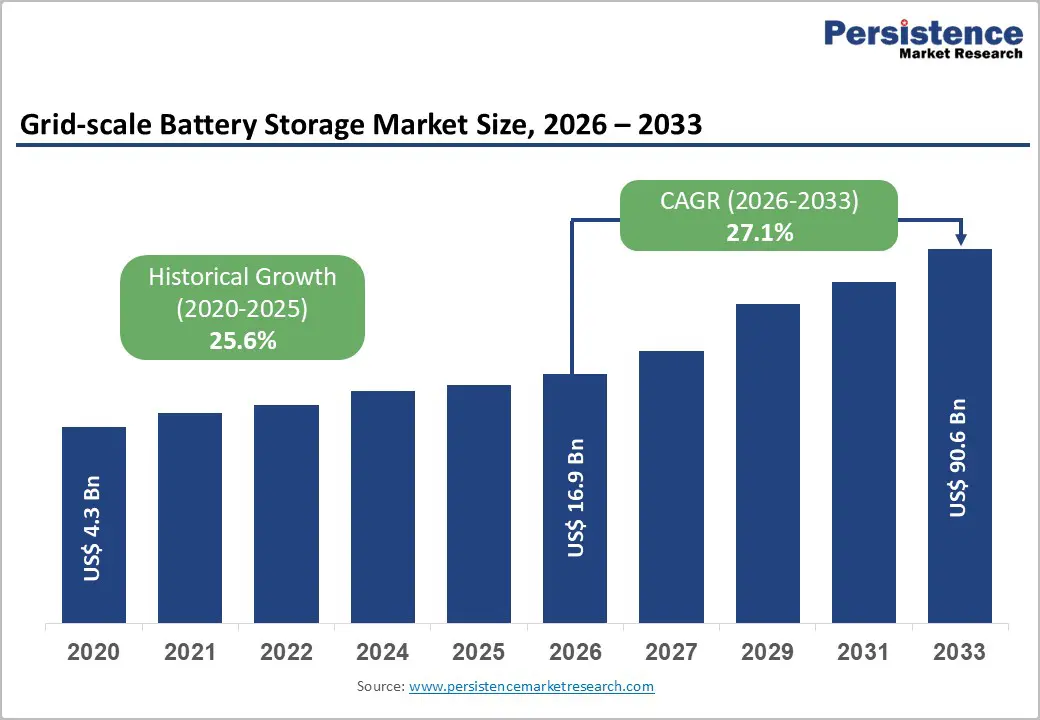
The global grid-scale battery storage market size is expected to be valued at US$ 16.9 billion in 2026 and projected to reach US$ 90.6 billion by 2033, growing at a CAGR of 27.1% between 2026 and 2033. This growth is driven by the increasing integration of renewable energy sources and the need for modernized, resilient grids.
Declining battery costs and supportive policies are enabling utilities and industries to deploy storage solutions at scale, ensuring grid stability, peak management, and backup power. Rising electrification and ambitious clean energy targets further reinforce strong adoption and long-term market potential.
Key Industry Highlights:
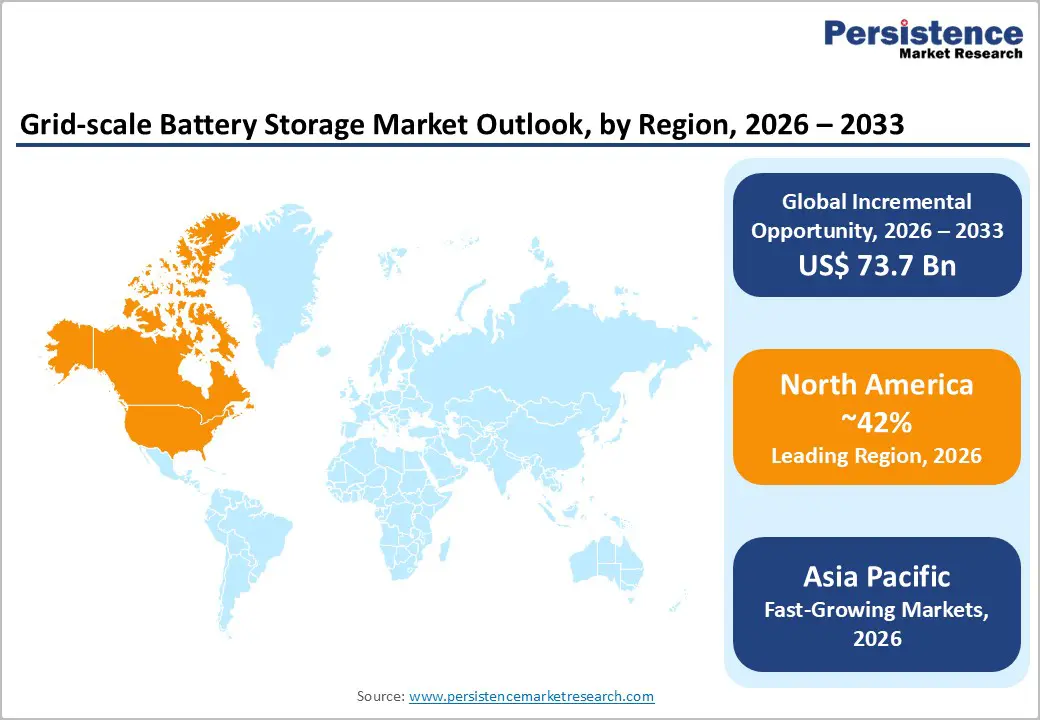
- Leading Region: North America leads the Grid-scale Battery Storage Market with 42% share in 2025, driven by strong U.S. policies and renewable energy integration.
- Fastest-Growing Region: Asia Pacific is the fastest-growing region with a 32% share in 2025, propelled by China’s manufacturing dominance and India’s supportive storage incentives.
- Leading Battery Type: Lithium-ion dominates the market with a 78% share in 2025, favored for its high energy density and efficiency in renewable-heavy grids.
- Fastest-Growing Application: Renewable integration is the fastest-growing application, addressing solar and wind intermittency and supporting hybrid renewable projects.
- Key Opportunity: Policy-driven utility-scale deployments, similar to IRA-style incentives, provide significant opportunities for storage subsidies and accelerated adoption.
| Key Insights | Details |
|---|---|
| Grid-scale Battery Storage Size (2026E) | US$ 16.9 billion |
| Market Value Forecast (2033F) | US$ 90.6 billion |
| Projected Growth CAGR (2026 - 2033) | 27.1% |
| Historical Market Growth (2020 - 2025) | 25.6% |
DRO Analysis
Drivers - Surging Global Renewable Energy Adoption Boosts Storage Demand
The accelerating global transition to renewable energy is a primary driver for grid-scale battery storage, as intermittent solar and wind generation creates a need for reliable energy balancing. Batteries enable utilities to store excess energy during peak generation and discharge it when demand rises, ensuring consistent grid performance. Regions heavily investing in renewables are seeing energy storage become critical for maintaining stability and reducing reliance on fossil fuels.
Supportive policies worldwide further amplify deployment. Incentives like tax credits and subsidies encourage utilities to integrate storage solutions at scale. By enabling continuous renewable integration, these measures help meet ambitious decarbonization targets, improve energy security, and drive sustained investment, positioning battery storage as essential infrastructure for a low-carbon, electrified future.
Declining Battery Costs and Technological Advancements Propel Market Growth
Falling lithium-ion battery costs have dramatically improved the economics of grid-scale storage. Cheaper pack prices allow utilities and industrial players to adopt energy storage at scale, making projects financially viable and increasing return on investment. Alongside cost reductions, innovations in battery chemistry, including safer and longer-lasting cathodes, enhance operational efficiency and lifespan.
These technological improvements support advanced applications such as frequency regulation, peak shaving, and energy arbitrage, increasing system utility. As storage becomes more efficient and reliable, utilities are motivated to expand installations across mature and emerging markets. Combined with ongoing cost declines, these advancements ensure accelerated adoption, reinforcing battery storage as a cornerstone for modern, resilient, and decarbonized electricity grids.
Restraints - High Upfront Capital Investment Limits Market Expansion
The substantial initial expenditure required for grid-scale battery storage remains a major barrier, particularly in emerging and capital-constrained markets. High installation costs, driven by materials, manufacturing, and engineering complexity, make projects financially challenging. Fluctuating commodity prices and limited access to affordable financing exacerbate the issue, often delaying or downsizing planned deployments.
This financial hurdle slows the rollout of large-scale projects and encourages reliance on conventional short-term power solutions. Even with long-term operational savings and efficiency gains, the sheer scale of upfront investment can deter utilities and private developers, restricting market growth and reducing the speed at which energy storage can be integrated to support renewable adoption and grid modernization globally.
Regulatory and Grid Integration Challenges Hinder Growth
Complex and inconsistent regulations, coupled with prolonged grid interconnection procedures, pose significant obstacles to market adoption. Lengthy approval cycles, fragmented rules across regions, and evolving policy frameworks increase project uncertainty and delay deployment timelines. Utilities and developers often face multi-year hurdles before systems can operate at full capacity.
Such regulatory bottlenecks inflate costs, complicate planning, and limit the pace of large-scale grid storage installations. The uncertainty surrounding permitting and compliance discourages investment, slowing adoption even in regions with strong renewable energy mandates. Streamlined regulatory frameworks and faster integration processes are crucial to unlocking the full potential of grid-scale battery storage.
Opportunities - Expansion in Peak Shaving and Load Shifting Applications Drives Growth
Peak shaving and load shifting represent substantial opportunities for grid-scale battery storage as electrification fuels rising demand peaks. Batteries allow utilities to store energy during low-demand periods and discharge it during peak hours, optimizing operational costs. Projects leveraging these capabilities can reduce energy expenditures by 20-30%, improve grid reliability, and provide additional revenue through energy arbitrage.
High-profile deployments, such as large-scale storage projects in Australia and the U.S., demonstrate tangible financial benefits, including millions in annual savings via ancillary services. As global peak electricity demand continues to rise, utilities and commercial operators increasingly seek smart grid solutions. Companies targeting these applications can capture significant market share while supporting efficiency, flexibility, and resilience across modern electricity networks.
Policy-Driven Utility-Scale Deployments Enable Market Expansion
Government policies and incentives present strong opportunities for accelerating utility-scale battery storage adoption. Mandates for renewable energy integration, storage capacity targets, and funding programs reduce financial barriers and de-risk large deployments. Subsidies and grants covering up to 40-50% of project costs make storage more attractive to developers and utilities, driving large-scale contract wins for experienced manufacturers.
Regions with aggressive renewable and storage policies, such as Europe, China, and the U.S., are particularly lucrative. Firms with expertise in lithium-ion and other scalable storage technologies can leverage these initiatives to expand footprints, participate in high-value projects, and strengthen market positioning. Policy-driven deployments thus act as a catalyst for revenue growth and accelerated adoption globally.
Category-wise Analysis
Battery Type Insights
Lithium-ion dominates the grid-scale battery storage market with a 78% share in 2025, driven by superior energy density of 250 Wh/kg and round-trip efficiencies exceeding 90%. Most global projects, including Tesla Megapack installations in California, rely on lithium-ion for 4-hour discharge cycles. Its scalable supply chains, cost-effectiveness, and proven reliability in renewable-heavy grids cement its leadership among energy storage technologies.
Meanwhile, flow batteries and emerging sodium-based chemistries are among the fastest-growing alternatives. These technologies cater to long-duration storage needs and offer enhanced safety and lifecycle stability. Their development is accelerating as utilities and project developers look beyond short-duration lithium-ion solutions to address multi-hour renewable integration, grid flexibility, and resilience in future energy systems.
Application Insights
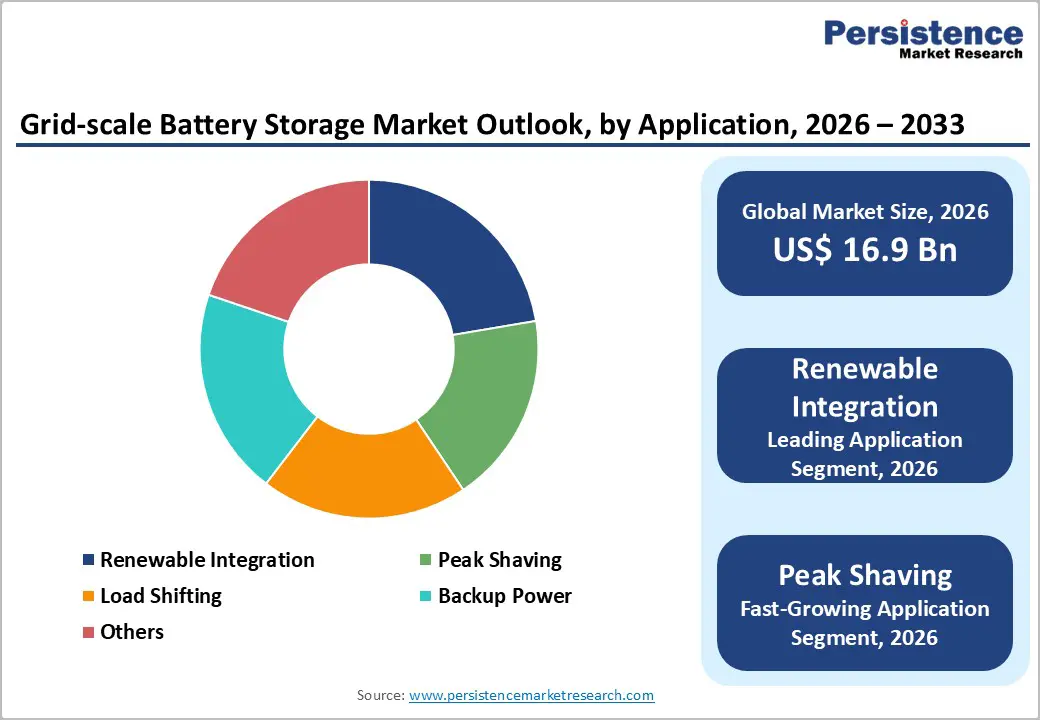
Renewable integration leads applications with a 45% share in 2025, fueled by the need to balance variable solar and wind generation. Hybrid solar-wind projects, such as Australia’s 13 GW tender, demonstrate the role of storage in smoothing output variability and supporting ambitious renewable targets. Policy mandates and reliability requirements further strengthen its prominence as the principal application driving market deployment.
Other applications, including peak shaving, load shifting, and backup power, are expanding rapidly. These use cases enable utilities and commercial operators to optimize operational costs, enhance grid efficiency, and provide ancillary services. As demand peaks grow and grids modernize, these applications are increasingly being prioritized alongside renewable integration for maximizing storage value.
End-user Insights
Utilities dominate the market with 65% share in 2025, driven by large-scale grid modernization mandates and regulatory incentives. Global projects, including the UK National Grid and U.S. utility interconnections, underscore their commanding position. FERC Order 2222 and other policies provide economies of scale and investment confidence, making utilities the primary adopters of grid-scale storage capacity.
Commercial and industrial (C&I) users represent the fastest-growing segment. Increasing electricity costs, demand charge management needs, and resiliency requirements are encouraging businesses to adopt battery storage. As energy-intensive industries and large campuses pursue efficiency and backup solutions, C&I end-users are emerging as a significant driver of storage deployment alongside utilities.
Regional Insights
North America Grid-scale Battery Storage Market Trends and Insights
North America leads the grid-scale battery storage market with a 42% share in 2025, driven primarily by the U.S. The region benefits from strong policy support, including state-level renewable mandates and federal frameworks that expedite interconnections. California’s SB 100 targets 1.3 GW of annual storage additions, fostering innovation hubs and large-scale deployments, while DOE reports 18 GW operational capacity by 2025. Regulatory measures like FERC incentives further facilitate rapid adoption and enhance grid resilience, addressing reliability challenges such as ERCOT blackouts.
The fastest adoption in commercial and utility-scale projects underscores North America’s position as a mature market. Investments in large batteries for ancillary services, peak management, and renewable integration continue to rise, with utilities leveraging economies of scale. Innovation clusters support long-duration storage and hybrid solutions, strengthening the region’s dominance in global deployments.
Europe Grid-scale Battery Storage Market Trends and Insights
Europe is a high-growth market with a projected CAGR of 11% through 2032, driven by harmonized policies under the Clean Energy Package. Germany aims for 15 GW of storage by 2030, while the UK integrates 2 GW at Sizewell C. Spain awarded 5 GW in 2024 auctions, and France is developing nuclear-battery hybrid systems targeting 10 GW resilience. Strong regulatory frameworks and renewable mandates support both utility and industrial-scale projects, making Europe a strategic expansion region.
Emerging investments in long-duration and hybrid storage solutions highlight Europe’s innovation trajectory. Utilities increasingly pair storage with renewables to balance grid fluctuations and ensure stability. Cross-border interconnections and supportive incentives further accelerate deployment, positioning Europe as both a growing market and a hub for advanced storage technologies.
Asia Pacific Grid-scale Battery Storage Market Trends and Insights
Asia Pacific is the fastest-growing region with a 32% share, reflecting rapid adoption across China, India, Japan, and ASEAN countries. China dominates with 45 GW installed capacity, accounting for over 70% of global manufacturing, while India’s PLCI adds 13.2 GW by 2027. Japan and Southeast Asia leverage cost advantages and supportive policies, enabling accelerated project rollouts.
The region’s growth is fueled by rising electrification, renewable integration, and grid modernization. Large-scale projects, including Australia’s Sun Cable exports, demonstrate both domestic and cross-border storage deployment. Utilities and commercial operators increasingly invest in hybrid systems and long-duration solutions, securing Asia Pacific’s position as a dynamic, high-growth market in the global grid-scale battery storage landscape.
Competitive Landscape
The grid-scale battery storage market shows moderate consolidation, with leading players focusing on large-scale manufacturing and advanced technology development. Companies invest heavily in research for long-duration and high-efficiency storage solutions, including flow batteries and next-generation chemistries. Innovation in energy management software and AI-driven optimization is becoming a key differentiator, enhancing operational efficiency, grid stability, and predictive maintenance.
Service-oriented models are gaining traction, enabling utilities to deploy storage without heavy upfront capital expenditures. Leasing and BESS-as-a-Service approaches allow flexible project financing, faster adoption, and scalable deployment across utility and commercial sectors. This strategic focus drives competitiveness and shapes the market landscape.
Key Developments:
- In January 2025, Tesla deployed a 2.2 GWh Megapack system in Texas, enhancing ERCOT grid reliability. The large-scale installation supports renewable integration, frequency regulation, and peak demand management, demonstrating the viability of utility-scale lithium-ion storage for stable and resilient power delivery.
- In June 2024, Fluence secured a 4 GWh battery order from Saudi Arabia’s NEOM project to support green hydrogen production. The deployment enables large-scale renewable storage, facilitates hydrogen electrolysis operations, and underscores the growing role of BESS in industrial and clean energy infrastructure.
- In October 2024, CATL introduced sodium-ion batteries for pilot projects with Chinese utilities. These batteries offer longer duration, improved thermal safety, and cost advantages, enabling utilities to test alternative chemistries for grid-scale storage and diversify technology portfolios for future deployments.
Companies Covered in Grid-scale Battery Storage Market
- CATL (Contemporary Amperex Technology Co. Limited)
- Tesla Energy
- BYD Company Ltd.
- Fluence Energy
- Sungrow Power Supply Co., Ltd.
- LG Energy Solution
- Samsung SDI
- Panasonic Corporation
- Siemens Energy
- Hitachi Energy
- General Electric (GE Vernova)
- Mitsubishi Electric Corporation
- NGK Insulators
- Huawei Technologies
- Sumitomo Electric Industries
Frequently Asked Questions
The grid-scale battery storage market is expected to reach US$ 16.9 billion in 2026, driven by renewable integration and policy support.
Surging renewable energy adoption requires storage for grid stability, with the IEA noting that capacity must triple by 2030.
North America holds 42% share in 2025, led by U.S. regulatory frameworks and innovation.
Policy incentives such as the U.S. IRA enable utility-scale deployments, unlocking subsidized growth.
Leading firms include Tesla, CATL, Fluence Energy, and LG Energy Solution, dominating with innovative BESS solutions.


