




- Pharmaceuticals
- Gastrointestinal Products Market
Gastrointestinal Products Market Size, Share, and Growth Forecast 2026 - 2033
Gastrointestinal Products Market by Product Type (Endoscopy Devices, Motility Testing Devices, Ablation Devices, Biopsy Devices, pH Monitoring Devices, Others), Application, End-User, by Regional Analysis, 2026 - 2033

Gastrointestinal Products Market Size and Trend Analysis
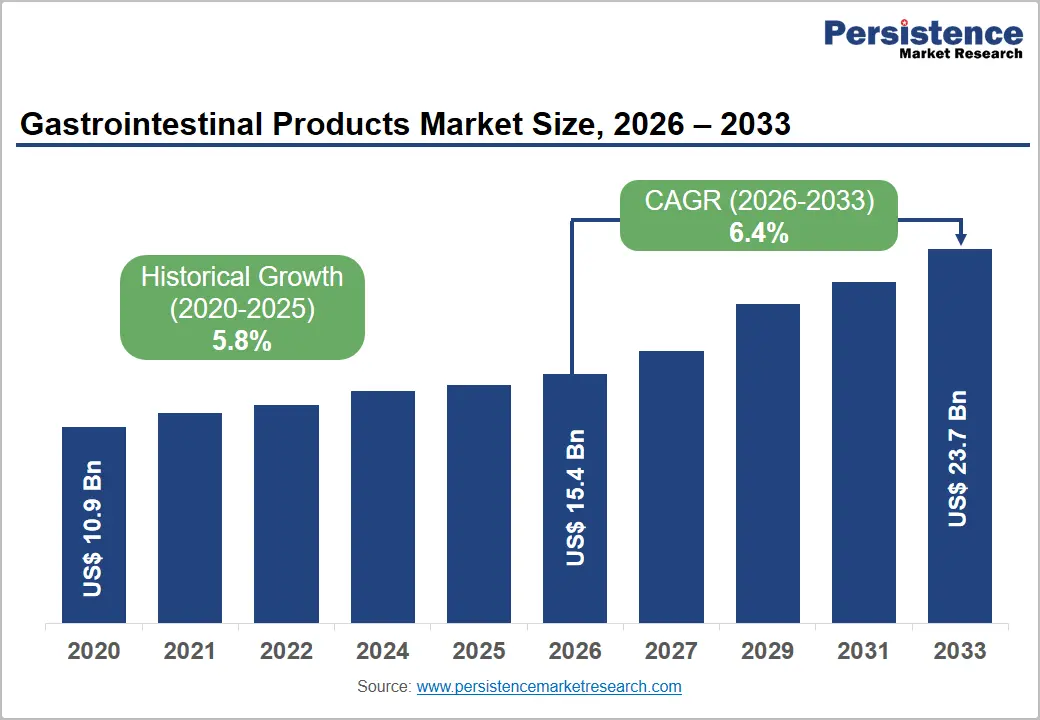
The global gastrointestinal products market size is expected to be valued at US$ 15.4 billion in 2026 and projected to reach US$ 23.7 billion by 2033, growing at a CAGR of 6.4% between 2026 and 2033.
This sustained expansion is driven by the rising global burden of gastrointestinal diseases, the accelerating adoption of minimally invasive endoscopic procedures as standard-of-care diagnostics and interventions, and significant technology investment in AI-assisted endoscopy and capsule-based platforms that are broadening clinical applications.
The World Health Organization (WHO) identifies colorectal cancer as the third most diagnosed malignancy globally with ~1.9 million new cases in 2022, while GERD affects an estimated 10-20% of the Western adult population according to the American College of Gastroenterology (ACG), collectively ensuring non-discretionary device utilization across diagnostic and therapeutic endoscopy programs through 2033.
Key Industry Highlights
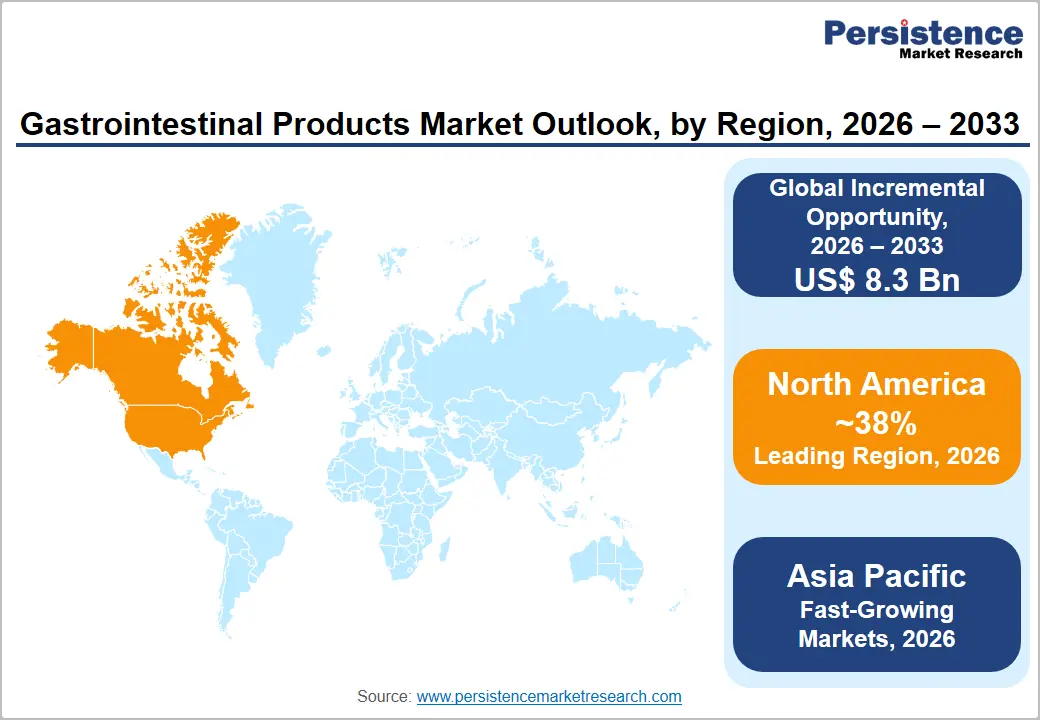
- Leading Region: North America leads with 38% market share in 2025, supported by high GI procedure volumes, colorectal screening mandates, advanced healthcare infrastructure, and increasing adoption of single-use endoscopes.
- Fastest Growing Region: Asia Pacific is expected to register the highest CAGR through 2033 due to expanding cancer screening programs, healthcare investments, improving hospital infrastructure, and rising gastrointestinal disease prevalence.
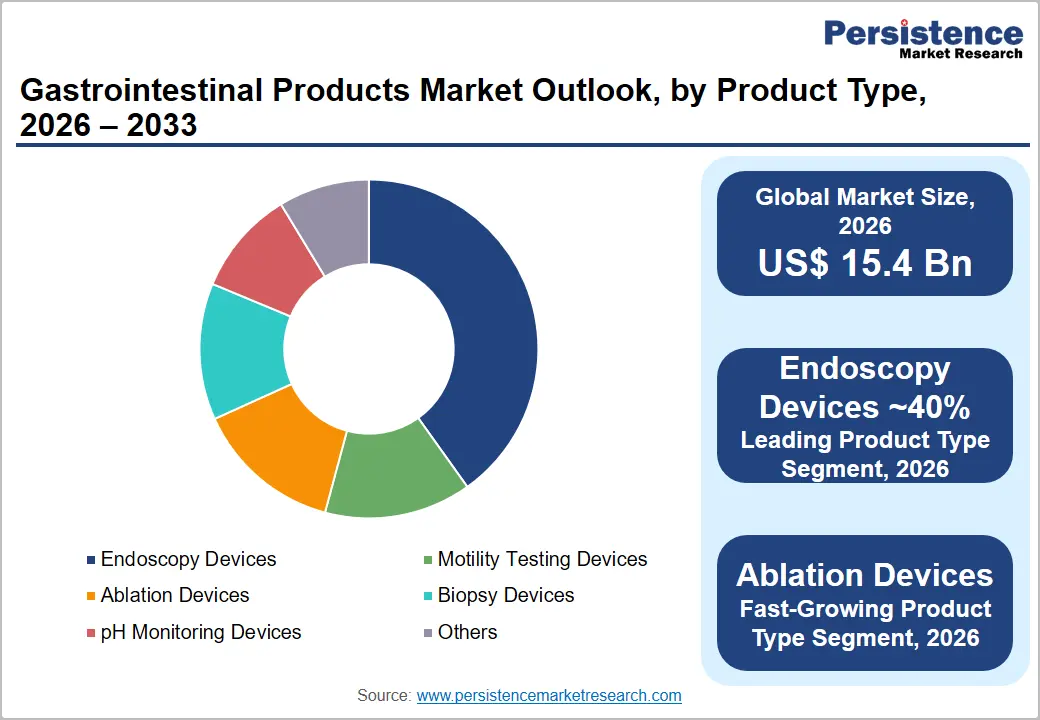
- Dominant Segment: Endoscopy devices dominate with 40% market share in 2025, driven by widespread use in GI cancer screening, GERD diagnosis, inflammatory bowel disease management, and minimally invasive procedures.
- Fastest Growing Segment: Ablation devices are projected to witness the fastest growth due to rising adoption of minimally invasive GI cancer treatments and increasing use of radiofrequency ablation therapies.
- Key Market Opportunity: Single-use endoscopes present a major growth opportunity, supported by infection-control requirements, regulatory approvals, reimbursement support, and increasing hospital demand for safer endoscopic procedures.
Market Dynamics
Drivers - Escalating Global GI Cancer Incidence Driving Diagnostic Device Adoption
The rising number of gastrointestinal (GI) cancer cases worldwide is a major factor driving demand for gastrointestinal diagnostic products and endoscopy devices. Cancers such as colorectal, stomach, esophageal, and pancreatic cancer are increasing rapidly across both developed and developing countries. According to the International Agency for Research on Cancer (IARC), colorectal cancer accounted for nearly 1.9 million new cases globally in 2022, while stomach cancer recorded around 968,000 new cases. Growing awareness regarding early cancer detection and government-supported screening programs are increasing the number of endoscopic procedures performed every year.
Countries including the U.S., Germany, Japan, and Australia have implemented national colorectal cancer screening programs that recommend routine colonoscopy procedures, especially for adults above 45 years. This has significantly increased demand for endoscopy systems, biopsy devices, and disposable accessories such as forceps, snares, and injection needles. Since these accessories are used during every procedure, they create continuous recurring revenue opportunities for gastrointestinal device manufacturers worldwide.
Restraints - High Capital Cost of Advanced Endoscopy Systems Limiting Adoption in Resource-Constrained Settings
Premium video endoscopy systems including Olympus Corporation’s EVIS X1™ and Fujifilm’s ELUXEO™ platforms carry unit prices of US$ 30,000-US$ 80,000 per endoscope stack, representing substantial capital equipment barriers for smaller community hospitals, ASCs in low-income settings, and public hospitals in Asia Pacific, Latin America, and Africa. The additional investment required for high-definition video processors, reprocessing equipment, and endoscope storage systems further elevates total system costs. These affordability constraints create market access disparities that limit device utilization to well-funded tertiary care centers in many geographies, restricting market penetration below underlying demand potential.
Opportunities - Rising Single-Use Endoscope Adoption Transforming Gastrointestinal Device Market Growth Worldwide
Single-use endoscopes are emerging as one of the fastest-growing segments in the gastrointestinal products market due to increasing concerns regarding infection risks linked with reusable devices. Traditional endoscopes require complex cleaning and reprocessing procedures, and contamination outbreaks have encouraged hospitals to adopt safer disposable alternatives. Regulatory support and growing awareness about infection prevention are further accelerating demand for single-use endoscopy systems across healthcare facilities worldwide.
Companies such as Ambu A/S and Boston Scientific Corporation are leading innovation in this segment with products including aScope™ and Exalt® Model D. These devices have received FDA clearance and demonstrated strong clinical performance in gastrointestinal procedures. Additionally, improving CMS reimbursement policies and stricter hospital infection-control standards are expected to increase adoption of single-use endoscopes across ERCP, bronchoscopy, and upper GI procedures through 2033.
Category-wise Insights
Product Type Analysis
Endoscopy Devices lead the gastrointestinal products market by product type, commanding ~40% of market share in 2025. This dominant position reflects endoscopy’s role as the gold standard diagnostic and therapeutic platform across virtually all major GI disease indications encompassing diagnostic colonoscopy, upper GI endoscopy, ERCP, endoscopic ultrasound (EUS), and capsule endoscopy. The ASGE documents over 75 million annual GI endoscopic procedures in the U.S. alone, generating high-volume capital equipment and disposable device procurement.
Olympus Corporation holds market leadership in video endoscopy systems globally, with its EVIS EXERA III™ and EVIS X1™ platforms installed in most high-volume endoscopy units worldwide. Fujifilm Holdings Corporation and PENTAX Medical (Hoya Corporation) compete as the second and third global endoscopy system providers, collectively reinforcing endoscopy devices’ revenue leadership through the forecast period.
End-User Analysis
Hospitals represent the dominant end-user segment in the gastrointestinal products market in 2025, commanding the majority of device procurement volume and revenues. Hospitals house most the world’s dedicated endoscopy units, operate intensive GI cancer screening programs, and perform high-complexity endoscopic procedures including EUS-guided biopsies, endoscopic retrograde cholangiopancreatography (ERCP), and endoscopic ultrasound that require advanced capital equipment only justifiable at high procedure volumes.
The American Hospital Association (AHA) reports ~6,093 registered hospitals in the U.S., each maintaining endoscopy suite infrastructure serving inpatient and outpatient GI diagnostic needs. In Asia Pacific, government-funded hospital endoscopy unit expansion under China’s national cancer prevention programs and India’s Ayushman Bharat scheme is sustaining hospital as the dominant procurement channel through the forecast period.
Regional Insights
North America Gastrointestinal Products Market Trends and Insights
North America leads the global gastrointestinal products market with ~38% market share, supported by advanced healthcare infrastructure, high endoscopy procedure volumes, and strong reimbursement systems. The region benefits from widespread colorectal cancer screening programs, increasing adoption of minimally invasive GI procedures, and rising demand for AI-assisted and single-use endoscopy devices. Regulatory support from the FDA and clinical guidelines from organizations such as ASGE continue to encourage rapid technology adoption across hospitals and ambulatory surgical centers.
The U.S. remains the major contributor due to its large installed base of advanced endoscopy systems and strong presence of leading GI device manufacturers. Growing awareness of digestive disorders and infection control measures further supports steady market growth across North America.
U.S. Gastrointestinal Products Market Size
The U.S. accounts for ~88% of the North American gastrointestinal products market, driven by high procedure volumes and advanced healthcare infrastructure. More than 75 million GI endoscopic procedures are performed annually, creating strong recurring demand for endoscopy systems, biopsy devices, stents, and accessories. The country has a large installed base of Olympus and Fujifilm video endoscopy platforms across hospitals and specialty clinics. Rising colorectal cancer screening rates and favorable reimbursement policies from CMS continue to support market expansion.
Additionally, growing adoption of AI-assisted colonoscopy systems and single-use endoscopes from companies such as Ambu and Boston Scientific is improving infection control and procedural efficiency in healthcare facilities.
Europe Gastrointestinal Products Market Trends and Insights
Europe is the second-largest gastrointestinal products market, supported by organized colorectal cancer screening programs, strong healthcare funding, and strict medical device regulations. Countries such as Germany, the UK, and France are investing heavily in advanced endoscopy systems and minimally invasive GI procedures. The implementation of EU MDR regulations is improving product quality and patient safety standards across the region. Demand for AI-assisted endoscopy, reusable and single-use devices, and advanced visualization technologies is steadily increasing among hospitals and specialty clinics.
Public healthcare systems and national screening programs continue to create consistent procurement demand for GI products. Growing awareness regarding digestive diseases and rising elderly population further contribute to long-term market growth across Europe.
Germany Gastrointestinal Products Market Size
Germany contributes ~26% of the European gastrointestinal products market, supported by one of Europe’s most advanced healthcare systems and a strong national colonoscopy screening program. The country has a large network of gastroenterology specialists and hospitals performing high volumes of diagnostic and therapeutic GI procedures. Demand for advanced endoscopy systems from Olympus and Karl Storz remains strong across university hospitals and specialty clinics.
Government-supported colorectal cancer screening initiatives continue to increase procedure rates and equipment procurement. Additionally, Germany’s focus on healthcare modernization, infection prevention, and adoption of minimally invasive technologies is driving investments in AI-assisted endoscopy and high-performance gastrointestinal devices throughout the country.
UK Gastrointestinal Products Market Size
The UK accounts for ~19% of the European gastrointestinal products market, supported by the NHS Bowel Cancer Screening Programme across England, Scotland, Wales, and Northern Ireland. Increasing colonoscopy volumes and rising awareness of colorectal cancer are driving demand for endoscopy systems and GI accessories. The NHS is actively adopting innovative technologies, including Medtronic’s GI Genius AI-assisted colonoscopy platform, to improve diagnostic accuracy and patient outcomes.
Government healthcare investments and centralized procurement systems create stable demand for advanced GI products across hospitals and specialty clinics. Additionally, increasing preference for minimally invasive procedures and early disease detection is supporting steady growth in the UK gastrointestinal products market.
Asia Pacific Gastrointestinal Products Market Trends and Insights
Asia Pacific is the fastest-growing gastrointestinal products market due to rising digestive disease prevalence, expanding hospital infrastructure, and increasing cancer screening initiatives. Countries such as China, India, and Japan are investing heavily in healthcare modernization and endoscopy capabilities. The region has a high burden of gastric and colorectal cancers, creating strong demand for diagnostic and therapeutic GI devices. Domestic manufacturers are introducing cost-effective endoscopy systems for public hospitals, while international companies continue expanding regional operations.
Growing healthcare awareness, increasing medical tourism, and rising adoption of minimally invasive procedures are further supporting market growth. Government healthcare reforms and investments in cancer screening programs continue to accelerate gastrointestinal product demand across Asia Pacific countries.
India Gastrointestinal Products Market Size
India accounts for ~12% of the Asia Pacific gastrointestinal products market, supported by expanding healthcare infrastructure and rising awareness regarding digestive diseases and cancer screening. Government initiatives such as Ayushman Bharat PM-JAY are increasing investments in hospital endoscopy units and diagnostic services. Private hospital chains in metropolitan cities are actively expanding gastroenterology departments and adopting advanced endoscopy technologies.
Increasing prevalence of gastrointestinal disorders, growing medical tourism, and rising healthcare spending are further driving demand for GI products. Additionally, national programs for non-communicable disease prevention and improved access to diagnostic services are encouraging greater adoption of minimally invasive gastrointestinal procedures across urban healthcare facilities in India.
Japan Gastrointestinal Products Market Size
Japan contributes ~20% of the Asia Pacific gastrointestinal products market and is recognized as one of the world’s most advanced endoscopy markets. The country has very high per-capita endoscopy procedure rates due to widespread gastric cancer screening programs and strong healthcare awareness. Olympus Corporation’s headquarters and manufacturing operations in Japan support continuous innovation in endoscopy technologies. Hospitals and academic medical centers actively adopt premium GI imaging systems, AI-assisted diagnostics, and minimally invasive technologies.
Japan’s aging population and high healthcare spending continue to generate stable demand for gastrointestinal products. Additionally, strict quality standards and advanced healthcare infrastructure maintain Japan’s position as a premium and technology-driven GI device market.
Competitive Landscape
The global gastrointestinal products market is moderately consolidated at the premium endoscopy systems tier, with Olympus Corporation, Fujifilm Holdings Corporation, and PENTAX Medical (Hoya Corporation) commanding the dominant share of video endoscopy system installations globally. Boston Scientific Corporation, Medtronic plc, and Cook Medical lead in therapeutic endoscopy accessories and ablation devices. Key competitive differentiators include AI-assisted polyp detection integration (Medtronic’s GI Genius™), single-use endoscope disruption (Ambu A/S), and endoscopic ultrasound capability. Emerging trends include digital endoscopy cloud platforms, remote training ecosystems, and value-based procedure bundling for ASC customers.
Key Developments
- In May 2026, Johnson & Johnson launched the “Gut Tunnel” experience in Singapore to raise awareness about the importance of achieving endoscopic remission in inflammatory bowel disease (IBD).
- In October 2025, Medtronic launched the Endoflip™ 300 impedance planimetry system in India, enabling real-time assessment of the esophagus, pylorus, and anal sphincter during endoscopic evaluation of motility disorders.
- In July 2025, FUJIFILM Thailand introduced the ELUXEO® 8000 Endoscopy System and 800 Series ELUXEO® Endoscopes in Thailand, expanding its healthcare diagnostic and patient treatment innovation portfolio.
- In May 2025, Olympus Corporation announced that the U.S. FDA granted 510(k) clearance for its EZ1500 series endoscopes equipped with Extended Depth of Field (EDOF™) technology.
Companies Covered in Gastrointestinal Products Market
- Olympus Corporation
- Boston Scientific Corporation
- Medtronic plc
- Fujifilm Holdings Corporation
- PENTAX Medical
- Stryker Corporation
- Cook Medical
- Johnson & Johnson
- Karl Storz SE & Co. KG
- Conmed Corporation
- Hoya Corporation
- SonoScape Medical Corp.
- Richard Wolf GmbH
- Ambu A/S
- Others
Frequently Asked Questions
The global market is projected to be valued at US$ 15.4 billion in 2026.
The primary drivers are rising GI cancer cases, increasing colorectal screening programs, and growing adoption of minimally invasive endoscopic procedures for diagnosis and treatment of gastrointestinal diseases.
North America leads the gastrointestinal products market with around 38% share, supported by high endoscopy procedure volumes, strong screening programs, and rapid adoption of advanced GI technologies.
The key growth opportunity lies in single-use endoscopes, driven by infection-control requirements, regulatory approvals, reimbursement support, and increasing hospital demand for safer endoscopic procedures.
Key players include Olympus, Fujifilm, Boston Scientific, Medtronic, PENTAX Medical, Cook Medical, Johnson & Johnson, Ambu, Karl Storz, and Conmed Corporation among others.


