




- Pharmaceuticals
- Endothelin Receptor Antagonist Market
Endothelin Receptor Antagonist Market Size, Share, and Growth Forecast 2026 - 2033
Endothelin Receptor Antagonist Market by Drug (Macitentan, Bosentan, Ambrisentan), Indication (Pulmonary Arterial Hypertension, IgA Nephropathy), Distribution Channel (Hospital Pharmacies, Retail Pharmacies), and Regional Analysis for 2026 - 2033

Endothelin Receptor Antagonist Market Size and Trends Analysis
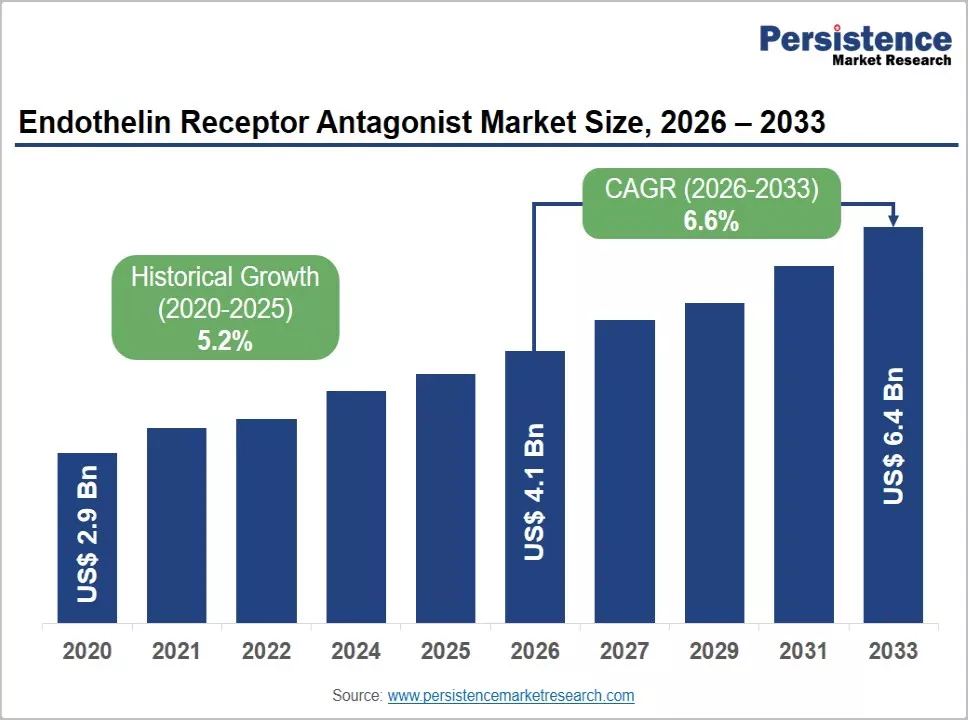
The global endothelin receptor antagonist market is likely to be valued at US$ 4.1 billion in 2026 and is estimated to reach US$ 6.4 billion by 2033, growing at a CAGR of 6.6% during the forecast period 2026 to 2033.
Market growth is driven by sustained use in pulmonary arterial hypertension and new approvals for kidney disease and hypertension. Expanding therapeutic applications are also expected to broaden the eligible patient pool.
Key Industry Highlights
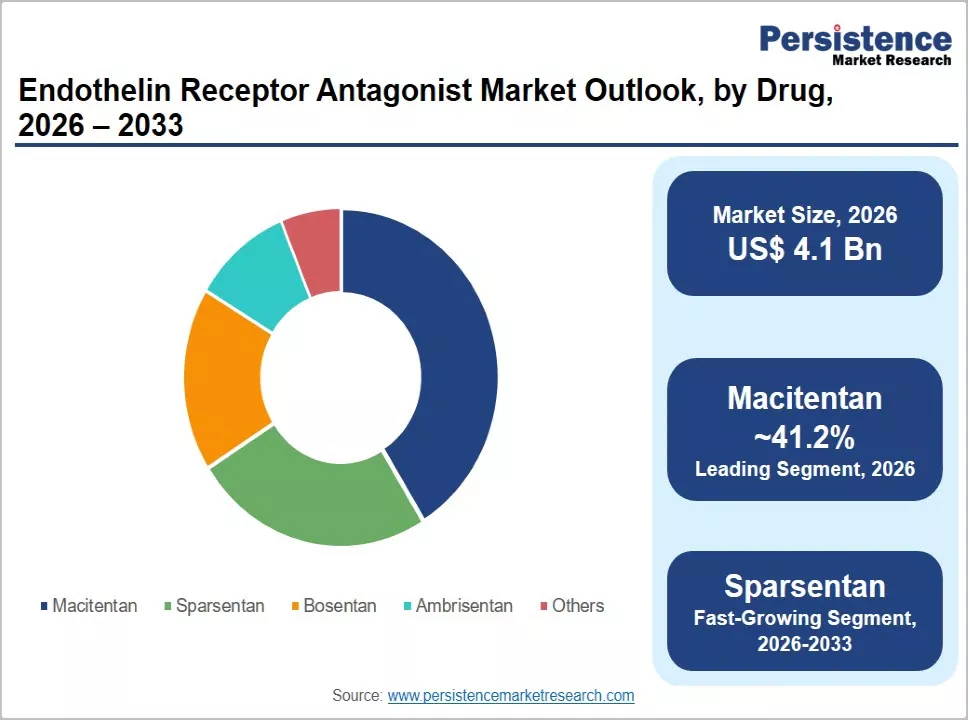
- Leading Drug: Macitentan is the leading segment, accounting for about 41.2% of the market share in 2026, owing to its crucial role in reducing the risk of disease progression in pulmonary arterial hypertension.
- Dominant Indication: Pulmonary arterial hypertension accounts for around 78.6% of the market share in 2026, as endothelin receptor antagonists are an established component of its treatment.
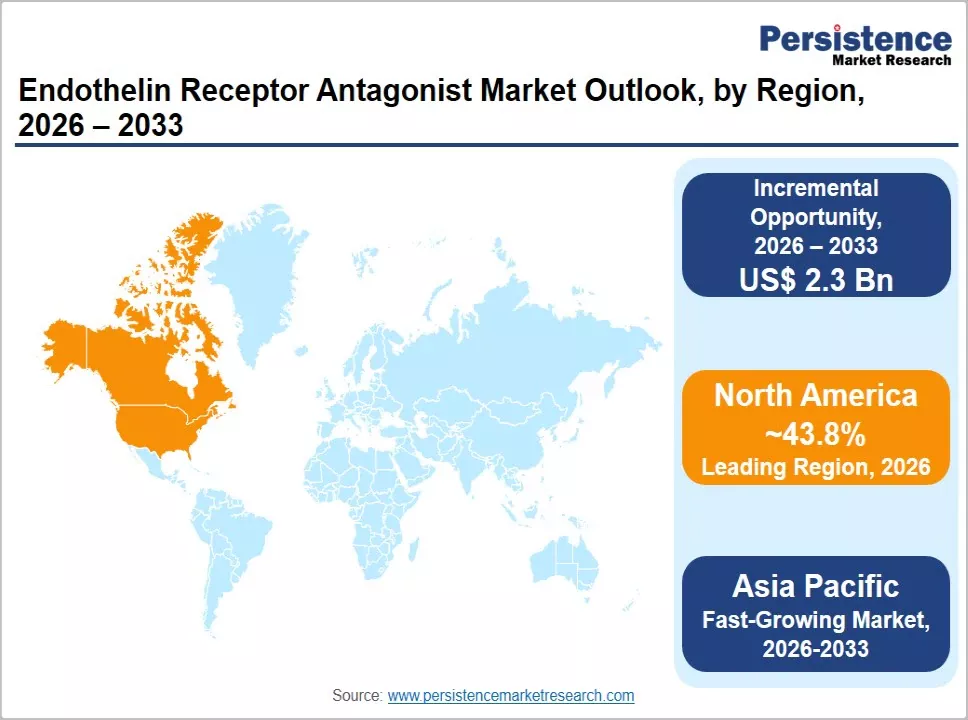
- Leading Region: North America is expected to lead the market by holding about 43.8% of the market share in 2026, supported by early drug launches and well-established specialty care infrastructure.
- Fastest-Growing Region: Asia Pacific is expected to record the fastest growth, driven by rising diagnosis rates and broader access to advanced therapies.
- Latest Study: In June 2026, The Lancet published the final 2.5-year results of the Phase III ALIGN trial evaluating atrasentan in patients with IgA nephropathy. The study found that atrasentan reduced proteinuria and improved the overall estimated kidney-function trajectory compared with placebo. At week 136, the between-group difference in eGFR change was 2.4 mL/min/1.73 m², although the confidence interval included zero and the p-value was 0.057. The publication provided peer-reviewed long-term evidence on selective endothelin A receptor blockade in progressive kidney disease and highlighted the importance of assessing both proteinuria reduction and preservation of kidney function.
Market Dynamics
Drivers - Established Role in Pulmonary Arterial Hypertension to Foster Demand
Endothelin receptor antagonists (ERAs) block the effects of endothelin, a peptide that narrows blood vessels, and are used to treat pulmonary arterial hypertension (PAH). In Europe, PAH prevalence averages about 50 cases per million people, while median survival is about six years. ERAs are oral therapies with a long history of clinical use, making them an established long-term treatment option for many patients. Treatment initiation follows diagnostic confirmation through cardiac catheterization.
Clinical evidence supports their established role. The SERAPHIN trial enrolled 742 patients with PAH and found that macitentan 10 mg reduced the risk of a morbidity or mortality event by 45% compared with placebo, while the 3 mg dose reduced it by 30%. The FDA approved macitentan on October 18, 2013. These results support the continued use of ERAs in standard PAH care. Patients received treatment for up to three and a half years. The most common adverse events included nasopharyngitis, headache, and anemia.
Rising Demand for Combination Therapy and New Formulations
Combination therapy is expanding treatment options. On March 22, 2024, the FDA approved Opsynvi, a once-daily tablet combining macitentan and tadalafil for adults with PAH in WHO functional classes II and III. The A DUE trial demonstrated a greater reduction in pulmonary vascular resistance at 16 weeks compared with either drug alone. Opsynvi was submitted to the FDA on May 30, 2023, and carries a boxed warning for embryo-fetal toxicity.
Combination tablets reduce pill burden and support the use of dual therapy earlier in treatment. European sources report that about 14 PAH agents have been approved over the past 25 years. Treatment guidelines recommend phosphodiesterase-5 (PDE5) inhibitors as part of initial therapy, with ERAs often used in combination. This established role supports continued demand for the drug class. Fewer pills also offer potential adherence benefits for patients requiring long-term treatment.
Restraint – Safety Risks and New Competing Drugs to Constrain Growth
ERAs face important safety-related limitations. Most carry a boxed warning for embryo-fetal toxicity. Filspari also carries a boxed warning for liver injury, with its label requiring liver-function testing every three months. The drug is available through a restricted distribution program, adding compliance requirements that can increase treatment complexity and limit uptake. Alanine aminotransferase (ALT) and aspartate aminotransferase (AST) levels require monitoring, and treatment interruption is indicated when aminotransferase levels exceed three times the upper limit of normal. Filspari is also contraindicated during pregnancy.
New treatment classes are adding competitive pressure in PAH. Merck’s Winrevair (sotatercept) received FDA approval on March 26, 2024. In the STELLAR trial, it improved six-minute walk distance by a placebo-adjusted 41 meters. Most trial participants were already receiving multiple PAH therapies, indicating that sotatercept is generally added to existing regimens rather than replacing ERAs. However, its use adds to treatment costs and can affect healthcare budget allocation. In STELLAR, 61% of patients were receiving three PAH drugs, 35% were receiving two, and 40% received prostacyclin infusions.
Opportunities – Expanding Applications into Kidney Disease
Kidney disease represents an emerging growth opportunity for endothelin pathway therapies. On April 3, 2025, the FDA granted accelerated approval to Novartis’ Vanrafia (atrasentan) for IgA nephropathy. The ALIGN trial demonstrated a 36.1% reduction in proteinuria compared with placebo. Vanrafia does not require a restricted distribution program. In the U.S., about 13 people per million are diagnosed with IgA nephropathy each year. The drug is used alongside supportive care, including renin-angiotensin system (RAS) inhibition. Up to 50% of patients with persistent proteinuria progress to kidney failure within 10 to 20 years, supporting demand for treatments that reduce proteinuria and help preserve kidney function.
Sparsentan provides another growth avenue by blocking both endothelin and angiotensin II receptors. The FDA granted full approval for IgA nephropathy in September 2024. In the PROTECT trial, proteinuria declined by 49.8% with sparsentan, compared with 15.1% with irbesartan at 36 weeks. Its approval for focal segmental glomerulosclerosis (FSGS) in April 2026 further broadens its potential patient population. The FDA initially approved Filspari in February 2023, with full approval following on or around September 11, 2024. Two-year PROTECT data also showed a statistically significant benefit in estimated glomerular filtration rate (eGFR) slope compared with irbesartan.
Rising Hypertension Cases to Create New Demand Pools
Rising cases of hypertension offer another avenue for market expansion. On March 20, 2024, the FDA approved Idorsia’s Tryvio (aprocitentan) at a dose of 12.5 mg once daily for adults whose blood pressure remains uncontrolled despite treatment with other drugs. In the PRECISION trial, aprocitentan reduced systolic blood pressure more than placebo at week 4. At week 40, patients who continued aprocitentan maintained a statistically superior reduction in blood pressure, while those switched to placebo experienced a rise.
This indication addresses a substantial unmet need. Experts report that physicians fail to achieve target blood pressure in at least 10% of treated patients. Tryvio is used alongside other antihypertensive drugs, with edema and anemia among the most common adverse reactions. Broader adoption depends on payer coverage, appropriate patient selection, and ongoing safety monitoring, including checks for liver-related effects and fluid retention. Its once-daily formulation offers an additional treatment option for patients with difficult-to-control hypertension.
Category-wise Analysis
Drug Insights
Macitentan is the leading drug segment, accounting for about 41.2% of the market share in 2026, supported by its ability to reduce the risk of disease progression in PAH. The SERAPHIN trial showed a 45% reduction in the risk of a morbidity or mortality event with the 10 mg dose. Macitentan is also available in combination with tadalafil as Opsynvi. Japan approved macitentan in March 2015, according to trade reports. The 3 mg dose reduced the same risk by 30%, and the SERAPHIN trial followed patients for up to three and a half years.
Sparsentan is estimated to be the fastest-growing drug segment during the forecast period, driven by its expanding use across IgA nephropathy and focal segmental glomerulosclerosis (FSGS). This projection reflects our analyst view, as publicly available sales breakdowns by drug remain limited. Filspari also holds approvals in the EU and U.K. The Medicines and Healthcare products Regulatory Agency (MHRA) approved it on November 6, 2024. The FDA approved Filspari for adults and children aged 8 years and older with FSGS to reduce proteinuria in patients without nephrotic syndrome.
Indication Insights
Pulmonary arterial hypertension is the dominant indication category, accounting for around 78.6% of the market share in 2026, supported by the established role of ERAs in PAH treatment. Registries indicate a prevalence of about 50 cases per million people in Europe. Scotland reported a prevalence of 48.5 cases per million in a 2012 audit. ERAs remain widely used in combination regimens, while median survival of about six years underscores the need for long-term treatment.
IgA nephropathy is expected to be the fastest-growing indication during the forecast period, supported by the availability of three ERA-based treatment options. Up to 50% of patients with persistent proteinuria progress to kidney failure within 10 to 20 years, highlighting the need for therapies that reduce proteinuria and help preserve kidney function. This growth outlook reflects our analyst view. Atrasentan, sparsentan, and older ERAs differ in their approved indications and monitoring requirements.
Regional Analysis
North America Endothelin Receptor Antagonist Market Trends
North America is expected to lead the global endothelin receptor antagonist market by capturing around 43.8% share in 2026. The region’s leadership is supported by early drug launches and well-established specialty care infrastructure. Several recent ERA-based treatment approvals were first granted by the FDA, including Opsynvi, Tryvio, Vanrafia, and the FSGS indication for Filspari. Established payer coverage also supports treatment uptake. The FDA approved Opsynvi on March 22, 2024, and Tryvio on March 20, 2024.
U.S. Endothelin Receptor Antagonist Market Trends
The U.S. is expected to account for nearly 61.2% of the North American market in 2026, supported by its role as an early launch market for new therapies. In 2025, the FDA removed the fetal-toxicity Risk Evaluation and Mitigation Strategy (REMS) requirements for ambrisentan, macitentan, and Opsynvi, while their boxed warnings remained in place. Bosentan continues to be subject to a REMS. Vanrafia received FDA approval on April 3, 2025, while Filspari received approval for FSGS on April 13, 2026. The ALIGN trial randomized 340 adults.
Asia Pacific Endothelin Receptor Antagonist Market Trends
Asia Pacific is expected to be the fastest-growing regional market during the forecast period. Japan approved macitentan in 2015, while a prospective study evaluated ambrisentan in Chinese adults with PAH. The region's growth outlook reflects our analyst view, supported by wider disease diagnosis and the availability of lower-cost generic therapies. Japan's macitentan approval was reported on March 26, 2015.
China Endothelin Receptor Antagonist Market Trends
China is expected to lead the Asia Pacific market by holding about 36.5% of the regional market in 2026. A prospective cohort study has evaluated ambrisentan in Chinese adults with PAH. However, verified public data on ERA sales in China are unavailable, so this market-share estimate reflects our analyst view. Expanding hospital networks and improved diagnosis are expected to support wider treatment use. ERAs are also used alongside phosphodiesterase-5 (PDE5) inhibitors in many PAH treatment regimens, based on our analyst assessment.
India Endothelin Receptor Antagonist Market Trends
India is anticipated to account for about 12.1% of the Asia Pacific market in 2026, supported by rising diagnosis rates and the availability of lower-cost generic therapies. No verified public source provides a specific ERA sales breakdown for India; therefore, this market-share estimate reflects our analyst view. Growth depends on access to specialists and greater awareness of PAH. Local drug manufacturers supply lower-cost versions of older ERAs, according to our analyst assessment.
Europe Endothelin Receptor Antagonist Market Trends
Europe is expected to hold nearly 16.8% share of the global market in 2026, supported by established PAH centers and access to treatments for kidney disease. The European Commission granted Filspari conditional approval in April 2024, followed by standard approval in April 2025. PAH prevalence averages about 50 cases per million people in Europe. In the PROTECT trial, proteinuria declined by 49.8% with sparsentan at 36 weeks, compared with 15.1% with irbesartan.
Germany Endothelin Receptor Antagonist Market Trends
Germany is expected to account for about 25.6% of the European market in 2026, supported by its patient base and established specialist care centers. Public data on ERA sales in Germany are unavailable, so this market-share estimate reflects our analyst view. EU approvals apply across member states, including Germany. Filspari is indicated for adults with protein excretion of at least 1.0 g per day.
U.K. Endothelin Receptor Antagonist Market Trends
The U.K. is projected to account for nearly 17.9% of the European market in 2026, supported by its national PAH care network. The MHRA approved sparsentan for IgA nephropathy on November 6, 2024, through the International Recognition Procedure. The U.K. conversion to standard approval took effect on April 15, 2025. Scotland reported PAH prevalence of 48.5 cases per million in a 2012 audit; current prevalence rates are likely to differ.
Competitive Landscape
The global endothelin receptor antagonist market is consolidated, with large pharmaceutical firms leading. Johnson & Johnson markets Opsumit and Opsynvi through Actelion. Novartis markets Vanrafia. Idorsia markets Tryvio. Travere Therapeutics markets Filspari. Gilead Sciences markets ambrisentan. Generic makers add price pressure on older drugs.
Competition centers on safety, label breadth, and combination products. Firms with kidney and hypertension labels gain new revenue. Drugs with no restricted program are easier to prescribe. Makers also invest in trials to widen indications. Generic versions of older ERAs raise price competition, so newer firms focus on label growth.
Key Industry Developments
- In May 2026, Bayer announced an agreement to acquire Perfuse Therapeutics in a transaction valued at up to US$ 2.45 billion, comprising US$300 million upfront and additional payments tied to development, regulatory and commercial milestones. The acquisition would give Bayer full rights to PER-001, an investigational small-molecule endothelin receptor antagonist in Phase II development for glaucoma and diabetic retinopathy. The deal reflects growing interest in targeting the endothelin pathway beyond cardiovascular and kidney diseases, particularly in ophthalmology.
- In February 2026, Novartis announced final results from the Phase III ALIGN trial evaluating Vanrafia (atrasentan) in adults with IgA nephropathy. At week 136, the difference in estimated glomerular filtration rate (eGFR) change between atrasentan and placebo was 2.39 mL/min/1.73 m², with a p-value of 0.057; the result did not meet the conventional threshold for statistical significance at that time point. The findings nevertheless supported further assessment of atrasentan’s potential to slow kidney-function decline, and Novartis said it planned to pursue traditional FDA approval in 2026.
- In January 2026, Idorsia announced that Health Canada had authorized Jeraygo (aprocitentan), a dual endothelin receptor antagonist, for treating resistant hypertension in adults whose blood pressure remains uncontrolled despite at least three antihypertensive medicines. The approval expanded the drug’s geographic availability and introduced an endothelin-pathway treatment option into Canada’s resistant-hypertension market. Aprocitentan works by blocking endothelin A and endothelin B receptors, helping reduce the blood-vessel constriction associated with elevated blood pressure.
Companies Covered in Endothelin Receptor Antagonist Market
- Johnson & Johnson
- Novartis
- Idorsia
- Travere Therapeutics
- Gilead Sciences
- Others
Frequently Asked Questions
The global endothelin receptor antagonist market is projected to be valued at US$ 4.1 billion in 2026.
The market is expected to reach US$ 6.4 billion by 2033.
Key market trends include combination pills for PAH, expansion into IgA nephropathy and hypertension, and easing of fetal toxicity rules.
Macitentan is expected to be the leading drug segment, holding around 41.2% of the market share in 2026, due to its proven benefit in PAH.
The market is expected to grow at a CAGR of 6.6% from 2026 to 2033.
Johnson & Johnson, Novartis, and Idorsia are among the key market players.


