




- Nutraceuticals & Functional Foods
- Europe Nutraceuticals Market
Europe Nutraceuticals Market Size, Share, and Growth Forecast 2026 - 2033
Europe Nutraceuticals Market by Product Type (Functional Foods, Functional Beverages, Dietary Supplements), Source (Plant Based, Animal Based), Distribution Channel (Supermarkets/Hypermarkets, Convenience Stores), and Regional Analysis, 2026 - 2033

Europe Nutraceuticals Market Size and Trend Analysis
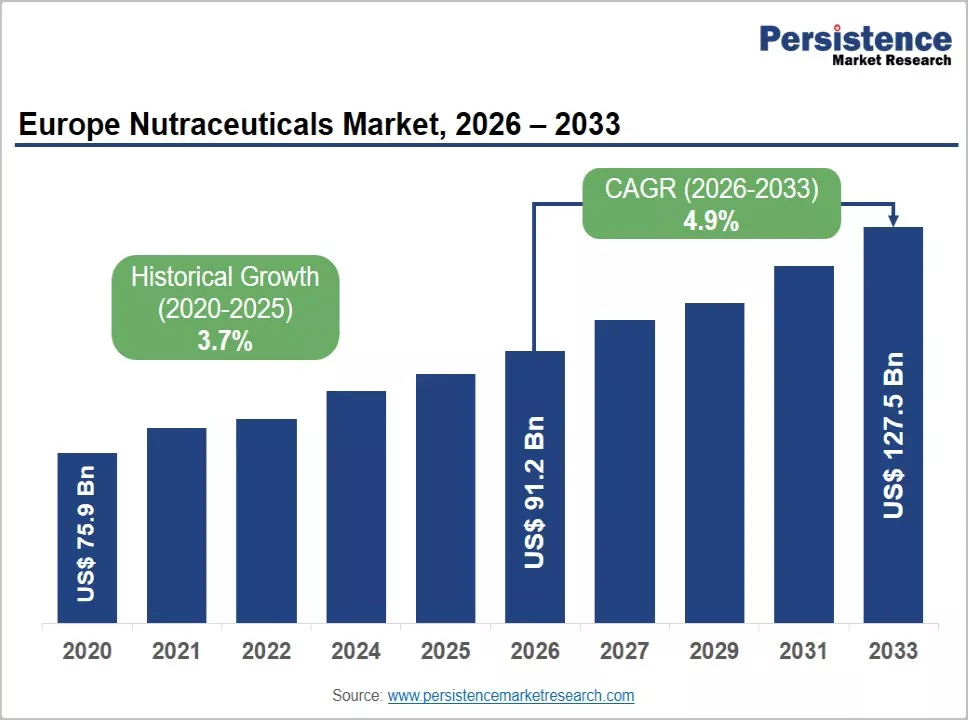
The Europe nutraceuticals market size is likely to be valued at US$ 91.2 billion in 2026, and is estimated to reach US$ 127.5 billion by 2033, growing at a CAGR of 4.9% during the forecast period 2026 - 2033. Growth is underpinned by an ageing population, rising preventive healthcare spending, and growing consumer interest in gut health, immunity, and healthy ageing, supported by a broad base of functional foods, beverages, and supplements.
The market recorded a CAGR of 3.7% during 2020–2025, as inflation, cautious consumer spending, and fragmented national rules moderated expansion. However, the forecast period anticipates firmer acceleration as personalization, clinically supported ingredients, plant-based and sustainable formulations, and online retail broaden access and strengthen consumer confidence across the region.
Key Industry Highlights
- Dominant Product Type: Dietary supplements are set to command around 46% of the revenue share in 2026, while functional beverages are likely to grow the fastest at 6.2% CAGR through 2033, as consumers seek convenient, ready-to-drink wellness formats.
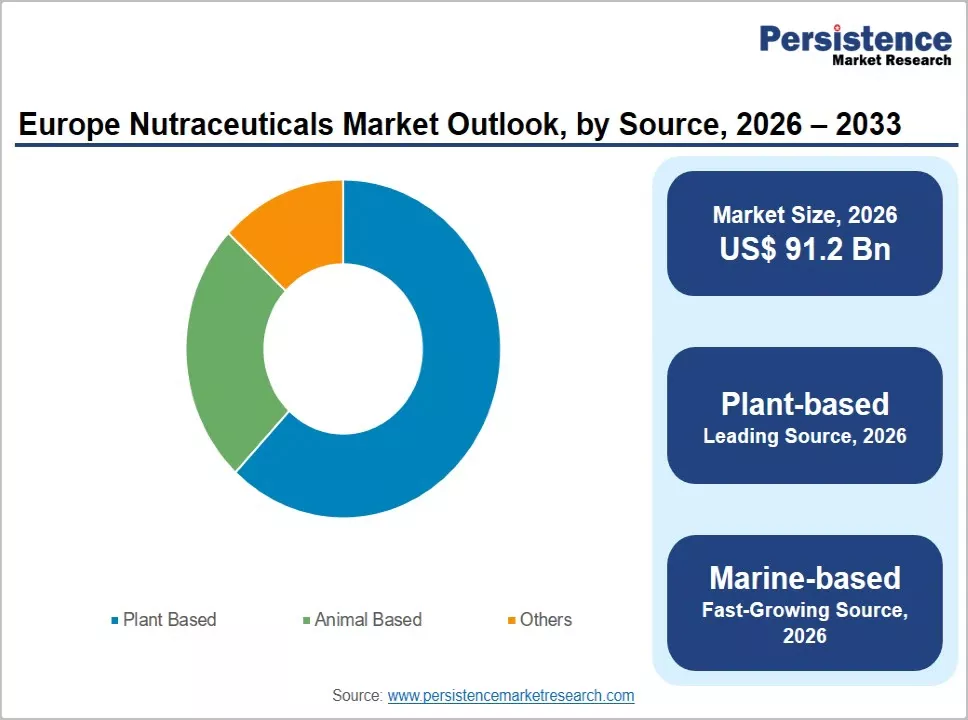
- Leading Source: Plant-based sources are expected to lead with 48% in 2026, while marine-based sources are likely to be the fastest-growing at about 6.0% CAGR during 2026–2033, reflecting demand for algal omega-3 and marine collagen.
- Dominant Distribution Channel: Supermarkets and hypermarkets are anticipated to lead with an estimated 34% share in 2026, while online retail is slated to represent the fastest-growing channel at 8.5% CAGR from 2026 to 2033.
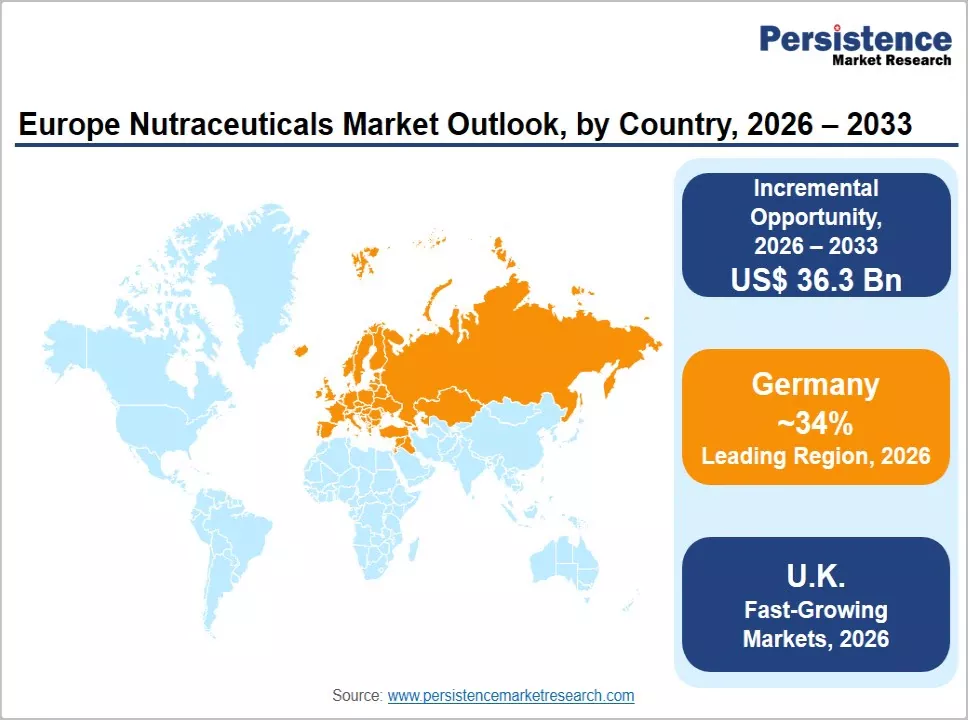
- Regional Country: Germany is poised to dominate with an estimated 34% share in 2026, while U.K. is likely to register the fastest growth at an estimated 5.4% CAGR through 2033.
- Competitive Environment: Competitive dynamics include portfolio consolidation, acquisitions of regional supplement businesses, and ingredient innovation, amid tightening rules on health claims, botanicals, and packaging.
DRO Analysis
Drivers: Aging Population and Preventive Health as Primary Growth Catalyst
Ageing demographics and the shift towards preventive healthcare are the leading forces driving the Europe nutraceuticals market growth, as consumers and health systems look for ways to manage chronic conditions and maintain independence later in life. Rising healthcare costs and longer life expectancy are encouraging individuals to use supplements and functional foods for bone and joint health, cardiovascular support, cognitive function, and gut and immune health.
Pharmacies and healthcare professionals increasingly recommend evidence-backed products, while retailers expand own-label ranges in vitamins, probiotics, and omega-3 products. Supplements are also gaining relevance among younger consumers interested in sleep, stress, sports nutrition, and beauty-from-within, which broadens the demand base and supports premium positioning for clinically substantiated products.
Personalization and Science-Backed Innovation
Industry interest in personalized nutrition, microbiome science, and ingredients with clinical evidence is fueling product development. Brands are adopting ingredient transparency, clinical trials, and digital tools that help consumers select products tailored to age, lifestyle, and goals.
Pharmaceutical innovation is also shaping adjacent supplement categories, as companies introduce products aimed at consumers using weight-management medicines, further widening the addressable market. Growing attention to women’s health, menopause, sleep, and cognitive performance is generating dedicated product lines, while sports and active-lifestyle consumers are broadening demand for protein, creatine, and electrolyte formats beyond traditional fitness channels.
Restraints: Regulatory Fragmentation and Health Claim Constraints
Regulatory fragmentation is a major challenge for the Europe nutraceuticals market. Although the region operates under common frameworks such as the Food Supplements Directive and the Nutrition and Health Claims Regulation, national rules on permitted ingredients, maximum levels, and notification procedures differ, so a product accepted in one country may be restricted in another.
Many botanical health claims remain on hold, limiting how companies can communicate benefits, and scrutiny of traditional herbal ingredients is increasing. Consumer trust can also be affected by inconsistent product quality and unsubstantiated claims, which has led regulators and industry bodies to emphasize good manufacturing practice, third-party testing, and transparent labelling.
Safety Reviews, Packaging Rules, and Cost Pressure
Safety reassessments can remove ingredients from the market quickly; the European Commission has moved to prohibit monacolins from red yeast rice in foods and supplements after the European Food Safety Authority concluded that no dose could be considered safe. New packaging legislation and sustainability requirements add compliance costs, while inflation in raw materials, energy, and logistics compresses margins.
Small and mid-sized brands often lack the regulatory resources to manage these requirements across multiple markets. Currency movements and divergent VAT treatment of supplements across countries also complicate pricing and cross-border online sales.
Opportunities: Online Retail, Plant-Based Ingredients, and Healthy Ageing Products
Online retail and direct-to-consumer subscription models are opening new routes to market, allowing brands to build loyalty, collect first-party data, and offer personalized regimens at lower acquisition costs than traditional retail. Growth in specialty e-commerce platforms and pharmacy websites is also strengthening consumer access in markets with limited store coverage, especially in Southern and Central & Eastern Europe. Retail media, social commerce, and telehealth-linked recommendations are additional touchpoints that help brands reach consumers with tailored messages and subscription offers.
Sustainable Sourcing and Contract Manufacturing
Consumers are shifting towards plant-based, vegan, and sustainably sourced products, creating demand for algae-derived omega-3, fermented ingredients, and botanicals with traceable supply chains. Europe’s contract manufacturing base, including growing capacity in Eastern Europe, supports faster product launches and lower costs for brands.
Consolidation among manufacturers, such as ANJAC Health & Beauty’s acquisition of PharmaLinea, is creating larger multi-site platforms that can serve international brands with broader formulation and production capabilities. Upcycled ingredients from food processing by-products are also attracting interest as brands seek lower-impact sourcing.
Category-wise Insights
Product Type Analysis
Why Do Dietary Supplements Lead the Europe Nutraceuticals Market?
Dietary supplements are the leading product type segment, expected to hold about 46% of the Europe nutraceuticals market revenue share in 2026. Vitamins, minerals, probiotics, omega-3, protein, and botanical products in capsules, tablets, gummies, powders, and liquids are widely used for general wellness, immunity, joint health, and healthy ageing. Established regulation, strong pharmacy distribution, and high consumer awareness support recurring purchases. Premiumization towards clinically supported ingredients, along with delivery format innovation such as gummies and sachets, sustains value growth, although regulatory restrictions on certain ingredients and claims require continuous reformulation.
Functional beverages are likely to grow the fastest through 2033, at an estimated 6.2% CAGR. Ready-to-drink products with added protein, probiotics, vitamins, adaptogens, or collagen appeal to consumers who prefer convenient, enjoyable formats over pills. Sports and energy drinks with reduced sugar, gut-health drinks, and relaxation beverages are expanding shelf space in supermarkets and online channels. Beverage manufacturers are also launching better-for-you lines, creating cross-industry competition. Functional foods, including fortified dairy, cereals, bakery, and snacks, remain a significant segment, benefiting from everyday consumption occasions and health-focused retail positioning.
Source Analysis
Why Do Plant-Based Sources Lead Europe Nutraceuticals?
Plant-based sources are poised to lead with an estimated 48% share in 2026, reflecting consumer preference for natural, vegan, and sustainable products. Botanical extracts, herbal blends, plant proteins, fibers, and vitamins and minerals from plant origins feature across supplements, functional foods, and beverages. Rising adoption of flexitarian and vegan diets, together with concerns about animal welfare and environmental impact, supports demand. Suppliers invest in standardization, traceability, and sustainability certifications, although regulatory scrutiny of botanical safety and on-hold health claims creates uncertainty for some ingredients.
Marine-based sources are the fastest-growing segment, expected to register about 6.0% CAGR during 2026–2033. Omega-3 oils from fish and algae, marine collagen, krill, and seaweed-derived ingredients are linked to cardiovascular, cognitive, joint, and skin health benefits. Algae-based omega-3 is gaining ground among vegan consumers and as an answer to concerns about overfishing, while supply chain traceability and sustainability certification are becoming differentiators. Animal-based sources, including dairy proteins, collagen, and bone broth, continue to serve sports nutrition and healthy ageing applications with well-established efficacy evidence.
Distribution Channel Analysis
Why Do Supermarkets and Hypermarkets Lead Distribution Channels?
Supermarkets and hypermarkets are expected to lead the distribution channel segment with about 34% of the revenue share in 2026, offering broad assortments of functional foods, beverages, and entry-level supplements under one roof. Retailers expand health and wellness aisles and own-label ranges to capture price-conscious consumers, while promotions and in-store visibility encourage trial. Discounters and large grocers are also driving category growth by offering affordable vitamins and fortified products, though pharmacies retain strong trust for higher-value supplements. Private-label expansion and loyalty programs further reinforce the role of grocery retail in everyday wellness purchases.
Online retail is the fastest-growing channel, anticipated to achieve about 8.5% CAGR during the 2026–2033 period. E-commerce platforms, brand websites, and subscription services allow consumers to compare ingredients, read reviews, and personalize regimens, while giving brands direct access to data. Pharmacies and drug stores remain important for guidance and credibility, and convenience stores serve impulse purchases of functional beverages and snacks. Regulatory requirements for online claims and cross-border compliance are shaping how brands operate across markets.
Regional Insights
Germany Nutraceuticals Market Size
Germany is estimated to account for approximately 34.0% of the nutraceuticals market in 2026. Market growth is likely to be supported by an ageing population, strong pharmacy and drugstore channels, and high consumer willingness to spend on vitamins, minerals, and magnesium products. The country is also a base for leading ingredient and pharmaceutical groups, strengthening research and product development. Rising interest in plant-based and sports nutrition products, along with expanding e-commerce, is expected to further support consumption.
U.K. Nutraceuticals Market Size
The U.K. is estimated to represent fastest growing regional market in 2026. Market growth is expected to be supported by a mature supplement culture, strong online and health retailer channels, and active innovation in sports nutrition and wellness. Botanical and traditional herbal ingredients face increasing scrutiny, which is likely to raise compliance demands, while demand for products aimed at consumers using weight-management medicines is emerging as a new niche. Retailers and direct-to-consumer brands are expected to expand personalized offerings through 2033.
Competitive Landscape
The Europe nutraceuticals market structure is moderately fragmented, with the top vendors, including Nestlé, Danone, Bayer, Haleon, and Glanbia, controlling a significant share of the revenue. These established players have been leveraging strong brands, extensive retail and pharmacy relationships, and integrated research capabilities. They are also known to invest heavily in clinical science, personalization, and sustainable sourcing to maintain leadership. Retail own-label ranges from major supermarkets and drugstore chains are also gaining share, adding pressure on branded players to demonstrate clinical credibility.
Ingredient suppliers and regional specialists such as BASF, dsm-firmenich, Kerry Group, and ANJAC Health & Beauty are focusing on specialized segments, contract manufacturing, and private label. Barriers such as regulatory compliance, claim substantiation, and distribution access limit new entrants, but digital channels are enabling direct-to-consumer start-ups to participate. Market consolidation is expected to increase gradually as larger groups acquire regional brands and manufacturers to expand geographically and technologically.
Key Market Developments
- In August 2026, The EU Packaging and Packaging Waste Regulation began to apply generally, requiring supplement and functional food brands to review packaging design, recyclability, and labelling across their European portfolios.
- In March 2026, The European Commission moved to prohibit monacolins from red yeast rice in foods and dietary supplements after the European Food Safety Authority concluded that no dose is safe, with the draft regulation entering WTO consultation.
- In November 2025, ANJAC Health & Beauty acquired PharmaLinea, expanding its group of 17 companies with research and manufacturing sites across Europe and North America in food supplements, health, and beauty.
Companies Covered in Europe Nutraceuticals Market
- Nestlé S.A.
- Danone S.A.
- Bayer AG
- BASF SE
- Glanbia plc
- dsm-firmenich AG
- Haleon plc
- Kerry Group plc
- Herbalife Nutrition Ltd.
- ANJAC Health & Beauty
- Amway Corp.
Frequently Asked Questions
The Europe nutraceuticals market is valued at US$ 91.2 billion in 2026 and is projected to reach US$ 127.5 billion by 2033, expanding at a CAGR of 4.9% during 2026–2033.
An ageing population, rising preventive healthcare spending, growing interest in gut health and immunity, and innovation in clinically supported and personalized products are driving the market.
The leading segments in 2026 are dietary supplements by product type (about 46% share), plant based by source (about 48% share), and supermarkets/hypermarkets by distribution channel (about 34% share).
Germany dominates the market with an estimated 34% share in 2026, owing to well-established pharmacy and drugstore channels.
Online and direct-to-consumer retail, plant-based and sustainably sourced ingredients, and consolidation of contract manufacturing platforms are key market opportunities.
The market is moderately fragmented, with Nestlé, Danone, Bayer, Haleon, and Glanbia controlling a significant share of the revenue.


