




- Food Ingredients & Additives
- Fermented Cellulose Market
Fermented Cellulose Market Size, Share, and Growth Forecast 2026 – 2033
Fermented Cellulose Market by Form (Gel and Pellicle, Dry Powder), Production Process (Static Fermentation, Agitated and Submerged Fermentation), Application (Food and Beverages, Personal Care and Cosmetics), and Regional Analysis, 2026 – 2033

Fermented Cellulose Market Size and Trends Analysis
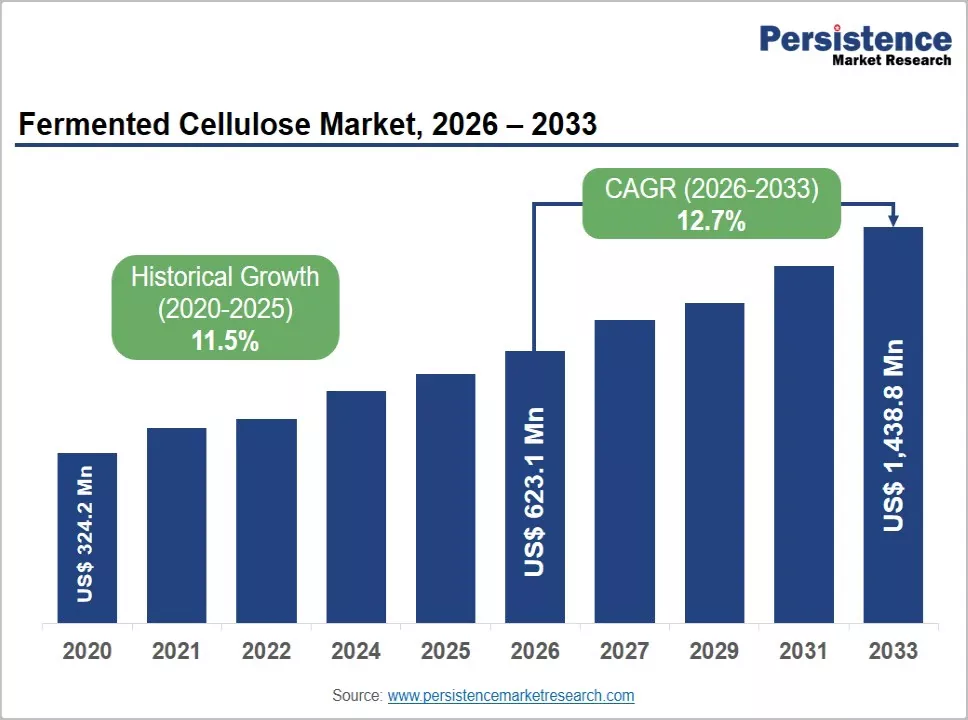
Fermented cellulose is the bio-degradable and eco-friendly product which is produced by the fermentation of cellulose, which is derived from different vegetables and plant. During the fermentatioThe global fermented cellulose market size is likely to be valued at US$623.1 million in 2026 and is estimated to reach US$1,438.8 million by 2033, growing at a CAGR of 12.7% during the forecast period from 2026 to 2033, driven by the rising demand for biodegradable, bio-based ingredients in food, cosmetics, and biomedical products. Stringent microplastic rules and advances in precision fermentation are also helping new products reach the market.n process of cellulose, primarily corn-syrup based media with the bacteria is used.
Fermented cellulose is naturally derived product fermented by the microbial and available in ready-to-use liquid form which is further utilized for the different applications. Fermented cellulose is primarily used for home care, fabric care, and personal care applications.
Fermented cellulose’s reticulated network offers the suspension by nominal impact to the viscosity and dispersibility of finish products. During the production of fermented cellulose natural ingredients are used which creates a discrete advantage and also support the being eco-friendly and sustainable status of the products.
Fermented cellulose is also a cost-effective option due to its low use levels and as well as offers the optimal suspension in the existence of a high concentration of surfactants and polymers. The product is compatible with even the most concentrated liquid detergent and also shows the tolerance to the different conditions.
Key Industry Highlights:
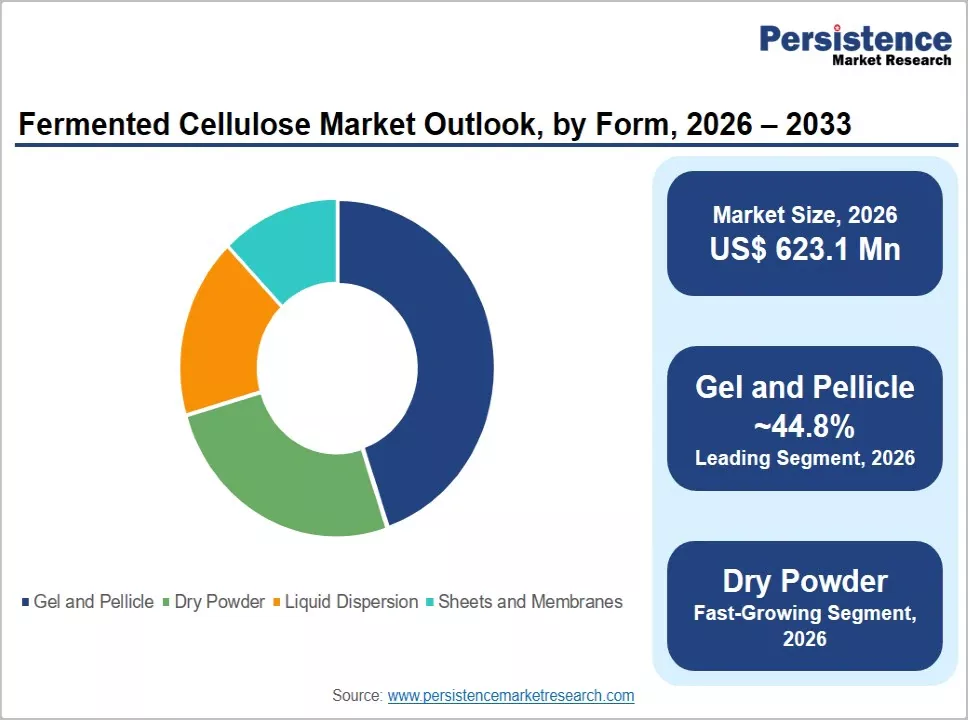
- Leading Form: Gel and pellicle, about 44.8% share in 2026, as nata de coco, facial mask sheets, and wound care materials all start as wet, water-rich cellulose.
- Dominant Application: Food and beverages, around 38.6% share in 2026, as nata de coco has a long commercial history in desserts, beverages, and fruit products across Asia.
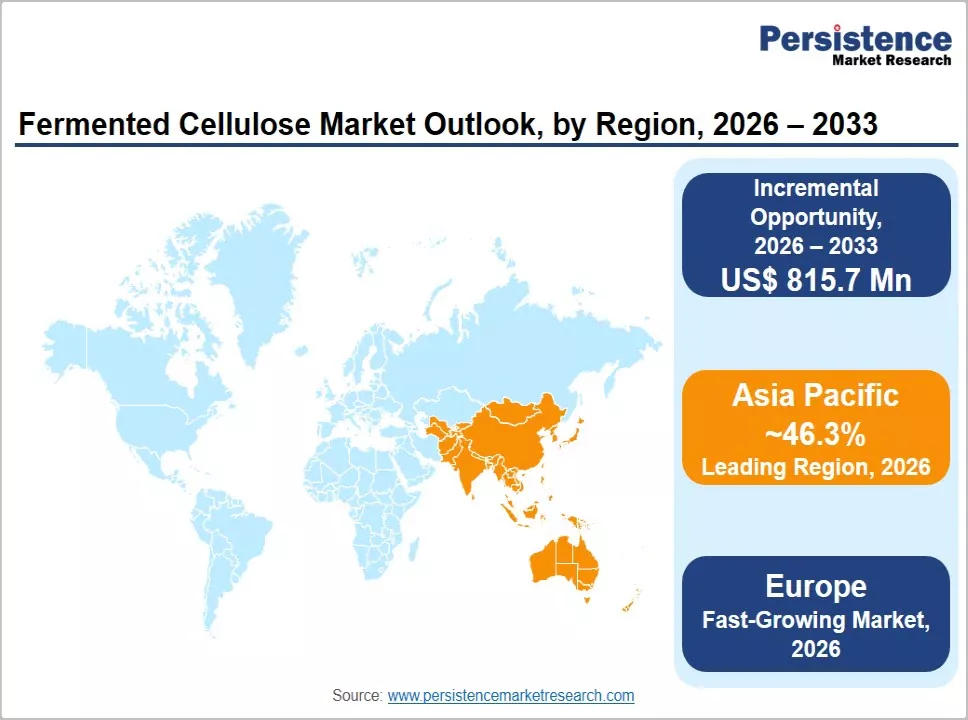
- Leading Region: Asia Pacific, with about a 46.3% share in 2026, due to large nata de coco production bases and growing industrial fermentation in China.
- Fast-growing Region: Europe, due to strict microplastic rules, exponential cosmetic ingredient demand, and new bacterial cellulose start-ups.
- Latest Update: In August 2026, Nanollose announced plans to establish and operate its own pilot-scale microbial cellulose pulp facility in Western Australia to accelerate commercialization of its Nullarbor lyocell fiber. The company said the facility will be used to validate its microbial-cellulose process at an industry-relevant scale before pursuing licensing, joint-venture, or sale arrangements. The move represents a shift toward greater control over the scale-up process for microbial cellulose-based textile fibers.
DRO Analysis
Driver- EU Microplastics Rules to Propel Demand for Bio-based Ingredients
Microplastic rules are changing cosmetic formulations. The European Commission adopted Regulation (EU) 2023/2055 on September 25, 2023. It restricts synthetic polymer microparticles added to products. Sales of rinse-off cosmetics with such particles must stop from October 17, 2027. Leave-on products follow from October 17, 2029. Makeup, lip, and nail products follow from October 17, 2035. The restriction is expected to prevent the release of about 500,000 tons of microplastics over 20 years.
Fermented cellulose offers a biodegradable alternative. Cellugy says its EcoFlexy RP can replace common rheology modifiers. Worlée’s WorléeSuspens Eco has a natural origin content of 99.4% under ISO 16128 and is microplastic-free. Bioweg says its bacterial cellulose micropowder can degrade fully within 60 days. Cellugy also cites the Plastic Soup Foundation, which says about 87% of cosmetic products contain petrochemical ingredients. These claims help brands meet the new rules.
Superior Material Properties to Bolster Use across Industries
Bacterial cellulose has strong technical value. A peer-reviewed review in the International Journal of Agricultural and Biological Engineering notes that it has high crystallinity, tensile strength of 20–300 megapascals (MPa), and water-holding capacity above 95%. Other reviews report crystallinity of up to 85%. Unlike plant cellulose, it is free from lignin and hemicellulose. These traits support use in food, cosmetics, wound care, and composite membranes.
Commercial supply is already proven. CP Kelco says its fermentation-derived cellulose uses the same microorganism that produces nata de coco. It is chemically identical to plant cellulose. Its grades meet COSMOS, ECOCERT, NATRUE, vegan, non-GMO, and halal standards. A ScienceDirect book chapter notes that traditional nata de coco farms in the Philippines, Indonesia, Vietnam, and Thailand can produce 500–1,500 tons per year per producer. This base supports further scale-up.
Restraint- High Production Cost and Scale-up Challenges May Limit Adoption
Cost remains the main barrier. Peer-reviewed reviews describe high cost and low productivity as limits to industrial use. The culture medium alone can account for more than 30% of production cost. A 2025 review in Experimental Biology also cites slow fermentation rates as a barrier to large-scale use. Downstream steps such as purification and drying add further expense. In September 2024, Cellugy began a project with the Danish Technological Institute to develop a more cost-effective downstream process.
Scale is still early for many new suppliers. Cellugy raised €4.9 million (approx. US$5.5 million) in seed funding in 2024 to increase annual production from kilos to several tons. Process choice also matters. Agitated culture can raise output, but a review notes that it may lower polymerization, crystallinity, and mechanical strength. Price-sensitive buyers may delay adoption until costs fall.
Opportunity- Biomedical and Wound Care Uses to Open High-value Segments
Medical uses can bring high margins. Peer-reviewed reviews describe bacterial cellulose as a strong wound dressing material owing to its porosity, water retention, gas exchange, and biocompatibility. The woven fiber network also allows controlled release of substances. Researchers are also studying it for vascular grafts, tissue engineering, and drug delivery. One review notes that wet dressings loaded with antibiotics healed infected wounds.
Quality needs are higher in this segment. A Frontiers review notes that food uses do not need the same purity as biomedical uses. This allows suppliers to price high-purity grades at a premium. Companies that invest in documentation, sterile processing, and clinical data can move beyond bulk ingredients into medical products.
Upcycled Feedstock and New Facilities to Reduce Costs
Low-cost feedstock can improve economics. Reviews highlight agricultural residues, including molasses, as potential low-cost culture media. In January 2026, Bioweg secured a €16 million Series A. It plans to convert food industry byproducts into bacterial cellulose and build a first-of-its-kind production facility in Germany. The company’s micropowder is designed to replace solid microplastics.
New capacity can also widen applications. Reports on the market name Polybion and Modern Synthesis among companies working on biofabricated leather and sustainable textiles. As yields improve, suppliers can serve textile, packaging, and home care uses. CP Kelco already offers fermentation-derived cellulose for fabric care, home care, and personal care.
Category-wise Analysis
Form Insights
Gel and pellicle is predicted to lead with a share of about 44.8% in 2026, as nata de coco, bacterial cellulose masks, and wound dressings all start as wet pellicles. The Philippines has exported nata de coco since 1977. It is used in desserts, fruit cocktails, ice cream, and as a cheese and yogurt stabilizer. Nata de coco also appears in sausage casings, speaker diaphragms, and high-grade paper. A bacterial nanocellulose facial mask is a crystalline, flexible, thin film.
Dry powder is estimated to be the fastest-growing segment over the forecast period, as it is easier to store, ship, and blend than water-rich gel. Cellugy produces a dry cellulose that acts as a thickener and emulsifier. Bioweg offers a bacterial cellulose micropowder. Worlée’s suspending agent is ready to use and mixes with moderate stirring. These formats suit cosmetic and home care makers.
Application Insights
Food and beverages are anticipated to dominate with a share of around 38.6% in 2026, as nata de coco is a mature product with steady export demand. The Philippines and Indonesia are top exporting countries of nata de coco products. Coconut water is available year-round, which supports reliable production. Uses include desserts, beverages, and high-fiber foods.
Personal care and cosmetics are expected to remain in the second position in 2026, and they are growing faster than food. Fermented cellulose works as a thickener, suspending agent, and emulsifier. Brands need alternatives to synthetic polymers before the EU deadlines. Cellugy says its ingredient gives a glide-on feel with low stringiness. It also develops a sun protection booster and a color cosmetics enhancer.
Regional Insights
Asia Pacific Fermented Cellulose Market Trends
Asia Pacific is anticipated to dominate in 2026 globally with a share of approximately 46.3%, due to its long nata de coco tradition and large coconut-based supply chains. Commercial nata de coco is made across the Philippines, Indonesia, China, Vietnam, Malaysia, and Thailand. Producers serve both domestic and export markets, including Europe. Japan, Hong Kong, and the U.S. were major destinations for Philippine nata de coco in 2013. Facial masks and biomedical research add new demand.
China Fermented Cellulose Market Trends
China will likely lead in Asia Pacific in 2026 with a share of about 31.6%, supported by strong fermentation capability and a large cosmetics industry. A 2020 peer-reviewed review in Frontiers in Bioengineering and Biotechnology described industrial-scale bacterial cellulose production in China. Hainan Yeguo Foods is among the named producers. China also supplies many bio-cellulose sheet masks.
India Fermented Cellulose Market Trends
In 2026, India is projected to account for a share of just about 16.8% in Asia Pacific, as its market is early but has strong potential. India has large sugar and coconut sectors. Reviews highlight molasses and coconut water as low-cost substrates. Growing cosmetics, wound care, and food ingredient demand could support local production over the forecast period.
Europe Fermented Cellulose Market Trends
Europe is anticipated to be the fastest-growing region over the forecast period with a share of roughly 24.8% in 2026 globally, as microplastic rules and clean beauty demand favor bio-based ingredients. The first EU deadline for rinse-off products is October 17, 2027. Leave-on products follow in 2029, which extends the demand window. Denmark’s Cellugy and Germany’s Bioweg show that new supply is emerging in the region.
Germany Fermented Cellulose Market Trends
Germany is predicted to register a substantial share of approximately 29.4% in 2026 in Europe, as it hosts specialty chemical and cosmetic ingredient suppliers. Bioweg plans a first-of-its-kind bacterial cellulose production facility in Germany. Hamburg-based Worlée launched WorléeSuspens Eco in April 2026. The company says it improves the stability of insoluble ingredients and sensory feel. The product complies with COSMOS and NATRUE standards.
U.K. Fermented Cellulose Market Trends
In Europe, a share of nearly 12.7% is predicted to be held by the U.K. in 2026, due to its established beauty and personal care sector. The U.K. banned microbeads in rinse-off personal care products from 2018. England banned manufacture from January 9, 2018, and sale followed in July 2018. Scotland’s rules took effect on June 19, 2018, and Wales’s on June 30, 2018. Brands now look for biodegradable ingredients that go beyond microbead limits.
North America Fermented Cellulose Market Trends
North America is predicted to hold a share of around 21.4% in 2026 globally, supported by strong cosmetic, biomedical, and home care ingredient demand. Regulation is narrower than in Europe. The U.S. law covers rinse-off cosmetics with plastic microbeads that exfoliate or cleanse. This limits regulatory pull. Brand-led sustainability goals and medical research drive most demand.
U.S. Fermented Cellulose Market Trends
In North America, a share of nearly 80.2% is expected to be held by the U.S. in 2026, as it is the region’s largest ingredient and biotech market. The Microbead-Free Waters Act stopped the manufacture of covered rinse-off cosmetics on July 1, 2017, and their sale on July 1, 2018. The law also covers toothpaste. Atlanta-based CP Kelco offers fermentation-derived cellulose for personal care, home care, and fabric care.
Competitive Landscape
The global fermented cellulose market is highly fragmented and technology-driven, with competition spread across bacterial cellulose producers, biomaterial developers, specialty cellulose manufacturers, and biotechnology companies. BIOWEG, Nanollose, Suzano, Hainan Guangyu Biotechnology, and Kombuchery are among the companies developing or commercializing microbial or bacterial cellulose-based materials, while universities and research-driven start-ups continue to develop new fermentation and scale-up technologies.
Competition is also developing around production technology rather than finished cellulose alone. Companies and research institutions are working on continuous bioreactors, waste-derived fermentation media, seawater-based production and engineered microbial strains to address bacterial cellulose's historically high production costs. The CelloTECH project in Germany, for example, is developing continuous bioreactor technology, while recent research has demonstrated the use of grass clippings, spent coffee grounds, cereal flours and other waste streams as alternative fermentation inputs.
Key Industry Developments:
- In September 2026, BIOWEG announced a €30 million (approx. US$33.7 million) Series A expansion and plans to build Europe's largest bacterial cellulose production plant in Elsdorf, Germany. The facility is expected to have annual production capacity of up to 10,000 tons, with construction scheduled to begin in Q4 2026 and first commercial volumes targeted for 2028. BIOWEG said the plant will use molasses and other sugar-industry side streams as fermentation feedstock to produce biodegradable bacterial cellulose for applications including fertilizer coatings, seed coatings, cosmetics and detergents.
- In April 2026, Nanollose reported a fourth pilot production run of its Nullarbor forest-friendly lyocell fiber, producing 580 kg of fiber from microbial cellulose. The trial used 200 kg of microbial cellulose supplied by Hainan Guangyu Biotechnology and produced Nullarbor-25 and Nullarbor-30 fiber blends with FSC-certified wood pulp. The company reported that the microbial cellulose could be directly incorporated into existing lyocell production lines without additional pre-processing, supporting the potential integration of fermented cellulose into established textile manufacturing infrastructure.
- In March 2026, Stony Brook University and SWFT Labs expanded their research partnership to accelerate commercialization of cellulose nanomaterials. The Master Research Agreement builds on Stony Brook's patented Nitro-Oxidation Process, which SWFT Labs has exclusively licensed worldwide to produce functionalized cellulose nanofibers. SWFT Labs said it planned its first commercial product launch for April 2026, initially targeting agriculture, while also pursuing applications in industrial materials, water filtration, beauty and personal care, medical technologies and aerospace.
The report covers exhaustive analysis on:
| Key Insights | Details |
|---|---|
|
Current Market Value (2026) |
US$623.1 Mn |
|
Projected Market Value (2033) |
US$1,438.8 Mn |
|
CAGR (2026-2033) |
12.7% |
|
Leading Region |
Asia Pacific, 46.3% |
|
Dominant Form |
Gel and Pellicle, 44.8% |
|
Top-ranking Application |
Food and Beverages, 38.6% |
|
Incremental Opportunity |
US$815.7 Mn |
Frequently Asked Questions
The global fermented cellulose market is projected to be valued at US$623.1 million in 2026.
The fermented cellulose market is expected to reach US$1,438.8 million by 2033.
Key market trends include microplastic-free cosmetic ingredients, dry powder formats, upcycled feedstocks, and wound care uses.
Gel and pellicle is expected to be the leading form with a share of around 44.8% in 2026, as nata de coco, masks, and wound materials start as wet cellulose.
The fermented cellulose market is expected to grow at a CAGR of 12.7% from 2026 to 2033.
CP Kelco, Worlée-Chemie GmbH, and Cellugy ApS are a few key market players.


