




- Industrial Goods & Service
- Explosion Proof Equipment Market
Explosion Proof Equipment Market Size, Share, and Growth Forecast, 2026 - 2033
Explosion Proof Equipment Market by Product Type (Enclosures, Lighting System, Others), Protection Methods (Explosion Proof, Explosion Prevention, Others), End-user Industry, and Regional Analysis for 2026 - 2033

Explosion Proof Equipment Market Size and Trends Analysis
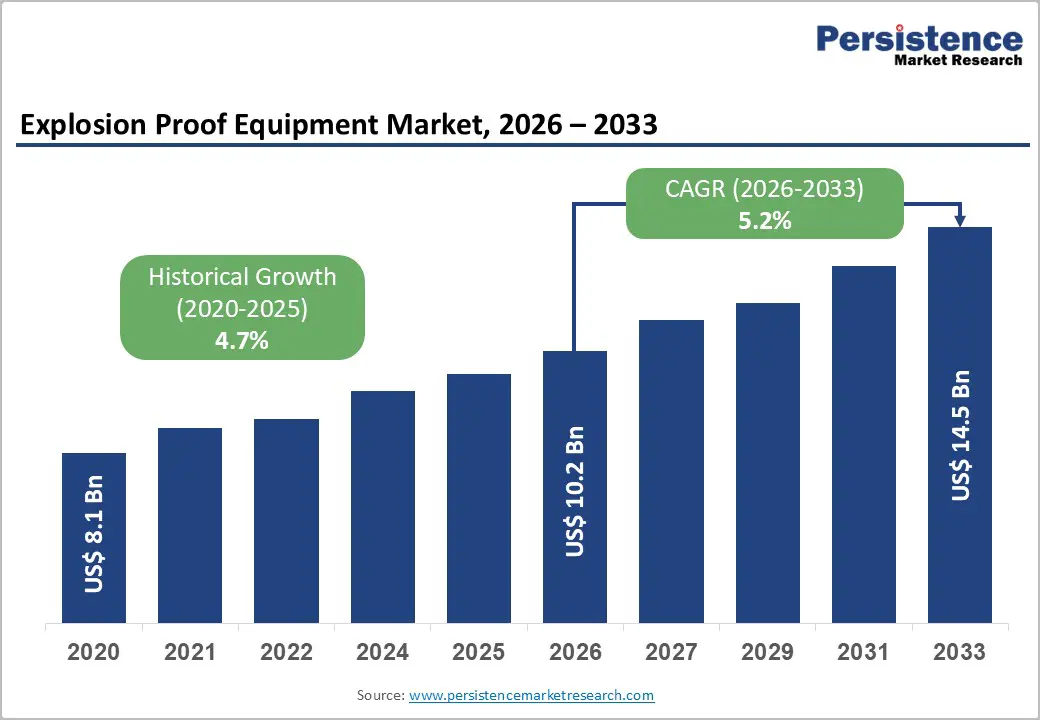
The global explosion proof equipment market size is likely to be valued at US$10.2 billion in 2026 and is expected to reach US$14.5 billion by 2033, growing at a CAGR of 5.2% between 2026 and 2033, driven by stringent hazardous-area safety regulations, sustained capital expenditure across energy and process industries, and increased adoption of certified equipment designed to minimize ignition risks in volatile environments.
Regulatory frameworks such as OSHA hazardous-location standards, the ATEX Directive, and IECEx certification systems ensure that procurement decisions remain compliance-driven rather than discretionary. This regulatory dependency creates a stable and recurring demand environment across industries operating in explosive atmospheres.
Key Industry Highlights:
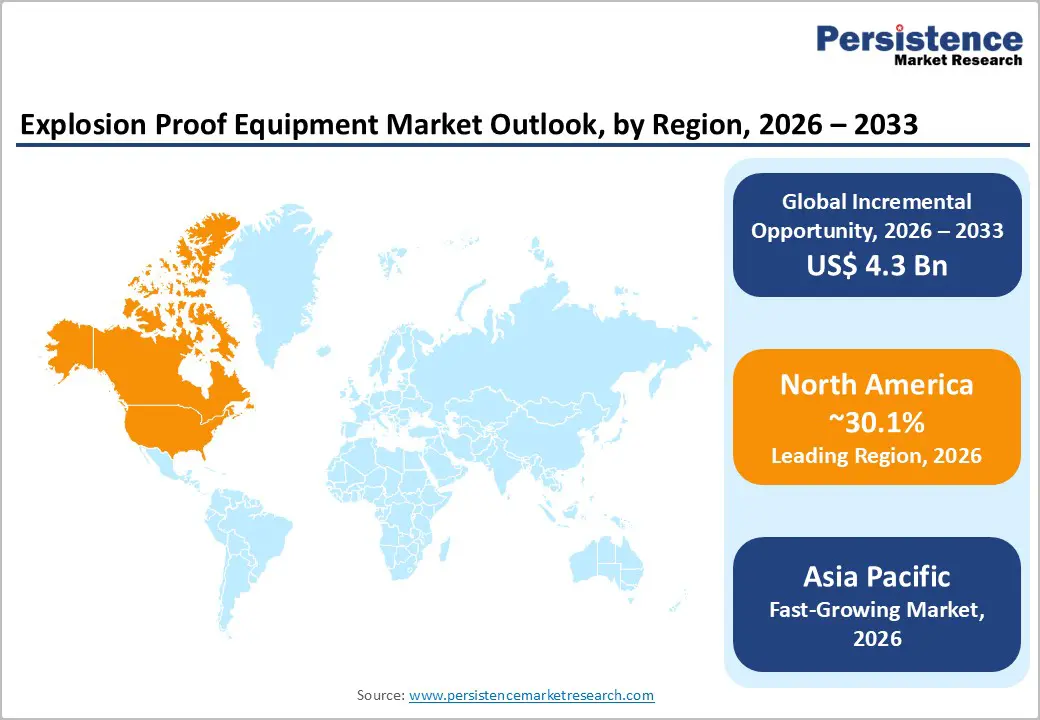
- Leading Region: North America is projected to account for 30.1% of market share, supported by strong regulatory enforcement, advanced industrial infrastructure, and continuous investments in oil & gas and manufacturing sectors.
- Fastest-growing Region: Asia Pacific is the fastest-growing region, driven by rapid industrialization in China and India, expanding manufacturing bases, and increasing adoption of international safety standards across emerging economies.
- Investment Plans: Major industry players are focusing on regional manufacturing expansion and localization strategies, particularly in Asia Pacific, with increased investments in production facilities, smart safety technologies, and digital monitoring solutions to meet rising demand.
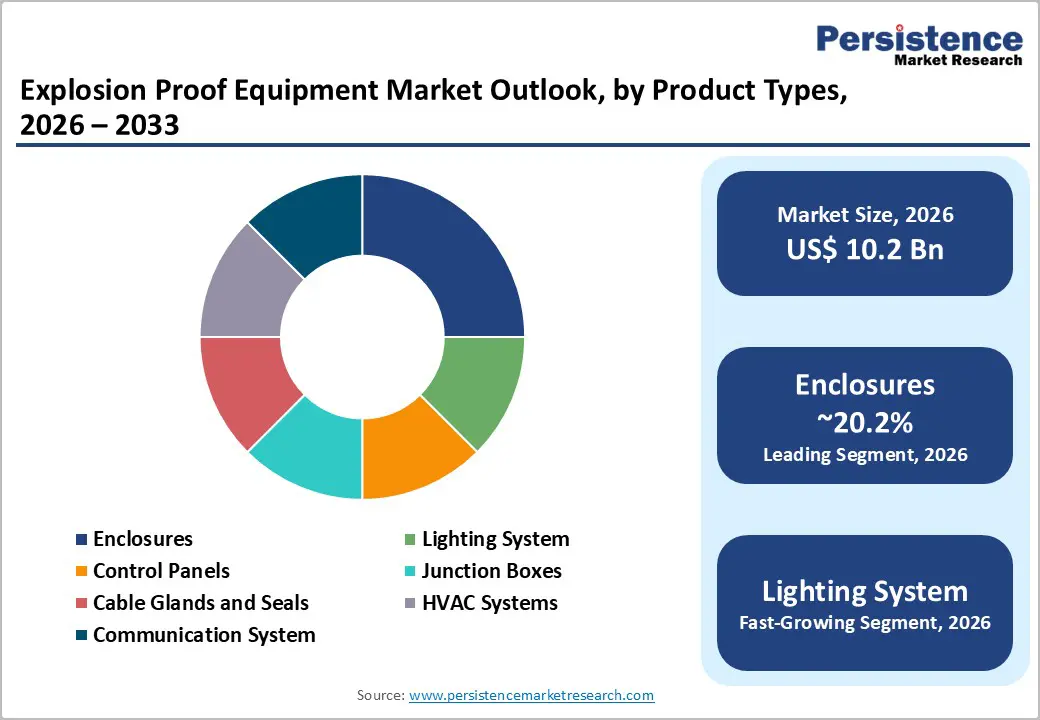
- Dominant Product Type: Enclosures dominate, holding an anticipated market share of approximately 20.2%, due to their essential role in protecting electrical components in hazardous environments.
- Leading Protection Methods: Explosion-proof protection methods lead the market, accounting for an anticipated share of approximately 45.6%, driven by widespread adoption across high-risk industries such as oil & gas, chemicals, and mining.
| Key Insights | Details |
|---|---|
| Explosion Proof Equipment Market Size (2026E) | US$10.2 Bn |
| Market Value Forecast (2033F) | US$14.5 Bn |
| Projected Growth (CAGR 2026 to 2033) | 5.2% |
| Historical Market Growth (CAGR 2020 to 2025) | 4.7% |
Market Factors - Growth, Barriers, and Opportunity Analysis
Growth Analysis - Tightening Safety Regulations across Hazardous Industries
Explosion-proof equipment demand is fundamentally anchored in regulatory compliance. OSHA mandates that equipment used in hazardous environments must be approved for specific classifications or designed to be intrinsically safe. Similarly, the ATEX Directive establishes harmonized requirements for equipment operating in explosive atmospheres across Europe, while IECEx provides an internationally recognized certification framework. These regulatory systems create a structured procurement environment where compliance is mandatory. As a result, industrial operators prioritize certified equipment over cost alternatives, ensuring consistent replacement cycles and upgrades. For manufacturers, regulatory alignment directly influences product design, certification investments, and distribution strategies, reinforcing long-term market stability.
Rising Capital Expenditure in Energy, Manufacturing, and Process Industries
Global industrial investment continues to support demand for explosion-proof equipment. The energy sector alone is witnessing multi-trillion-dollar annual investments, while industrial sectors account for a substantial share of global energy consumption. This reflects the scale of operations requiring protection in hazardous conditions. Expanding oil refineries, chemical plants, mining operations, and manufacturing facilities are increasingly integrating explosion-safe systems during both greenfield and brownfield projects. Growth in industrial automation and plant modernization further accelerates demand for explosion-proof enclosures, lighting systems, control panels, and communication devices. This trend ensures sustained market expansion, particularly in regions experiencing industrial growth.
Technological Advancements and Smart Hazardous-Area Solutions
The market is transitioning from conventional flameproof equipment toward integrated, intelligent systems. Manufacturers are introducing solutions that combine explosion protection with real-time monitoring, industrial networking, and mobility features. Technologies such as Ethernet-enabled hazardous-area communication systems, advanced purge and pressurization solutions, and connected sensing devices are reshaping product offerings. These innovations enable predictive maintenance, improved safety performance, and operational efficiency. As industries increasingly adopt digital transformation strategies, explosion-proof equipment is evolving into a critical component of connected industrial ecosystems rather than a standalone safety solution.
Barrier Analysis - High Certification and Lifecycle Costs
Explosion-proof equipment involves significantly higher costs compared to standard industrial equipment due to complex design requirements, certification processes, and compliance documentation. Equipment must undergo rigorous testing and periodic recertification, increasing lifecycle costs. Installation and maintenance also require specialized expertise, further elevating operational expenses. Small and mid-sized enterprises often delay adoption or upgrades due to these financial constraints, particularly in non-mandatory applications. For manufacturers, pricing pressure from customers seeking cost optimization can compress margins while extending sales cycles due to lengthy approval processes.
Supply Chain Constraints and Product Qualification Challenges
The supply chain for explosion-proof equipment is highly specialized, relying on certified materials and components that must meet strict regulatory standards. Traceability requirements and compliance audits add complexity to sourcing and manufacturing processes. Any modification in product design, such as changes in enclosure materials, sealing mechanisms, or thermal performance, may require requalification and recertification. This slows product innovation and time-to-market. Delays in certification approvals can also impact project timelines, posing revenue risks for manufacturers and limiting flexibility in responding to market demand.
Opportunity Analysis - Industrial Expansion and Hazardous-Area Modernization in Asia Pacific
Asia Pacific represents the fastest-growing market, with countries such as China and India driving demand through rapid industrialization and infrastructure development. Expansion of petrochemical complexes, manufacturing hubs, ports, and energy projects is creating significant demand for explosion-proof systems. India, in particular, is emerging as a key growth engine due to government-led industrial initiatives and increasing investments in domestic manufacturing. Companies that establish localized production, certification capabilities, and service networks are well-positioned to capitalize on this growth by reducing lead times and improving cost competitiveness.
Integration of Digital Monitoring and Smart Safety Systems
The convergence of explosion protection with industrial automation and digital monitoring presents a major growth opportunity. Industrial operators increasingly require solutions that combine safety compliance with operational intelligence. Integration of gas detection, remote diagnostics, and communication systems within explosion-proof environments allows real-time monitoring and improved risk management. This shift enables vendors to offer high-value, integrated solutions rather than standalone products, increasing revenue potential through system-level sales, service contracts, and lifecycle management offerings.
Category-wise Analysis
Product Types Insights
Enclosures represent the largest product category, anticipated to hold approximately 20.2% of the market share in 2026. These systems form the foundation of explosion protection by housing critical electrical components such as switches, relays, circuit breakers, and terminals in environments exposed to flammable gases, vapors, and combustible dust. Their widespread use across industries such as oil & gas, chemicals, mining, and manufacturing ensures consistent demand. For example, flameproof enclosures are extensively deployed in refinery control rooms and offshore drilling rigs to isolate ignition sources. In addition to safety, modern enclosures are increasingly designed with corrosion resistance, thermal stability, and ingress protection, making them suitable for harsh industrial environments. Their essential role in maintaining system integrity and preventing ignition risks makes them indispensable in hazardous-area operations.
Lighting systems are the fastest-growing segment, driven by the transition toward energy-efficient LED technologies and increasing emphasis on workplace safety standards. Explosion-proof lighting is widely used in industrial plants, offshore platforms, marine vessels, and mining operations where reliability and durability are critical. For instance, LED-based explosion-proof luminaires are increasingly installed in petrochemical plants and storage terminals to enhance visibility while minimizing heat generation. These systems offer longer operational life, reduced maintenance frequency, and lower energy consumption compared to traditional lighting solutions. In hazardous environments where maintenance access is limited and shutdowns are expensive, these benefits significantly improve operational efficiency. The growing adoption of smart lighting systems with remote monitoring capabilities is further accelerating segment growth.
Protection Methods Insights
Explosion-proof protection methods dominate the market and are anticipated to hold approximately 45.6% market share in 2026. These systems are engineered to contain internal explosions and prevent them from igniting the surrounding hazardous atmosphere. They are widely used across oil & gas, petrochemical, mining, and marine industries due to their proven reliability and strict compliance with regulatory standards. Common examples include flameproof motors used in drilling operations, explosion-proof control panels in refineries, and sealed junction boxes in chemical processing plants. These solutions are particularly critical in high-risk zones where flammable gases or vapors are continuously present. Their long-standing adoption and regulatory acceptance make them the default choice in many hazardous applications, ensuring sustained demand.
Explosion prevention methods are the fastest-growing segment as industries shift toward proactive safety strategies. Unlike containment-based approaches, these methods focus on eliminating ignition sources before an explosion can occur. Technologies such as intrinsic safety barriers, pressurization and purging systems, gas detection sensors, and automated shutdown mechanisms are gaining traction. For example, intrinsic safety systems are widely used in pharmaceutical and chemical plants to limit electrical energy in circuits, preventing sparks. Similarly, gas detection systems integrated with control systems can trigger immediate shutdowns in case of leaks. This preventive approach aligns with modern industrial safety frameworks that prioritize risk mitigation over incident control. As digital monitoring and automation capabilities advance, the adoption of explosion prevention solutions is expected to accelerate further.
Regional Insights
North America Explosion Proof Equipment Market Trends - OSHA-Driven Demand & Industrial Modernization Cycles
North America is projected to lead the market, accounting for 30.1% of the market share in 2026. The U.S. dominates the region due to its extensive oil and gas infrastructure, advanced manufacturing sector, and strong regulatory framework. Compliance with hazardous-location standards such as those enforced by the Occupational Safety and Health Administration (OSHA) ensures continuous demand for certified equipment. The region benefits from a well-established industrial base and ongoing investments in plant modernization and automation, particularly in refining, LNG, and chemical processing facilities.
Canada and Mexico contribute to regional growth, with Mexico showing strong potential due to industrial expansion and nearshoring trends. The presence of leading global manufacturers such as Eaton Corporation, Honeywell International, and Emerson Electric strengthens the competitive landscape. For example, Eaton has continued expanding its hazardous-area lighting and electrical solutions portfolio in North America, supporting energy and industrial customers transitioning toward safer and more energy-efficient systems.
Similarly, Honeywell has been advancing connected safety solutions, integrating gas detection and industrial IoT platforms for hazardous environments. Innovation in digital monitoring, predictive maintenance, and integrated safety systems is accelerating adoption. Replacement cycles for aging infrastructure, particularly in refineries and chemical plants, play a critical role in sustaining demand alongside new project investments, ensuring a stable and recurring revenue base for suppliers.
Europe Explosion Proof Equipment Market Trends - ATEX Compliance & Engineering-Led Safety Solutions
Europe represents a mature, compliance-driven market supported by harmonized regulatory frameworks such as the ATEX Directive. Key contributors include Germany, the U.K., France, and Italy, with Germany leading due to its strong industrial base and engineering expertise. The region emphasizes high-quality, durable, and certified equipment, supporting demand for premium explosion-proof solutions across chemical processing, pharmaceuticals, and advanced manufacturing industries.
The competitive landscape is shaped by established European players such as Siemens AG, R. STAHL AG, and BARTEC GmbH, which continue to invest in product innovation and global expansion. For instance, R. STAHL has been actively expanding its international manufacturing footprint, including investments in Asia, while maintaining strong engineering and product development capabilities in Germany.
BARTEC has strengthened its position through certification-focused solutions and training programs, reflecting the region’s emphasis on compliance expertise. Growth in Europe is increasingly driven by modernization projects, including upgrades in chemical plants and pharmaceutical production facilities, as well as emerging applications in the hydrogen and renewable energy sectors, where explosion risks must be carefully managed.
Although growth is moderate compared to Asia Pacific, Europe remains strategically important due to its technological leadership, stringent regulatory environment, and focus on operational efficiency. The region’s commitment to safety and sustainability continues to drive demand for advanced, high-performance explosion protection systems.
Asia Pacific Explosion Proof Equipment Market Trends - Rapid Industrialization & Localized Manufacturing Expansion
Asia Pacific is the fastest-growing regional market, driven by rapid industrialization, infrastructure development, and expanding manufacturing capacity. China holds the largest market share in the region, supported by its extensive manufacturing base, petrochemical industry, and energy sector investments. India is emerging as a key growth market due to accelerating industrial activities, government-led initiatives such as “Make in India,” and increasing investments in domestic manufacturing and energy infrastructure.
The region benefits from cost advantages, rising foreign direct investment, and the expansion of industrial clusters across sectors such as chemicals, mining, oil & gas, and electronics manufacturing. Leading global companies are strengthening their regional presence to capture this growth. For example, ABB Ltd expanded its flameproof motor portfolio in India in 2025, targeting hazardous applications in oil & gas, chemicals, and food processing industries. Similarly, R. STAHL AG initiated the development of a new manufacturing facility in Tamil Nadu, reinforcing its commitment to local production and faster delivery capabilities in Asia.
ASEAN countries are also contributing to market expansion through investments in energy infrastructure, marine operations, and industrial parks. Countries such as Indonesia, Vietnam, and Thailand are witnessing increasing demand for explosion-proof systems due to growth in refining, mining, and port operations. The adoption of international safety standards such as IECEx is improving regulatory alignment across the region, enabling easier market entry for global players. As a result, Asia Pacific is transitioning from a cost-driven manufacturing base to a strategically important market for advanced and integrated explosion protection solutions.
Competitive Landscape
The global explosion proof equipment market is moderately fragmented, with a mix of global industrial conglomerates and specialized manufacturers. Leading players hold significant market share due to their strong product portfolios, global presence, and certification capabilities. A large number of regional and niche players contribute to competition, particularly in specific product categories and local markets.
Key players focus on regulatory compliance, product innovation, and regional expansion. Strategies include localization of manufacturing, integration of digital technologies, and development of comprehensive safety solutions. Companies are increasingly offering bundled systems and lifecycle services to differentiate themselves and capture long-term customer value.
Key Industry Developments:
- In August 2025, Pepperl+Fuchs SE highlighted the expansion of its global Solution Engineering Centers (SECs), aimed at delivering customized explosion protection systems and strengthening its ability to provide application-specific hazardous-area solutions to industrial clients.
Companies Covered in Explosion Proof Equipment Market
- ABB Ltd
- Eaton Corporation plc
- Siemens AG
- Honeywell International Inc.
- R. STAHL AG
- Pepperl+Fuchs SE
- Emerson Electric Co.
- Rockwell Automation, Inc.
- BARTEC GmbH
- Adalet (Marmon Group)
- Marechal Electric Group
- Intertek Group plc
- G.M. International S.p.A.
- i.safe MOBILE GmbH
- Warom Technology Incorporated Company
- Rae Systems (Honeywell Analytics)
Frequently Asked Questions
The global explosion proof equipment market size is estimated to be US$10.2 billion in 2026.
The explosion proof equipment market is projected to reach US$14.5 billion by 2033.
Key trends include the increasing adoption of explosion prevention technologies, integration of digital monitoring and smart safety systems, and rising investments in industrial automation and hazardous-area compliance across energy and manufacturing sectors.
The explosion proof protection method segment leads the market with an anticipated share of approximately 45.6%, driven by its widespread use in high-risk industries such as oil & gas and chemicals.
The explosion proof equipment market is expected to grow at a CAGR of 5.2% from 2026 to 2033.
Some of the major players include ABB Ltd, Eaton Corporation plc, Siemens AG, Honeywell International Inc., and R. STAHL AG.


