




- Semiconductor Materials & Components
- Everything As A Service Market
Everything As A Service Market Size, Share, and Growth Forecast 2026 – 2033
Everything As A Service Market by Product Type (IaaS, PaaS, SaaS), Offering (Solutions, Services), Organization Size (SMEs, Large Enterprises), Vertical (BFSI, IT and Telecom, Media and Entertainment), and Regional Analysis, 2026 – 2033

Everything As A Service Market Size and Trends Analysis
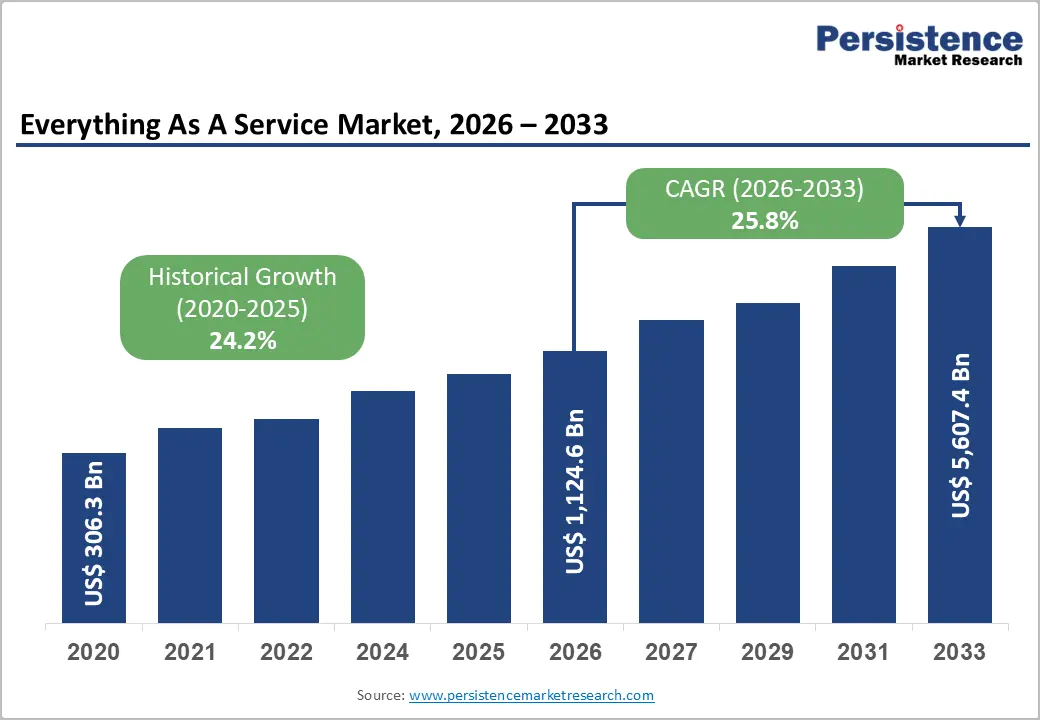
The global everything as a service market size is likely to be valued at US$1,124.6 billion in 2026 and is expected to reach US$5,607.4 billion by 2033, growing at a CAGR of 25.8% during the forecast period from 2026 to 2033, driven by rising shift of enterprises toward cloud-native architectures and subscription-based IT models. Surging integration of AI, data analytics, and automation into cloud platforms is also fueling demand for extensible and flexible service offerings.
Key Industry Highlights:
- Leading Product Type: SaaS, approximately 32.6% share in 2026, as it allows businesses to access software instantly without installation.
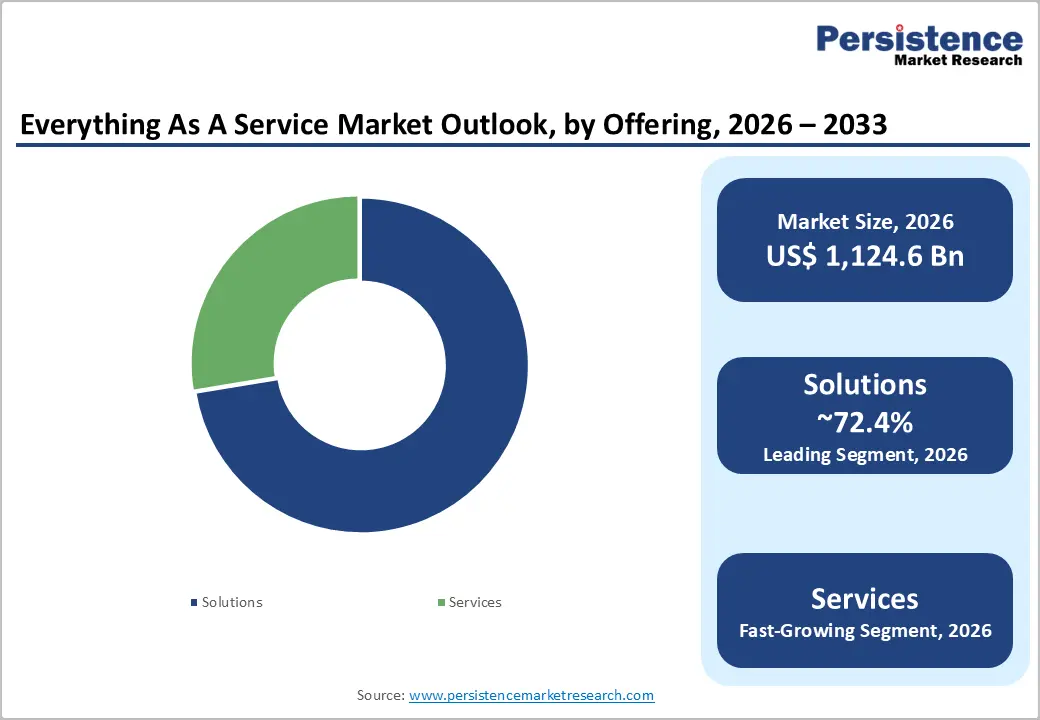
- Dominant Offering: Solutions, nearly 72.4% share in 2026, as enterprises prefer integrated platforms that combine multiple functions, reducing the need to manage separate tools and vendors.
- Strategic Partnership: In August 2025, Oracle and Google Cloud strengthened their strategic alliance to bring Google's Gemini AI models to Oracle Cloud customers. The partnership allows enterprises to access advanced generative AI models directly through Oracle's cloud infrastructure, improving AI-as-a-Service capabilities for developers and businesses.
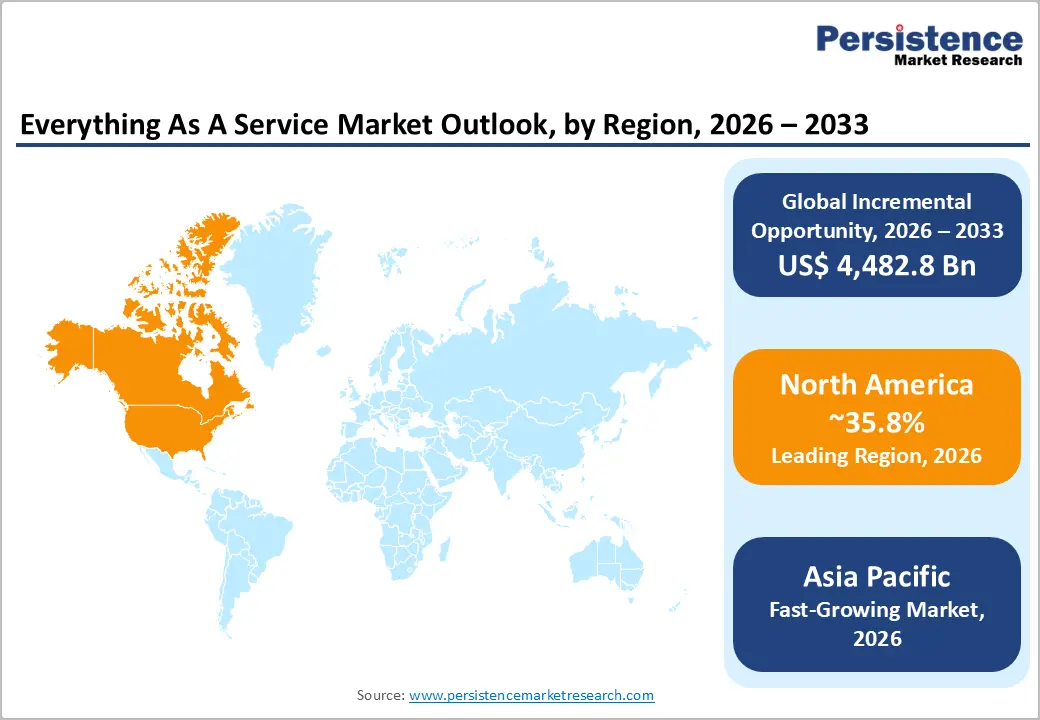
- Leading Region: North America, with about 35.8% share in 2026, owing to early cloud adoption and rising enterprise IT spending.
- Fast-growing Region: Asia Pacific, backed by ongoing digital transformation and government-backed cloud initiatives.
DRO Analysis
Driver - Need to Offload Internal IT Operations to External Providers
One of the key factors enterprises are moving to everything as a Service (XaaS) is the shift in who manages IT. Service providers handle maintenance, updates, and troubleshooting, which reduces the burden on businesses' internal IT teams and allows them to focus on strategic goals. According to a recently published industry whitepaper, adopting a Device-as-a-Service model can reduce IT support time by up to 28%, freeing up internal resources and cutting associated costs.
IBM, in an International Data Corporation (IDC) whitepaper it sponsored, further noted that by 2028, 80% of IT buyers will prioritize XaaS consumption for key workloads that require flexibility to help optimize IT spending, augment IT Ops skills, and attain sustainability metrics. Hence, companies are not just outsourcing hardware management, but they are restructuring their entire IT operating model around service consumption.
Requirement for Built-In Access to Emerging Technology
XaaS subscriptions ensure that companies are never stuck on outdated versions. Enterprises are prioritizing agility over the ownership of legacy assets, and this is evidenced by significant revenue increases among key infrastructure providers. Microsoft's 2024 Work Trend Index Report highlighted that 75% of knowledge workers now use AI tools at work, reflecting how quickly cloud-based services have embedded themselves into daily operations.
Flexera's 2024 data strengthened this, finding that 89% of organizations have adopted a multi-cloud strategy. It confirmed that XaaS has become the standard platform for accessing and updating technology without capital investments. Unlike traditional software licenses, XaaS models push updates automatically, keeping users current with zero additional cost or effort.
Restraint - Hidden Cost Problem in Subscription-Based Spending
Subscription models promise cost predictability, but the reality is often different. Businesses have been ambushed by unexpected cloud costs with subscription models, leading to inconsistent monthly bills. Many of the largest providers of cloud infrastructure are also increasing storage and hosting fees as inflation takes hold. Without comprehensive tools to track usage across platforms, companies fail to pinpoint the exact cause of overruns.
A recent survey of nearly 2,500 enterprise software buyers found that over half of respondents passed on a vendor due to higher-than-expected pricing, and nearly one-third swapped a software solution after cost overruns. IDC data also showed that predictable billing helps reduce hardware budget overruns by up to 35%, suggesting that without proper governance, the opposite is just as likely. As subscriptions multiply across departments, organizations face subscription sprawl, where cumulative monthly fees exceed what outright purchases would have cost.
Opportunity- Delivering AI Capabilities Through Cloud-Based Subscription Models
AI-as-a-Service is rapidly becoming one of the strongest growth vectors in XaaS. Rather than building their own models or data centers, companies can now access frontier AI capabilities on a pay-as-you-go basis. Microsoft has been a central driver of this shift. At Microsoft Ignite 2025, the company made Claude Sonnet 4.5, Opus 4.1, and Haiku 4.5 available through Microsoft Foundry, positioning Azure as the only cloud offering both OpenAI and Anthropic models.
This is part of a broad push to give enterprises a choice of AI models without infrastructure overhead. OpenAI has contracted to purchase an incremental US$250 billion of Azure services as part of the next chapter of its Microsoft partnership, signaling massive capacity expansion ahead. For enterprises, AIaaS eliminates the need for in-house GPU infrastructure while providing access to continuously updated models, which is a direct extension of the XaaS value proposition.
Extending Subscription Models to Physical Assets and Industrial Equipment
XaaS is no longer limited to software. The model is moving into heavy industry, where manufacturers now provide equipment on a pay-per-use or outcome-based basis. Rolls-Royce pioneered this approach with its Power-by-the-Hour model, delivering a complete engine and accessory replacement service on a fixed-cost-per-flying-hour basis. It complies the manufacturer's incentives with the operator's performance needs.
The same logic is now spreading into healthcare, energy, and mining. In healthcare, Digital-Surgery-as-a-Service provides medical robots to hospitals on a pay-per-use model. In energy, Sustainability-as-a-Service gives customers access to energy management without upfront costs. These models allow asset-heavy industries to move capital expenditure off their balance sheets while ensuring they only pay for outcomes. It is a structural opportunity that is still in its early stages across most industrial sectors.
Category-wise Analysis
Product Type Insights
Software as a service (SaaS) is predicted to lead with a share of approximately 32.6% in 2026, as it is easy to use and quick to deploy. Companies no longer need to install software on local systems. They can access tools through a browser. This reduces IT workload and cuts setup time from months to days. For example, Microsoft reported in its official earnings releases that adoption of Microsoft 365 grew strongly due to hybrid work trends. Governments also validate this shift. The U.S. General Services Administration (GSA) has promoted cloud-first policies, encouraging agencies to adopt SaaS tools instead of legacy systems.
Disaster recovery as a service (DRaaS) is estimated to be the fastest-growing segment over the forecast period, as cyberattacks and outages are increasing. Ransomware incidents have compelled companies to rethink backup strategies. According to reports from Cybersecurity and Infrastructure Security Agency, ransomware attacks continue to target critical infrastructure, pushing organizations to adopt cloud-based recovery solutions. DRaaS allows businesses to recover data and systems quickly without maintaining physical backup sites.
Offering Insights
Solutions are anticipated to dominate with a share of nearly 72.4% in 2026, as companies want complete systems instead of separate tools. A solution combines software, infrastructure, and analytics into one platform. This reduces integration issues and improves efficiency. For example, SAP delivers integrated business suites that include Enterprise Resource Planning (ERP), analytics, and supply chain modules. Enterprises prefer such solutions as they reduce the need to manage multiple vendors. SAP’s official reports show rising demand for its cloud-based business transformation packages.
Services are expected to remain in the second position in 2026, as several organizations lack in-house expertise to manage XaaS platforms. Moving from legacy systems to cloud requires planning, migration, and testing. Service providers help reduce risks during this transition. Managed services are also important after deployment. Companies require continuous monitoring, security updates, and performance optimization. This is especially critical in sectors such as banking and healthcare, where downtime is not acceptable.
Regional Insights
North America Everything As A Service Market Trends
North America is predicted to dominate in 2026 with a share of approximately 35.8%, as local enterprises adopted cloud services earlier than other regions. Large companies shifted from on-premise systems to cloud platforms over the last decade. This created a strong base for SaaS, PaaS, and IaaS expansion. The U.S. government also supported this shift. The U.S. General Services Administration introduced the Cloud Smart strategy, which encourages federal agencies to adopt cloud-first solutions. Another factor is the presence of leading providers such as Amazon Web Services, Microsoft, and Google. These companies invest heavily in AI, cloud infrastructure, and cybersecurity. Their continuous product launches and global expansion strengthen the region’s leadership.
U.S. Everything As A Service Market Trends
A share of nearly 73.2% is expected to be held by the U.S. in 2026, as companies are investing in AI-supported cloud services. Enterprises are moving beyond basic cloud usage and adopting advanced tools such as generative AI and data analytics. For example, Microsoft reported steady growth in Azure, boosted by AI workloads in its recent earnings releases. Government-backed digital initiatives also support growth. The National Institute of Standards and Technology promotes cloud standards and cybersecurity frameworks which builds trust among enterprises.
Asia Pacific Everything As A Service Market Trends
Asia Pacific is anticipated to be the fastest-growing region in 2026 with a share of nearly 31.2%, as several countries are still in the early stages of cloud adoption. Businesses are moving from limited IT setups to cloud-based systems, which creates superior growth momentum. Governments are actively supporting digital infrastructure. For example, Singapore’s Smart Nation initiative and India’s Digital India program promote cloud adoption across industries. These initiatives are officially backed by government policies and funding programs. Another reason is the rise of start-ups and digital businesses. E-commerce, fintech, and edtech companies prefer cloud-based models as they expand easily. This increases demand for XaaS solutions across the region.
China Everything As A Service Market Trends
China will likely lead Asia Pacific in 2026 with a share of around 38.4%, fueled by local cloud providers and government support. Companies prefer domestic platforms due to data security regulations. Providers such as Alibaba Cloud and Tencent Cloud dominate the market. The government has also promoted digital infrastructure through its New Infrastructure policy. This includes investments in data centers, AI, and cloud computing. Another factor is the expansion of digital platforms. China’s e-commerce and digital payment networks generate large volumes of data, which increases demand for extensible cloud and analytics services.
India Everything As A Service Market Trends
In 2026, India is projected to account for a share of approximately 27.2%, owing to several government-led digital programs. The Ministry of Electronics and Information Technology supports initiatives such as Digital India and cloud adoption frameworks. Platforms, including Aadhaar and UPI, have created a large digital network. Start-ups are another prominent driver. India has one of the largest start-up cultures globally. These companies prefer SaaS and cloud-native models to reduce costs and expand quickly. Global cloud providers are further investing in India. Google and Amazon Web Services have broadened data center regions in the country. This improves service availability and supports adoption.
Europe Everything As A Service Market Trends
Europe will likely see decent growth over the forecast period with a share of nearly 17.6% in 2026, as enterprises are adopting cloud services carefully. Data privacy regulations play a key role. The General Data Protection Regulation (GDPR) requires companies to handle data securely. This increases demand for compliant cloud solutions. The European Commission has also supported cloud initiatives through programs such as GAIA-X. This project aims to build a secure and sovereign cloud network in Europe. Companies in sectors, including banking, healthcare, and manufacturing, are gradually shifting to cloud platforms. This steady transition supports long-term growth.
Germany Everything As A Service Market Trends
Germany will likely register a substantial share of approximately 45.1% in 2026, owing to its industrial base. Manufacturing companies are adopting cloud and IoT solutions under the Industry 4.0 initiative. This program is supported by the country’s government and focuses on smart factories. Companies are using cloud platforms for predictive maintenance and supply chain management. SAP, headquartered in Germany, plays a key role by delivering cloud-based enterprise solutions. Data security is also a priority in the country. This increases demand for private cloud and hybrid cloud models.
U.K. Everything As A Service Market Trends
A share of around 20.5% is predicted to be held by the U.K. in 2026, spurred by high SaaS adoption. Businesses widely use cloud-based tools for finance, HR, and customer management. The government supports cloud adoption through the G-Cloud framework. This initiative, managed by the U.K. Government Digital Service, helps public sector organizations procure cloud services easily. The fintech sector is another key driver. London remains a global fintech hub. Companies rely on cloud infrastructure for payments, analytics, and compliance, which creates ongoing demand for XaaS solutions.
Competitive Landscape
The global everything as a service market is moderately consolidated at the top tier but highly fragmented across specialized service segments. A small group of hyperscalers, primarily AWS, Microsoft Azure, and Google Cloud, control a significant portion of global cloud infrastructure spending. Hundreds of SaaS, security, communications, analytics, and industry-specific service providers compete in niche areas. Competition is centered on AI-enabled services, multi-cloud capabilities, cybersecurity offerings, and industry-specific platforms rather than basic cloud infrastructure.
Beyond the hyperscalers, the market remains fragmented across individual XaaS categories. In SaaS, companies such as Salesforce, ServiceNow, SAP, and Adobe dominate specific application areas. In Security-as-a-Service, vendors such as CrowdStrike, Palo Alto Networks, and Zscaler maintain leading positions. Unified Communications-as-a-Service (UCaaS) is similarly competitive, with players including Zoom Video Communications, RingCentral, and Cisco's Webex platform.
Key Industry Developments:
- In April 2026, Oracle extended its partnership with Google Cloud by launching the Oracle AI Database Agent for Gemini Enterprise. The new service allows users to query enterprise databases using natural language through Google's Gemini platform, eliminating the need for SQL expertise and strengthening the integration between database-as-a-service and AI-as-a-service offerings.
- In January 2026, Oracle accelerated investments in AI cloud infrastructure to address rising enterprise demand for AI services and cloud computing capacity. The company outlined plans for significant expansion of its cloud and AI infrastructure footprint, underscoring the rising importance of AI-as-a-Service in the broad XaaS space.
- In June 2025, Oracle announced a partnership with xAI to make the Grok 3 model available through Oracle Cloud Infrastructure (OCI). The collaboration enables enterprises to access advanced generative AI capabilities through Oracle's cloud platform, expanding OCI's AI-as-a-Service portfolio and providing customers with greater flexibility in deploying large language models.
Companies Covered in Everything As A Service Market
- Amazon Web Services
- Alibaba Group
- Avaya
- Cisco Systems Inc.
- Dell
- IBM
- Microsoft
- Oracle Corporation
- Rackspace
- VMware
- Others
Frequently Asked Questions
The global everything as a service market is projected to be valued at US$1,124.6 billion in 2026.
The market is expected to reach US$5,607.4 billion by 2033.
Key market trends include the integration of AI into cloud services and increasing adoption of multi-cloud strategies.
SaaS is expected to be the leading product type with a share of nearly 32.6% in 2026, due to its ability to deliver continuous updates and built-in security.
The market is expected to grow at a CAGR of 25.8% from 2026 to 2033.
Amazon Web Services, Alibaba Group, and Avaya are a few key market players.


