




- Energy Storage Solutions
- Drone Battery Market
Drone Battery Market Size, Share, and Growth Forecast, 2026 - 2033
Drone Battery Market by Battery Type (Lithium Polymer, Fuel Cell, Others), Battery Capacity (Below 3000 mAh, 5000-10000 mAh, Others), Application, End-use Industry, and Regional Analysis for 2026 - 2033

Drone Battery Market Size and Trends Analysis
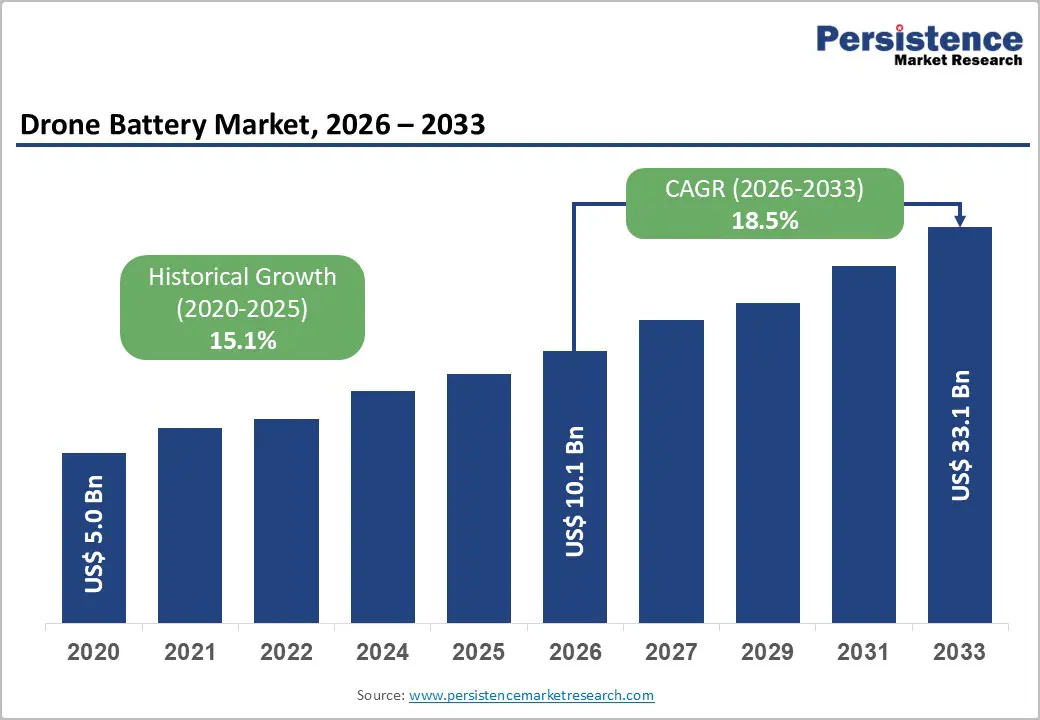
The global drone battery market size is likely to be valued at US$10.1 billion in 2026 and is expected to reach US$33.1 billion by 2033, growing at a CAGR of 18.5% between 2026 and 2033, driven by rising drone deployment across delivery, agriculture, inspection, and defense, along with stricter regulatory frameworks that emphasize reliability and compliance. Battery innovation is accelerating as operators prioritize longer flight endurance, faster charging cycles, and lightweight configurations.
A clear structural shift is underway from conventional consumer-grade batteries to high-performance, application-specific energy systems. Regulatory frameworks in the U.S., Europe, and India are formalizing drone operations, increasing the need for advanced battery management systems and certified components. This transition is shortening replacement cycles and elevating the value of premium batteries integrated with intelligent monitoring and safety features.
Key Industry Highlights:
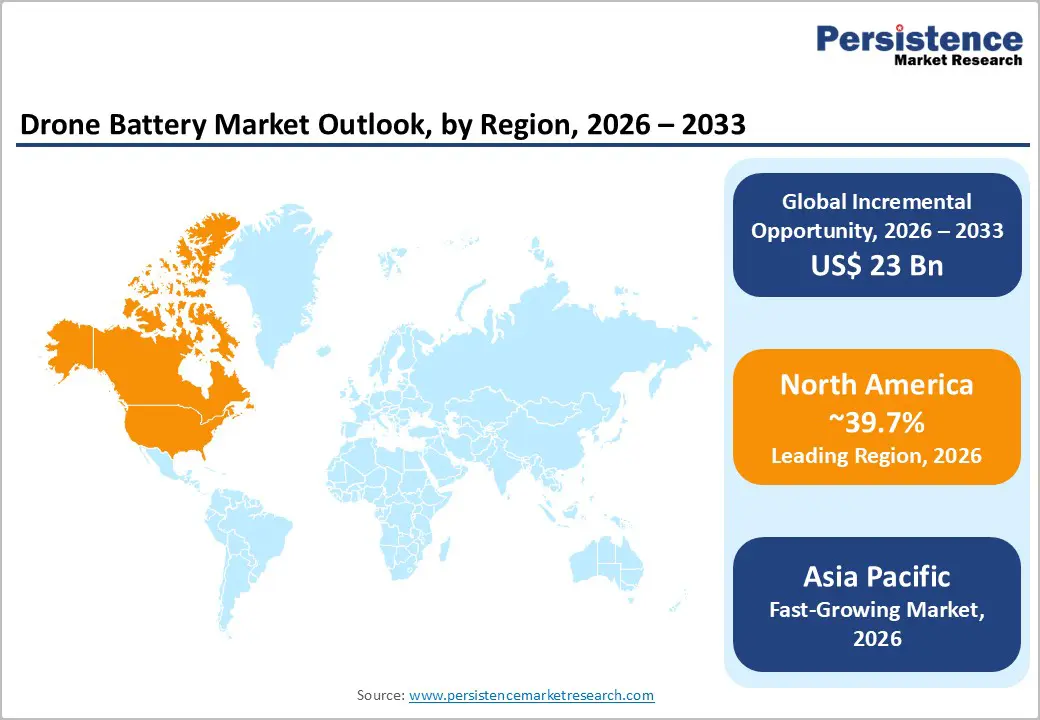
- Leading Region: North America is projected to account for approximately 39.7% of the market share, supported by strong regulatory frameworks, advanced drone commercialization, and high defense spending.
- Fastest-growing Region: Asia Pacific is the fastest-growing region, driven by large-scale manufacturing in China, technological advancements in Japan and South Korea, and rapid policy-driven drone adoption in India.
- Investment Plans: The market is witnessing increased investments in advanced battery chemistries, domestic manufacturing capabilities, and supply chain localization, particularly in North America and Asia Pacific, to enhance energy density, improve endurance, and reduce dependency on critical mineral imports.
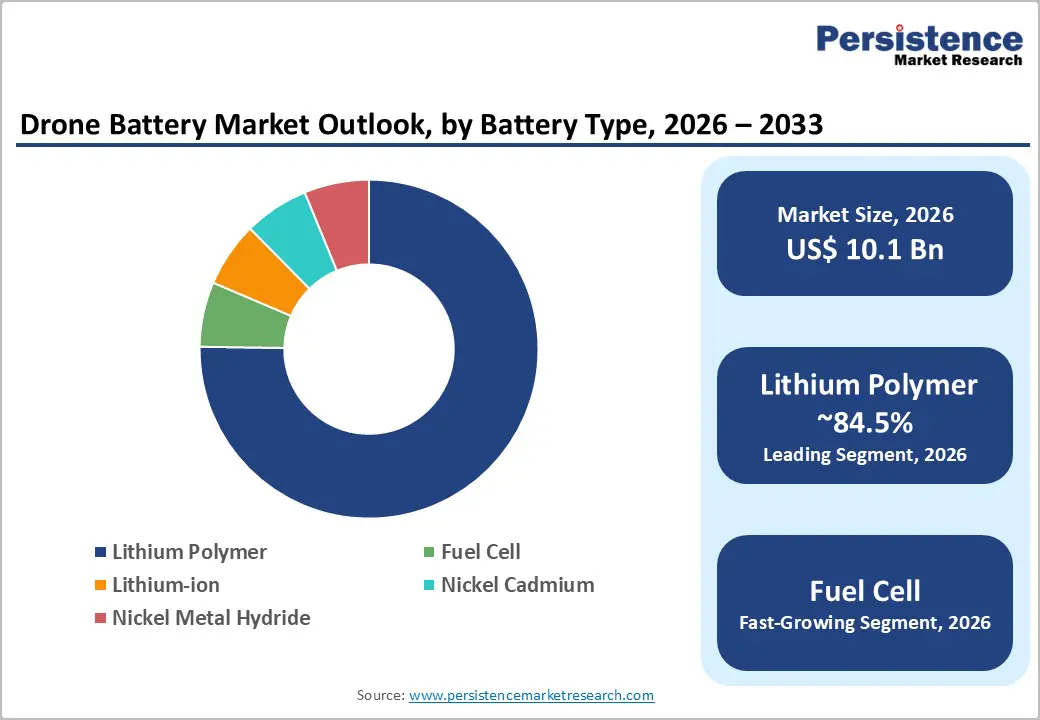
- Dominant Battery Type: Lithium polymer batteries dominate the market with an anticipated share of approximately 84.5%, owing to their lightweight structure, high energy density, and widespread adoption in consumer and commercial drones.
- Leading Battery Capacity: The below 3000 mAh segment leads with an anticipated market share of 47.6%, driven by strong demand from consumer drones and high-volume usage in recreational and entry-level applications.
| Key Insights | Details |
|---|---|
| Drone Battery Market Size (2026E) | US$10.1 Bn |
| Market Value Forecast (2033F) | US$33.1 Bn |
| Projected Growth (CAGR 2026 to 2033) | 18.5% |
| Historical Market Growth (CAGR 2020 to 2025) | 15.1% |
Market Factors - Growth, Barriers, and Opportunity Analysis
Growth Analysis - Regulatory Formalization Driving Demand for Compliant Battery Systems
Regulatory frameworks across major markets are standardizing drone operations and increasing the need for reliable, traceable battery systems. In the U.S., remote ID requirements mandate identification and tracking capabilities, pushing operators toward upgraded drones with integrated battery intelligence. Europe’s unified drone regulations and India’s evolving drone policies are similarly promoting structured deployment across commercial and public sectors. This regulatory shift increases the demand for high-quality, certified battery systems that support safe operations, data integration, and repeatable performance. As compliance becomes a prerequisite, battery suppliers that meet certification and traceability standards gain a competitive advantage.
Expansion of Commercial Drone Applications Increasing Battery Consumption
Commercial drone adoption is accelerating across delivery, agriculture, infrastructure inspection, and surveillance. Large-scale drone delivery programs and precision agriculture initiatives are transitioning from pilot phases to operational scale. In agriculture, drones are used for crop monitoring, spraying, and yield optimization, while infrastructure sectors deploy drones for asset inspection and mapping. These use cases require longer operational hours and frequent battery cycling, significantly increasing replacement demand. The result is a shift toward high-capacity, fast-charging batteries that support continuous operations and minimize downtime, directly boosting market growth.
Advancements in Battery Chemistry Enhancing Performance and Value
Technological innovation in battery chemistry is expanding the performance envelope of drone systems. Developments in silicon-anode lithium batteries, high-energy-density cells, and hybrid power systems are enabling longer flight durations and improved payload capacity. These advancements are critical for high-value applications such as defense, logistics, and industrial inspection. Improved energy density directly translates into extended mission time, which is a key economic driver for operators. As a result, customers are increasingly willing to invest in premium battery solutions that enhance operational efficiency and reduce the total cost of ownership.
Barrier Analysis - High Cost of Advanced Battery Technologies and Material Dependency
Despite strong innovation, advanced drone batteries remain expensive due to complex manufacturing processes and reliance on critical minerals such as lithium, cobalt, and nickel. Supply chain volatility and geopolitical risks further impact material availability and pricing. While prices have stabilized in recent years, the need for secure and diversified sourcing continues to influence production costs. This creates a barrier for smaller drone manufacturers and operators, who may delay adopting advanced battery systems. The result is a cost-performance trade-off, where adoption of high-end batteries is sometimes limited by budget constraints.
Stringent Safety and Certification Requirements Slowing Deployment
Drone batteries must meet strict safety and performance standards, particularly in commercial and defense applications. Certification processes involve rigorous testing for thermal stability, cycle life, and environmental resilience. These requirements increase development timelines and costs for battery manufacturers. Regulatory approvals for drone operations can also delay procurement cycles, especially when batteries are integrated into certified drone platforms. This slows market penetration in certain segments and creates longer commercialization timelines for new battery technologies.
Opportunity Analysis - Rising Demand for Defense and Public Safety UAVs
Defense and public safety sectors present significant opportunities for drone battery manufacturers. These applications require high-reliability, long-endurance battery systems capable of operating in extreme environmental and operational conditions, including high altitudes, temperature variations, and continuous mission cycles. Military drones used for surveillance, reconnaissance, border security, and tactical missions demand superior energy density, durability, and rapid recharge capabilities to ensure uninterrupted performance. Unlike consumer markets, defense procurement prioritizes performance, reliability, and lifecycle efficiency over cost, enabling suppliers to achieve higher margins and long-term contracts. Companies such as EaglePicher Technologies specialize in mission-critical battery solutions for aerospace and defense, highlighting the premium nature of this segment. The increasing use of drones in disaster management, firefighting, and law enforcement is further expanding demand for rugged, fail-safe battery systems, creating a strong pipeline for advanced battery technologies in public sector deployments.
Growth of Agriculture and Mapping Applications in Emerging Economies
Emerging economies are witnessing the rapid adoption of drones in agriculture, land surveying, and infrastructure development. Government-backed initiatives promoting precision farming, crop monitoring, and rural digitization are accelerating drone deployment, particularly in countries such as India and Southeast Asia. Subsidy programs, pilot training initiatives, and streamlined regulations are lowering entry barriers for farmers, cooperatives, and service providers. This expansion is creating a large and growing installed base of drones, which directly drives recurring demand for battery replacements, upgrades, and maintenance services. Agricultural drones, especially those used for spraying and mapping, require mid- to high-capacity batteries (5000-10000 mAh) to support extended flight operations across large fields. Companies such as DJI have introduced agriculture-specific drone platforms, further accelerating adoption. Beyond hardware sales, this trend is enabling the growth of battery leasing models, charging infrastructure, and service ecosystems, creating long-term revenue streams for market participants.
Development of Next-Generation Battery Technologies
The transition toward next-generation battery technologies, including fuel cells, silicon-anode lithium batteries, and solid-state systems, presents significant long-term growth opportunities. Fuel cells offer extended flight durations, higher energy efficiency, and reduced downtime, making them ideal for logistics, long-range inspection, and defense surveillance. Companies such as Doosan Mobility Innovation are already commercializing hydrogen-powered drone solutions capable of multi-hour flight endurance. Advancements in silicon-based and solid-state batteries are also improving energy density, safety, and lifecycle performance, addressing key limitations of conventional lithium-ion technologies. Firms such as Amprius Technologies are pushing the boundaries of high-energy-density cells for UAV applications. As these technologies mature and achieve commercial scalability, they are expected to unlock new use cases such as long-range delivery networks, persistent aerial monitoring, and heavy-payload drones, significantly expanding the addressable market and reshaping competitive dynamics.
Category-wise Analysis
Battery Type Insights
Lithium Polymer (LiPo) dominates the market with an anticipated share of 84.5% in 2026, driven by its high energy density, lightweight design, and flexible form factor. These characteristics make LiPo batteries ideal for consumer and small commercial drones, where weight reduction directly improves flight stability, maneuverability, and energy efficiency. Leading drone manufacturers such as DJI widely integrate LiPo batteries across their consumer and prosumer models, reinforcing their market leadership. The widespread adoption of compact drones across recreational photography, surveillance, and mapping applications further strengthens this segment’s dominance.
LiPo batteries also offer high discharge rates and consistent voltage output, enabling stable flight performance and responsive control, which is critical for applications such as aerial videography and real-time monitoring. Their adaptability to different drone sizes and configurations supports both entry-level and mid-range UAV platforms. As a result, LiPo batteries remain the preferred choice for mainstream drone applications, although their dominance may gradually moderate as higher-end technologies gain traction in specialized use cases.
Fuel cell technology is likely to be the fastest-growing segment, driven by the increasing need for extended flight duration and operational efficiency in commercial and defense applications. Unlike traditional batteries, fuel cells can sustain significantly longer missions without frequent recharging, making them highly suitable for logistics, long-range surveillance, and industrial inspection. Companies such as Doosan Mobility Innovation are already deploying hydrogen fuel cell-powered drones capable of multi-hour flight times, demonstrating the technology’s commercial viability. This technology is gaining traction in high-value, mission-critical operations where downtime directly impacts productivity and operational costs.
Fuel cells also offer advantages in terms of rapid refueling compared to battery charging, which enhances fleet efficiency. While adoption is still emerging due to infrastructure and cost constraints, fuel cells are expected to play a transformative role in redefining endurance standards, particularly in logistics delivery networks and defense surveillance programs.
Battery Capacity Insights
The below 3000 mAh segment holds an anticipated 47.6% market share in 2026, primarily due to its dominance in consumer drones. These batteries are lightweight, compact, and cost-effective, making them ideal for short-duration flights in recreational and entry-level applications. Popular consumer drones from manufacturers such as DJI and Parrot SA typically use batteries within this capacity range to optimize portability and ease of use.
The large installed base of consumer drones ensures consistent demand for this segment, supported by frequent battery replacements and upgrades. This category benefits from high unit volumes, even though the individual battery value remains relatively low. The segment’s strength lies in its accessibility and alignment with the growing hobbyist and entry-level user base, making it a foundational component of overall market volume.
The 5000-10000 mAh segment is anticipated to be the fastest-growing, driven by increasing demand from commercial and enterprise applications. Drones used in delivery, agriculture, infrastructure inspection, and surveying require higher capacity batteries to support longer flight durations and heavier payloads. For example, agricultural spraying drones and industrial inspection UAVs often operate within this capacity range to balance endurance and operational efficiency.
This segment is benefiting from the rapid expansion of professional drone fleets, where performance metrics such as uptime, route efficiency, and payload stability are critical. As commercial use cases scale, operators are prioritizing batteries that reduce downtime and enhance productivity. This trend is expected to significantly increase demand for mid-to-high capacity batteries, positioning this segment as a key driver of market value growth.
Regional Insights
North America Drone Battery Market Trends - Regulatory-Driven Upgrades & High-Performance UAV Battery Innovation
North America is projected to account for approximately 39.7% of the market share in 2026, making it the leading region. The U.S. drives growth through strong regulatory frameworks, advanced technology adoption, and significant defense spending. Regulatory requirements such as Remote ID have increased the need for compliant drone systems, directly supporting demand for advanced, integrated battery solutions with enhanced safety and monitoring capabilities. This regulatory clarity has encouraged operators to upgrade fleets, thereby accelerating battery replacement cycles and demand for higher-performance energy systems.
The region also leads in commercial drone deployment, particularly in delivery and inspection applications. Companies such as Walmart and Wing have expanded drone delivery operations across multiple U.S. cities, increasing the need for high-cycle, fast-charging batteries that can support continuous operations. At the technology level, Amprius Technologies has advanced silicon-anode battery commercialization, significantly improving energy density and flight endurance for UAVs. These developments reinforce North America’s position as a hub for premium battery innovation and high-value commercial applications, while ongoing investments in domestic battery manufacturing are strengthening supply chain resilience and reducing reliance on imports.
Europe Drone Battery Market Trends-Safety-Centric Design & Sustainable High-Reliability Battery Systems
Europe represents a mature and regulation-driven market, supported by harmonized drone policies and strong industrial demand. Countries such as Germany, the U.K., France, and Spain are leading adoption across inspection, public safety, and defense applications. The region emphasizes strict safety, compliance, and environmental standards, which directly influence battery design, lifecycle management, and recycling practices. This regulatory environment encourages the development of high-reliability, certified battery systems tailored for mission-critical operations.
European companies are increasingly focusing on specialized and high-performance battery solutions. For instance, Parrot SA has introduced advanced UAV platforms with custom high-endurance battery systems designed for defense and surveillance missions. Similarly, Saft and Denchi Group are developing rugged battery technologies for aerospace and defense applications, emphasizing durability and operational reliability. These developments highlight Europe’s strategic focus on quality-driven innovation rather than volume production. Investment trends also show increasing emphasis on sustainable materials and energy-efficient battery chemistries, positioning Europe as a leader in environmentally compliant drone battery technologies.
Asia Pacific Drone Battery Market Trends - Manufacturing Dominance & Rapid Drone Battery Demand Expansion
Asia Pacific is likely to be the fastest-growing region, driven by strong manufacturing capabilities, supportive government policies, and expanding drone adoption across multiple sectors. China dominates global drone production, with companies such as DJI leading the consumer and commercial drone market. This manufacturing concentration creates a robust ecosystem for battery production, enabling cost efficiencies and rapid scalability. In parallel, Grepow supplies high-performance LiPo batteries widely used in UAVs, strengthening the region’s supply chain integration.
Japan and South Korea contribute significantly through advanced battery technologies. Companies such as Panasonic Corporation and LG Energy Solution are investing in high-energy-density lithium-ion batteries, supporting innovation in drone endurance and performance. In India, government initiatives promoting drone adoption in agriculture, infrastructure, and public services are accelerating market growth. Programs supporting precision farming and rural drone deployment are increasing demand for mid- to high-capacity batteries, particularly in the 5000-10000 mAh range. The region benefits from cost advantages, large-scale production, and rapidly expanding domestic demand. Rapid urbanization, infrastructure development, and digitalization initiatives further support drone deployment across logistics, mapping, and surveillance. These combined factors position Asia Pacific as a critical growth engine, with both manufacturing leadership and rising end-user demand driving the expansion of the drone battery market.
Competitive Landscape
The global drone battery market is fragmented globally but concentrated within specific segments. Large players dominate consumer and commercial drone batteries, while specialized companies focus on defense and high-performance applications. Competition is driven by technological innovation, product reliability, and cost efficiency. Companies that offer advanced battery chemistries and integrated solutions are gaining a competitive edge.
Key players are focusing on innovation, strategic partnerships, and geographic expansion. Companies are investing in advanced battery chemistries, improving energy density, and developing application-specific solutions. Supply chain localization and vertical integration are emerging as critical strategies to ensure reliability and reduce dependency on external suppliers.
Key Industry Developments:
- In November 2025, Amprius Technologies announced that its SiCore® batteries were integrated into Nokia’s drone networks platform, improving mission reliability and endurance for industrial and telecom drone operations.
- In February 2026, Amprius Technologies entered into a manufacturing agreement with Nanotech Energy to scale domestic silicon-anode battery production, aiming to meet rising demand from defense and commercial drone sectors while strengthening supply chain compliance.
Companies Covered in Drone Battery Market
- DJI
- Panasonic Corporation
- LG Energy Solution
- Samsung SDI
- Saft
- Amprius Technologies
- EaglePicher Technologies
- Grepow
- Autel Robotics
- Parrot SA
- Denchi Group
- RRC Power Solutions
- NEO Battery Materials
- MaxAmps
- Doosan Mobility Innovation
- Ballard Power Systems
Frequently Asked Questions
The drone battery market is estimated to be valued at US$10.1 billion in 2026.
The global drone battery market is projected to reach US$33.1 billion by 2033.
Key trends include the shift toward high-energy-density battery technologies, increasing adoption of fuel cells for extended flight duration, growing demand for fast-charging and lightweight batteries, and rising integration of battery management systems for enhanced safety and performance.
Lithium Polymer (LiPo) is the leading segment, accounting for an anticipated share of approximately 84.5%, owing to its lightweight design and high energy density.
The drone battery market is projected to grow at a 18.5% CAGR from 2026 to 2033.
Some of the major players include DJI, Panasonic Corporation, LG Energy Solution, Amprius Technologies, and Parrot SA.


