




- Medical Devices
- Digital Dental Impressions Market
Digital Dental Impressions Market Size, Share, and Growth Forecast, 2026 - 2033
Digital Dental Impressions Market by Product Type (Standalone, Mobile/Portable System, Intra-oral Devices, Others), Technology (Video Scanning Technology, Others), End-user (Dental Hospitals, Dental Clinics, Others), and Regional Analysis for 2026 - 2033

Digital Dental Impressions Market Size and Trends Analysis
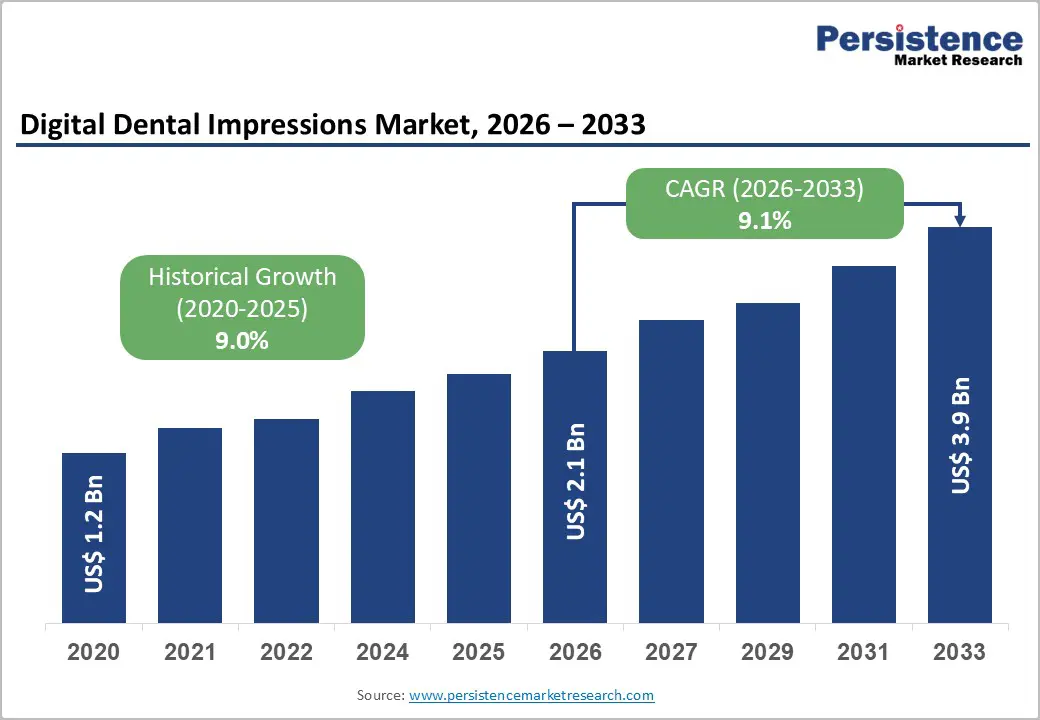
The global digital dental impressions market size is likely to be valued at US$2.1 billion in 2026 and is expected to reach US$3.9 billion by 2033, growing at a CAGR of 9.1% during the forecast period from 2026 to 2033, driven by the ongoing transition from traditional elastomeric impression techniques to fully digital workflows within modern dental practices.
This shift is largely supported by the increasing need for improved accuracy, reduced procedural time, and enhanced patient comfort, as digital systems eliminate common issues such as material distortion and patient discomfort associated with conventional methods. According to the World Health Organization data published in 2025, oral diseases affect approximately 3.7 billion people worldwide, making them among the most prevalent non-communicable health conditions globally. Dental caries remains the most widespread condition, with nearly 2 billion adults affected in permanent teeth and over 500 million children impacted in primary teeth, demonstrating a substantial and continuous demand for advanced dental diagnostic and treatment solutions. Digital impressions also contribute to minimizing errors and reducing the need for remakes, thereby improving productivity in both dental clinics and laboratories.
Key Industry Highlights:
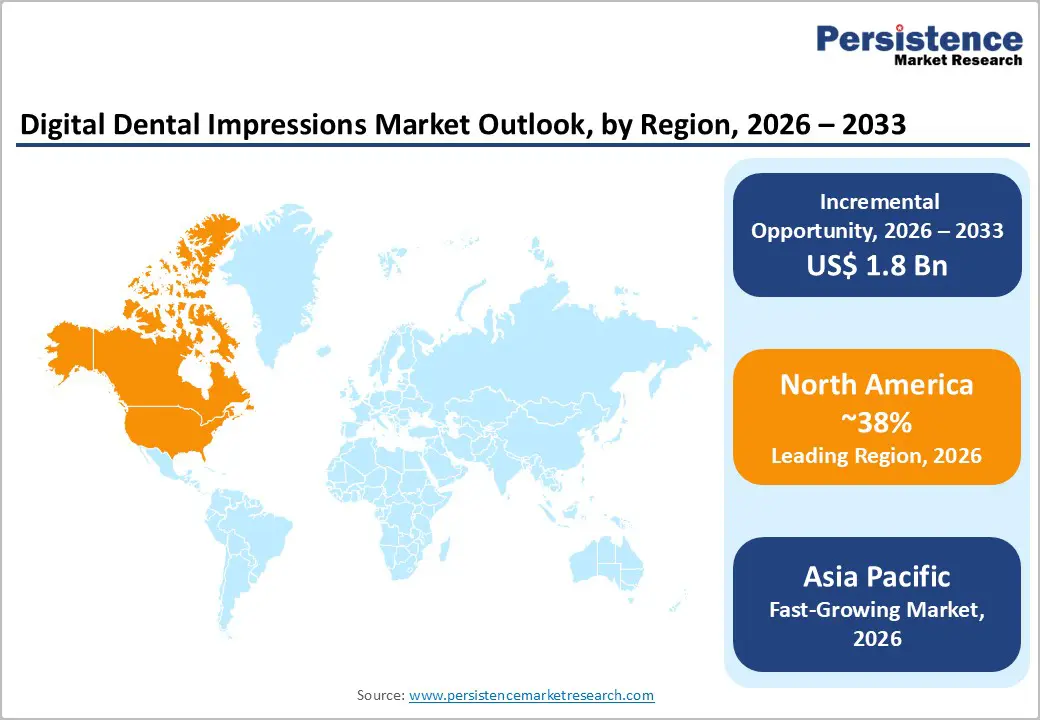
- Leading Region: North America is anticipated to be the leading region, accounting for a market share of 38% in 2026, driven by high adoption of digital dentistry technologies and advanced healthcare infrastructure.
- Fastest-growing Region: Asia Pacific is likely to be the fastest-growing region, supported by expanding healthcare infrastructure and growing adoption of digital dentistry technologies.
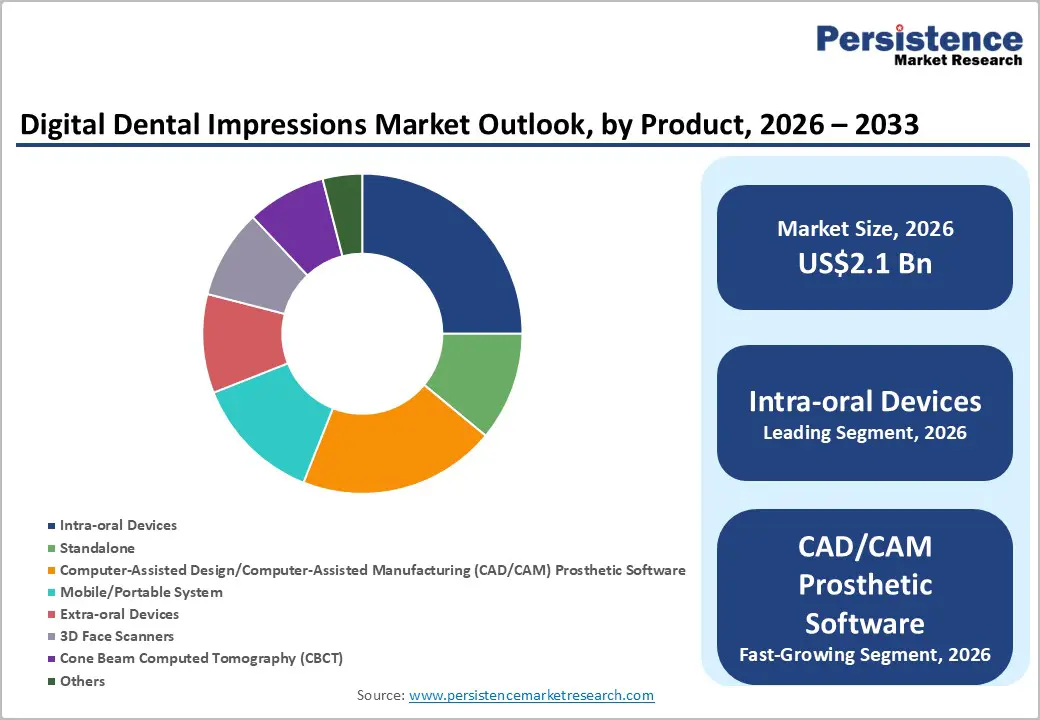
- Leading Product Type: Intra-oral devices are projected to represent the leading product type in 2026, accounting for 45% of the revenue share, driven by high adoption in dental clinics for accurate, fast, and patient-friendly digital impressions.
- Leading Technology Type: Video scanning technology is anticipated to be the leading technology type, accounting for over 60% of the revenue share in 2026, supported by real-time imaging capabilities and high accuracy in capturing continuous 3D dental impressions.
| Key Insights | Details |
|---|---|
| Digital Dental Impressions Market Size (2026E) | US$2.1 Bn |
| Market Value Forecast (2033F) | US$3.9 Bn |
| Projected Growth (CAGR 2026 to 2033) | 9.1% |
| Historical Market Growth (CAGR 2020 to 2025) | 9.0% |
DRO Analysis
Driver - Technological Advancements in Scanning Accuracy and Workflow Integration
Continuous advancements in intraoral scanning technologies have significantly improved the precision, speed, and reliability of digital dental impressions. Modern scanners offer high-resolution imaging, real-time visualization, and enhanced depth capture, enabling clinicians to obtain highly accurate 3D models of oral structures. These improvements reduce common errors associated with traditional impressions, such as distortions and material shrinkage. Enhanced scanning accuracy supports better-fitting restorations, minimizing adjustments and remakes.
The integration of digital impression systems with computer-assisted design/computer-assisted manufacturing (CAD/CAM) platforms has streamlined dental workflows, enabling seamless data transfer from scanning to design and manufacturing. This connectivity allows for faster treatment planning, improved collaboration between clinics and laboratories, and the possibility of same-day restorations. Automated design software enhances productivity by reducing manual intervention and human error. As dental practices continue adopting fully digital ecosystems, the demand for integrated solutions grows.
Rising Demand for Aesthetic and Restorative Dentistry amid Demographic Shifts
The growing emphasis on dental aesthetics and restorative procedures is significantly influencing the adoption of digital dental impression technologies. Increasing awareness of cosmetic dentistry, including treatments such as veneers, crowns, and aligners, has led patients to seek precise and comfortable solutions. Digital impressions provide superior accuracy and eliminate discomfort associated with traditional methods, enhancing the overall patient experience.
Demographic trends, particularly the rising aging population, are contributing to increased demand for restorative dental treatments. Older individuals are more likely to require procedures such as implants, dentures, and bridges, which depend on accurate impressions for optimal outcomes. Younger populations are increasingly opting for orthodontic and cosmetic enhancements, expanding the market scope. These evolving demographic needs are driving clinics to invest in efficient and reliable digital systems.
Restraint - Integration and Interoperability Issues with Existing Systems
Despite advancements in digital dentistry, integration and interoperability challenges remain a significant concern for dental practices adopting digital impression systems. Many clinics operate with a mix of legacy equipment and software, which do not seamlessly integrate with newer digital solutions. Differences in file formats, proprietary systems, and compatibility limitations can hinder efficient data exchange between scanners, CAD/CAM software, and laboratory systems.
Interoperability challenges also affect collaboration between dental clinics and external laboratories, where mismatched systems can lead to delays or errors in case processing. The lack of standardized protocols across manufacturers complicates integration, requiring additional investments in compatible systems or middleware solutions. Smaller clinics, in particular, face financial and technical barriers in upgrading their infrastructure. Addressing these challenges requires industry-wide standardization and improved compatibility.
Cybersecurity and Data Privacy Risks
The increasing adoption of digital dental impression systems has led to a significant rise in the volume of sensitive patient data being captured, stored, and shared across digital platforms. Intraoral scanners, CAD/CAM software, and cloud-based systems generate detailed 3D images and patient records that require secure handling. As dental clinics and laboratories become more interconnected, the risk of unauthorized access, data breaches, and cyberattacks also increases. Many smaller clinics may lack advanced cybersecurity infrastructure, making them vulnerable to threats.
The growing reliance on cloud integration and remote data sharing further intensifies concerns around data privacy and system security. Digital workflows often involve transferring patient information between clinics, labs, and third-party platforms, increasing exposure to potential vulnerabilities. Any compromise in data security can impact patient trust and disrupt clinical operations. Integrating multiple software systems from different vendors may create gaps in security protocols, making systems more susceptible to breaches.
Opportunity - Technological Convergence with AI, 3D Printing, and Cloud Integration
The convergence of digital dental impression systems with advanced technologies such as artificial intelligence, 3D printing, and cloud computing is creating significant growth opportunities in the market. AI-powered software enhances diagnostic capabilities by enabling automated detection of dental conditions and improving treatment planning accuracy. When combined with digital impressions, these technologies allow for highly personalized and precise dental solutions.
3D printing complements digital impressions by enabling rapid production of dental restorations, aligners, and surgical guides with high precision. This integration reduces turnaround times and supports same-day dentistry, enhancing patient satisfaction. The combined use of these technologies is transforming traditional workflows into fully digital ecosystems, increasing efficiency and scalability.
Portable Systems Expansion
The expansion of mobile and portable digital dental impression systems is opening new avenues for market growth, particularly in settings where traditional infrastructure is limited. Portable scanners offer flexibility and ease of use, allowing dental professionals to perform procedures in various environments, including small clinics, outreach programs, and remote locations. These systems are designed to be lightweight, wireless, and user-friendly, making them ideal for enhancing accessibility to dental care.
The increasing demand for portable solutions is also driven by the rise of mobile dental services and the need for on-site patient care. Dental service organizations and group practices are adopting these systems to improve operational efficiency and expand service reach. Advancements in battery life, connectivity, and data synchronization ensure that portable devices deliver performance comparable to traditional systems. This trend is particularly beneficial in emerging markets, where affordability and accessibility are key factors, enabling broader adoption of digital dental impression technologies.
Category-wise Analysis
Product Type Insights
Intra-oral devices are expected to lead the digital dental impressions market, accounting for approximately 45% of revenue in 2026, driven by their essential role in capturing precise digital impressions for everyday dental procedures such as crowns, bridges, aligners, and implants. Their ability to deliver real-time, high-resolution 3D images significantly improves diagnostic accuracy and reduces errors compared to traditional impression methods. For example, intraoral scanning solutions offered by Align Technology are widely used in orthodontics and restorative dentistry, demonstrating how these devices support precision-driven workflows and reinforce their leading position in the digital dental impressions ecosystem.
CAD/CAM prosthetic software is likely to represent the fastest-growing segment, supported by increasing demand for flexible, efficient, and fully digital chairside solutions that minimize dependence on fixed infrastructure. Computer-assisted design/computer-assisted manufacturing (CAD/CAM) software enhances the digital workflow by enabling real-time design, modification, and manufacturing of dental prosthetics, significantly reducing turnaround time. For example, solutions developed by Dentsply Sirona showcase how integrated portable scanning and CAD/CAM systems enable faster, more precise restorations, positioning these segments as key growth drivers in the evolving digital dentistry landscape.
Technology Type Insights
Video scanning technology is projected to lead the market, capturing around 60% of the revenue share in 2026, supported by its ability to capture continuous, real-time data streams, enabling highly accurate and detailed 3D models of dental structures. Video scanning minimizes distortion and ensures smoother image acquisition, making it particularly suitable for high-volume clinical environments where speed and precision are critical. For example, the video-based scanning solutions from Carestream Health are widely utilized for accurate intraoral imaging, highlighting the technology’s role in supporting consistent, high-quality outcomes in modern dental practices.
Photo scanning technology is likely to be the fastest-growing technology type, driven by advancements in high-resolution imaging and sophisticated stitching algorithms that enable precise reconstruction of dental structures from multiple images. Photo-based systems offer advantages in specific applications requiring detailed surface capture, making them increasingly relevant in restorative and prosthetic dentistry. For example, imaging innovations by 3Shape demonstrate how advanced photo-based and hybrid systems are evolving to enhance accuracy, efficiency, and clinical outcomes in digital dental workflows.
Regional Insights
North America Digital Dental Impressions Market Trends
North America is anticipated to be the leading region, accounting for a market share of 38% in 2026, driven by high adoption of intraoral scanners, CAD/CAM integration, and cloud-based workflow systems. Clinics prioritize efficiency, accuracy, and patient comfort, which has accelerated the replacement of traditional elastomeric impressions with digital solutions. The region also benefits from robust regulatory oversight by the FDA, ensuring safe and fast approval of innovative dental technologies.
Increasing demand for restorative and aesthetic dentistry among aging populations, moreover, supports market growth, while investments in AI-enabled and ergonomic devices enhance clinical workflows. For example, Planmeca has expanded its presence in North America with advanced intraoral scanners and integrated digital platforms, enabling seamless design-to-manufacture workflows. Its systems allow dentists to capture precise 3D impressions in real-time, reduce remakes, and integrate with CAD/CAM labs efficiently.
Europe Digital Dental Impressions Market Trends
Europe is likely to be a significant market for digital dental impressions, due to high standards in clinical dentistry and widespread adoption of digital workflows in countries such as Germany, France, and the U.K. Clinics increasingly prefer intraoral scanners due to their accuracy, speed, and compatibility with prosthetic design software. Regulatory frameworks and certifications across the European Union ensure safety and standardization, facilitating the adoption of new technologies.
Rising demand for cosmetic and restorative treatments, combined with a focus on precision dentistry, drives investments in intraoral scanning systems and CAD/CAM integration. For example, Ivoclar Vivadent provides integrated digital impression solutions and advanced prosthetic software across Europe. Its platforms allow seamless transfer of high-accuracy scans to dental labs, reducing turnaround times and improving treatment outcomes. This adoption reflects Europe’s emphasis on efficiency, patient comfort, and fully digital workflows, ensuring that intraoral scanning systems continue to gain momentum across clinical and laboratory settings.
Asia Pacific Digital Dental Impressions Market Trends
The Asia Pacific region is likely to be the fastest-growing region, driven by expanding dental infrastructure, rising disposable incomes, and increased awareness of aesthetic dentistry. Countries such as China, India, and ASEAN nations are witnessing the rapid adoption of portable and cost-effective intraoral scanners. Growth is also supported by local manufacturing capabilities, government initiatives in digital healthcare, and the rising popularity of dental tourism.
Clinics in urban centers increasingly adopt digital workflows to improve accuracy, reduce chair time, and enhance patient satisfaction. For example, Shining 3D provides advanced intraoral scanners and CAD/CAM solutions across Asia Pacific. Its technology enables high-precision impressions, streamlined lab communication, and faster chairside workflows. The company’s focus on affordability and portability highlights the region’s growth dynamics, where accessibility and innovation combine to expand the adoption of digital dental technologies, positioning Asia Pacific as a key emerging market.
Competitive Landscape
The global digital dental impressions market exhibits a moderately fragmented structure, driven by rapid technological advancements, growing adoption of digital workflows, and rising demand for high-accuracy intraoral scanning systems across clinics and laboratories. The market comprises a mix of well-established multinational corporations and emerging regional players, each focusing on innovation, product differentiation, and expanding geographic reach.
With key leaders including Planmeca, Dentsply Sirona, Align Technology, and Ivoclar Vivadent, the competitive landscape is shaped by innovation and market penetration strategies. These players compete through continuous product development, integration of portable and chairside systems, strategic acquisitions, and expanding service networks. Marketing initiatives, clinician training programs, and software enhancements help differentiate offerings, ensuring high adoption rates and customer loyalty.
Key Industry Developments:
- In November 2025, Align Technology expanded its iTero Digital Solutions ecosystem with a series of new product innovations designed to enhance chairside workflows and elevate the digital dental impressions experience. The updates include advanced visualization tools, an expanded patient gallery, simplified oral health reports, and the Invisalign Outcome Simulator Pro with Smile Video, which helps clinicians simulate treatment outcomes in real time and improve patient engagement during consultations.
- In October 2025, Dandy unveiled the Dandy Vision intraoral scanner, marking a significant advancement in digital dentistry. The new scanner combines AI-powered precision with next-generation optics and has been trained on insights from over 11.5 million dental scans, enabling faster, highly accurate 3D impressions that support confident restorative treatment planning.
Companies Covered in Digital Dental Impressions Market
- GE HealthCare Technologies Inc.
- Parkell, Inc.
- Ormco Corporation
- ALIGN TECHNOLOGY INC.
- Dental Wings Inc.
- Carestream Health, Inc.
- Allied Healthcare Products, Inc.
- 3Shape
- Medit Corp.
- Shofu Dental
Frequently Asked Questions
The global digital dental impressions market is projected to reach US$2.1 billion in 2026.
The digital dental impressions market is driven by the increasing adoption of intraoral scanners and CAD/CAM systems for faster, more accurate, and patient-friendly restorative and orthodontic workflows.
The digital dental impressions market is expected to grow at a CAGR of 9.1% from 2026 to 2033.
Key market opportunities lie in the integration of AI, 3D printing, and portable intraoral scanning systems to expand adoption and streamline digital dental workflows.
GE HealthCare Technologies Inc, Siemens, Parkell, Inc., Dental Wings Inc., and Ormco Corporation are the leading players.


