




- Medical Devices
- Acute External Ventricular Drain Market
Acute External Ventricular Drain Market Size, Share, and Growth Forecast 2026 - 2033
Acute External Ventricular Drain Market by Patient Type (Pediatric, Adult), Application (Traumatic Brain Injury, Subarachnoid Hemorrhage, Intracerebral Hemorrhage), and Regional Analysis, 2026 - 2033

Acute External Ventricular Drain Market Size and Trends Analysis
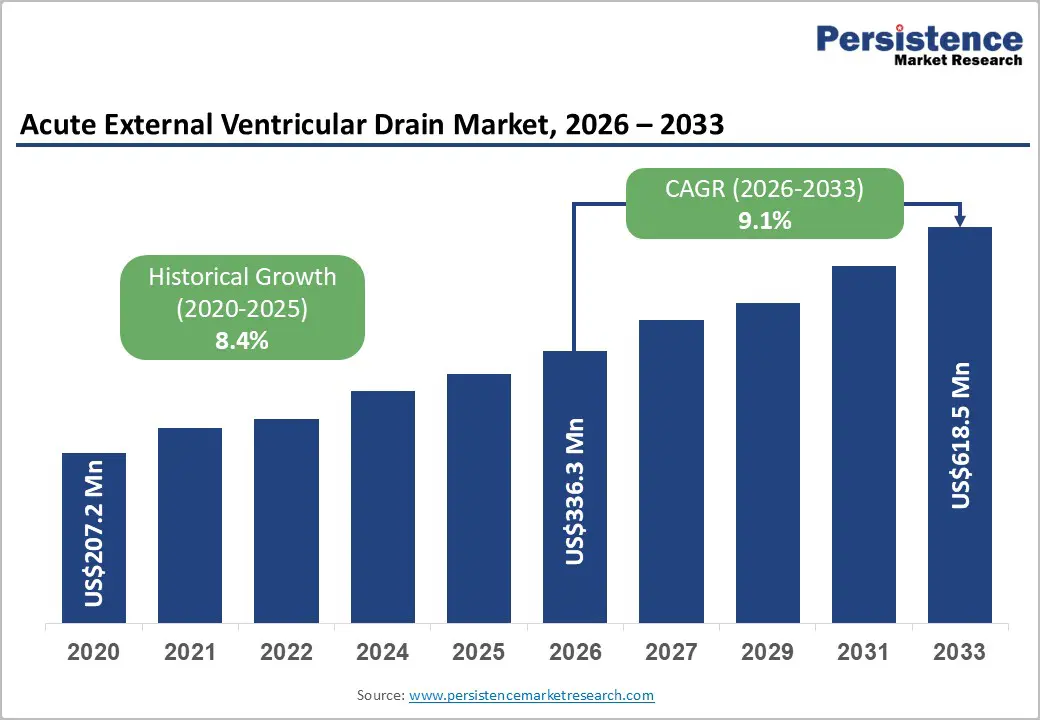
The global acute external ventricular drain market size is likely to be valued at US$336.3 million in 2026 and is expected to reach US$618.5 million by 2033, growing at a CAGR of 9.1% during the forecast period from 2026 to 2033, driven by rising global burden of traumatic brain injuries and hemorrhagic strokes and increasing ICU admissions requiring intracranial pressure monitoring. Expanding neurosurgical infrastructure in emerging economies is also predicted to boost growth.
Key Industry Highlights:
- Leading Patient Type: Adult patients, approximately 81.8% share in 2026, as conditions such as intracerebral hemorrhage, hydrocephalus, and traumatic brain injury occur more frequently in aging populations.
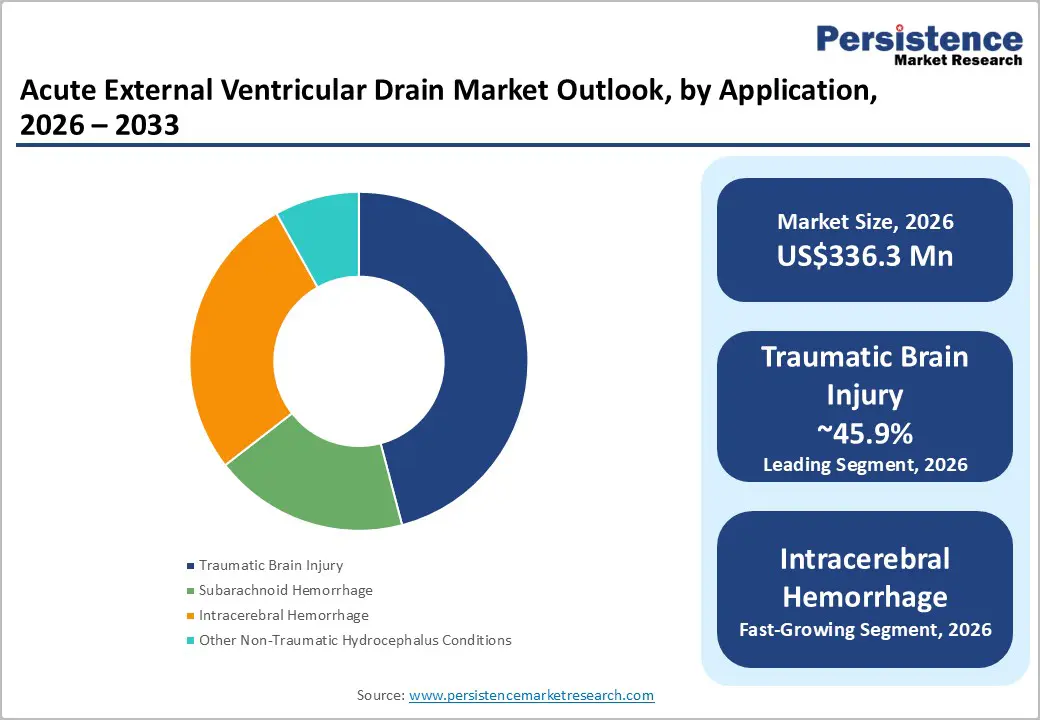
- Dominant Application: Traumatic brain injury, nearly 45.9% in 2026, spurred by rising road traffic accidents and falls.
- Research Study: In April 2026, researchers from Cooper University Hospital and Rowan-Virtua School of Osteopathic Medicine reported in Frontiers in Neurology that freehand External Ventricular Drain (EVD) placement is often less reliable due to anatomical distortion. It increases multi-pass attempts, while navigation technologies such as electromagnetic and augmented reality systems improve accuracy and safety.
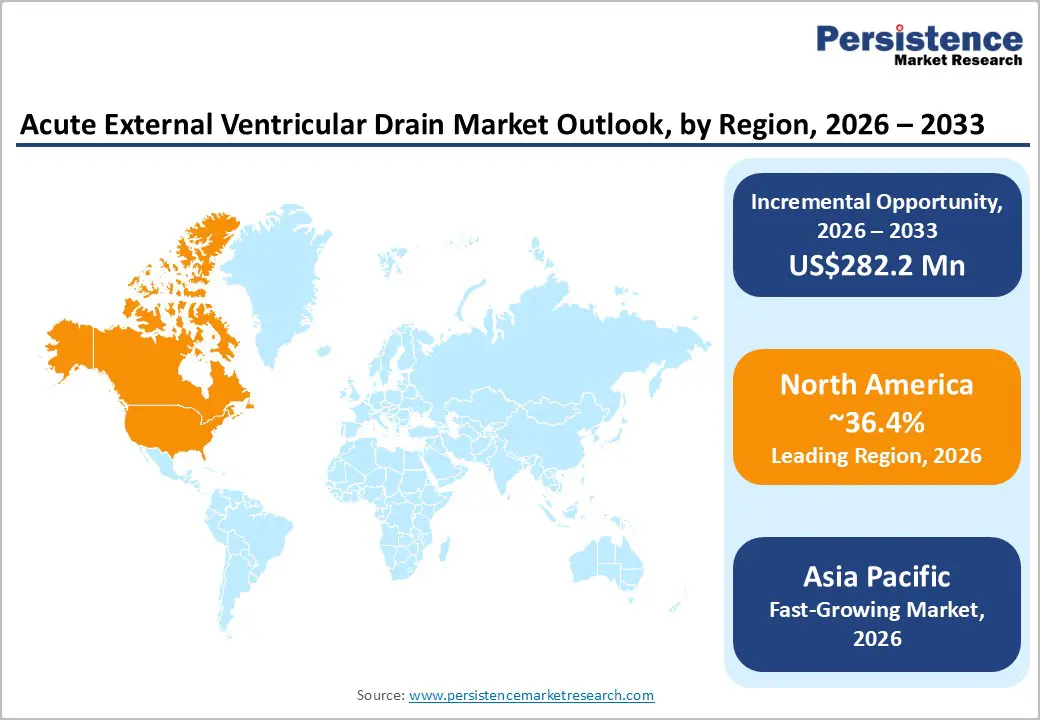
- Leading Region: North America, with about 36.4% share in 2026, backed by high neurocritical care capacity and established clinical protocols.
- Fast-growing Region: Asia Pacific, boosted by rising trauma burden and government investments in critical care.
DRO Analysis
Driver - Surging Cases of Brain Injury, Hemorrhage, and Hydrocephalus
The rising burden of neurological emergencies is a key reason for the growing use of external ventricular drains. According to the Centers for Disease Control and Prevention (CDC), the U.S. recorded over 69,000 Traumatic Brain Injury (TBI)-related deaths in 2021, around 190 every day. Beyond mortality, TBI frequently causes acute hydrocephalus and high intracranial pressure, both of which require immediate Cerebrospinal Fluid (CSF) drainage through an EVD. Hemorrhagic stroke adds another layer of demand.
Spontaneous intracerebral hemorrhage accounts for 10 to 15% of all strokes globally, and nearly 45% of these patients develop intraventricular hemorrhage. It is a condition closely linked to obstructive hydrocephalus that often requires urgent EVD placement. As road accidents, falls among the elderly, and sports injuries continue to rise in volume, the pool of patients requiring EVDs is expanding steadily.
Urgent Need for Continuous ICP Monitoring in Critical Care
Neurocritical care units are increasingly relying on EVDs not just for drainage, but for real-time Intracranial Pressure (ICP) tracking. ICP monitoring through EVDs allows clinicians to track pressure values, trends, and waveforms, i.e., information that directly guides decisions on fluid therapy, sedation, and surgical intervention in patients experiencing ICP crises. This dual function of simultaneous drainage and monitoring makes EVDs difficult to replace in acute settings.
The use of EVD catheters in conjunction with ICP monitoring has expanded in recent years. It enables the recording of ICP waveforms and values during continuous cerebrospinal fluid drainage. As hospitals invest in more capable neurocritical care infrastructure, the demand for EVDs that can integrate with broad monitoring systems continues to rise.
Restraint - Catheter Blockage Remains a Persistent Clinical Problem
EVD tube occlusion is one of the most frequent and disruptive complications in neurocritical care. Blockages are typically caused by blood clots, cellular debris, and protein deposits, or contact with the choroid plexus, all of which restrict or stop cerebrospinal fluid flow. Research shows that around 41% of patients develop at least one temporary obstruction, and 19% develop permanent EVD catheter occlusions. A few require more than one additional catheter placement.
Each replacement increases the patient's exposure to infection risk, prolongs ICU stay, and adds procedural cost. The problem is serious enough that it has drawn device-level attention. Anuncia Medical's ReFlow EVD, for instance, received Food and Drug Administration (FDA) Breakthrough Device Designation in March 2025. It was specifically designed to address this issue through a non-invasive flushing mechanism that nurses can use during routine patient checks. Until such solutions become mainstream, catheter blockage will likely continue to limit the reliability and cost-effectiveness of EVD-based care.
Opportunity - Dedicated Government Investment in Brain Injury Research and Care
Government funding for brain injury programs is creating a strong clinical and infrastructure base for EVD adoption. The U.S. National Institute of Neurological Disorders and Stroke (NINDS) actively supports clinical and translational studies on TBI, including work on diagnosis, treatment, and outcomes. The FY 2025 President's Budget proposed a total NINDS funding request of US$2,833.8 million, an increase from prior levels, and includes US$45.5 million provided under the 21st Century Cures Act for the BRAIN Initiative.
NINDS also coordinates TBI research with the Department of Defense and Veterans Affairs under the National Research Action Plan. It specifically targets prevention, diagnosis, and treatment for military and veteran populations. This sustained public investment in neurocritical research strengthens the evidence base and clinical infrastructure that support EVD utilization.
Automated CSF Drainage Systems to Provide Smart ICP Control
The shift from passive gravity-based EVD drainage to automated and pressure-regulated systems represents a meaningful opportunity in the field. Devices such as the LiquoGuard7 by Möller Medical actively monitor and control cerebrospinal fluid drainage in real time. Unlike conventional drains, the LiquoGuard continuously monitors for drainage problems and alerts clinical staff immediately when it detects occlusion, pressure discrepancies, or catheter disconnections. It hence allows intervention only when a problem is actually present.
This reduces the burden on nursing staff and limits the risk of both over-drainage and under-drainage. A feasibility study using the LiquoGuard7 in neurosurgical patients found that automated CSF drainage allowed a subset of patients to mobilize earlier, something that conventional dripping-chamber systems cannot support due to positional pressure sensitivity. As hospitals look for ways to improve patient safety and workflow efficiency in ICUs, automated drainage platforms are gaining clinical traction.
Category-wise Analysis
Patient Type Insights
Adult patients are predicted to lead with a share of approximately 81.8% in 2026, as they face the highest risk of conditions that directly require EVD placement. On top of TBI, adults are the primary victims of strokes, intracerebral hemorrhage, and subarachnoid hemorrhage. These frequently cause acute hydrocephalus requiring emergency CSF drainage. The incidence of intracerebral hemorrhage peaks in the elderly population, where a higher prevalence of cerebral amyloid angiopathy, hypertension, and increased use of anticoagulant medications contribute significantly to the risk.
Pediatric patients are estimated to be the fastest-growing segment over the forecast period, owing to better survival of premature infants and improved neonatal neurosurgical care. Hydrocephalus is one of the most common congenital abnormalities affecting the nervous system, occurring in 0.3 to 2.5 per 1,000 live births. EVDs are mainly helpful in diverting CSF in the acute stage of conditions such as meningitis, and also permit serial CSF sampling for culture. Developments in neonatal intensive care have increased the survival rate of very premature infants who are highly prone to post-hemorrhagic hydrocephalus.
Application Insights
The Traumatic Brain Injury (TBI) segment is anticipated to dominate with a share of nearly 45.9% in 2026. Every year, more than 60 million new cases of TBI are reported worldwide, with car accidents and falls being the most common causes. TBI is associated with intracranial hemorrhage, which increases the risk of mortality and disability. In patients who present with intracerebral hemorrhage and intraventricular hemorrhage, about 67% develop hydrocephalus. Hence, EVD placement is one of the most commonly performed neurosurgical procedures to treat hydrocephalus and manage elevated ICP in these populations.
The intracerebral hemorrhage (ICH) segment is expected to remain in the second position in 2026, as its primary risk factor, hypertension, is becoming more prevalent globally. The global incidence of ICH has increased over the past 30 years, a trend attributed in part to environmental factors such as high PM2.5 exposure, particularly among older men and in low-income countries. When ICH extends into the brain's ventricles, it causes acute obstructive hydrocephalus, a direct indication for EVD.
Regional Insights
North America Acute External Ventricular Drain Market Trends
In 2026, North America will dominate with a share of around 36.4%, owing to high trauma volumes, advanced infrastructure, and established clinical protocols for EVD use. Increased ICU admissions and favorable reimbursement frameworks are also anticipated to push the market. The U.S., in particular, has a dense network of Level I and II trauma centers that perform EVD placements routinely. The country further has a vast system of trauma centers and specialized neurology units, thereby creating new opportunities.
U.S. Acute External Ventricular Drain Market Trends
The U.S. remains both the largest and one of the most dynamic markets, propelled by rising non-traumatic hydrocephalus, demand for minimally invasive neurosurgeries, and the adoption of technologically improved devices. The FDA's Breakthrough Device Designation granted to Anuncia Medical's ReFlow EVD in March 2025 signals continued regulatory support for next-generation EVD innovation. The country also has one of the highest per-capita neurosurgical procedure volumes in the world. Its aging population, with over 58 million people above age 65 as of 2023, will likely continue to generate demand for emergency CSF management.
Asia Pacific Acute External Ventricular Drain Market Trends
Asia Pacific is expected to remain in the second position during the forecast period, backed by expanding healthcare systems as well as high TBI and stroke burdens. The rising incidence of neurological disorders and traumatic brain injuries is also predicted to augment demand. Growing awareness of neurological conditions and a rising number of brain injury cases due to traffic accidents, as well as aging populations, especially in China and India, are further estimated to boost the regional market.
Government investments in hospital infrastructure across Southeast Asia, South Korea, and Japan are also creating more neurosurgical capacity, widening the potential patient base for EVD procedures.
China Acute External Ventricular Drain Market Trends
China represents one of the most significant EVD growth opportunities globally, bolstered by its massive stroke and TBI burden. In 2021, the country reported around 4.09 million new stroke cases, 26.34 million prevalent cases, and 2.59 million deaths from stroke. Despite modest declines in age-standardized incidence and mortality from 2010 to 2021, absolute numbers continue to rise due to population aging. The ongoing expansion of stroke centers and neurosurgical ICUs in tier-2 and tier-3 cities is further broadening the market footprint.
India Acute External Ventricular Drain Market Trends
India is an emerging but high-potential market, fueled by its uniquely severe TBI burden and expanding hospital infrastructure. TBIs claim more than 150,000 lives and injure almost 500,000 people annually in India. Around 60% of head injuries in the country are due to traffic accidents, most commonly involving two-wheelers. The burden disproportionately affects the economically active younger population aged 20 to 45 years. As India invests in tertiary neurosurgical centers and trauma care units, more hospitals are gaining the capability to perform EVD procedures that were previously limited to top-tier urban hospitals.
Europe Acute External Ventricular Drain Market Trends
Europe is seeing steady growth due to aging populations, superior insurance coverage for neurosurgical procedures, and surging adoption of guided EVD placement technologies. Germany is estimated to dominate, owing to several technological developments in healthcare and government funds improving the market. Europe is also home to several multicenter EVD research programs. For instance, the multicenter augmented reality EVD placement trial published in Acta Neurochirurgica in December 2025 was conducted across Dutch and Swiss hospitals.
Germany Acute External Ventricular Drain Market Trends
Germany leads Europe in neurocritical care infrastructure and medical device adoption, making it a central driver of regional growth. Its dominance is bolstered by advanced neurocritical infrastructure and a well-established medtech network. The country hosts a notable number of neurology specialty hospitals, many integrated with university research centers that pioneer monitoring protocols. Germany is also home to Möller Medical, a manufacturer of the LiquoGuard automated CSF drainage system. It is a key technological development in the field of EVD.
U.K. Acute External Ventricular Drain Market Trends
The U.K.'s appeal comes from its structured national stroke and neurology care programs and consistent National Health Service (NHS) investment. The number of stroke cases and survivors is anticipated to continue to increase, boosted by predicted rises in the older population and expected improvements in care provision. NHS England's Long Term Plan designated stroke as a national priority and set targets for expanding neurosurgical access across integrated stroke delivery networks.
Competitive Landscape
The global acute external ventricular drain market is moderately consolidated, with a handful of neurosurgical device companies controlling a large share of hospital procurement contracts. Companies such as Medtronic, Integra LifeSciences, B. Braun, Sophysa, and Spiegelberg GmbH & Co. KG dominate through strong ICU relationships, bundled neurocritical care portfolios, and established regulatory approvals. Competition is mainly centered on infection prevention and real-time intracranial pressure monitoring rather than simple drainage functionality.
Hospitals are shifting toward antimicrobial-impregnated catheters, closed drainage systems, and digitally integrated ICP monitoring platforms because ventriculostomy-associated infections remain a key clinical concern in neuro-ICUs. This has pushed manufacturers to differentiate through safety-focused innovation instead of price competition alone. The market is also witnessing rising competition from specialized neurotechnology firms.
Key Industry Developments:
- In December 2025, a multicenter randomized controlled crossover study published in Acta Neurochirurgica evaluated an AR application for assisting EVD placements involving 15 neurosurgical residents and one neurosurgeon who performed 236 EVD procedures on biomimetic phantoms across multiple centers, including University Medical Center Utrecht and Amsterdam University Medical Center. Findings suggested that AR increases total procedural time but remains within clinically acceptable limits and provides favorable usability.
- In March 2025, researchers from the National Medical Research Center of Neurosurgery in Moscow published findings in Surgical Neurology International from a clinical trial assessing AR-assisted EVD placement using the Microsoft HoloLens 2 and Medgital software. Results indicated that AR navigation may improve catheter placement accuracy, with deviations from the planned trajectory as low as 0.5 mm in the best-performing case.
- In March 2025, Anuncia Medical, Inc. received Breakthrough Device Designation from the FDA for its ReFlow EVD. It is an innovative solution designed for external ventricular drains used to manage brain swelling and elevated intracranial pressure. It is the first device of its kind to incorporate a non-invasive, manual flushing mechanism designed to restore and maintain cerebrospinal fluid flow.
Companies Covered in Acute External Ventricular Drain Market
- Spiegelberg GmbH & Co. KG (Luciole Medical AG)
- Medtronic
- Sophysa
- Suzhou Yaxin Medical Products Co., Ltd.
- Natus Medical Incorporated
- Neuromedex GmbH
- Integra LifeSciences
- Delta Surgical
- Möller Medical
- B. Braun SE
- Fuji Systems
- DESU
Frequently Asked Questions
The global acute external ventricular drain market is projected to be valued at US$336.3 million in 2026.
The acute external ventricular drain market is expected to reach US$618.5 million by 2033.
Key trends include rising adoption of antimicrobial-impregnated catheters and integration of digital ICP monitoring systems.
Traumatic brain injury is expected to be the leading application with a share of nearly 45.9% in 2026, as it often requires immediate intracranial pressure management.
The acute external ventricular drain market is expected to grow at a CAGR of 9.1% from 2026 to 2033.
Spiegelberg GmbH & Co. KG (Luciole Medical AG), Medtronic, and Sophysa are a few key market players.


