




- Medical Devices
- Dental Articulators Market
Dental Articulators Market Size, Share, Growth, and Regional Forecast, 2026 - 2033
Dental Articulators Market by Product Type (Semi-Adjustable Articulators, Fully Adjustable Articulators, Non-Adjustable / Fixed Articulators), Material Type (Aluminum, Stainless Steel, Brass, Titanium, Others), End User (Dental Laboratories, Dental Clinics, Hospitals / Dental Hospitals, Others), and Regional Analysis from 2026 - 2033

Dental Articulators Market Share and Trends Analysis
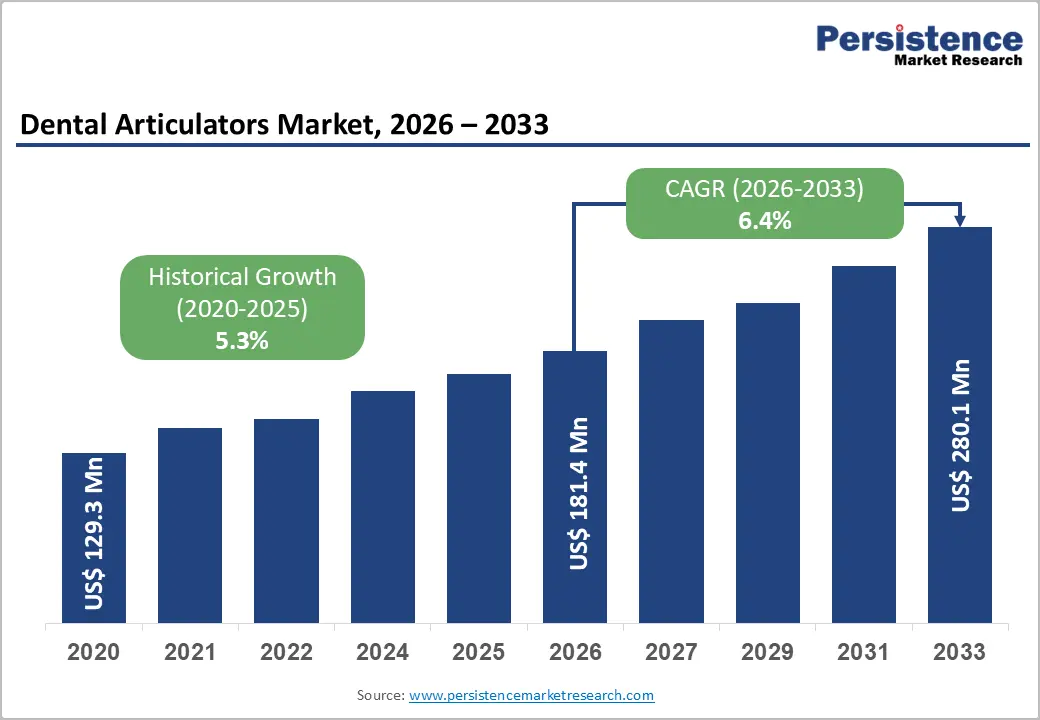
The global dental articulators market is estimated to grow from US$ 181.4 million in 2026 to US$ 280.1 million by 2033 projected to record a CAGR of 6.4% during the forecast period from 2026 to 2033.
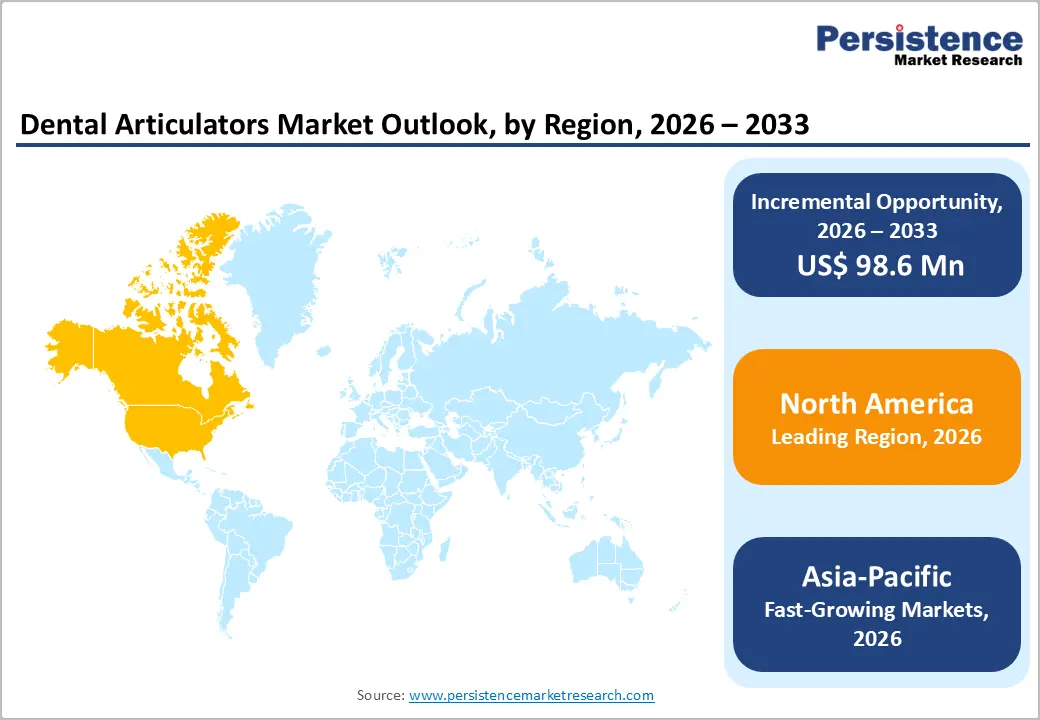
The global market is experiencing steady growth, driven by increasing prosthodontic procedures, rising demand for precise occlusion analysis, and expanding dental laboratory activities. North America leads due to advanced dental infrastructure and technology adoption. Asia-Pacific is the fastest-growing region, supported by improving dental care access, growing dental tourism, and increasing awareness of restorative dentistry.
Key Industry Highlights:
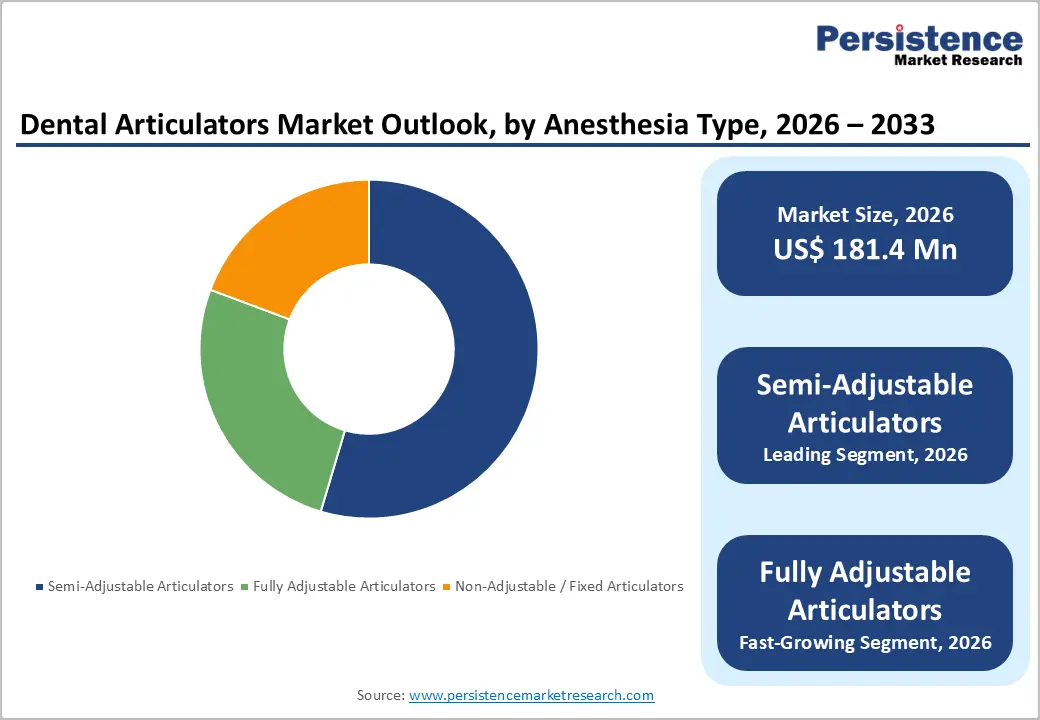
- Dominant Product: Semi-adjustable articulators held 54.6% share in 2025, driven by their balance of accuracy, affordability, and suitability for routine prosthodontic procedures such as crowns, bridges, and dentures, making them widely used in dental laboratories and clinics.
- Regional Leadership: North America led the dental articulators market in 2025 with 36.5% share, supported by advanced dental infrastructure, high demand for restorative dentistry, strong presence of dental equipment manufacturers, and widespread adoption of digital dentistry technologies.
- Growth Indicators: Growth is driven by rising prevalence of dental disorders, increasing demand for prosthodontic and restorative procedures, expanding dental laboratory services, and growing adoption of CAD/CAM and digital dentistry workflows.
- Opportunity: Opportunities exist in the development of digital and CAD/CAM-integrated articulators, increasing adoption of advanced prosthodontic treatments, and expanding dental care infrastructure in emerging markets, particularly across Asia-Pacific and Latin America.
| Key Insights | Details |
|---|---|
|
Global Dental Articulators Market Size (2026E) |
US$ 181.4 Mn |
|
Market Value Forecast (2033F) |
US$ 280.1 Mn |
|
Projected Growth (CAGR 2026 to 2033) |
6.4% |
|
Historical Market Growth (CAGR 2020 to 2025) |
5.3% |
Market Dynamics
Driver: Rising Demand for Prosthodontic and Restorative Dental Procedures
The growing demand for prosthodontic and restorative dental treatments is a major driver for the dental articulators market because articulators are essential tools used to replicate jaw movements during crown, bridge, denture, and implant fabrication. The burden of oral diseases continues to increase globally, creating significant demand for restorative dental procedures. According to the World Health Organization (WHO), oral diseases affect around 3.5 billion people worldwide, making them among the most common health conditions globally. Tooth decay and periodontal diseases frequently lead to tooth loss, requiring prosthodontic treatments such as dentures, crowns, and implants. These procedures require precise occlusion analysis, which increases the clinical use of dental articulators in laboratories and dental clinics.
In addition, aging populations are significantly increasing the need for dental restorations. The WHO estimates that the global population aged 60 years and above will reach about 1.4 billion by 2030, and older individuals are more susceptible to tooth loss and oral disorders requiring prosthetic treatment. Studies also show that 65.8% of dental patients in some clinical populations require prosthetic replacements due to missing teeth or severe dental damage. As restorative and cosmetic dentistry procedures increase globally, dental laboratories and dentists rely heavily on articulators to accurately simulate jaw motion during prosthetic fabrication. Consequently, the rising prevalence of tooth loss, aging populations, and expanding prosthodontic procedures are strongly driving the demand for dental articulators worldwide.
Restraint: High Cost of Advanced and Fully Adjustable Articulators
The high cost associated with advanced dental equipment, including fully adjustable articulators, acts as a restraint for the dental articulators market. Fully adjustable articulators are complex devices designed to replicate mandibular movements with high precision, but their advanced mechanical design and calibration requirements make them expensive. Many small dental clinics and laboratories, particularly in developing countries, often rely on simpler semi-adjustable or hinge articulators due to cost constraints. Dental laboratories also need additional investments in accessories such as facebows, mounting systems, and training for technicians, which increases the total cost of adopting advanced articulator systems. This financial burden can limit the adoption of high-precision articulators despite their clinical advantages.
The broader cost barrier associated with prosthodontic procedures also contributes to this restraint. According to the American Dental Association (ADA), the cost of a dental crown procedure can range between USD 800 and USD 3,000 depending on material and complexity, making restorative treatments expensive for many patients. In several countries, dental treatments are not fully covered by public health insurance, leading to high out-of-pocket expenditures. As a result, patients may delay or avoid restorative procedures, which indirectly reduces the demand for prosthetic fabrication tools such as articulators. High treatment costs and limited reimbursement policies therefore remain significant barriers affecting the widespread adoption of advanced articulator systems globally.
Opportunity: Integration of Articulators with Digital Dentistry and CAD/CAM Systems
The rapid integration of digital technologies into dentistry presents a major opportunity for the dental articulators market. Digital dentistry tools such as intraoral scanners, CAD/CAM design software, and 3D printing systems are transforming the way dental restorations are designed and fabricated. These technologies enable dentists and dental laboratories to create digital models of the patient’s oral cavity, allowing virtual articulators to simulate jaw movements more accurately than traditional mechanical systems. The adoption of digital workflows improves prosthetic precision, reduces laboratory turnaround time, and enhances patient outcomes. As digital dentistry continues to expand globally, the demand for digital and hybrid articulator systems is expected to increase significantly.
The opportunity is further supported by growing demand for customized prosthetics and aesthetic dental procedures. Studies indicate that over 90% of dental practitioners report increasing demand for aesthetic dental treatments, including veneers, crowns, and implant-supported restorations. Additionally, expanding digital dental laboratories are adopting CAD/CAM systems to improve productivity and reduce manufacturing errors. These digital workflows require articulator integration to simulate occlusion during prosthetic design. As dental clinics increasingly adopt advanced digital technologies, manufacturers are developing virtual articulators and digitally integrated articulator systems, creating substantial growth opportunities in the Dental Articulators Market.
Category-wise Analysis
By Product Type Insights
Semi-adjustable articulators dominate the dental articulators market with 54.6% share because they provide a practical balance between accuracy, ease of use, and affordability for most prosthodontic procedures. These articulators can simulate essential mandibular movements such as condylar guidance and lateral movements, which are necessary for fabricating crowns, bridges, and dentures. Unlike fully adjustable articulators, they require less complex calibration and training, making them suitable for routine use in dental clinics and laboratories. This versatility has led to widespread adoption in restorative dentistry.
The demand is supported by the global burden of oral diseases and tooth loss. According to the World Health Organization (WHO), oral diseases affect around 3.5 billion people worldwide, and severe periodontal disease affects nearly 19% of adults globally. Such conditions often require restorative treatments that depend on articulators for accurate occlusion analysis and prosthesis fabrication.
By Material Type Insights
Aluminum dominates the dental articulators market because it offers an optimal combination of lightweight structure, durability, corrosion resistance, and cost efficiency. Dental technicians frequently handle articulators during prosthesis fabrication, mounting casts, and adjusting occlusion. Aluminum articulators are significantly lighter than stainless steel or brass models, reducing operator fatigue while maintaining sufficient strength and stability for precise jaw-movement simulation. Additionally, aluminum is easier to machine and manufacture with high precision, allowing manufacturers to produce reliable articulators at lower costs, which supports widespread adoption in dental laboratories and educational institutions.
The growing demand for dental prosthetics also supports aluminum articulator usage. According to the U.S. Centers for Disease Control and Prevention (CDC), about 19.7% of adults aged 75 and older have lost all their natural teeth, increasing the need for dentures and restorative dental treatments.
Regional Insights
North America Dental Articulators Market Trends
North America dominates the dental articulators market primarily because of its advanced dental healthcare infrastructure, high dental care utilization, and strong adoption of restorative dentistry technologies. The region has a large number of dental clinics, dental laboratories, and well-trained dental professionals that frequently use articulators for prosthodontic procedures such as crowns, bridges, and implants. In addition, high awareness of oral health and strong insurance coverage encourage regular dental visits and restorative treatments, increasing demand for dental laboratory equipment including articulators.
Government health statistics support this trend. According to the U.S. Centers for Disease Control and Prevention (CDC), about 65.5% of U.S. adults had a dental exam or cleaning within the past year. Furthermore, 63.7% of adults aged 65 and older visited a dentist in 2022, reflecting strong utilization of dental services. High procedure volumes and well-established dental care systems therefore contribute to North America’s leadership in the dental articulators market.
Europe Dental Articulators Market Trends
Europe represents a key region in the dental articulators market due to its strong dental care systems, widespread preventive dentistry programs, and high prevalence of oral diseases that require restorative treatments. Many European countries operate publicly funded or insurance-supported dental care systems that encourage early diagnosis and treatment of dental conditions. As a result, prosthodontic treatments such as dentures, crowns, and implants are widely performed across the region, which increases the need for dental laboratory tools including articulators.
Public health data highlights the scale of oral health needs in the region. According to the World Health Organization (WHO) European Region, about 50.1% of adults are affected by major oral diseases, and around 33.6% of the population experiences dental caries in permanent teeth. The large patient base requiring restorative dental treatments supports continuous demand for prosthodontic equipment such as dental articulators across Europe.
Asia-Pacific Dental Articulators Market Trends
Asia-Pacific is the fastest-growing region in the dental articulators market due to expanding dental healthcare infrastructure, growing middle-class populations, and increasing demand for cosmetic and restorative dentistry. Governments and private healthcare providers across countries such as India, China, Thailand, and Malaysia are investing heavily in dental clinics and dental education. Rising awareness of oral health and increasing disposable income are encouraging more individuals to seek dental treatments, which drives the need for prosthodontic tools used in dental laboratories.
Another major factor supporting regional growth is the expansion of dental tourism. Countries such as Thailand, India, and Malaysia attract large numbers of international patients seeking affordable dental procedures. Thailand alone receives hundreds of thousands of dental tourists annually, while Asia-Pacific overall accounts for a significant share of global dental tourism activity. This growing patient inflow increases demand for restorative procedures and laboratory equipment such as dental articulators throughout the region.
Competitive Landscape
The dental articulators market is highly competitive, led by companies such as Dentsply Sirona, Amann Girrbach, Ivoclar Vivadent, SAM, and Schuler Dental. These players focus on product innovation, precision engineering, integration with digital dentistry and CAD/CAM systems, expanding dental laboratory solutions, and strengthening global distribution networks to address growing prosthodontic treatment demand.
Key Industry Developments:
- In February 2026, Dentsply Sirona, in collaboration with Dreve, advanced the clinical evaluation of Primeprint Direct Aligner Resin, a material designed for producing clear orthodontic aligners using 3D printing technology. The evaluation focused on assessing the resin’s safety, performance, and effectiveness in manufacturing orthodontic appliances directly through digital workflows.
- In June 2025, Amann Girrbach launched the Artex Print&Click articulator mounting system, designed to simplify the workflow of dental laboratories. The system enables 3D-printed dental models to be mounted directly on articulators using magnetic click technology, eliminating the need for plaster mounting and reducing laboratory processing time. The solution also improves precision and efficiency in prosthetic fabrication by enabling easier positioning of printed models within articulators.
Companies Covered in Dental Articulators Market
- Amann Girrbach AG
- Dentflex
- Zimmer Biomet
- Hager & Werken GmbH & Co. KG
- So-Young International, Inc.
- Schuler Dental
- Prestige Dental Products UK Ltd.
- Dentsply Sirona
- SAM
- Ivoclar Vivadent AG
- Others
Frequently Asked Questions
The global dental articulators market is projected to be valued at US$ 181.4 Mn in 2026.
Rising prosthodontic procedures, increasing tooth loss cases, growing dental laboratories, and adoption of digital dentistry technologies.
The global dental articulators market is poised to witness a CAGR of 6.4% between 2026 and 2033.
Growth in digital dentistry, CAD/CAM integration, expanding dental laboratories, rising dental tourism, emerging market dental infrastructure development.
Amann Girrbach AG, Dentflex, Zimmer Biomet, Hager & Werken GmbH & Co. KG, So-Young International, Inc., Schuler Dental.


