




- Transportation & Logistics
- Cycle Tourism Market
Cycle Tourism Market Size, Share, and Growth Forecast 2026 - 2033
Cycle Tourism Market by Traveler Type (Groups (Family/Friends), Couples, Solo), Age Group (Below 18, 18 to 30 Years, 31 to 50 Years, Above 50 Years), Activity Type (Mountain Biking, Road Cycling, Leisure Cycling, Adventure Cycling), Trip Duration (Short Trips (1-3 Days), Medium Trips (4-7 Days), Long Trips (8+ Days)), Mode of Booking (Direct Booking, Company Websites & Digital Platforms, Travel Agents), and Regional Analysis, 2026 - 2033

Cycle Tourism Market Size and Trend Analysis
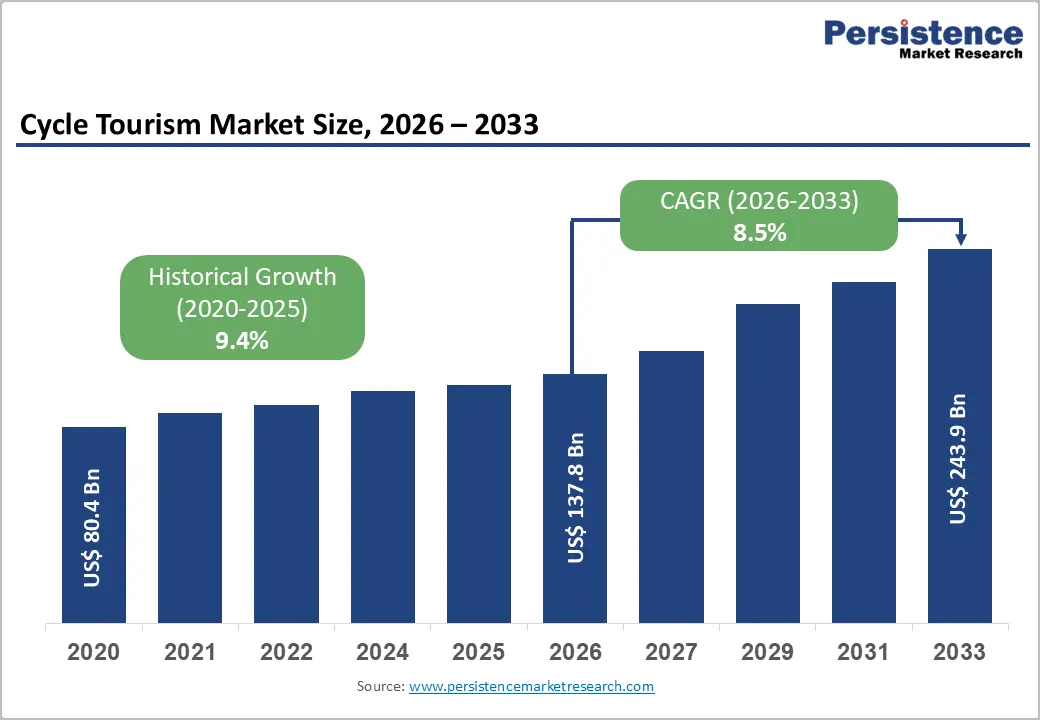
The global Cycle Tourism market size is expected to be valued at US$ 137.8 billion in 2026 and is projected to reach US$ 243.9 billion by 2033, growing at a CAGR of 8.5% between 2026 and 2033. It is witnessing sustained high growth, driven by the convergence of sustainable travel preferences, rising health-conscious tourism, and increasing investments in cycling infrastructure. Governments and private stakeholders are actively supporting low-emission mobility, which is strengthening the long-term outlook for cycling-based travel experiences across developed and emerging regions.
According to the European Cyclists' Federation, the EuroVelo network spans over 90,000 kilometers and generates significant economic impact, with steady growth in route usage observed in 2025. At the same time, e-bike adoption is expanding the consumer base, with over 64% of tour participants now using electric bikes as per joint findings by the Adventure Travel Trade Association and ECF, enabling broader participation and supporting strong revenue growth for operators globally.
Key Industry Highlights:
- Leading Region: Europe dominates the global cycle tourism market with ~44% share in 2025, anchored by the EuroVelo network's 90,000+ km of certified routes, record 5.6% traffic growth in 2025, and Germany's EUR 23 billion annual sector contribution.
- Fastest Growing Region: Asia Pacific is the fastest-growing cycle tourism region, forecast at a CAGR exceeding 14% through 2033, driven by China's greenway investments, Japan's ShimanamiKaido product innovation, India's emerging cycling policy, and ASEAN inbound tourism.
- Dominant Segment: Leisure Cycling holds ~44% of global activity-type share in 2025, driven by universal accessibility, UNESCO-linked heritage routes such as Loire à Vélo attracting 1M+ cyclists annually, and growing older traveler participation.
- Fastest Growing Segment: Solo cycle tourism is the fastest-growing traveler type segment at ~12.8% CAGR through 2033, enabled by GPS navigation apps, flexible digital itineraries, and platform tools that give independent cyclists the confidence to travel alone.
- Opportunity: AI-powered booking personalization, carbon tracking tools, and e-bike adventure packages in emerging destinations represent the highest-growth opportunity, targeting millennials and Gen Z who prioritize sustainable, tech-enabled experiential travel.
| Key Insights | Details |
|---|---|
|
Cycle Tourism Market Size (2026E) |
US$ 137.8 Billion |
|
Market Value Forecast (2033F) |
US$ 243.9 Billion |
|
Projected Growth CAGR (2026–2033) |
8.5% |
|
Historical Market Growth (2020–2025) |
9.4% |
Market Dynamics
Drivers - Surging Investment in Cycling Infrastructure and Supportive Government Policy
Government investment in dedicated cycling infrastructure is rapidly transforming cycle tourism from a niche activity to a mainstream travel category. The Netherlands earmarked EUR 18 million (approximately US$ 21 million) in 2024 for new cycling highways, while Quebec's 2025–2030 cycling investment plan links cultural hubs, lodging clusters, and wayfinding technologies into integrated tourism ecosystems. In Greece, the Central Union of Municipalities (KEDE) signed a landmark cooperation agreement in January 2025 with the "Cities for Cycling" NGO to promote cycling tourism and expand EuroVelo route certification across the country. The European Declaration on Cycling (2024), adopted at the EU level, further mandates dedicated funding streams for active mobility infrastructure across all 27 member states. These interlocking policy frameworks create a compounding demand effect, transforming rural byways into high-yield tourism corridors and directly expanding operator revenue opportunities.
Rising Health Consciousness and the E-Bike Revolution Broadening Market Demographics
A sustained global trend toward wellness-oriented and active travel is significantly expanding the cycle tourism addressable market. The World Health Organization recommends at least 150 minutes of moderate physical activity per week for adults, and cycling tours closely align with this guideline, attracting health-conscious travelers across age groups. This shift is reinforcing demand for experiential, fitness-driven travel formats worldwide.
The rapid adoption of electric bikes is emerging as the most transformative growth enabler in the market. According to the 2024 report by the European Cyclists' Federation and the Adventure Travel Trade Association, based on a survey of 245 operators, around 64 percent of clients now use e-bikes on organized tours, allowing broader participation across demographics. Trek Travel has expanded its e-bike tour portfolio to capitalize on this shift, while the WarmShowers community has surpassed 200,000 members globally, reflecting strong grassroots growth in cycle tourism participation.
Restraints - Seasonality and Weather Dependency Constraining Year-Round Revenue
Cycle tourism remains acutely sensitive to seasonal weather patterns, limiting revenue generation to a compressed peak season in most temperate markets. The EuroVelo Usage Barometer shows that cycle traffic is overwhelmingly concentrated between spring and early autumn, with a notably dry 2025 spring boosting ridership, a factor outside operators' control. The ADFC Bicycle Travel Analysis 2024 identifies physical effort, lack of equipment, and absence of travel companions as the top three barriers to cycle tourism participation, all of which intensify during adverse weather periods. Operators with primarily European exposure face meaningful shoulder-season revenue gaps that constrain profitability and complicate year-round staffing and asset utilization.
Inflation and Marketing Cost Pressures on Tour Operators
Persistent inflationary pressures on operational costs represent a material headwind for cycle tourism businesses. The ECF/Adventure Travel Trade Association 2024 Cycling Tour Operators Survey found that 62% of respondents cited inflation as a major business challenge, while 50% struggled with the cost and complexity of marketing to new customer segments. Rising costs for bicycle maintenance, accommodation, logistics, and guide services, combined with customers' heightened price sensitivity following years of elevated inflation across major economies, are squeezing margins for small and mid-size operators, accelerating consolidation dynamics and raising the barrier to entry for new market participants.
Opportunities - E-Bike Tourism and Adventure Cycling in Emerging Destinations
The rapid commercialization of electric bicycle technology is creating a multi-billion-dollar growth opportunity for cycle tourism operators willing to invest in e-bike fleets and develop technically challenging routes for a newly accessible customer base. G Adventures launched 25 new Active trips in 2025, expanding into Pakistan, Japan, and the Balkans, targeting independent travelers seeking adventure cycling in off-the-beaten-path destinations.
Backroads introduced 'Unplugged Bike Tours' priced at US$ 4,799–US$ 5,899, capturing fitness-oriented cyclists seeking premium, traditional cycling challenges. The Adventure Travel Trade Association (ATTA) consistently identifies cycling as a top trending activity in adventure travel research, and with mountain biking dominating as the leading discipline outside Europe, operators expanding e-bike adventure offerings into Asia, Latin America, and Africa stand to unlock significant untapped demand among millennials and Gen Z travelers who prioritize experiential, sustainability-aligned travel.
Digital Platform Integration and AI-Driven Personalization
The accelerating digitalization of travel planning and booking presents transformative commercial opportunities for cycle tourism operators. Company websites and digital platforms already command a leading share of cycle tourism bookings, and the integration of GPS-guided route navigation, real-time weather-adaptive itineraries, AI-driven personalized trip recommendations, and carbon-footprint tracking tools is creating a new tier of premium digital experience.
Germany's Federal Environment Agency launched a bike tourism carbon tracker toolkit for operators in January 2024, signaling that sustainability reporting is becoming a competitive differentiator. Intrepid Travel's January 2025 acquisition of Sawadee Reizen, adding approximately US$ 100 million in revenue and 20,000 customers, demonstrates how digital-first operators with broad product libraries and robust CRM ecosystems can rapidly scale through both organic growth and strategic M&A in the fragmented cycle tourism landscape.
Category-wise Analysis
Traveler Type Insights
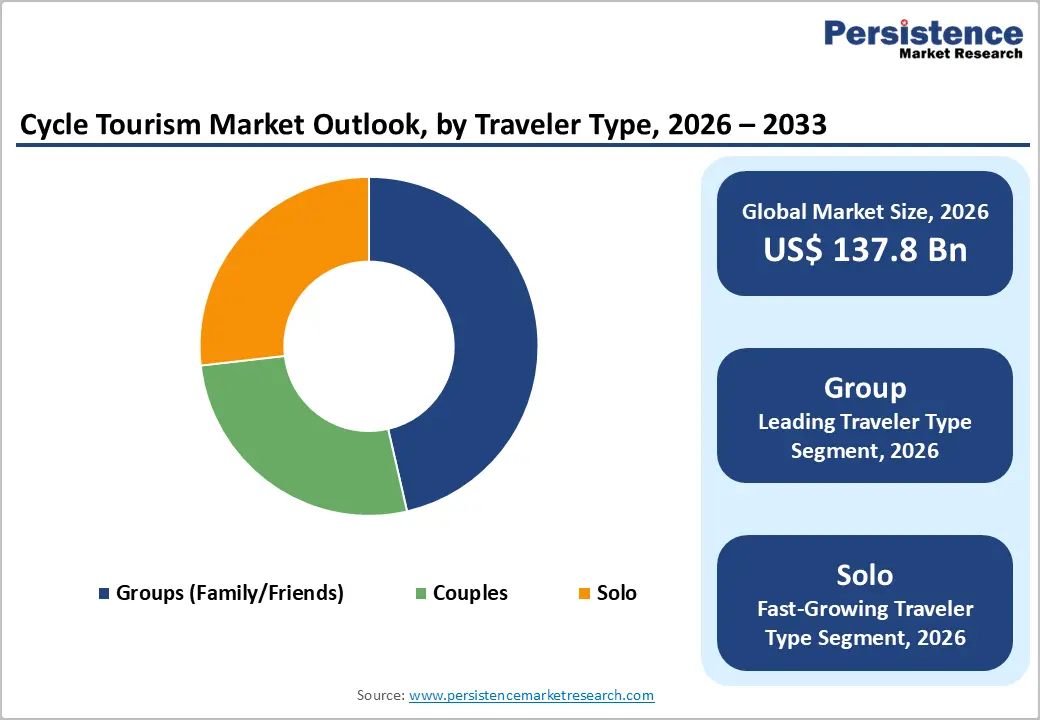
Groups including family and friends represent the dominant traveler type segment in the global cycle tourism market, accounting for approximately 42% of market share in 2025. The segment’s leadership is driven by social, economic, and safety advantages of group travel, where shared itineraries lower individual costs, logistics are collectively managed, and the overall experience encourages repeat bookings and referrals.
The European Cyclists' Federation and Adventure Travel Trade Association 2024 survey confirms that organized group cycling tours serve as a key entry point for new participants globally. Operators such as G Adventures, Exodus Travels, and Intrepid Travel have developed strong offerings around structured group experiences. The solo traveler segment is the fastest growing, projected to expand at a CAGR of around 12.8% through 2033, supported by app-based navigation, flexible itineraries, and the increasing preference for independent travel.
Age Group Insights
The 31 to 50 Years age cohort is the leading demographic segment in the cycle tourism market, representing approximately 38% of market share in 2025. This group demonstrates the highest propensity for discretionary spending on active travel, combining disposable income, paid vacation entitlement, and a strong health-consciousness orientation. The ADFC Bicycle Travel Analysis 2024 confirms that this age group forms the backbone of organized cycling tour participation in Germany, the world's most mature cycle tourism market, where daily per-cyclist spending ranges from EUR 117 to EUR 130. The expanding availability of e-bikes has made multi-day cycling accessible to this cohort regardless of prior fitness levels. The Above 50 Years segment is identified as the fastest growing age group through 2033, driven by active retirement lifestyles, higher disposable incomes, and the accessibility that e-bike technology provides to physically demanding routes across Europe, North America, and Asia Pacific.
Activity Type Analysis
Leisure cycling represents the dominant activity type in global cycle tourism, accounting for approximately 44% of market share in 2025. This leadership is supported by its broad accessibility, requiring minimal equipment and physical effort, which enables participation across diverse age groups, fitness levels, and budgets while offering scenic and culturally immersive travel experiences.
Routes such as La Loire à Vélo demonstrate the strong economic impact of leisure cycling, attracting over one million cyclists annually and generating significant regional revenue. The segment is characterized by low-impact travel and cultural exploration. Meanwhile, adventure cycling is the fastest-growing segment, driven by rising interest in bikepacking, gravel events, and expanding offerings by operators such as SpiceRoads Cycling and World Expeditions across emerging destinations.
Trip Duration Insights
Medium Trips (4–7 Days) represent the leading trip duration segment, capturing approximately 41% of global cycle tourism market share in 2025. This duration strikes the optimal balance between experiential depth, logistical manageability, and affordability for the majority of working-age cycle tourists. Four-to-seven-day itineraries, such as the iconic Danube Cycle Path sections, the Loire Valley route, and classic Tuscany circuits, represent the core product offerings of leading operators including Butterfield & Robinson, Ciclismo Classico, and Discover France Adventures. These trips enable operators to offer comprehensive logistics packages including luggage transfer, curated accommodation, and guided commentary, maximizing per-customer revenue. Long Trips (8+ Days) are the fastest-growing duration segment as e-bikes, improved wayfinding, and luggage-forwarding services remove the traditional physical and logistical barriers to extended cycle travel.
Mode of Booking Insights
Direct Booking is the dominant mode of booking in the global cycle tourism market, holding approximately 57% of market share in 2025. Cycle tourism's inherently specialized and customized nature, encompassing route selection, fitness level matching, equipment rental, and accommodation pairing, makes direct engagement between traveler and operator the preferred and most commercially effective channel. The ECF's EuroVelo.com search engine connects cyclists directly to bookable tour offers across the continent, reinforcing direct-channel relationships. Data from the Europe market corroborates this pattern, with the direct booking share at 60.9% in 2024 for the region. However, Company Websites & Digital Platforms are the fastest-growing booking mode through 2033, as operators invest heavily in AI-powered recommendation engines, mobile-first booking interfaces, and integrated carbon-offset tools to capture direct digital demand from younger, tech-native travelers.
Regional Insights
North America Cycle Tourism Market Trends and Insights
North America is a significant and fast-growing market for cycle tourism, with the United States and Canada collectively accounting for approximately 24% of global market share in 2025. The U.S. market is driven by diverse natural landscapes, from the Pacific Coast Highway to the iconic Great Divide Mountain Bike Route, and a growing culture of adventure travel among millennials and Generation X. Companies such as Austin Adventures, Butterfield & Robinson, and BikeHike Adventures operate premium multi-day cycling packages across the continent. In January 2025, Kooth Digital Health launched the Soluna California Cycle Tour, a 1,000-mile mental health awareness journey, illustrating the growing integration of wellness and social purpose into cycle tourism offerings.
Canada's Quebec 2025–2030 cycling plan links cultural destinations, lodging, and route-wayfinding technology into cohesive cycle tourism ecosystems, driving significant regional infrastructure investment. U.S. government initiatives under the Bipartisan Infrastructure Law allocate funding for active transportation networks, expanding the trail systems upon which cycle tourism depends. The North American market is also a global leader in digital booking innovation, with companies investing in AI-driven itinerary personalization, real-time route navigation apps, and sustainable travel certification programs, positioning the region as an innovation hub for next-generation cycle tourism experiences.
Europe Cycle Tourism Market Trends and Insights
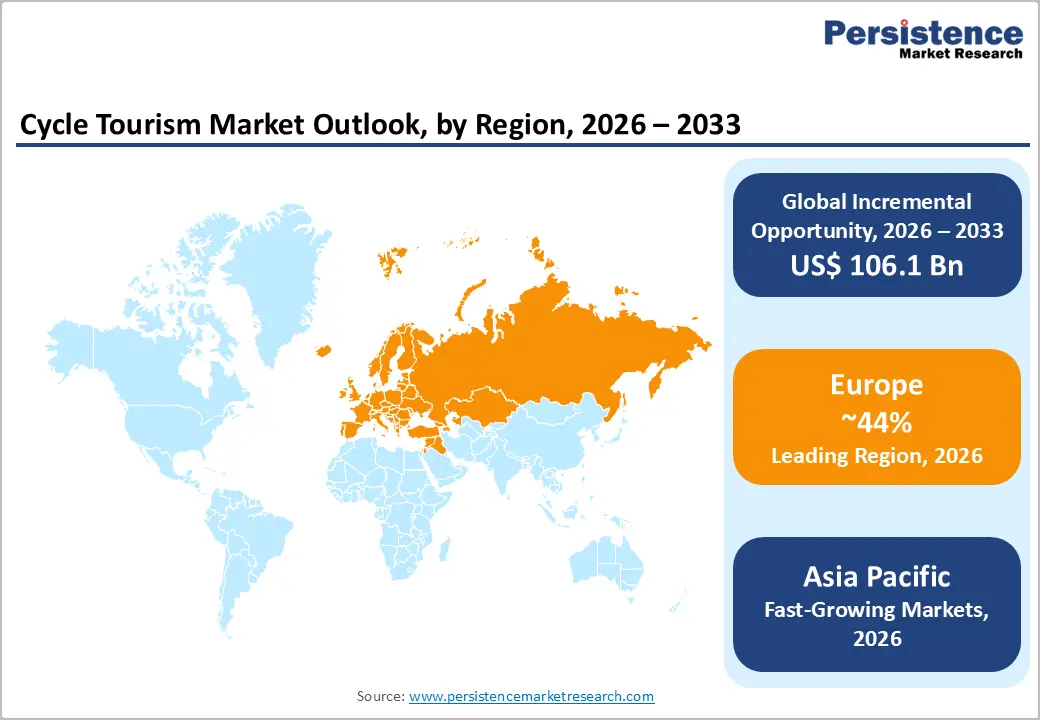
Europe is the uncontested global leader in cycle tourism, accounting for approximately 44% of global market share in 2025. The region's dominance is anchored by the EuroVelo network of 17 trans-European cycling routes, which generated a 5.6% increase in route traffic in the first eight months of 2025 versus 2024 (ECF/Eco-Counter EuroVelo Usage Barometer). Germany is the world's most economically significant single cycle tourism market, generating EUR 23 billion in revenue and sustaining approximately 284,000 jobs in 2024. Daily cycle tourist spending in Germany reaches EUR 117–130, among the highest globally. France's La Loire à Vélo and Provence routes attract millions of visitors annually, with cycling tourists spending 24% more per day than the average French tourist.
Spain's cycling tourism sector is booming, with routes like El Camino de Santiago attracting growing numbers of international cyclists. The U.K.'s National Cycle Network, maintained by Sustrans, spans over 16,000 miles and supports a thriving domestic and inbound cycling tourism industry. The EU's European Declaration on Cycling (2024) is harmonizing investment standards across member states, while Slovenia's Green Scheme certified over 120 cyclist-friendly villages in 2024, demonstrating how smaller European nations are creating high-value, sustainability-certified cycle tourism products that command premium pricing.
Asia Pacific Cycle Tourism Market Trends and Insights
Asia Pacific is the fastest-growing regional market for cycle tourism, forecast to expand at a CAGR exceeding 14% through 2033. China is a powerhouse in both domestic and inbound cycling tourism, with the government actively investing in greenways and cycling-specific infrastructure under its 14th Five-Year Plan for sustainable transportation. Japan's ShimanamiKaido cycling highway, a 70-kilometer inter-island route linking Honshu and Shikoku, is a globally recognized cycling destination, and in October 2024 it launched a 'Night Ride' initiative featuring solar-lit paths and cultural rest stops, demonstrating the region's commitment to cycling tourism product innovation.
India is an emerging cycle tourism market of considerable promise. The government's National Cycling Policy and growing state-level initiatives, such as the "Dooars Darshan" bicycle tourism program at Buxa Tiger Reserve, West Bengal (2023), are laying the foundations for organized cycling tourism networks. Scott Sports partnered with the Himalayan Adventure Sports and Tourism Promotion Association (HASTPA) in August 2024 to develop competitive mountain biking teams, boosting destination credibility. ASEAN markets such as Vietnam, Thailand, and Cambodia are attracting growing numbers of international cycle tourists seeking immersive cultural and natural experiences, supported by expanding cycling tour operators like SpiceRoads Cycling and Himalayan Glacier Adventure, which offer bespoke multi-day itineraries across the region.
Competitive Landscape
The global cycle tourism market is highly fragmented, characterized by the presence of numerous small and mid-sized operators alongside a limited number of internationally scaled tour providers. The market structure is shaped by strong regional specialization, with operators competing across diverse route networks, terrain types, and experience levels. Low entry barriers in local markets encourage new entrants, while scalability remains constrained by logistical complexity and destination-specific expertise.
Competition is driven by differentiation in route design, quality of support services, and the integration of premium offerings such as e-bike fleets and seamless logistics. Companies are increasingly adopting digital platforms for itinerary customization and direct booking, enhancing customer experience and operational efficiency. Strategic focus areas include expansion into emerging destinations, development of sustainable and carbon-neutral tour offerings, and partnerships with local service providers. Additionally, operators are leveraging AI-driven personalization, app-based self-guided tours, and corporate wellness programs to capture evolving consumer preferences and higher-value segments.
Key Developments:
- January 2025: Intrepid Travel completed the acquisition of Sawadee Reizen, adding approximately US$ 100 million in annual revenue and 20,000 customers, accelerating its U.S. market expansion toward a target of USD 500 million in sales by 2030.
- January 2025: G Adventures announced the launch of 25 new active travel trips for 2025, expanding its portfolio in cycling, hiking, and multi-activity tours to meet rising demand for experiential and adventure-based tourism.
Companies Covered in Cycle Tourism Market
- SpiceRoads Cycling
- World Expeditions
- Travel + Leisure Holdco, LLC
- Exodus Travels Limited
- Intrepid Travel
- G Adventures
- Himalayan Glacier Adventure and Travel Company
- Sarracini Travel
- Arbutus Routes
- Austin Adventures
- BikeHike Adventures
- Pedalers Pub & Grille
- Discover France Adventures
- Ciclismo Classico
- Butterfield & Robinson
- Backroads
- Trek Travel
- Bike Tours LLC
- Unlimited Biking Rentals LLC
- The Natural Adventure Company
Frequently Asked Questions
The global cycle tourism market is valued at US$ 137.8 billion in 2026 and is projected to reach US$ 243.9 billion by 2033 at a CAGR of 8.5%.
Key drivers include government investment in cycling infrastructure, rising adoption of e-bikes, and growing demand for sustainable and health-focused travel.
Europe leads the market with around 44% share, supported by strong cycling infrastructure and established tourism routes.
The main opportunity lies in e-bike tourism expansion and digital platform-based personalized travel experiences in emerging destinations.
Major players include Intrepid Travel, G Adventures, Butterfield & Robinson, Backroads, Exodus Travels, Trek Travel, and SpiceRoads Cycling.


