




- Communication Infrastructure & Services
- Bluetooth Beacon and iBeacon Market
Bluetooth Beacon and iBeacon Market Size, Share, and Growth Forecast 2026 - 2033
Bluetooth Beacon and iBeacon Market by Technology (Bluetooth Low Energy (BLE), iBeacon, Eddystone, Multi-protocol Beacons), by Deployment (On-Premises, Cloud-Based, Hybrid), by Application (Asset Tracking, Proximity Marketing, Indoor Navigation, Customer Analytics, Security & Access Control, Smart Buildings), by End-Use (Retail, Healthcare, Transportation & Logistics, Manufacturing, Hospitality, Education, Government), by Regional Analysis, 2026-2033

Bluetooth Beacon and iBeacon Market Size and Trend Analysis
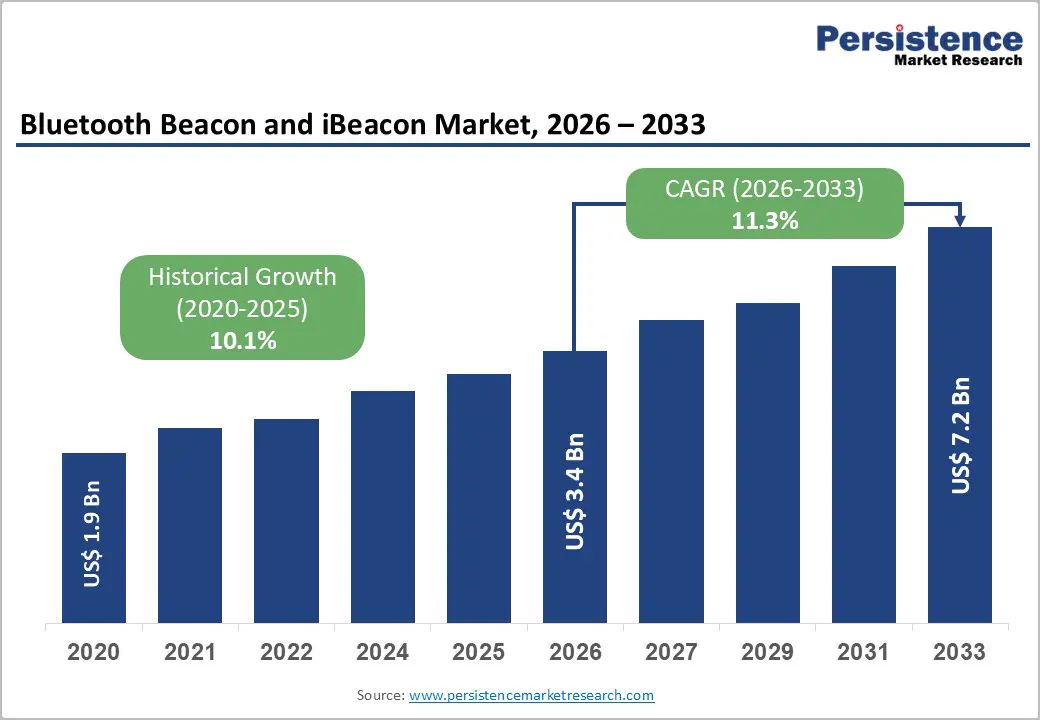
The global bluetooth beacon and iBeacon market size is likely to be valued at US$ 3.4 billion in 2026 and is expected to reach US$ 7.2 billion by 2033, growing at a CAGR of 11.3% during the forecast period from 2026 to 2033. The expansion of the Bluetooth Beacon and iBeacon market is being driven by the accelerating adoption of location-based services across retail and enterprise sectors, coupled with the proliferation of Internet of Things (IoT) devices and increasing demand for real-time asset tracking solutions.
Key Market Highlights
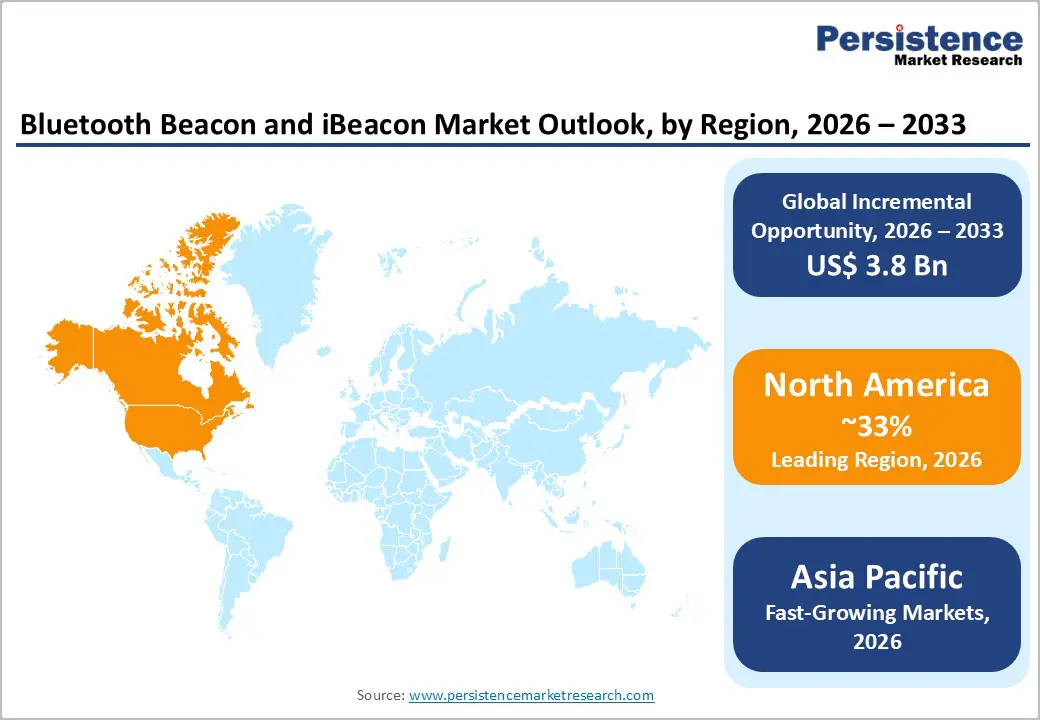
- Leading Region: North America dominates the Bluetooth Beacon and iBeacon market, accounting for 38% of global market share in 2024, supported by early technology adoption, mature digital infrastructure, and strong investment in omnichannel retail and smart building solutions across the United States and Canada.
- Fastest Growing Region: Asia Pacific exhibits the highest growth trajectory, projected to expand at a CAGR exceeding 50% through 2033, driven by China's extensive smart city programs, India's Smart Cities Mission with US$ 19.67 billion allocated budget, and rapid IoT adoption across major metropolitan areas.
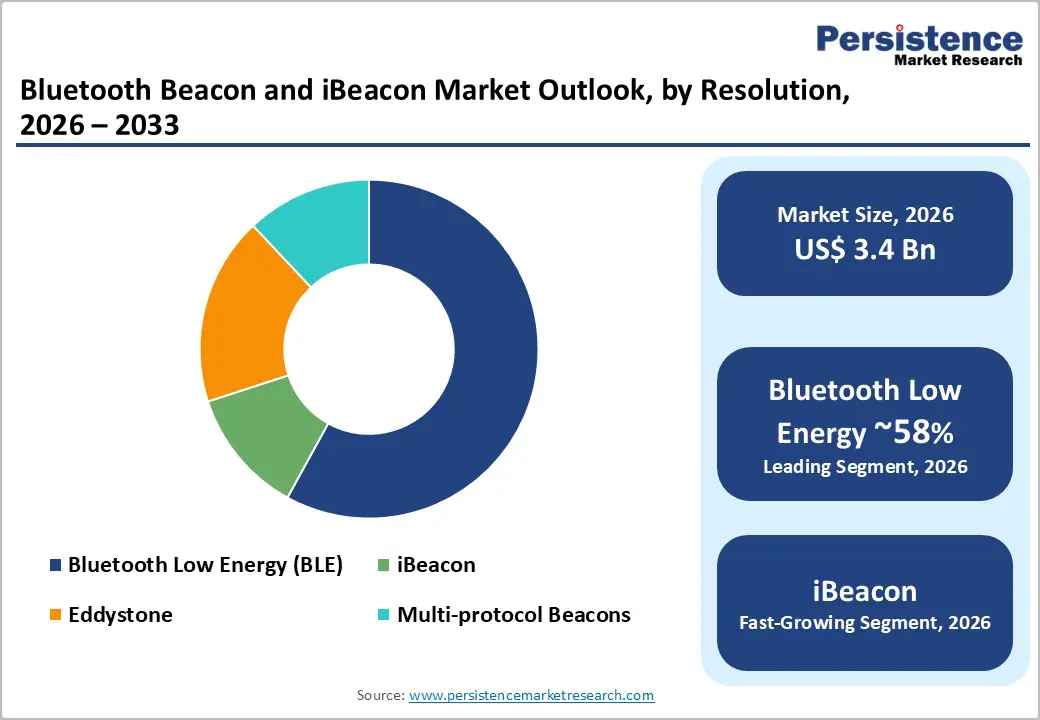
- Dominant Segment: Bluetooth Low Energy (BLE) Technology commands 58% market share, driven by superior energy efficiency, chipset availability, and universal smartphone compatibility, establishing BLE as the de facto standard for beacon implementations across retail, healthcare, and IoT applications.
- Fastest Growing Segment: Healthcare applications for real-time asset tracking and indoor navigation represent the fastest-growing end-use segment, with patient monitoring, equipment tracking, and wayfinding solutions driving accelerated adoption as healthcare organizations prioritize operational efficiency improvements.
- Key Market Opportunity: Ultra-Wideband (UWB) Technology Integration represents the most significant emerging opportunity, enabling centimeter-level positioning accuracy compared to Bluetooth Low Energy's 1-5 meter range, unlocking advanced use cases in precision asset tracking, secure digital keys, and fine-range navigation across retail, healthcare, and logistics sectors.
| Report Attribute | Details |
|---|---|
|
Bluetooth Beacon and iBeacon Market Size (2026E) |
US$ 3.4 Billion |
|
Market Value Forecast (2033F) |
US$ 7.2 Billion |
|
Projected Growth CAGR (2026-2033) |
11.3% |
|
Historical Market Growth (2020-2025) |
10.1% |
Market Dynamics
Market Growth Drivers
Explosive Growth in Proximity Marketing and Location-Based Services Adoption
The global location-based services (LBS) market reached US$ 59.65 Billion in 2024 and is projected to grow at a CAGR of 16.7% through 2033, significantly outpacing the broader beacon market. This growth in location-based services is directly translating into increased beacon deployments, particularly in proximity marketing applications.
Retailers are leveraging Bluetooth Low Energy beacons to deliver hyper-personalized offers, with studies showing that beacons have increased retail foot traffic by 25% and improved customer engagement by 20% in beacon-enabled stores. The convergence of indoor positioning technology with behavioral analytics enables retailers to understand customer movement patterns, optimize store layouts, and tailor marketing strategies in real time, directly driving beacon market expansion as brands compete to capture consumer attention at the point of purchase.
Accelerating IoT Adoption and Smart City Infrastructure Development
Government initiatives across major markets are accelerating beacon deployment within broader smart city and IoT infrastructure ecosystems. India's Smart Cities Mission, which has allocated US$ 19.67 billion in its 2024-25 budget and completed 94% of 8,067 projects totaling US$ 17.64 trillion in investment by March 2025, is incorporating beacon technology as a critical component of integrated command and control centers and urban infrastructure management.
China's PATH project aimed to develop approximately 500 cities with advanced technologies including beacons to improve urban services. These large-scale government initiatives, combined with the installation of 84,000 CCTV surveillance cameras and 1,884 emergency call boxes across 100 Smart Cities in India, demonstrate the critical role of beacon technology in building connected, resilient urban infrastructure, thereby driving sustained market growth.
Market Restraints
Data Privacy Concerns and Regulatory Compliance Barriers
The beacon market faces significant headwinds from growing concerns about data privacy and user consent, which pose formidable restraints on market expansion. Beacon technology inherently involves the collection and processing of sensitive personal location data through Bluetooth Low Energy (BLE) signals, raising substantial privacy concerns among consumers and regulators. The lack of standardized data protection frameworks and regulatory clarity regarding location tracking across different jurisdictions creates operational complexities and potential compliance liabilities for organizations deploying beacon solutions.
These privacy concerns have led some consumers to disable Bluetooth connectivity, thereby reducing the addressable market for beacon-enabled services and slowing adoption rates in privacy-conscious markets, particularly in Europe where General Data Protection Regulation (GDPR) compliance requirements impose strict limitations on personal data collection.
High Initial Deployment Costs and Infrastructure Fragmentation
Organizations face substantial upfront capital expenditures for comprehensive beacon network deployment, particularly in large facilities requiring hundreds or thousands of beacons for adequate coverage and positioning accuracy. The fragmentation of beacon protocols and the absence of universal interoperability standards across different beacon manufacturers and technology platforms necessitate specialized technical expertise for installation, configuration, and integration with existing enterprise systems.
Battery management costs, network infrastructure requirements, and the need for sophisticated cloud-based management software further inflate the total cost of ownership, making beacon solutions financially prohibitive for small and medium-sized enterprises, thereby limiting market penetration across the full spectrum of potential end users.
Market Opportunities
Healthcare Sector Expansion and Real-Time Patient and Asset Tracking Applications
The healthcare sector represents one of the fastest-growing segments for beacon technology, driven by escalating demand for real-time location systems (RTLS) to track critical medical equipment, patients, and staff within hospital facilities. Healthcare providers are deploying beacon-enabled solutions to address the critical challenge of equipment loss and the time-consuming process of locating medical assets, with studies demonstrating that beacon-based asset tracking has reduced equipment search times by 30% in hospital environments.
The implementation of Bluetooth Low Energy beacons enables clinicians to instantly locate critical assets such as wheelchairs, infusion pumps, and portable imaging devices, thereby reducing operational delays and improving patient care quality. As healthcare systems increasingly prioritize digital transformation and invest in smart hospital infrastructure, the adoption of beacon-enabled asset tracking and indoor navigation solutions is expected to accelerate significantly, presenting substantial revenue opportunities for beacon manufacturers and solution providers throughout the 2026-2033 forecast period.
Ultra-Wideband (UWB) Technology Integration and Next-Generation Positioning Solutions
The emergence of Ultra-Wideband (UWB) technology represents a transformative opportunity for the beacon market, addressing the fundamental limitations of Bluetooth Low Energy positioning, which typically provides accuracy in the 1-5 meter range. UWB technology delivers centimeter-level accuracy of less than 50 centimeters with sub-millisecond latency and real-time location tracking capabilities, unlocking new use cases previously impossible with traditional BLE beacons.
Major technology vendors, including Apple, which has embedded UWB across most devices since 2019 with adoption projections exceeding 60% of active iPhones by 2030, are driving hybrid BLE + UWB deployments across retail, healthcare, and logistics sectors. The integration of UWB technology with AI-driven location analytics and edge computing is enabling organizations to implement advanced solutions such as secure digital keys, fine-ranging navigation, and precision asset tracking, creating substantial market opportunities for vendors developing next-generation beacon solutions that leverage multiple positioning technologies to deliver enhanced accuracy and functionality.
Category-wise Insights
Technology Analysis
Bluetooth Low Energy (BLE) dominates the beacon market with a commanding 58% market share, driven by its unparalleled chipset availability, sub-milliwatt power consumption, and seamless integration with smartphones and IoT devices. BLE technology has established itself as the de facto standard for beacon implementations due to its energy efficiency, enabling battery-powered beacons to operate for extended periods without requiring frequent battery replacements.
The widespread adoption of BLE beacons in 22% increase in shipments during 2024 compared to 2023 demonstrates the technology's critical importance in proximity marketing and asset tracking applications. The dominance of BLE is further supported by the fact that 97% of all Bluetooth devices are expected to include Bluetooth Low Energy by 2028, ensuring continued market penetration and ecosystem maturity.
Deployment Analysis
Cloud-Based deployment models are emerging as the fastest-growing segment, driven by organizations' need for scalable, centralized management of distributed beacon networks and real-time data analytics capabilities. Cloud-based beacon management systems enable enterprises to monitor beacon performance, analyze location data, and trigger automated workflows from a centralized platform, facilitating omnichannel customer experiences and operational optimization.
The integration of cloud infrastructure with artificial intelligence (AI) and machine learning algorithms enables predictive analytics, enabling retailers to anticipate customer behavior and optimize promotional campaigns in real time. Hybrid deployment architectures, combining on-premises beacon networks with cloud-based analytics and management platforms, are gaining traction as organizations seek to balance data security, latency requirements, and operational flexibility.
Application Analysis
Proximity Marketing represents the largest application segment, accounting for 45% of market demand, driven by retailers' ongoing digital transformation and the need to create compelling in-store experiences that compete with e-commerce alternatives. Location-based promotions powered by beacon technology have demonstrated measurable impact, with retailers reporting 32% more "Buy Now" clicks from customers engaged through beacon-triggered notifications.
Retail chains including Walmart, Target, Macy's, and CVS have implemented extensive beacon deployments to deliver location-specific offers, product information, and aisle-level navigation to shoppers, significantly improving conversion rates and customer loyalty. Asset Tracking represents the second-largest application, with 178,000 Bluetooth Real-Time Location Systems (RTLS) implementations globally by the end of 2024, growing to 322 million asset tracking device shipments projected for 2028, reflecting the critical importance of real-time visibility across manufacturing, healthcare, and logistics sectors.
End-Use Analysis
Retail maintains its position as the dominant end-use sector, with iBeacon technology benefiting from 72% market share due to its seamless integration with Apple's ecosystem and unmatched adoption in iOS devices, enabling retailers to implement straightforward proximity marketing strategies. Retail locations deploying beacon technology have experienced increased sales conversion rates of 15% to 20% through personalized offers and enhanced in-store navigation experiences.
Healthcare emerges as the fastest-growing end-use segment, driven by hospitals' urgent need to track critical medical equipment, manage patient flow during peak operations, and reduce time-to-treatment in emergency situations. The deployment of BLE-based asset tracking in healthcare facilities has reduced equipment search times by 30% and improved staff efficiency, making beacon technology increasingly attractive for healthcare administrators seeking to optimize operational workflows and enhance patient outcomes through real-time location visibility.
Regional Insights
North America Bluetooth Beacon Trends
North America maintains its position as a mature, technologically advanced beacon market, with established early adoption of location-based services and a robust digital infrastructure supporting large-scale deployments. The United States market is projected to grow at a CAGR of 24.9%, significantly outpacing the global average, driven by intensive investments in AI-driven location services, omnichannel retail strategies, and IoT-connected asset tracking solutions. Major retail chains in the region, including Walmart, Target, Macy's, and CVS, have deployed beacon networks across their store locations to enhance proximity marketing, improve in-store navigation, and generate actionable foot traffic analytics.
North America accounted for 38% of the global iBeacon and Bluetooth Beacon market share in 2024, supported by a well-established technology ecosystem, early adoption by retail and healthcare sectors, and significant investments in smart city infrastructure. The region's mature smartphone penetration rate of nearly 100% for devices supporting Bluetooth Low Energy and the strong presence of beacon technology vendors create a favorable environment for continued market expansion and innovation. Healthcare organizations in North America are increasingly adopting beacon-enabled solutions for patient tracking, asset management, and indoor navigation applications, recognizing the substantial return on investment through improved operational efficiency and patient safety outcomes.
Europe Bluetooth Beacon Trends
Europe demonstrates strong market growth momentum, particularly in Germany, United Kingdom, and France, where beacon technology has achieved significant adoption in retail, hospitality, and tourism sectors. Germany holds the leading position in the European beacon market with 25.9% of the European market share in 2024, driven by its robust industrial base, strong emphasis on digital transformation, and widespread adoption of IoT solutions across manufacturing and retail sectors. A study by Eurostat highlights that over 70% of German enterprises have integrated advanced technologies, including beacons, into their operations, reflecting the region's technological maturity and commitment to digital innovation.
The United Kingdom holds the second-largest position in Europe's beacon market, with high smartphone penetration rates and rapid adoption of beacon technology in retail and tourism sectors. Tesco PLC, a major United Kingdom-based retail company, deployed beacons in all of their Tesco Lotus stores, demonstrating the widespread adoption of beacon technology among European retailers. The British Retail Consortium reports that beacon-enabled stores have increased sales conversion rates by 15%, validating the business case for beacon deployments. Europe's emphasis on data privacy through GDPR compliance and regulatory harmonization is driving the development of privacy-respecting beacon solutions, positioning European vendors as leaders in compliant, security-focused beacon technology implementations.
Asia Pacific Bluetooth Beacon Trends
Asia Pacific emerges as the fastest-growing regional market, driven by rapid urbanization, extensive smart city initiatives, and massive investments in IoT infrastructure across China, India, and Southeast Asia. China's market is projected to grow at a CAGR of 51.7% through the forecast period, driven by the government's commitment to smart city development and the integration of beacons with artificial intelligence, 5G networks, and cloud computing platforms. The PATH project, China's smart city initiative, aims to develop approximately 500 cities with advanced technologies including beacon systems, representing one of the world's largest infrastructure modernization efforts incorporating beacon technology as a critical component.
India's Smart Cities Mission, which has completed 94% of its 8,067 multi-sectoral projects valued at US$ 17.64 trillion by March 2025, incorporates beacon technology in its Integrated Command and Control Centers (ICCCs) and urban infrastructure management systems. The Indian beacon market is projected to grow at a CAGR of 54.1%, the fastest among major regions, driven by government initiatives for digital infrastructure development, rising demand for AI-based location analytics, and the expansion of smart retail solutions. Japan, South Korea, and Singapore are deploying beacon technology for precision marketing, smart building automation, and public safety applications, establishing Asia Pacific as the region with the highest growth potential and most dynamic beacon market development through 2033.
Competitive Landscape
Market Structure Analysis
The Bluetooth Beacon and iBeacon market exhibits a moderately consolidated competitive structure, characterized by a mix of established semiconductor manufacturers, specialized beacon solution providers, and emerging startups focused on niche applications. Apple Inc. exercises dominant influence through its iBeacon ecosystem, which has achieved 72% market share among iBeacon implementations, leveraging its seamless integration with iOS devices and the installed base of over 1 billion active iPhones globally. Major semiconductor companies including Texas Instruments Inc., Nordic Semiconductor ASA, Silicon Laboratories Inc., and NXP Semiconductors control significant portions of the beacon chipset market, employing strategies focused on low-power design innovation, cost reduction, and ecosystem integration to maintain competitive advantage. Specialized beacon solution providers such as Estimote Inc., Kontakt Micro-Location, BlueCats Australia Pty Limited, and Gimbal Inc. compete through software sophistication, platform scalability, and vertical industry specialization, offering differentiated solutions for retail, healthcare, and logistics segments. The market exhibits increasing competition in AI-driven location analytics and cloud-based management platforms, with vendors investing heavily in research and development to develop next-generation solutions incorporating machine learning, edge computing, and ultra-wideband technology integration to enhance positioning accuracy and enable advanced use cases previously impossible with traditional Bluetooth Low Energy beacons.
Key Market Developments
- February 2025: Nordic Semiconductor announced a strategic partnership with Skylo to bring ultra-low power satellite connectivity to massive IoT applications, enabling beacon-based asset tracking solutions to function in remote and rural areas previously limited to terrestrial connectivity options.
- January 2024: Cisco introduced Meraki Go, a comprehensive solution incorporating smart beacon functionalities for small businesses, integrating indoor navigation and wayfinding capabilities with network security, guest Wi-Fi, and remote management features.
- December 2024: Nordic Semiconductor acquired Memfault, launching the first complete chip-to-cloud platform for lifecycle management of connected products, enabling manufacturers of beacon-based IoT devices to remotely monitor performance, diagnose issues, and implement over-the-air firmware updates throughout the product lifecycle.
Companies Covered in Bluetooth Beacon and iBeacon Market
- Texas Instruments Inc.
- Nordic Semiconductor ASA
- Silicon Laboratories Inc.
- Onyx Beacon LTD
- Estimote Inc.
- Kontakt Micro-Location Sp. Z.o.o.
- BlueCats Australia Pty Limited
- Gimbal Inc.
- Blue Sense Networks Ltd
- Accent Advanced Systems
- Glimworm Beacons
- Aruba Networks
- Sensorberg GmbH
- Radius Networks Inc.
- Apple Inc.
- NXP Semiconductors
- Broadcom Corporation
- Cypress Semiconductor
- Cisco Systems
- Qualcomm Incorporated
Frequently Asked Questions
The global Bluetooth Beacon and iBeacon market is valued at US$ 3.4 Billion in 2026E and is projected to reach US$ 7.2 Billion by 2033F, expanding at a CAGR of 11.3% during the forecast period, driven by accelerating adoption of location-based services and IoT integration across retail, healthcare, and smart city applications.
The Bluetooth Beacon market is primarily driven by the explosive growth of proximity marketing, rising adoption of real-time location systems (RTLS) in healthcare for asset tracking, large-scale government-backed smart city initiatives in India and China, and the integration of beacons with artificial intelligence for location-based analytics, enabling retailers and enterprises to optimize customer engagement and operational efficiency.
Bluetooth Low Energy (BLE) Technology dominates the market with 68% to 82% market share, driven by its superior energy efficiency enabling multi-year battery life, universal smartphone compatibility, and established chipset ecosystem, establishing BLE as the standard-bearer for beacon implementations across retail, healthcare, and IoT sectors.
North America leads in current market value with 38% global market share, supported by early technology adoption and mature infrastructure, while Asia Pacific exhibits the highest growth potential with CAGR exceeding 50%, driven by China's PATH project, India's Smart Cities Mission, and rapid IoT adoption across major metropolitan areas.
Ultra-Wideband (UWB) Technology Integration represents the most significant emerging opportunity, delivering centimeter-level positioning accuracy compared to BLE's 1-5 meter range, enabling advanced applications in precision asset tracking, secure digital keys, and fine-range navigation, unlocking new revenue streams across retail, healthcare, and logistics sectors through 2033.
Major semiconductor vendors including Texas Instruments Inc., Nordic Semiconductor ASA, Silicon Laboratories Inc., and Apple Inc. dominate through their control of beacon chipsets and iBeacon ecosystem, while specialized solution providers including Estimote Inc., Kontakt Micro-Location, BlueCats, and Gimbal Inc. compete through platform differentiation and vertical industry specialization in retail, healthcare, and logistics applications.


