




- Communication Infrastructure & Services
- Quantum Communication Market
Quantum Communication Market Size, Share, and Growth Forecast, 2026 - 2033
Quantum Communication Market by Offering (Hardware, Software, Services), Technology (Quantum Key Distribution (QKD), Quantum Teleportation, Quantum Dense Coding, Quantum Cryptography, Others), End-user (Government & Defense, BFSI, IT & Telecom, Healthcare, Energy & Utilities, Aerospace, Research & Academia, Others), and Regional Analysis for 2026 - 2033

Quantum Communication Market Size and Trends
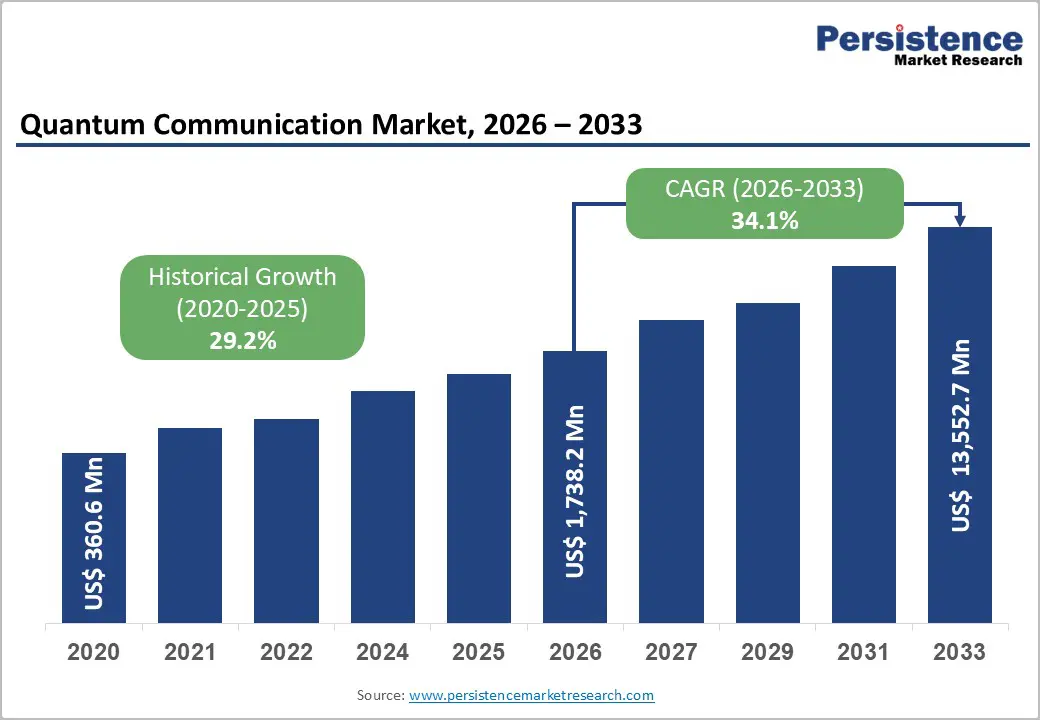
The global Quantum Communication Market size is projected to rise from US$ 1,738.2 million in 2026 to US$ 13,552.7 million by 2033. It is anticipated that the market will grow at a CAGR of 34.1% from 2026 to 2033, driven by escalating concerns over next-generation cyber threats, particularly the Harvest Now, Decrypt Later (HNDL) risk, in which encrypted data is collected today for potential decryption in the future using fault-tolerant quantum computers.
Organizations are increasingly accelerating preparedness due to the long migration cycles required for cryptographic transitions. Investment in technology is increasing steadily, supported by both public funding initiatives and private sector participation.
Key Industry Highlights:
- Leading Offering: Hardware dominates with over 56% market share in 2026, valued at more than US$ 973.4 million, driven by the critical requirement for high-performance, low-noise, and precision-engineered components to ensure accuracy and stability in quantum signal transmission.
- Leading Technology: Quantum Key Distribution (QKD) holds over 60% share in 2026, valued at more than US$ 1,042.9 Mn, due to its near-unbreakable encryption capabilities and strong adoption across government and financial sectors.
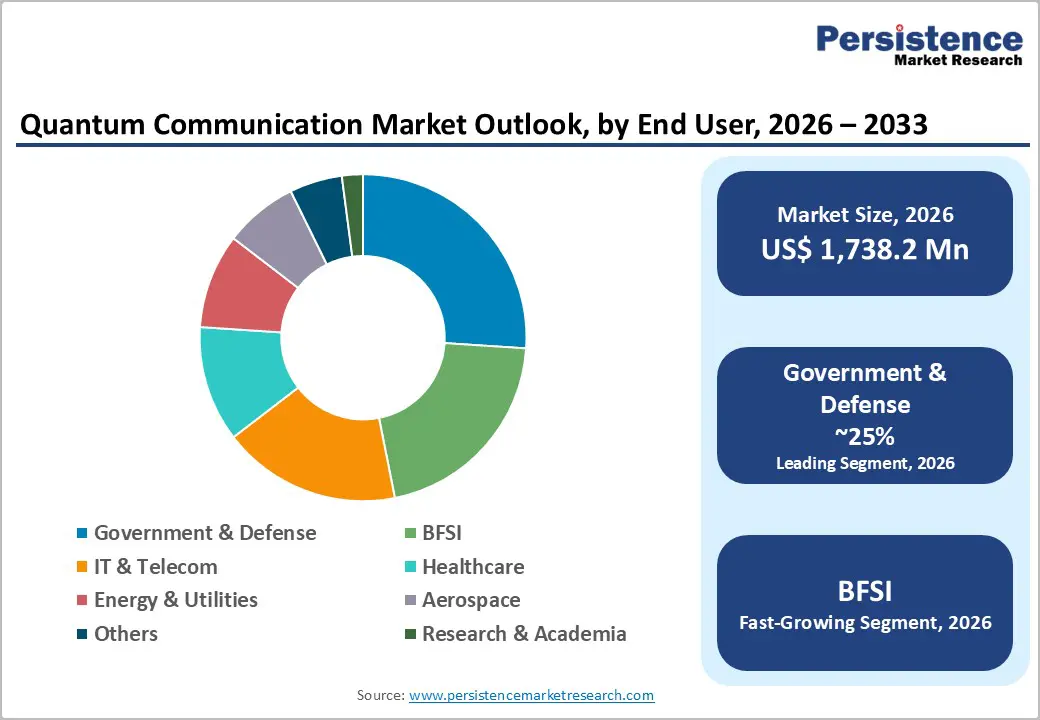
- Leading End-user: Government & defense lead with over 25% market share in 2026, valued at more than US$ 434.6 million, driven by the need for secure communication in national security and defense operations.
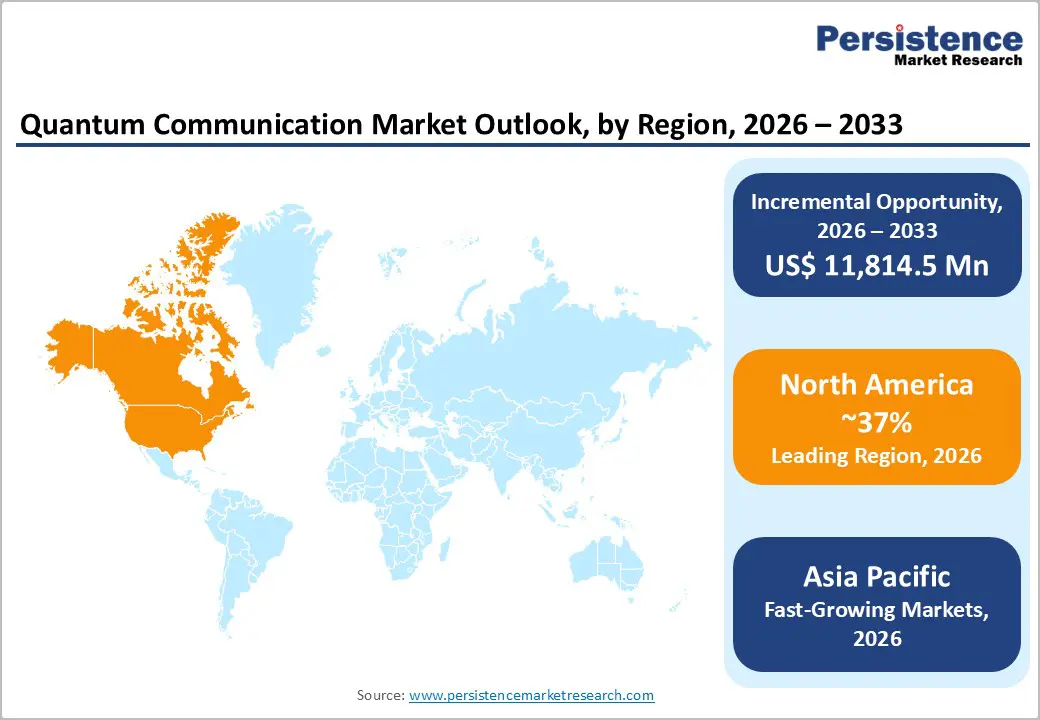
- Leading Region: North America leads with over 37% share in 2026, valued at US$ 643.1 Mn, supported by strong government funding, an advanced R&D ecosystem, and early adoption of quantum technologies.
| Key Insights | Details |
|---|---|
|
Quantum Communication Market Size (2026E) |
US$ 1,738.2 Mn |
|
Market Value Forecast (2033F) |
US$ 13,552.7 Mn |
|
Projected Growth (CAGR 2026 to 2033) |
34.1% |
|
Historical Market Growth (CAGR 2020 to 2025) |
29.2% |
Market Dynamics
Driver - Need for Long-Distance, Reliable Communication Spurs Satellite-Based Networks
The need for long-distance, reliable, and ultra-secure communication is pushing the development of satellite-based quantum communication networks. Traditional terrestrial networks are limited in range and vulnerable to interception, creating a demand for satellite-enabled quantum links. China’s Micius satellite and Europe’s Quantum Internet Alliance exemplify this trend, enabling secure communication across borders.
Global investments exceeding US$2 billion highlight the priority given to satellite quantum networks. These systems address the critical requirement for uninterrupted and secure communication for government, military, and financial operations, thereby creating extensive market growth opportunities for companies deploying satellite-based quantum technologies.
NIST Post-Quantum Cryptography Standards and Government Mandates Catalyzing Global Enterprise Migration
The finalization of NIST's post-quantum cryptography standards in August 2024, comprising ML-KEM (FIPS 203), ML-DSA (FIPS 204), and SLH-DSA (FIPS 205), has transformed quantum communication from a discretionary investment into a regulatory imperative. These standards mandate that U.S. federal agencies begin inventorying and migrating cryptographic systems immediately, while Canada has established legal deadlines requiring federal departments to submit PQC migration plans by April 2026, prioritize critical systems by 2031, and achieve full migration by 2035.
The U.S. government further underscored the strategic priority through programs under the National Quantum Initiative Act. These overlapping government mandates are creating an irreversible, large-scale procurement cycle for QKD hardware, quantum-safe software, and implementation services across regulated sectors globally.
Restraint - Prohibitive Hardware Costs and Limited Transmission Distance of Fiber-Based QKD
Despite rapid technological progress, QKD systems remain substantially more expensive than conventional cryptographic alternatives. Quantum communication hardware, including single-photon sources, high-performance detectors, and quantum random number generators, requires precision manufacturing and specialized supply chains that maintain elevated price points.
Fiber-based QKD transmission distances are inherently constrained by photon loss in optical fiber, historically limiting secure quantum links to metropolitan-scale deployments without quantum repeaters. While Toshiba's fiber QKD record in 2024 pushes these boundaries, repeater-free commercial deployments remain largely confined to under 200 km, restricting national-scale fiber QKD rollouts without costly repeater infrastructure.
Skilled Talent Scarcity and Integration Complexity Slowing Enterprise Deployment
The global quantum communication ecosystem faces a critical shortage of qualified physicists, photonics engineers, and quantum network architects to design, deploy, and maintain production-grade quantum communication infrastructure. Enterprise integration of QKD systems with existing ERP, SIEM, and zero-trust architecture requires specialized expertise that is scarce across all geographies. Government funding, while significant, covers only 25-35% of startup investment needs in quantum communication, leaving a substantial funding gap for commercialization. The complexity of migrating legacy cryptographic systems spanning potentially thousands of endpoints across large organizations creates additional timeline and cost risks that slow enterprise procurement decisions.
Opportunity - Emergence of Quantum-as-a-Service Business Models
Cloud-based Quantum-as-a-Service (QaaS) models are opening new market opportunities by allowing enterprises to access quantum encryption and communication services without heavy upfront investment in infrastructure. Companies subscribe to secure quantum communication networks on demand, reducing technical barriers and accelerating adoption in sectors such as healthcare, BFSI, and research institutes.
The adoption of QaaS is facilitated by partnerships between hardware providers and software developers, enabling seamless integration with existing IT and telecom networks. This not only expands the potential customer base but also provides recurring revenue opportunities for market participants.
?Telecom-led Commercial Networks Development
Leading telecom operators in North America, Europe, and the Asia Pacific are actively investing in quantum communication infrastructure to offer secure connectivity solutions to enterprises and government agencies. By leveraging existing fiber-optic networks and integrating Quantum Key Distribution (QKD) technologies, these operators aim to provide high-speed, tamper-resistant communication services at scale.
Partnerships between telecom providers and technology vendors are facilitating pilot deployments and proof-of-concept trials, demonstrating operational feasibility. The development of these networks not only accelerates the adoption of quantum communication services but also opens avenues for hardware suppliers, software developers, and managed service providers to participate in long-term, revenue-generating commercial networks.
Category-wise Analysis
Offering Insights
Hardware dominates the market, capturing more than 56% share in 2026, with a value exceeding US$ 973.4 Mn, driven by the need for advanced quantum devices, such as photon sources, quantum repeaters, and detectors, to enable secure communication channels. High demand from government, defense, and large enterprises for secure networks ensures hardware remains the primary revenue contributor.
Reliability, low-latency, and scalability needs also make hardware investments critical. As organizations prepare for future quantum networks, hardware adoption continues to surge. Within this segment, quantum detectors are expected to hold a 24% share of the hardware market in 2026.
Services are expected to grow significantly due to increasing demand for quantum network integration, consulting, and managed security services. Organizations require expert guidance to implement complex quantum systems efficiently. It also supports interoperability and maintenance, helping businesses adopt quantum solutions without extensive in-house expertise.
Technology Insights
Quantum Key Distribution (QKD) holds over 60% share in 2026, with a value exceeding US$ 1,042.9 million, as it ensures near-unbreakable encryption, addressing the urgent need for secure communication against cyber threats. Financial institutions, governments, and defense agencies rely on QKD to safeguard sensitive data. Continuous advancements in QKD protocols and long-distance transmission make it the most trusted quantum communication technology. Organizations prioritize QKD for compliance, risk reduction, and future-proofing digital infrastructure.
Quantum Teleportation is expected to grow rapidly due to its potential in creating ultra-fast, high-fidelity quantum networks. Businesses and research institutions are exploring teleportation for real-time data transfer across distant nodes. Technology addresses the need for instant, secure communication without physical transmission of qubits. Early-stage adoption is driven by innovation in quantum computing and academic research collaborations.
End-user Insights
Government & Defense command the largest market share at over 25% in 2026, with a value exceeding US$ 434.6 Mn, as this segment prioritizes secure communications for national security, intelligence, and defense operations. The increasing threat of cyberattacks and espionage drives governments to adopt quantum solutions. The need for encrypted communication channels in military operations and critical infrastructure makes this sector a key consumer.
BFSI is expected to achieve a 38.4% CAGR due to the rising need for protecting sensitive financial transactions and client data. Banks and insurers require end-to-end security to prevent breaches and fraud. The growing adoption of digital banking, online payments, and cloud platforms accelerates the demand for quantum-secured communication. Organizations in this segment focus on compliance with regulatory standards and safeguarding critical financial information.
Regional Insights
North America Quantum Communication Market Trends
North America holds over 37% share in 2026, reaching US$ 643.1 Mn value, due to its advanced technology ecosystem and substantial government investments. The region also hosts significant innovation hubs, attracting venture capital and accelerating the commercialization of secure quantum encryption solutions. The U.S. private sector actively invests in end-to-end quantum networks for the BFSI and defense sectors. Companies are pioneering practical applications, enhancing regional competitiveness. Regulatory frameworks ensure secure deployment and interoperability across networks, reinforcing North America’s leadership in both terrestrial and satellite-based quantum communication systems.
Asia Pacific Quantum Communication Market Trends
Asia Pacific is expected to grow at a significant rate with a CAGR of 39.8%. China has established the world’s largest satellite-based quantum communication network, while Japan and India are investing heavily in national quantum initiatives. These developments leverage quantum networking infrastructure development to connect remote regions securely. The region benefits from competitive manufacturing advantages, lower deployment costs, and government-backed R&D. Collaborative projects between research institutes and companies promote commercial scalability.
Europe Quantum Communication Market Trends
Europe is expected to hold more than 24% share by 2026, with a focus on harmonized standards and strategic investments in quantum communication infrastructure. Germany, the U.K., France, and Spain are leading initiatives to deploy fiber and satellite-based Quantum Key Distribution (QKD) networks.
The European Union’s Quantum Flagship Program accelerates the development of secure communication technologies and research, fostering innovation across member countries. Germany’s Fraunhofer Institute and France’s Thales Group spearhead R&D in scalable photonic technologies, while regulatory harmonization ensures cross-border interoperability and smooth integration into existing IT networks, bolstering Europe’s market growth potential.
Competitive Landscape
The global quantum communication market exhibits a moderately consolidated structure, dominated by established players that are actively pursuing product innovation and global expansion to enhance market share. R&D investments focus on improving QKD systems, photon detectors, and satellite-based networks. Emerging business models include quantum-as-a-service offerings and integrated encryption solutions, enabling scalability for enterprise and governmental adoption. Differentiation strategies emphasize technological superiority, deployment reliability, and compatibility with legacy infrastructure.
Key Developments:
- In April 2026, India’s National Quantum Mission (NQM) achieved a major milestone by successfully demonstrating a 1,000 km quantum-secure communication network using indigenous technology. Strengthens secure communication for defence, banking, and critical infrastructure while advancing India’s quantum technology capabilities.
- In March 2026, Quantum Computing Inc. and Ciena jointly demonstrated a next-generation quantum-secured communications system, combining quantum key distribution (QKD), post-quantum cryptography (PQC), and high-speed optical encryption. The solution delivers a layered security architecture with high-performance encryption (up to ~1.6 Tb/s), aimed at protecting critical data against future quantum threats.
Companies Covered in Quantum Communication Market
- ID Quantique
- QuantumCTek
- Toshiba Corporation
- QNu Labs
- QuintessenceLabs
- MagiQ Technologies
- KETS Quantum Security
- Qubitekk
- SpeQtral
- Quantropi
- IonQ
- Quantum Computing Inc.
- Others
Frequently Asked Questions
The global quantum communication market is projected to be valued at US$ 1,738.2 Mn in 2026.
The need for ultra-secure data transmission to counter emerging cyber threats, including quantum-enabled decryption, are key driver of the market.
The quantum communication market is expected to witness a CAGR of 34.1% from 2026 to 2033.
The rise of Quantum-as-a-Service (QaaS) models, enabling scalable and cost-effective access to quantum-secure solutions, is creating strong growth opportunities.
ID Quantique, QuantumCTek, Toshiba Corporation, QNu Labs, QuintessenceLabs, MagiQ Technologies, KETS Quantum Security, Qubitekk are among the leading key players.


