




- HVAC
- Blower Doors Market
Blower Doors Market Size, Share, and Growth Forecast, 2026 - 2033
Blower Doors Market by Product Type (Single-Fan Blower Doors, Multi-Fan Blower Doors, Others), Application (Residential Buildings, Commercial Buildings, Others), Technology, and Regional Analysis for 2026 - 2033

Blower Doors Market Size and Trends Analysis
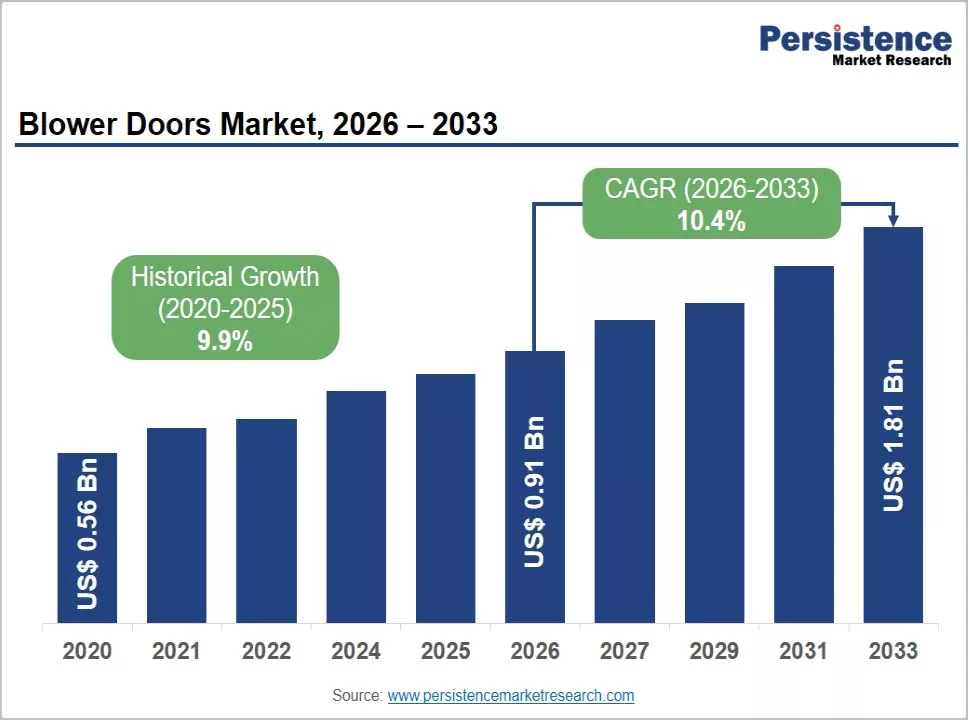
The global blower doors market size is likely to be valued at US$0.91 billion in 2026 and is expected to reach US$1.81 billion by 2033, growing at a CAGR of 10.4% between 2026 and 2033, driven by tighter building-envelope requirements, expanding energy-efficiency certification programs, and increasing investment in new construction and building retrofits.
Regulatory emphasis on measurable air leakage performance is increasing the use of blower-door testing across residential and commercial buildings. At the same time, digital gauges, automated fan controls, wireless connectivity, and data-logging capabilities are improving testing efficiency and reporting accuracy.
Key Industry Highlights:
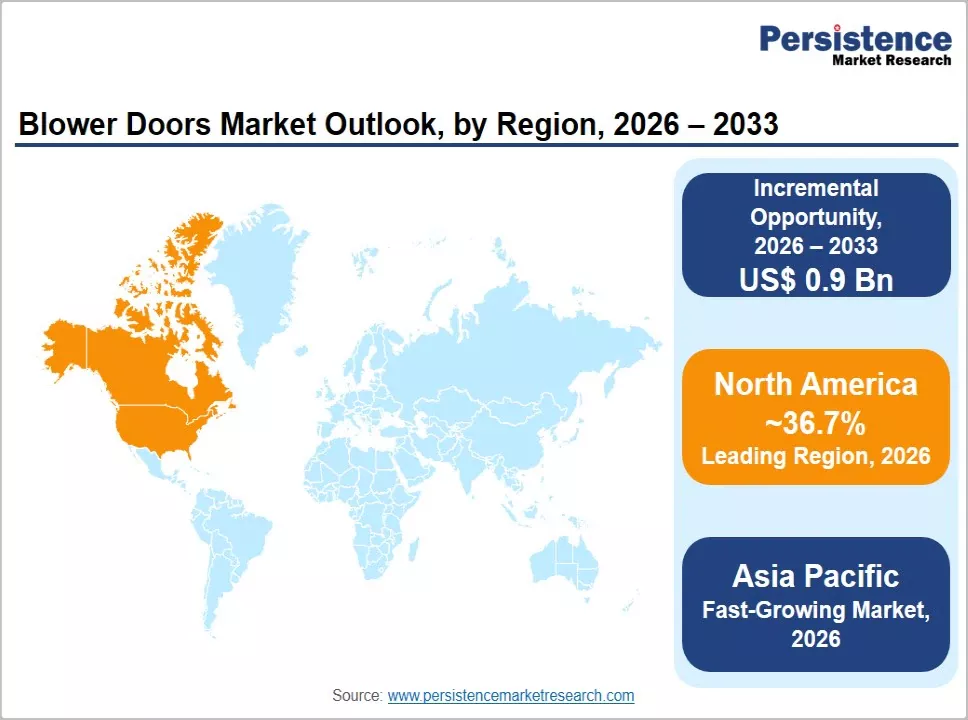
- Leading Region: North America is projected to account for 36.7% of the market share, supported by established blower-door testing practices, ENERGY STAR programs, weatherization initiatives, building codes, and a mature network of energy auditors and building-performance professionals.
- Fastest-growing Region: Asia Pacific, driven by rapid urbanization, expanding energy-efficient construction, green-building initiatives, and stronger building-performance requirements across China, Japan, India, and ASEAN economies.
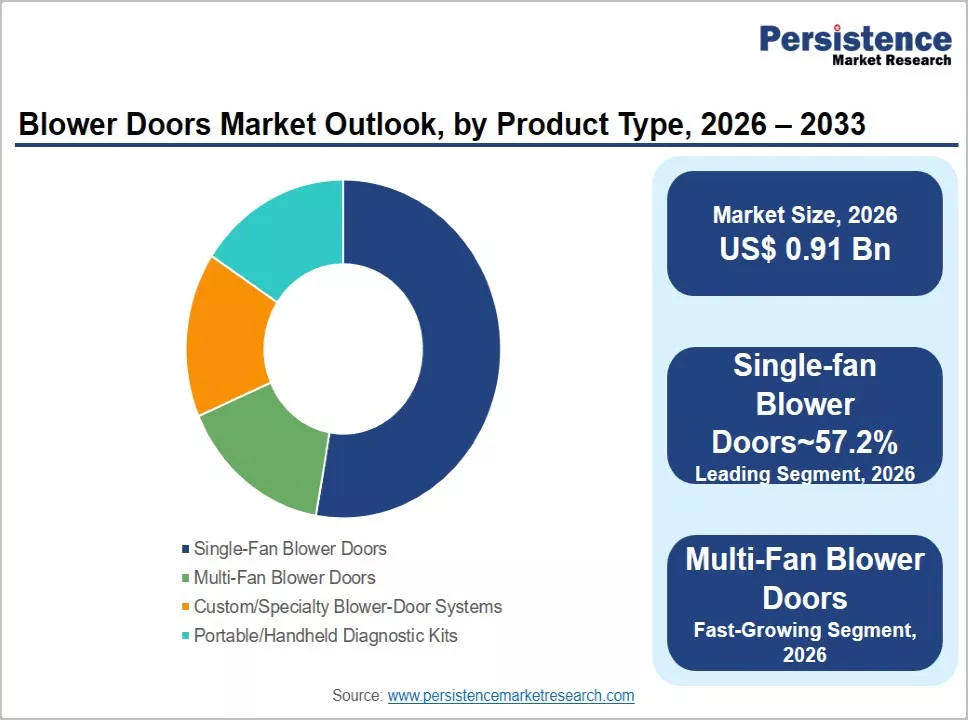
- Dominant Product Type: Single-fan blower doors are anticipated to account for 57.2% of the market share, supported by widespread residential applications, including home energy audits, weatherization, certification, construction verification, and retrofit assessments.
- Leading Application: Residential buildings are anticipated to represent 51.3% of market share, due to larger building sizes, energy-performance requirements, and increasing demand for whole-building envelope verification.
DRO Analysis
Drivers - Tightening Building-Energy Standards Increase Demand for Airtightness Testing
Building-energy regulations are placing greater emphasis on envelope performance, air leakage, and overall building efficiency. In the United States, blower-door testing is incorporated into established residential energy-rating and certification frameworks, while ENERGY STAR-certified homes and apartments require air-leakage testing. The adoption of updated building-energy codes is also increasing the importance of documented envelope performance in new construction. These regulatory requirements create recurring demand for calibrated blower doors, pressure gauges, measurement software, and qualified technicians.
The market impact extends beyond equipment purchases because testing requirements also generate demand for calibration, certification, training, maintenance, and reporting services. As building owners and contractors face greater accountability for energy performance, reliable airtightness measurement becomes an increasingly important part of construction quality assurance.
Energy-Efficiency Retrofits Expand the Addressable Building Base
The global focus on reducing building energy consumption is creating additional applications for blower-door testing across existing structures. Building-envelope improvements such as air sealing, insulation upgrades, window replacement, and weatherization require diagnostic measurements to identify leakage locations and evaluate improvement after renovation. The International Energy Agency identifies building efficiency and improved envelope performance as important components of energy-transition strategies.
In Europe, the revised Energy Performance of Buildings Directive is supporting a broader renovation framework for existing buildings while establishing progressively stronger energy-performance requirements for new construction. These developments expand blower-door applications beyond new residential construction. Testing can be performed before and after renovation, creating repeat demand from energy auditors, contractors, building owners, and retrofit programs.
Restraint - Equipment Costs, Calibration Requirements, and Skilled Labor Limit Adoption
Blower-door systems require specialized fans, calibrated pressure-measurement equipment, door panels, tubing, software, and trained operators. Initial equipment costs can be significant for small contractors and independent energy auditors, particularly when demand is seasonal or testing volumes are low. Multi-fan systems require additional equipment and greater technical expertise, increasing capital and operating requirements for commercial testing companies.
Calibration and periodic equipment verification also add lifecycle costs. Differences between national standards, test procedures, reporting requirements, and accreditation systems can further increase training and compliance expenses for international operators. These structural barriers can slow adoption in emerging markets where building-envelope testing is not yet routinely incorporated into construction practices or energy-efficiency programs.
Opportunities - Commercial and Multifamily Testing Creates a Scalable Growth Opportunity
Commercial and multifamily buildings provide an expanding opportunity because their larger volumes frequently require higher airflow capacity and more sophisticated testing configurations. Multiple blower-door fans can be operated simultaneously to achieve the required pressure differential in large structures.
Advanced software can coordinate multiple fans and pressure gauges while recording test results in real time. This creates opportunities for suppliers to move beyond individual equipment sales and provide integrated testing platforms that include fans, gauges, software, calibration, training, and reporting. The growing emphasis on building commissioning and energy performance is also encouraging contractors and owners to incorporate envelope testing into broader construction-quality programs. As a result, commercial applications can support higher-value equipment configurations and more specialized professional services.
Connected Diagnostics Create Opportunities for Software-Enabled Testing
The integration of wireless communication, digital pressure gauges, automated fan controls, data logging, and cloud-based reporting is creating a new technology layer within blower-door testing. Connected systems allow technicians to control equipment remotely, record multiple measurements, automate test sequences, and transfer results directly into digital reports. This reduces manual data entry and can improve consistency across repeated tests.
Cloud-enabled workflows can also support project-level data management, calibration records, quality assurance, and remote review. For manufacturers, these capabilities create opportunities to establish equipment ecosystems that combine hardware with software and recurring services. For testing companies, digital workflows can improve technician productivity and simplify documentation for builders, certification bodies, and building owners.
Category-wise Analysis
Product Type Insights
Single-fan blower doors are anticipated to account for 57.2% of the market share. Their position is supported by extensive residential testing across detached homes, apartments, and smaller structures, where one fan is generally sufficient. For example, home energy audits, ENERGY STAR-related testing, and weatherization projects commonly use single-fan systems because of their portability and straightforward setup. Manufacturers are also introducing lighter fan assemblies, higher airflow capacity, digital controls, and integrated measurement features to improve field usability.
Multi-fan blower doors are anticipated to be the fastest-growing product category, driven by testing requirements in multifamily developments, commercial buildings, industrial facilities, and other large structures. Multiple fans can operate simultaneously to achieve the required pressure differential across larger building envelopes. For example, large apartment complexes, warehouses, schools, and office buildings may require coordinated fan systems for whole-building testing. Automated controls and reporting software further simplify multifan testing while supporting more detailed building-performance assessments.
Application Insights
Residential buildings are anticipated to represent 51.3% of market share. Demand is supported by residential energy audits, weatherization, energy-efficiency certification, and building-code compliance. For example, new single-family homes can undergo blower-door testing before occupancy, while existing homes may be tested before and after air sealing or window replacement to measure improvements in envelope performance. The large volume of residential construction and renovation provides a broad base for equipment sales and professional testing services.
Commercial buildings are anticipated to be the fastest-growing application segment, supported by increasing emphasis on energy performance, commissioning, and building-envelope verification. Large projects such as office buildings, hotels, hospitals, schools, and multifamily developments can require multiple fans, advanced pressure measurement, automated controls, and detailed reporting. Multifamily properties are particularly relevant because a single project can contain numerous dwelling units and require whole-building or compartment-level testing. As building owners focus on operating efficiency and compliance, blower-door testing is increasingly integrated into broader building-performance assessments.
Regional Insights
North America Blower Doors Market Trends
North America is the leading regional market, accounting for 36.7% of market revenue. Demand is supported by established residential energy-rating programs, weatherization, building-code requirements, and a mature professional testing ecosystem. Growing commercial and multifamily construction is also increasing demand for higher-capacity and multi-fan systems.
U.S. Blower Doors Market Trends
The U.S. is the primary North American demand center, with blower-door testing integrated into residential energy-efficiency and building-performance programs. ENERGY STAR, home energy audits, weatherization, and state-level requirements support recurring testing activity. The U.S. market also benefits from specialized suppliers such as Retrotec and The Energy Conservatory, whose product portfolios include blower-door systems, pressure gauges, software, and multifan configurations. Retrotec's development of lighter, higher-performance equipment illustrates the market's movement toward more portable and digitally integrated testing. Commercial and multifamily projects are creating additional demand as testing expands beyond conventional single-family applications.
Canada Blower Doors Market Trends
Canada provides a complementary market driven by cold-climate building performance and stringent envelope requirements. The R-2000 standard, administered by Natural Resources Canada, specifies airtightness performance using fan-depressurization testing, including a maximum of 1.5 air changes per hour at 50 Pa under the standard's airtightness requirement. This creates a direct technical application for blower-door equipment and supports demand among builders, energy auditors, and building-performance professionals. Increasing attention to heating efficiency and retrofit performance further supports envelope diagnostics.
Europe Blower Doors Market Trends
Europe represents a significant market because energy-performance policy increasingly emphasizes airtightness, renovation, and low-energy buildings. The region's large existing building stock creates sustained retrofit opportunities, while commercial and multifamily developments support demand for sophisticated testing configurations.
Germany Blower Doors Market Trends
Germany is a major European market with established building-performance practices and specialized airtightness-testing providers. Companies such as BlowerDoor GmbH supply professional blower-door systems and multifan configurations used for building-envelope testing. Germany's focus on energy-efficient construction supports demand for accurate pressure measurement, calibration, and professional testing services. The market is also well positioned for digital systems because high-performance buildings require increasingly detailed documentation.
United Kingdom Blower Doors Market Trends
The U.K. market benefits from established air-permeability requirements under Building Regulations Part L, supporting professional airtightness testing for new construction. Testing providers and equipment suppliers therefore operate within a mature compliance-oriented ecosystem. Commercial buildings, housing developments, and retrofit projects are creating opportunities for automated testing and digital reporting. The combination of regulatory requirements and building-performance verification keeps blower-door equipment relevant across construction quality assurance and energy-efficiency programs.
Asia Pacific Blower Doors Market Trends
Asia Pacific is expected to record the fastest growth through 2033, supported by urbanization, construction activity, green-building initiatives, and increasingly stringent energy-performance policies. Adoption remains less mature than in North America and Europe, creating substantial scope for technician training, localized distribution, and affordable digital equipment.
Japan Blower Doors Market Trends
Japan represents an important growth market following the April 2025 expansion of mandatory energy-efficiency compliance to essentially all new residential and non-residential buildings. The country's ZEH and ZEB initiatives also strengthen attention to insulation and building-envelope performance. Japan's advanced measurement and construction-technology ecosystem creates opportunities for digitally controlled blower doors and integrated reporting systems.
India Blower Doors Market Trends
India offers a developing opportunity as commercial construction, energy-efficient buildings, and building-performance practices expand. The Energy Conservation Building Code includes building-envelope provisions addressing air leakage and sealing, providing a regulatory foundation for improved envelope performance. The broader adoption of energy-efficient commercial buildings can increase demand for professional testing, particularly in offices, hotels, hospitals, and large residential developments. Local distributors and training providers can help expand blower-door adoption as awareness of airtightness testing increases.
Competitive Landscape
The global blower doors market is fragmented to moderately concentrated, with a small group of specialized manufacturers competing alongside broader measurement-equipment companies and regional suppliers. Competition is based on fan capacity, measurement accuracy, portability, calibration, software functionality, technical support, distribution reach, and application specialization. Retrotec and The Energy Conservatory have established strong positions in professional blower-door equipment, while specialized European manufacturers serve regional airtightness-testing markets. Individual company market-share percentages are not consistently disclosed for the blower-door category, making product capabilities and geographic presence more meaningful competitive indicators.
Companies are focusing on product innovation, digital automation, portability, calibration, professional training, and geographic expansion. Competitive differentiation increasingly depends on integrated hardware and software rather than fan capacity alone. Suppliers are also expanding into multi-fan systems, cloud-based reporting, technical services, calibration, and training to create broader customer relationships and recurring revenue opportunities.
Key Industry Developments:
- In July 2026, The Energy Conservatory released version 4.3.0.43 of its TECLOG 4 software, introducing improved gauge connectivity with Windows 11 and enhanced user interface and workflow guidance. TECLOG 4 supports whole-building and multifamily testing, including computerized control of multiple Minneapolis Blower Door fans and real-time tracking of building pressure and fan-flow measurements.
Companies Covered in Blower Doors Market
- Retrotec Inc.
- The Energy Conservatory
- BlowerDoor GmbH
- INFILTEC Inc.
- TSI Incorporated
- ACIN Instrumenten
- Testo SE & Co. KGaA
- Kanomax USA, Inc.
- SIBATA Scientific Technology Ltd.
- Coltraco Ultrasonics
- AeroBarrier
- Lindab International AB
- Aereco
- DuctTesters, Inc.
- Building Performance Equipment, Inc.
- BEMCO, Inc.
Frequently Asked Questions
The global blower doors market is valued at approximately US$0.91 billion in 2026.
The blower doors market is expected to reach approximately US$1.81 billion by 2033.
Key trends include the growing adoption of digital pressure gauges, automated fan controls, wireless connectivity, data logging, cloud-based reporting, and multi-fan testing systems. Demand is also expanding from residential testing toward commercial, multifamily, institutional, and retrofit applications.
Single-fan blower doors are the leading product category, anticipated to account for approximately 57.2% of the market.
The global blower doors market is projected to grow at a 10.4% CAGR from 2026 to 2033.
Key players include Retrotec Inc., The Energy Conservatory LLC, BlowerDoor GmbH, Testo SE & Co. KGaA, and INFILTEC Inc.


