




- Food Ingredients & Additives
- Beverage Acidulants Market
Beverage Acidulants Market Size, Share, and Growth Forecast, 2026 - 2033
Beverage Acidulants Market by Product Type (Acetic Acid, Citric Acid, Lactic Acid, Malic Acid, Phosphoric Acid), Application Type (Dairy-Based Beverages, Fruit Juices, Aerated Drinks, Energy Drinks, Alcoholic Beverages), and Regional Analysis for 2026 - 2033

Beverage Acidulants Market Size and Trends Analysis
The global beverage acidulants market size is likely to be valued at US$2.7 billion in 2026 and is expected to reach US$3.8 billion by 2033, growing at a CAGR of 4.9% during the forecast period from 2026 to 2033, driven by expanding demand for carbonated drinks, fruit beverages, dairy-based drinks, energy drinks, and functional formulations requiring acidity, flavor balance, and pH control.
The U.S. Food and Drug Administration (FDA) identifies citric and lactic acids as pH-control agents and acidulants used in beverages, supporting their functional importance in beverage processing.
Key Industry Highlights:
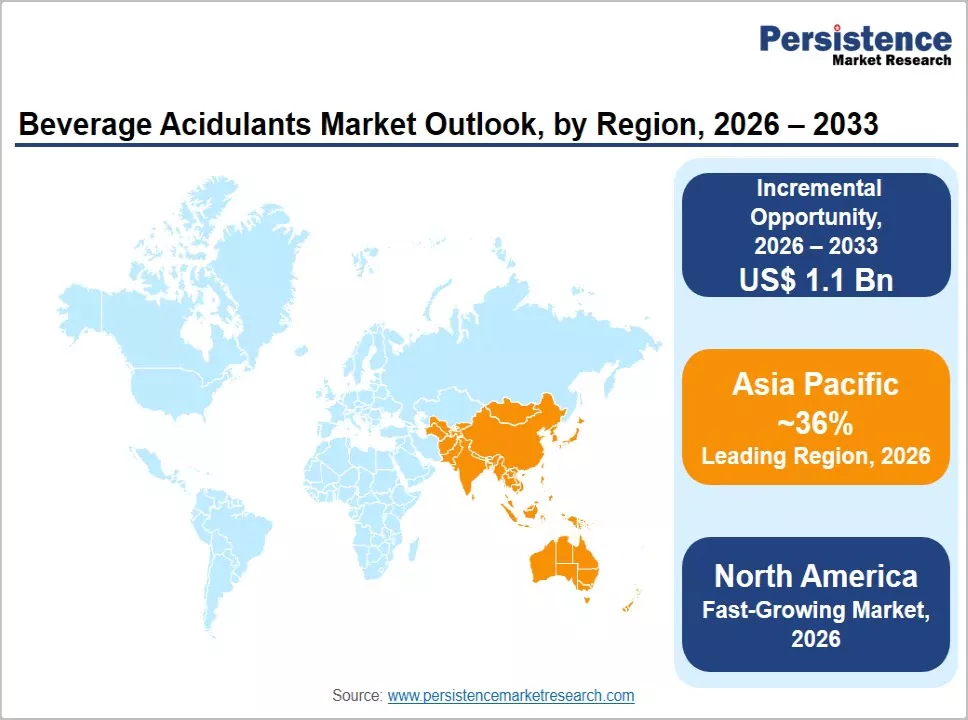
- Leading Region: Asia Pacific is anticipated to be the leading region, accounting for a market share of 36% in 2026, driven by expanding beverage production, urbanization, rising packaged-drink consumption, and strong citric acid manufacturing capacity.
- Fastest-growing Region: North America is likely to be the fastest-growing region, supported by strong demand for soft drinks, energy drinks, functional beverages, and clean-label acidulants.
- Leading Product Type: Citric Acid is projected to represent the leading product type in 2026, accounting for 52% of the revenue share, due to its versatility across soft drinks, juices, energy drinks, and functional beverages.
- Leading Application: Aerated drinks are anticipated to be the leading application, accounting for over 41% of the revenue share in 2026, supported by high consumption of carbonated beverages requiring consistent acidity and flavor balance.
- Key Opportunity: Expansion of natural, clean-label, and application-specific acidulants for reduced-sugar, functional, premium, and fruit-based beverages creates opportunities for suppliers to capture growing demand across emerging and developed markets.
DRO Analysis
Driver - Clean-label and Natural-Ingredient Preferences
Consumer preference for recognizable and naturally positioned ingredients is strengthening demand for beverage acidulants that support simpler product formulations. Citric and lactic acids are recognized by the U.S. Food and Drug Administration as pH-control agents and acidulants used in beverages, while ingredient labeling requirements increase visibility of formulation components.
In 2025, the FDA also continued advancing labeling initiatives intended to provide consumers with clearer information about packaged foods and ingredients. These developments encourage beverage manufacturers to evaluate acidulant sources, processing methods, and labeling compatibility when developing new products. Consequently, suppliers are increasingly emphasizing fermentation-derived, naturally positioned, and application-specific acidulant solutions.
The clean-label trend is particularly relevant to premium juices, functional beverages, plant-based drinks, and reduced-sugar formulations, where manufacturers seek acidity control without compromising flavor positioning. Acidulant producers can respond through organic-certified inputs, fermentation-based production, traceable sourcing, and documentation supporting clean-label claims.
Restraint - Trade Remedies and Anti-Dumping Measures
Trade remedies can constrain beverage acidulant supply chains by affecting the landed cost, sourcing flexibility, and procurement planning of internationally traded ingredients. Citric acid is particularly exposed to trade-policy developments because of its substantial cross-border production and consumption. In April 2026, the European Commission initiated an expiry review of anti-dumping measures applicable to citric acid originating in China, with the investigation examining whether existing measures should continue.
Trade-related uncertainty can also influence supplier selection, inventory policies, and regional production strategies across the beverage acidulants market. European Commission records show that anti-dumping measures on Chinese-origin citric acid remain subject to ongoing trade-defence procedures, illustrating the continuing regulatory attention surrounding this product category. Manufacturers may therefore face additional compliance requirements, customs considerations, and procurement complexity when sourcing acidulants internationally.
Opportunity - Expansion of Natural and Organic Acidulants in Premium and Functional Beverages
Expansion of premium, functional, and plant-based beverages creates opportunities for acidulant suppliers offering naturally positioned and organic-compatible ingredients. FDA reported in 2025 that consumer demand for plant-based alternatives had increased over time, while U.S. retail plant-based food sales reached US$8.1 billion in 2023, indicating continued development of alternative food and beverage categories.
These formulations frequently require controlled acidity for flavor balance, stability, and product development. Acidulants such as citric, malic, and lactic acids can support these applications while fitting formulation requirements. Suppliers can therefore develop beverage-specific blends, organic grades, and clean-label solutions for manufacturers targeting premium consumers.
The opportunity extends beyond conventional soft drinks into functional waters, sports beverages, energy drinks, plant-based beverages, and premium fruit formulations. For acidulant producers, this environment creates scope for certified-organic products, traceable raw materials, fermentation-based production, and customized acidity systems. Suppliers that combine sensory performance with documentation for organic and clean-label positioning can address formulation requirements across multiple beverage categories.
Category-wise Analysis
Product Type Insights
Citric acid is expected to lead, accounting for 52% of revenue in 2026, due to its broad application in carbonated beverages, fruit juices, energy drinks, and functional formulations. Its balanced sourness, pH-control capability, flavor enhancement, and established regulatory acceptance make it a preferred choice among beverage manufacturers. The Coca-Cola Company lists citric acid among the raw materials used across its beverage operations.
Malic acid is likely to represent the fastest-growing segment, supported by rising demand for fruit-flavored, low-calorie, and functional beverages requiring pronounced yet smooth tartness. Its longer-lasting acidic profile can complement fruit flavors and help maintain sensory balance when formulations reduce sugar. Beverage developers also value its versatility across powdered mixes, ready-to-drink products, sports beverages, and specialty formulations. Malic acid is widely used as an acidulant in fruit-flavored beverage formulations.
Application Insights
Aerated drinks are projected to lead the market, capturing around 41% of the revenue share in 2026, supported by extensive consumption of carbonated soft drinks that require controlled acidity for characteristic taste, flavor balance, and formulation stability. Citric and phosphoric acids are particularly relevant across different carbonated beverage profiles, while acidulants also help balance sweetness and flavor intensity.
Energy drinks are likely to be the fastest-growing application due to expanding consumer interest in beverages positioned around energy, hydration, sports performance, and functional benefits. Acidulants help these formulations achieve consistent tartness, balance sweetness, and integrate acidic fruit flavors with functional ingredients such as caffeine, vitamins, and minerals. Product innovation is also expanding toward reduced- and no-sugar formats, increasing the need for carefully balanced acidity and flavor profiles.
Regional Insights
North America Beverage Acidulants Market Trends
North America is likely to be the fastest-growing region, supported by demand for reduced-sugar, functional, flavored, and premium beverages, increasing the need for precise acidity and flavor balancing. Beverage manufacturers are also expanding zero-sugar and better-for-you formulations, creating continued opportunities for citric, malic, lactic, and phosphoric acids. Product innovation is increasingly focused on distinctive flavor combinations and functional positioning.
U.S. Beverage Acidulants Market Trends
The U.S. is expected to dominate the North America market, accounting for approximately 80% of the market share in 2026. Demand is expanding across carbonated soft drinks, energy beverages, sports drinks, and functional formulations. Reduced-sugar products are encouraging manufacturers to refine acidity and flavor balance. Zero-sugar beverages continue to receive substantial product-development attention. In 2026, PepsiCo expanded Pepsi Prebiotic Cola nationwide.
Canada Beverage Acidulants Market Trends
Canada is likely to be a significant market for beverage acidulants, holding approximately 20% of the market share in 2026. Manufacturers are introducing products with simpler ingredient positioning and distinctive flavors. Carbonated beverages remain an important application for acidulants. Functional and sparkling beverage formats are also expanding formulation opportunities. In 2026, PepsiCo Canada launched Bubly POP using real fruit juice and no artificial colors. The launch includes berry, black cherry, and lemon-lime variants.
Europe Beverage Acidulants Market Trends
Europe is likely to be a significant market for beverage acidulants in 2026, due to mature carbonated beverage consumption alongside growing demand for reduced-sugar, functional, premium, and clean-label products. Regulatory pressure on sugar content is encouraging beverage reformulation, increasing the importance of acidulants for maintaining flavor intensity when sweetness is reduced. Manufacturers are also expanding fruit-forward and specialty beverage formats.
U.K. Beverage Acidulants Market Trends
The U.K. is likely to remain a significant market for beverage acidulants, accounting for 15% of the European market in 2026. The Soft Drinks Industry Levy (SDIL) has encouraged manufacturers to reformulate products to manage sugar content. In July 2026, the government announced further changes to the levy, with the revised framework scheduled to lower the sugar threshold and extend coverage to milk-based and milk-substitute drinks from 2028. These measures are expected to encourage beverage producers to optimize formulations and support demand for acidulants used in reformulated beverages.
Germany Beverage Acidulants Market Trends
Germany is anticipated to dominate the regional market, accounting for around 37% of the Europe market share in 2026. Consumers are increasingly exposed to reduced-sugar and differentiated beverage formats. Regulatory developments are also encouraging manufacturers to reconsider sugar levels. Beverage companies are responding through product reformulation and new flavor concepts. In May 2026, PepsiCo launched Lipton Sensations Pink Ice Tea in Germany. The range combines fruit flavors, hibiscus, and Oolong tea.
Asia Pacific Beverage Acidulants Market Trends
The Asia Pacific region is anticipated to lead the market, accounting for 36% of the global market share in 2026. Growth is supported by expanding beverage production, rapid urbanization, rising consumption of packaged drinks, and increasing demand for functional and flavored beverages. China and India remain important growth markets, while manufacturers across the region continue to introduce localized flavors and reduced-sugar formulations. Rising consumption of carbonated beverages, juices, energy drinks, sports drinks, and functional beverages is expected to support demand for beverage acidulants.
China Beverage Acidulants Market Trends
China is projected to dominate the Asia Pacific market, accounting for around 30% of the regional market share in 2026. Beverage manufacturers are expanding localized flavor offerings to align with changing consumer preferences. Continued demand for carbonated beverages is expected to support acidulant consumption, while functional and reduced-sugar products are gaining increasing attention. Coca-Cola reported growth in its China business in its 2026 operating updates, reflecting continued activity in the country’s beverage market.
India Beverage Acidulants Market Trends
India is expected to emerge as a significant market, accounting for approximately 22% of the regional market share in 2026, supported by rapid urbanization, rising consumption of packaged beverages, and product diversification. Demand for carbonated drinks, juices, energy beverages, and functional products is contributing to formulation requirements. Regulatory oversight of the beverage industry is also evolving, with the FSSAI introducing amendments covering alcoholic ready-to-drink beverages in 2025, with the changes taking effect in 2026.
Competitive Landscape
The global beverage acidulants market remains moderately fragmented, with multinational ingredient suppliers, fermentation-based acid producers, and regional specialty manufacturers serving a broad range of beverage applications. Competitive positioning is shaped by product portfolios, supply reliability, formulation expertise, regulatory compliance, and the ability to offer clean-label and application-specific solutions.
Key players, including Tate & Lyle PLC, Cargill Incorporated, Archer Daniels Midland Company, and Northeast Pharmaceutical Group Co. Ltd., serve diverse applications across carbonated drinks, juices, energy beverages, dairy-based drinks, and alcoholic beverages. Companies are strengthening their market positions through product innovation, fermentation capabilities, technical formulation support, geographic expansion, and differentiated acidulant portfolios.
Key Industry Developments:
- In September 2026, Nestlé launched Starbucks Refreshers Concentrates in Strawberry Açaí, Mango Dragonfruit, and Lime Watermelon, targeting growing demand for customizable, fruit-based caffeinated beverages.
Companies Covered in Beverage Acidulants Market
- Tate & Lyle PLC
- Cargill Incorporated
- Archer Daniels Midland Company
- Corbion N.V.
- Parry Enterprises India Ltd.
- Batory Foods Inc.
- Northeast Pharmaceutical Group Co. Ltd
Frequently Asked Questions
The beverage acidulants market is projected to reach US$2.7 billion in 2026.
Rising demand for clean-label, reduced-sugar, functional, and flavored beverages drives beverage acidulant adoption.
The beverage acidulants market is expected to grow at a CAGR of 4.9% from 2026 to 2033.
Expansion of natural and organic acidulants in premium, functional, and plant-based beverages creates significant market opportunities.
Tate & Lyle PLC, Cargill Incorporated, Archer Daniels Midland Company, and Corbion N.V. are the leading players.


